


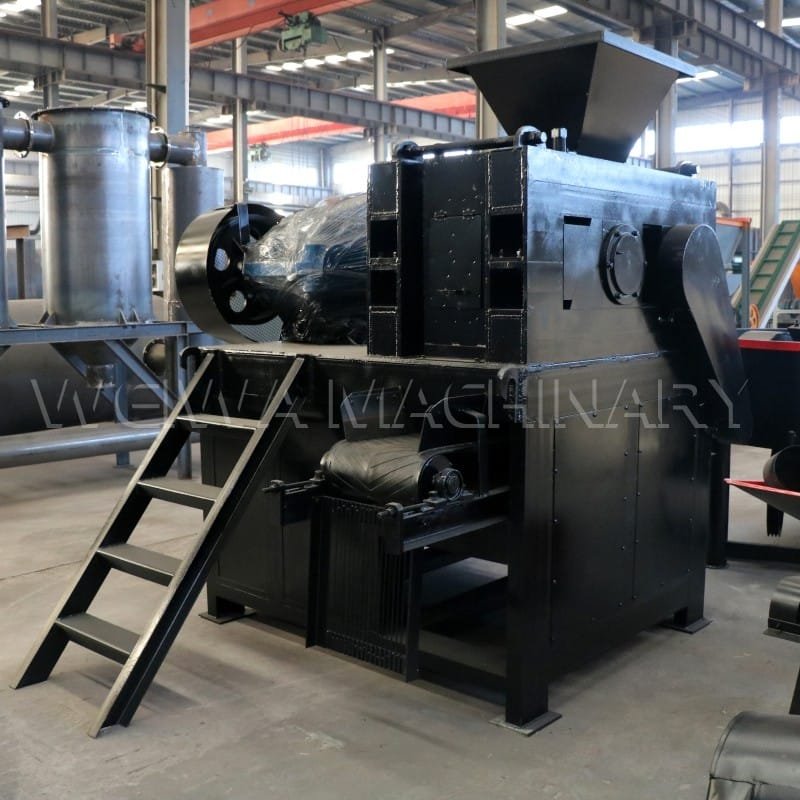
At Weiwa Machinery, every shipment represents more than just loading a Ball Charcoal Briquettes Machine onto a container. It reflects decades of engineering trust, a deep understanding of biomass energy transformation, and a commitment to empowering clients worldwide. Recently, our factory completed the inspection, testing, and dispatch of a high‑capacity charcoal ball press machine destined for a long‑term partner in Malaysia.
Shipment Site Observations at Weiwa Machinery Factory
The atmosphere on the factory floor was focused and orderly as technicians performed the final pre‑delivery checks on the Ball Charcoal Briquettes Machine prepared for Malaysia. Unlike standard batch exports, this unit was configured after two rounds of raw‑material simulation using coconut shell charcoal powder and sawdust‑based carbon, both abundant in Malaysia. Our engineering team calibrated roller pressure, verified gear synchronization, and tested the hydraulic overload protection system to ensure the charcoal ball press machine would perform reliably under tropical humidity and variable feed moisture.
During the loading process, anti‑rust coatings were inspected, roller molds were secured in custom wooden cases, and control panels were wrapped with moisture‑barrier film. The client requested spherical briquettes with uniform 35 mm diameter, so the roller pocket design on the Charcoal Briquette Machine was precision‑machined to maintain consistent ball density above 1.2 g/cm³. Observing the container being sealed, it was clear this was not merely a transaction but a continuation of Weiwa Machinery’s approach to making charcoal balls as a repeatable, scalable industrial process rather than a manual cottage activity.
Communication with the Malaysia client took place over several weeks, covering factory layout planning, voltage compatibility, and binder ratio recommendations. Their production site near Selangor will integrate this charcoal ball press machine into an existing line that already includes a rotary dryer and a double‑shaft mixer. This shipment reinforces how Weiwa Machinery does not simply sell machines; we align equipment specifications with real‑world constraints such as space, labor skill level, and local raw material characteristics when making charcoal balls in Malaysia.
Why Malaysia Is Becoming a Strategic Market for Charcoal Briquettes?
Malaysia’s biomass landscape is shaped by abundant agricultural residues, especially oil palm empty fruit bunches, coconut shells, and rubberwood waste. These materials, when carbonized, produce high‑calorific charcoal powders ideal for densification using a Ball Charcoal Briquettes Machine. Over the past decade, domestic demand for clean‑burning barbecue fuel, coupled with export interest to Japan, South Korea, and the Middle East, has pushed many Malaysian entrepreneurs toward mechanized making charcoal balls instead of relying on irregular lump charcoal.
Government initiatives promoting renewable energy and waste‑to‑wealth projects further encourage investment in Charcoal Briquette Machine infrastructure. In states like Johor and Perak, small‑to‑medium enterprises are transitioning from open‑pit carbonization to enclosed kilns and continuous briquette lines. A charcoal ball press machine fits this transition because it converts fine charcoal powder—often considered a byproduct—into premium spherical briquettes with higher bulk density, lower ash content, and uniform combustion behavior. For exporters, this consistency is critical when making charcoal balls in Malaysia for international buyers who enforce strict quality specifications.
Another factor is labor efficiency. Manual molding cannot match the throughput of a properly tuned Ball Charcoal Briquettes Machine, which can process several tons per hour depending on roller width and driving power. As wage levels rise and labor shortages appear in rural industrial zones, Malaysian producers increasingly view the charcoal ball press machine as a means to stabilize output while reducing dependence on seasonal manpower. Weiwa Machinery’s role in this shift is to provide not only the Charcoal Briquette Machine itself but also the process knowledge required to optimize binder selection, moisture control, and curing methods under local climate conditions.
Fundamentals of a Charcoal Briquette Production Line
While the charcoal ball press machine is the core shaping unit, it operates as part of an integrated system. A typical line for making charcoal balls begins with raw material preparation. Biomass such as coconut shell or sawdust is carbonized in a batch or continuous furnace to produce fragile charcoal chunks. These chunks are then crushed in a hammer mill to below 3 mm, ensuring the Ball Charcoal Briquettes Machine can compact the powder without voids that cause cracking during drying or combustion.
Moisture content is adjusted through a rotary dryer or natural sun‑drying until it falls within the 8–12% range preferred by most Charcoal Briquette Machine designs. Over‑wet powder leads to weak balls, while excessively dry material may require higher binder dosage. After drying, the charcoal powder is conveyed to a mixer where water and a natural binder such as cassava starch are blended uniformly. This step significantly influences the final strength of products when making charcoal balls in Malaysia, where ambient humidity can slow down post‑press drying.
The heart of the process is the charcoal ball press machine, where two counter‑rotating rollers with matched hemispherical pockets apply increasing pressure as material enters the nip zone. At the roller centerline, pressure peaks and forces particles into intimate contact, activating natural lignin and binder adhesion. The Ball Charcoal Briquettes Machine then ejects formed spheres, which are still relatively soft and must be cured on a cooling conveyor or in a low‑temperature dryer. Only after this stage do the charcoal balls acquire the hardness required for stacking, packaging, and long‑distance shipping. Understanding this sequence helps Malaysian investors avoid the common mistake of blaming the Charcoal Briquette Machine for quality issues that actually originate in crushing, drying, or mixing.
Key Components of a Charcoal Ball Press Machine
A professional‑grade charcoal ball press machine from Weiwa Machinery consists of a heavy‑duty base frame, twin rollers forged from wear‑resistant alloy steel, a reduction gearbox with high‑torque output, and an optional hydraulic system for pressure compensation. The roller surface is engraved with pocket geometries matching the client’s required ball size and shape. For clients focused on making charcoal balls for barbecue markets, shallow‑release pockets with polished surfaces reduce sticking and improve appearance. In contrast, industrial‑fuel clients may prioritize deeper pockets and higher compression ratios achievable with a hydraulic‑assisted Ball Charcoal Briquettes Machine.
The feeding assembly is equally important. A forced‑feeding hopper with agitators prevents bridging of lightweight charcoal powder, ensuring the Charcoal Briquette Machine receives a continuous, uniform supply. Without this, roller pockets may only partially fill, resulting in deformed balls and reduced throughput. Control panels on Weiwa units allow operators to monitor current load, roller speed, and hydraulic pressure, all of which are useful diagnostics when optimizing making charcoal balls in Malaysia under varying raw‑material batches.

Role of Binders and Moisture in Making Charcoal Balls
Although some charcoal ball press machine models advertise binderless operation, most commercial applications benefit from a small percentage of organic binder. Starch‑based binders are common in Malaysia due to local availability and food‑safe combustion residues. The binder is mixed with water to form a paste that coats charcoal particles before they enter the Ball Charcoal Briquettes Machine. Too much binder increases ash content; too little results in crumbling balls. Weiwa Machinery typically recommends trial runs with client‑supplied material to determine the optimum recipe for making charcoal balls that balance strength, burn time, and cost.
Moisture deserves equal attention. Charcoal powder exiting a crusher often carries hidden moisture even if it feels dry. When such material is fed into a Charcoal Briquette Machine, steam can form inside the ball during pressing, creating internal pores that weaken structure. Conversely, overdrying before adding binder paste can make the mix too stiff for the charcoal ball press machine to compact efficiently. Malaysian producers, accustomed to high ambient humidity, often install inline moisture sensors or rely on Weiwa’s drying‑mixer combination units to stabilize conditions prior to briquetting.
Technical Considerations When Making Charcoal Balls in Malaysia
Tropical climates impose specific demands on machinery. Condensation inside electrical enclosures, corrosion on unprotected steel surfaces, and swelling of wooden pallets used in packaging are routine challenges. Weiwa Machinery addresses these by applying anti‑corrosion paint systems on the Ball Charcoal Briquettes Machine frame, sealing control cabinets with rubber gaskets, and recommending stainless‑steel contact parts for clients handling acidic binders. When making charcoal balls in Malaysia, these details determine whether a charcoal ball press machine runs trouble‑free for years or requires frequent downtime.
Power supply stability is another consideration. Some Malaysian industrial estates experience voltage fluctuations that can affect motor performance on a Charcoal Briquette Machine. Weiwa equips larger charcoal ball press machine models with soft‑starters or variable frequency drives to accommodate such conditions and protect gearboxes from sudden torque spikes. Additionally, roller alignment must be checked periodically because thermal expansion in hot, humid environments can subtly alter the gap between pockets, influencing ball ejection quality from the Ball Charcoal Briquettes Machine.
Logistics also play a role. Malaysia’s mix of port‑side and inland production sites means road transport dimensions matter. Weiwa designs the Charcoal Briquette Machine base and drive units to fit standard 20‑foot and 40‑foot containers, minimizing disassembly. For clients making charcoal balls in Malaysia on islands such as Penang or Labuan, this modularity reduces freight costs and on‑site re‑assembly time, allowing faster commissioning of the charcoal ball press machine upon arrival.
Market Applications of Ball Charcoal Briquettes in Southeast Asia
Spherical briquettes produced by a Ball Charcoal Briquettes Machine are favored in the barbecue sector because they roll evenly in grills, provide steady heat, and produce less ash than irregular lumps. In Malaysia, weekend barbecue culture and halal‑friendly food festivals create steady urban demand. Hotels and restaurants increasingly source from local briquette makers who can guarantee smokeless ignition and consistent size—attributes directly tied to the calibration of the charcoal ball press machine and the uniformity of feed material when making charcoal balls.
Beyond cooking, industrial users such as metal foundries and brick kilns utilize high‑density balls from a Charcoal Briquette Machine as auxiliary fuel. The predictable calorific value simplifies furnace control compared to variable lump charcoal. Some Malaysian agro‑processors even blend charcoal balls with other biomass briquettes to create hybrid fuel pallets. In all these cases, the reliability of the charcoal ball press machine determines whether production scales smoothly or bottlenecks at the shaping stage. Weiwa Machinery’s experience across Southeast Asia shows that once clients standardize raw‑material prep and maintain the Ball Charcoal Briquettes Machine rollers, output quality remains stable enough to meet both domestic and export contracts for making charcoal balls in Malaysia.
Commissioning and After‑Sales Support for Malaysia Clients
Delivering a charcoal ball press machine is only the beginning. Weiwa Machinery provides commissioning guidance through remote video support and, when requested, on‑site engineer dispatch. Commissioning covers roller gap setting, no‑load running, gradual feed increase, and binder ratio fine‑tuning. For first‑time operators making charcoal balls, understanding how sound and amperage change with feed consistency is essential to preventing overloads on the Charcoal Briquette Machine.
Our after‑sales team maintains spare‑parts inventories for roller skins, bearings, and hydraulic seals commonly replaced on a Ball Charcoal Briquettes Machine after months of continuous operation. Malaysian clients benefit from our documented maintenance schedules, which outline weekly lubrication points, monthly alignment checks, and quarterly pressure‑system inspections. Because making charcoal balls in Malaysia often runs six days a week in peak season, planned maintenance minimizes unexpected stoppages of the charcoal ball press machine and protects ROI.
Training also covers safety, particularly around moving rollers and pressurized hydraulic units. Weiwa’s training packages include illustrated manuals in English and basic Malay terminology to ensure local staff can communicate issues clearly when requesting support. This human‑centric approach complements the mechanical robustness of the Charcoal Briquette Machine and reflects our understanding that sustainable making charcoal balls operations require both reliable equipment and confident operators.
Customization and Factory Layout Planning by Weiwa Machinery
No two briquette projects are identical. A charcoal ball press machine for a Penang‑based exporter handling coconut shell charcoal differs from one serving a Johor processor working with rubberwood carbon. Weiwa Machinery collects data on available workshop area, raw‑material moisture patterns, target hourly capacity, and preferred briquette diameter before proposing a Ball Charcoal Briquettes Machine configuration. In many cases, we supply CAD layout drawings showing equipment spacing, maintenance aisles, and utility connections to streamline installation of the entire Charcoal Briquette Machine line.
Customization extends to roller materials, pocket geometry, drive power, and control interfaces. For clients emphasizing aesthetic finish when making charcoal balls in Malaysia for retail barbecue packs, we polish roller surfaces and adjust ejection angles to minimize seam marks. For high‑throughput industrial users, we may reinforce the charcoal ball press machine frame and specify larger bearings to withstand continuous loads. These incremental adaptations accumulate into a production system where the Charcoal Briquette Machine integrates seamlessly with upstream crushers and downstream dryers, rather than functioning as an isolated unit.
Brief Introduction to Weiwa Machinery
Weiwa Machinery brings more than thirty years of experience in the design and manufacture of biomass and charcoal processing equipment. Our professional after‑sales team supports global clients with technical guidance, spare parts supply, and operator training. We offer customized services including design drawings and site planning to help customers optimize factory layouts for Ball Charcoal Briquettes Machine integration and efficient making charcoal balls in Malaysia or any other market. Whether you require a single charcoal ball press machine or a complete Charcoal Briquette Machine production line, Weiwa Machinery delivers tailored solutions backed by decades of field expertise. We welcome you to contact us for inquiries and quotations.
Contact Weiwa Machinery:
Mob: +8613838093177
Whatsapp: +8613838093177
E‑Mail: info@cjlmachinegroup.com
Reference: https://cjljx.com/product/ball-charcoal-briquettes-machine


 Wechat

 +8615937143060
