


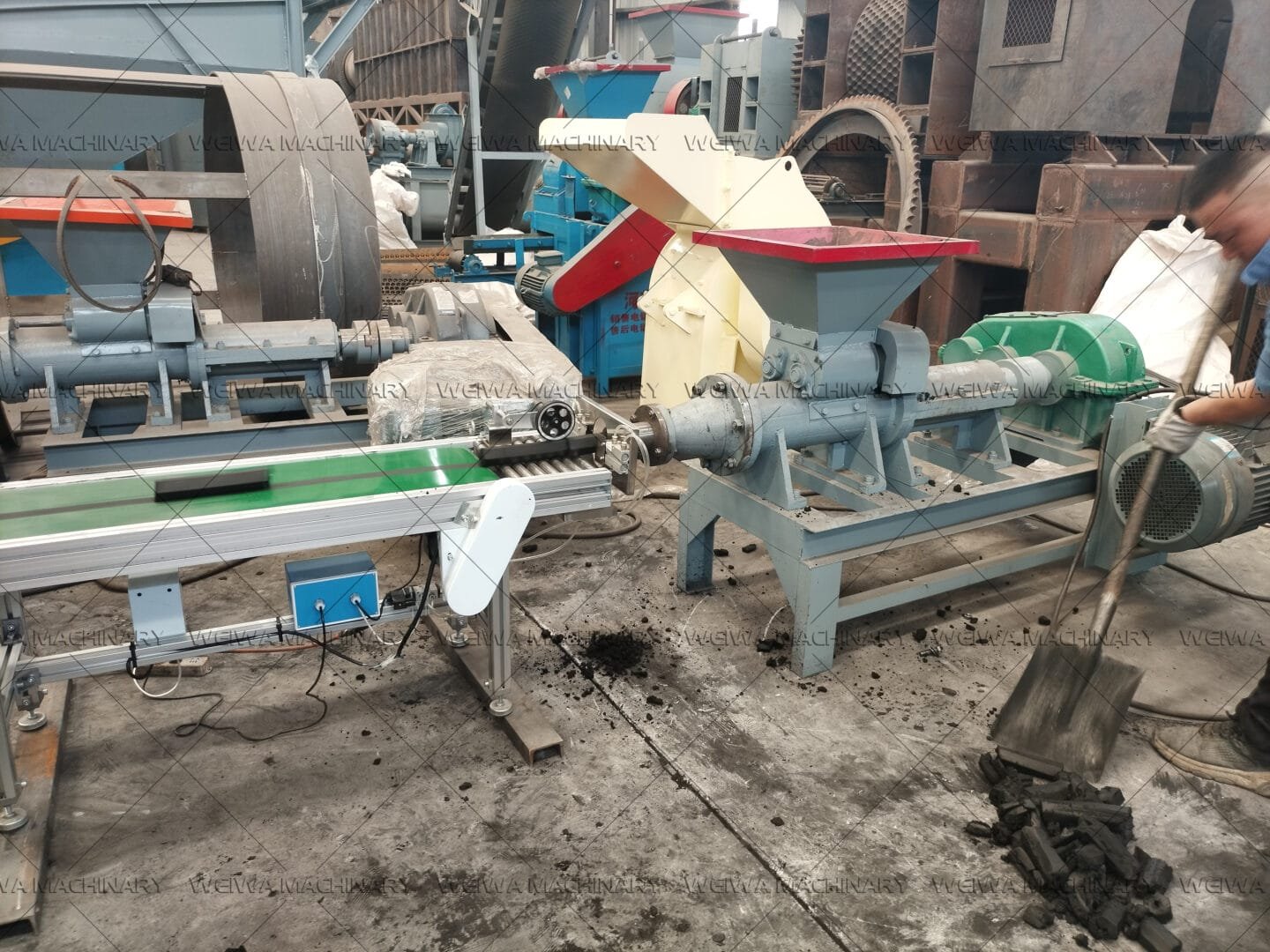
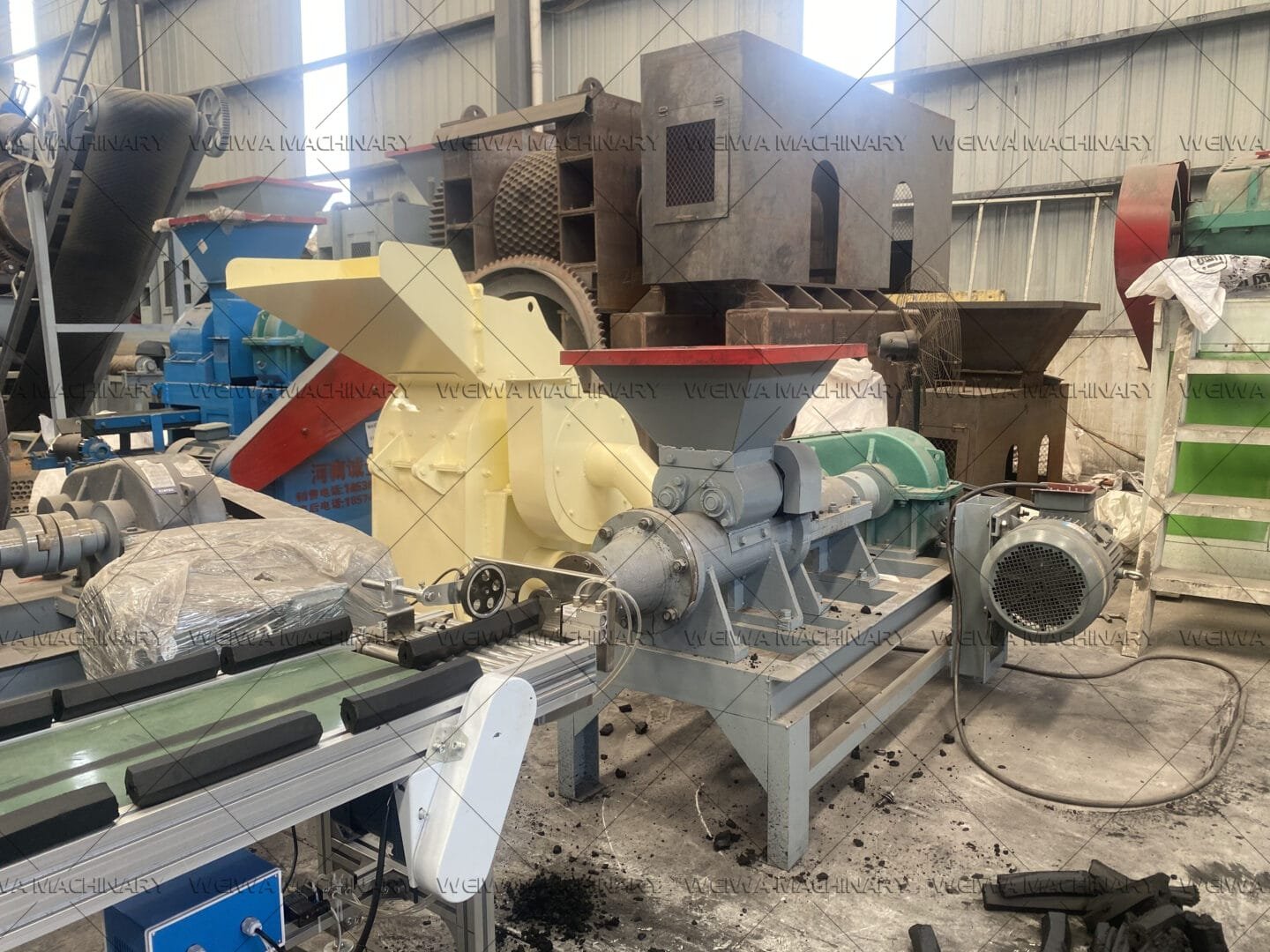
In recent months Weiwa Machinery completed a comprehensive on-site trial of our coal rod machine in Brazil for a renewable energy client located in Southeast Brazil. This trial was not only a technical validation of our charcoal extruder machine but also an important opportunity to observe how charcoal making machine solutions perform under Brazilian raw material conditions market expectations and environmental requirements. The charcoal briquette machine and rod charcoal making machine for Brazil markets must handle diverse biomass residues such as sugarcane bagasse coconut shell charcoal sawdust and hardwood charcoal powder. Throughout the trial the Weiwa team monitored extrusion pressure moisture adaptability rod density combustion behavior and continuous running stability. The results confirmed that our charcoal extruder machine maintains consistent output even when raw material particle size and humidity fluctuate which is common in Brazil production sites.
Trial Background and Client Requirements in Brazil
The Brazilian client operates in the biomass fuel and industrial heating sector and required a coal rod machine in Brazil capable of converting fine charcoal dust and agricultural residue powder into uniform solid fuel rods without excessive binder usage. In Brazil charcoal and biomass briquettes are widely used for barbecue household heating small-scale industrial furnaces and metal forging. The client previously relied on loose charcoal powder and imported firewood but faced rising costs environmental restrictions and inconsistent combustion quality. Their main requirements for the charcoal extruder machine included stable hourly capacity adjustable rod diameter low maintenance wear-resistant screws and molds compliance with local emission expectations and adaptability to varying moisture content. Weiwa Machinery proposed a charcoal briquette machine configured with a high manganese steel screw propeller hardened alloy mold automatic feeding hopper and variable frequency drive to control extrusion speed. Before shipment we conducted a factory acceptance test using simulated Brazilian raw materials including coconut shell charcoal powder mixed with 12 to 18 percent moisture. The charcoal making machine performed without clogging and produced rods with smooth surfaces high compressive strength and uniform length. After factory testing the coal rod machine in Brazil was shipped with installation guides remote commissioning support and spare parts kits. The on-site trial in Brazil lasted seven consecutive working days with daily operation exceeding eight hours.
Raw Material Characteristics in Brazil Trial
Brazil produces vast amounts of biomass waste annually such as sugarcane bagasse rice husk coffee husk coconut shell sawdust and forestry residues. For the trial the client provided wood charcoal powder with particle size below three millimeters coconut shell charcoal blend and a small portion of coal dust for industrial blending. One challenge in Brazil is that charcoal powder often retains higher moisture due to open-air storage and tropical humidity. The charcoal extruder machine must therefore tolerate moisture fluctuations without losing pressure or causing die blockage. During the trial the rod charcoal making machine for Brazil processed raw mixes with moisture between ten and twenty percent by adjusting screw speed and binder ratio slightly. The machine maintained extrusion pressure consistently and the charcoal briquette machine output rods with diameter forty fifty and sixty millimeters according to mold configuration. The client observed that even with higher moisture the coal rod machine in Brazil did not show screw slipping or irregular rod cracking which they attributed to the reinforced double-flight screw design and tapered compression chamber inside the charcoal making machine.
Operational Stability and Output During Trial
Stability is a decisive factor for any charcoal extruder machine exported to Brazil because downtime affects daily fuel supply and labor cost. Over the seven-day trial the coal rod machine in Brazil ran continuously with only scheduled stops for lubrication and mold inspection. The average hourly output ranged between eight hundred kilograms and one thousand two hundred kilograms depending on rod diameter and raw material density. The charcoal briquette machine demonstrated stable motor load with current fluctuation within five percent which indicates balanced feeding and extrusion force. The rod charcoal making machine for Brazil produced cylinders with dense inner structure minimal central porosity and high surface hardness. Samples were tested for drop resistance by lifting rods to one meter and dropping them on concrete with less than three percent breakage. Combustion tests conducted by the client showed that rods from the charcoal making machine ignited within three to five minutes produced steady blue flame low smoke and residual ash below six percent. These results align with Brazilian barbecue and small industrial heating preferences where long burn time and clean combustion are valued. The client also noted that the charcoal extruder machine noise level was within acceptable range for workshop environments and the enclosed transmission reduced dust scattering.
Technical Analysis of Coal Rod Machine in Brazil Performance
To understand why the trial succeeded it is necessary to examine the core components of a charcoal extruder machine and how they interact with Brazilian raw materials. The charcoal making machine mainly consists of a crushing and mixing feeder a screw conveyor an extrusion barrel a molding die and a cutting device. The screw propeller plays the most critical role because it compresses loose powder into a continuous dense strand. Weiwa Machinery uses high manganese alloy steel quenched and tempered to increase wear resistance since Brazilian charcoal powder especially coconut shell and hardwood contains silica and fibrous content that accelerate abrasion. The coal rod machine in Brazil also features an adjustable heating jacket around the extrusion barrel to soften natural binders in biomass and improve plasticity when moisture is marginal. The charcoal briquette machine mold is made of interchangeable alloy steel plates with polished inner bores to reduce friction and ensure smooth rod surfaces. During the trial the rod charcoal making machine for Brazil operated at screw speeds between 35 and 55 revolutions per minute depending on desired throughput. Lower speed increased compression time and produced harder rods while higher speed improved capacity with slight reduction in density which the client could balance based on market need. The charcoal extruder machine also includes a frequency converter to soft-start the motor protecting power systems common in Brazilian factories where voltage stability may vary.
Key Design Features Supporting Brazil Conditions
Several design elements of the charcoal making machine directly address Brazil market challenges. First the feeding hopper has anti-bridging paddles to prevent fine charcoal powder from arching which is frequent when material is dry and fluffy. Second the coal rod machine in Brazil uses a pre-compression zone before the main screw to remove air pockets and improve green strength of extruded rods. Third the cutting mechanism synchronizes with screw speed so rod length tolerance stays within plus minus two centimeters which matters for packaging and stacking in Brazilian warehouses. Fourth the charcoal briquette machine frame is reinforced to absorb vibration caused by continuous extrusion of high-density mixes. Fifth the rod charcoal making machine for Brazil includes accessible inspection doors grease nipples and modular screw segments so local technicians can maintain the charcoal extruder machine without specialized tools. These features collectively reduced trial downtime and gave the client confidence that the charcoal making machine can operate in remote areas of Brazil where technical support visits may be infrequent. The trial also validated that our standard machine can process not only charcoal but also partially carbonized biomass and coal dust blends which expands application scenarios in Brazil metallurgical and ceramic sectors.
Charcoal Extruder Machine Market Potential in Brazil
Brazil is among the largest producers of charcoal and biomass fuel in the world due to its agricultural scale forestry industry and strong barbecue culture. However traditional charcoal production still relies heavily on earth kilns and manual brick kilns which cause deforestation low carbon yield high emissions and inconsistent quality. There is growing interest in mechanized charcoal making machine systems that convert waste biomass into high-value fuel rods. The coal rod machine in Brazil addresses multiple pain points including waste utilization cost control and environmental compliance. Sugarcane bagasse alone exceeds hundreds of millions of tons annually in Brazil and most is burned in fields or discarded. Coconut shell from northeast Brazil is another underused resource. By introducing a charcoal extruder machine these residues can be powdered carbonized if needed and extruded into rods for domestic export or industrial use. The charcoal briquette machine market in Brazil is also supported by rising liquefied gas and electricity prices which push households and small enterprises toward affordable solid fuels. In states like Sao Paulo Minas Gerais Parana and Bahia there is visible demand for rod charcoal making machine for Brazil from agro-industry owners furnace operators and clean energy startups. Government discussions on circular economy incentives and stricter air quality rules further favor charcoal making machine adoption because extruded rods burn more completely and emit less particulate compared to loose powder or poorly made bricks. International buyers in Europe and North America also increasingly source Brazilian biomass briquettes for heating and industrial processes creating export potential for Brazilian producers equipped with reliable coal rod machine in Brazil lines.
Economic Drivers for Charcoal Briquette Machine Adoption
From an economic perspective the charcoal extruder machine enables value addition to zero-cost or low-cost waste. Many Brazilian sawmills furniture factories and crop processors pay to dispose of wood waste and husks. Installing a charcoal making machine onsite turns disposal cost into product revenue. The coal rod machine in Brazil typically pays back within twelve to twenty-four months depending on raw material access labor cost and local fuel prices. The rod charcoal making machine for Brazil also creates skilled jobs in machine operation maintenance quality checking and sales which aligns with rural industrialization goals. Compared to imported firewood or fossil fuels extruded charcoal rods have stable calorific value usually between twenty-eight and thirty-two megajoules per kilogram and lower logistics loss because rods pack densely without voids. The charcoal briquette machine also allows formulation flexibility such as adding small portions of binder starch or clay to improve strength without sacrificing combustion cleanliness. For Brazilian entrepreneurs entering the green fuel sector the charcoal extruder machine represents a scalable entry point because capacity can start from small models of five hundred kilograms per hour and expand to multi-ton lines with unified screw and die standards. Market feedback during our trial indicated strong distributor interest in charcoal making machine packages that include crusher mixer dryer and coal rod machine in Brazil rather than standalone units which is why Weiwa Machinery provides turnkey planning.
Environmental Alignment and Sustainability Outlook
Environmental alignment is increasingly central to Brazil energy projects. The charcoal extruder machine contributes to sustainability by diverting biomass waste from open burning reducing reliance on native forest charcoal and improving combustion efficiency which lowers smoke and carbon monoxide emissions. The coal rod machine in Brazil produces uniform rods that fit modern improved cookstoves and industrial burners designed for clean combustion. When paired with a carbonization furnace the rod charcoal making machine for Brazil can process semi-charred biomass into fully carbonized rods with fixed carbon above eighty percent as observed in our trial samples. This positions the charcoal briquette machine within circular bioeconomy frameworks supported by academic and policy discussions in Brazil. Although regulatory pathways differ by state the trend is clear that formalized briquette production with measurable emissions advantage will receive more favorable treatment than informal charcoal pits. The charcoal making machine also generates less dust hazard for workers when equipped with enclosed feeders and simple dust collection which matters for occupational health compliance. As Brazilian municipalities update waste management and air quality bylaws the charcoal extruder machine offers a compliant pathway for agro-industrial clusters to monetize residue while documenting environmental benefit which can support certification and financing.
Science and Working Principle of Rod Charcoal Making Machine for Brazil
Understanding the science behind a charcoal extruder machine helps Brazilian clients make informed decisions and optimize recipes. The coal rod machine in Brazil belongs to the extrusion molding category of charcoal briquette machine technology. The process begins with raw material preparation where charcoal or biomass is crushed below a certain mesh usually two to four millimeters to ensure particle packing. Binders such as cassava starch molasses or clay may be added in small percentages typically three to eight percent to improve green strength especially when final carbonization is not immediate. The mix is homogenized in a wheel mixer or paddle mixer to reach uniform moisture often twelve to fifteen percent depending on material hydrophilicity. The charcoal making machine then feeds the mix into the screw conveyor which compacts material gradually through decreasing pitch flights. As material moves forward air is expelled and particles rearrange into denser configuration. In the compression zone near the die the charcoal extruder machine applies pressure that can exceed several megapascals forcing material through the mold orifice to form continuous rod. The rod charcoal making machine for Brazil usually employs a cylindrical die with or without a central hole depending on market preference. Central hole rods ignite faster due to larger surface area and are popular in Brazilian barbecue contexts. After extrusion a rotary cutter slices rods to preset length. The rods are then dried to below eight percent moisture before storage or carbonization. The science lies in balancing moisture binder particle size screw geometry die resistance and extrusion speed. Too dry mix causes powdery rods too wet causes swelling or cracking. Too high screw speed reduces compaction time too low limits output. The charcoal briquette machine must therefore be tunable which is why Weiwa Machinery provides variable frequency drives adjustable heating sleeves and interchangeable dies for the Brazil market.
Differences Between Charcoal Extruder Machine and Other Briquette Presses
It is useful to distinguish the charcoal extruder machine from hydraulic press roller press and punch press briquette machines. The coal rod machine in Brazil using screw extrusion is continuous process rather than batch which yields uniform rod length and higher hourly throughput for medium-density briquettes. Hydraulic presses produce very high density tablets or pill-shaped briquettes often for hookah charcoal but operate intermittently and require higher investment. Roller presses compress material between two counter-rotating molds and are suitable for oval egg-shaped briquettes but may struggle with very fine charcoal lacking lignin unless binder is sufficient. The rod charcoal making machine for Brazil excels when the target product is long-burning cylindrical rod for grilling industrial heating or furnace feed because extrusion aligns fibers partially and creates continuous dense strand. The charcoal making machine also accommodates slightly higher moisture than dry briquette presses which is advantageous in humid regions like Brazil. However the charcoal briquette machine consumes more power per ton than some roller presses because screw friction is higher. Weiwa Machinery mitigates this by optimizing screw flight angle using hardened wear-resistant surfaces and matching motor power to actual torque requirement rather than oversizing. For Brazilian clients choosing between technologies we evaluate raw material type moisture availability labor skill product market and energy cost. In many cases the charcoal extruder machine fits best for rod products while coal rod machine in Brazil can also be complemented by carbonization unit to produce final charcoal rods from semi-briquetted biomass.
Quality Indicators for Charcoal Making Machine Output
Several measurable indicators determine whether a charcoal extruder machine meets Brazil market expectations. Density is primary because higher density correlates with longer burn time and lower transport damage. During trial the coal rod machine in Brazil produced rods with apparent density between nine hundred and eleven hundred kilograms per cubic meter depending on recipe. Compressive strength tested on green rods exceeded three megapascals which ensures handling survival. After mild sun drying and optional low-temperature carbonization the charcoal briquette machine output reached fixed carbon content between seventy-five and eighty-five percent when starting from well-carbonized charcoal powder. Moisture after drying stayed below six percent which prevents mold during storage in tropical Brazil climate. Combustion duration for a four hundred gram rod averaged ninety to one hundred twenty minutes in controlled firebox test which matches premium barbecue fuel expectation. The rod charcoal making machine for Brazil also achieved low fines generation during tumbling test which matters for bagged retail products. Smoke observation during ignition showed mostly water vapor initially and minimal visible smoke after one minute which clients attributed to low volatile residue and uniform densification by the charcoal making machine. These indicators collectively define marketable rod charcoal in Brazil and can be documented by Weiwa Machinery for prospective buyers evaluating charcoal extruder machine performance against local competitors.
Weiwa Machinery Experience and Client Support
Weiwa Machinery has more than thirty years of experience in designing and manufacturing industrial machinery for biomass briquetting and charcoal production. Our team includes senior engineers familiar with global market conditions including coal rod machine in Brazil projects in Latin America Southeast Asia Africa and the Middle East. We understand that Brazilian clients value not only machine quality but also responsive after-sales training and adaptable design. Therefore every charcoal extruder machine order is supported by pre-shipment video inspection spare parts list operation manual in English or Portuguese and remote commissioning via video or on-site engineer when feasible. Our after-sales team provides guidance on raw material testing binder selection screw and die replacement maintenance schedule and troubleshooting common issues such as die blockage pressure drop or irregular cutting. The charcoal briquette machine and rod charcoal making machine for Brazil can be customized in voltage configuration hopper size platform height mold shape and control panel language. We also offer design drawings for site planning including foundation requirements power supply layout material flow from crusher to mixer to charcoal making machine to dryer and storage. This turnkey mindset helps Brazilian clients reduce installation delay and comply with workshop safety norms. Many of our partners have operated charcoal extruder machine lines for over ten years with only routine wear part replacement which reflects our focus on structural durability and accessible maintenance. Whether you are a distributor setting up demonstration in Sao Paulo a cooperative utilizing coconut shell in Bahia or an industrial user replacing firewood in Minas Gerais Weiwa Machinery can tailor the coal rod machine in Brazil solution to your capacity and raw material profile.
Customization and Site Layout Services
Customization is often decisive for charcoal making machine projects because no two Brazil sites share identical raw material moisture power supply space or labor condition. Weiwa Machinery routinely adjusts screw pitch and diameter to match bulk density of local charcoal powder. We modify feeding hopper angle to prevent bridging when material is very fine. We supply coal rod machine in Brazil with mobile base frames for clients who relocate seasonally near agricultural harvest. Control panels can be analog or digital with PLC touchscreen and emergency stop zones labeled per client request. For site layout we provide CAD drawings showing machine footprint utility connections maintenance clearance and material flow from raw pile to crushing screening mixing extrusion drying and packaging. This helps clients estimate civil works budget crane access and worker movement. The charcoal extruder machine typically requires a reinforced concrete foundation due to vibration which we specify clearly. The charcoal briquette machine line can be arranged linearly or L-shaped depending on available shed dimensions. We also advise on roof ventilation dust extraction points and fire safety distance especially when carbonization units are co-located with rod charcoal making machine for Brazil. Our engineers have planned sites from five hundred kilogram per hour starter lines to five ton per hour industrial plants and we bring this experience to every Brazil inquiry. By aligning machine specification with site reality we reduce commissioning risk and help clients present professional project plans to local banks or incentive programs.
Contact Weiwa Machinery for Charcoal Extruder Machine Inquiry
If you are evaluating a charcoal extruder machine coal rod machine in Brazil charcoal making machine charcoal briquette machine or rod charcoal making machine for Brazil please contact Weiwa Machinery to discuss your raw material capacity and site condition. We welcome sample material by courier for trial testing in our factory and can arrange video trial or third-party witnessed test before order. With over thirty years of experience professional after-sales team customization capability and site layout design we aim to be your long-term partner in biomass fuel equipment.
Contact details:
Mob: +8613838093177
Whatsapp: +8613838093177
E-Mail: info@cjlmachinegroup.com
Reference website: https://cjljx.com/product/charcoal-extrude-machine
Weiwa Machinery looks forward to supporting your charcoal extruder machine and coal rod machine in Brazil project with reliable equipment and practical engineering services that help you succeed in the growing Brazilian charcoal and biomass briquette market.


 Wechat

 +8615937143060
