


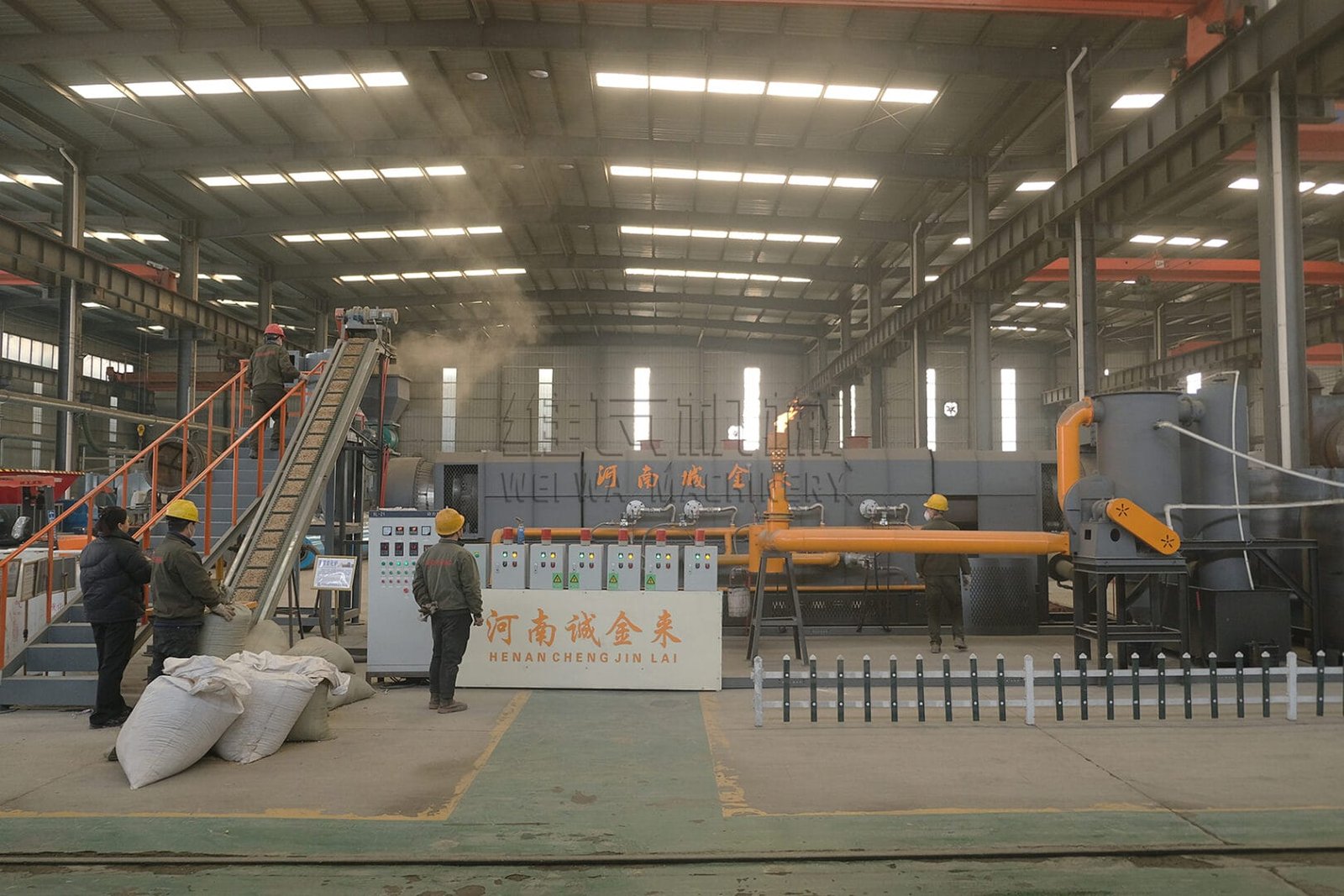
As a professional manufacturer of biomass carbonization and briquetting equipment, Weiwa Machinery has been committed to providing efficient and environmentally friendly solutions for global biomass waste recycling. In recent years, the demand for biochar in agriculture, industry, and renewable energy sectors has grown rapidly. Indonesia, as one of the largest palm oil producers in the world, generates millions of tons of palm kernel shells annually. These palm kernel shells were traditionally underutilized or openly burned, causing environmental concerns
Understanding the Continuous Carbonization Furnace and Its Working Principle
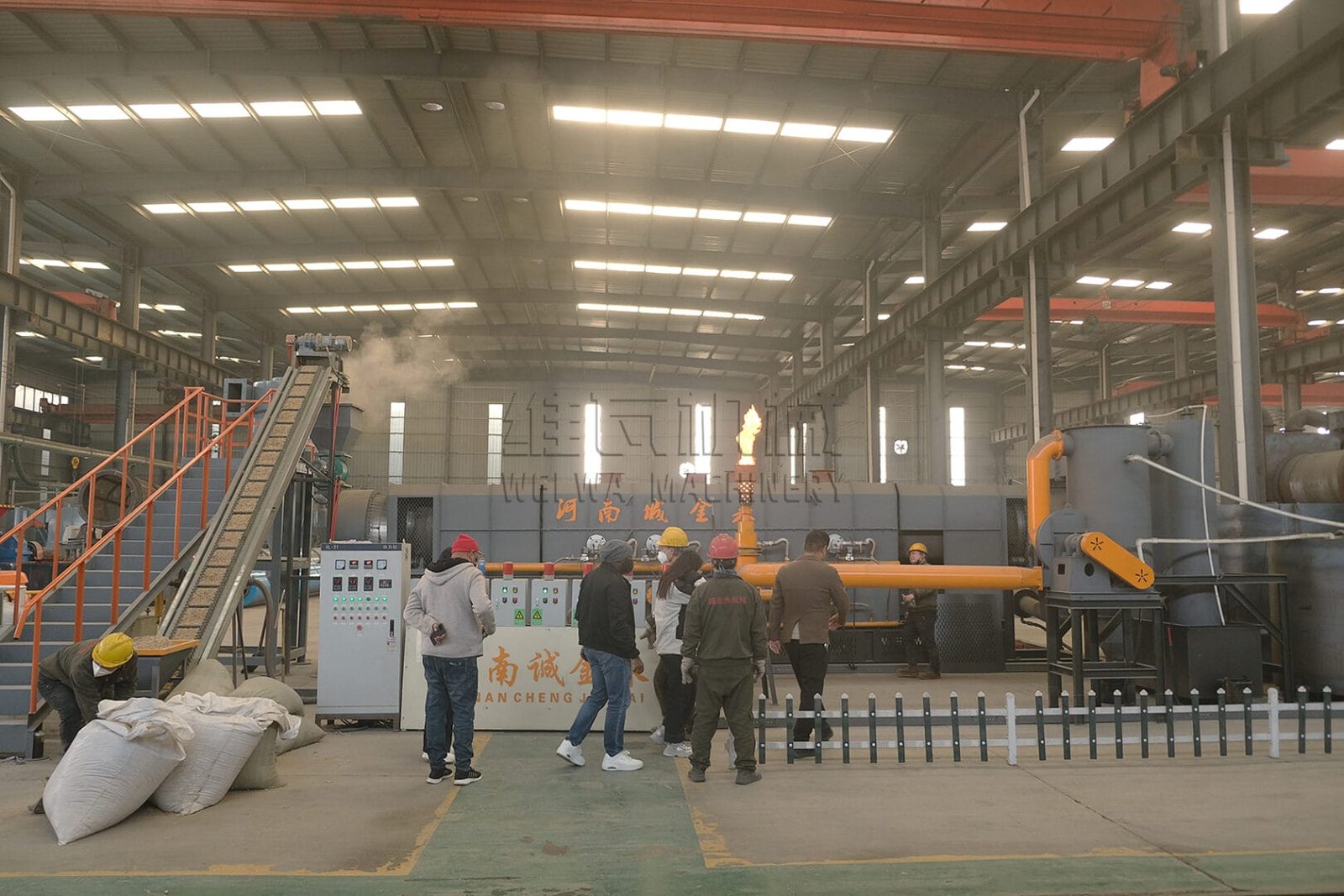
A continuous carbonization furnace is an advanced thermal processing system designed to convert biomass materials into biochar through oxygen‑limited pyrolysis in a non‑stop feeding and discharging mode. Unlike traditional batch kilns that require cooling and reloading after each cycle, the continuous carbonization furnace enables 24/7 operation with consistent temperature control and higher energy efficiency. The typical structure includes a double‑cylinder rotary drum where the inner drum is responsible for drying and pre‑heating, while the outer drum maintains the carbonization temperature. Biomass feedstock such as palm kernel shells, coconut shells, rice husk, sawdust, and wood chips spirals through the furnace under controlled conditions.
During the carbonization process, organic materials decompose at temperatures between 450°C and 600°C, releasing volatile gases composed mainly of carbon monoxide, methane, and hydrogen. These combustible gases are collected, purified, and redirected into the combustion chamber as a supplementary heat source. This gas recovery system allows the continuous carbonization furnace to achieve a self‑sustaining thermal cycle after initial preheating, significantly reducing external fuel consumption. The entire process is sealed to minimize smoke emission and ensure environmental compliance. Uniform residence time and precise temperature control result in stable biochar quality with high fixed carbon content, low moisture, and favorable porosity for agricultural and industrial applications.
The continuous carbonization furnace is particularly suitable for large‑scale biomass processing because it eliminates downtime, reduces labor intensity, and delivers predictable output. For investors in Indonesia dealing with abundant palm kernel shells, this technology represents a transformative step from waste disposal to value‑added biochar production. Weiwa Machinery has refined the structural design, sealing mechanism, and automation level of our continuous carbonization furnace to adapt to tropical climates, high‑humidity feedstock, and local power configurations commonly found in Indonesian plantations and palm oil mills.
Why Indonesia Is a Strategic Market for Continuous Carbonization Furnace Deployment?
Indonesia produces over 45 million tons of palm kernel shells every year as a by‑product of its palm oil industry. Most of this PKS is either stockpiled, used as low‑grade boiler fuel, or improperly disposed of through open burning. With increasing pressure from environmental regulations and growing awareness of soil degradation, Indonesian stakeholders are actively seeking sustainable alternatives. Biochar produced from PKS not only sequesters carbon but also serves as a soil amendment to improve water retention, nutrient availability, and microbial activity in acidic tropical soils. In addition, high‑quality PKS biochar can be processed into barbecue charcoal, hookah charcoal, or used as a reductant in industrial applications.
The Indonesian government has introduced several policies to support renewable energy, waste reduction, and low‑carbon agriculture. Subsidies for biochar producers, restrictions on open burning of agricultural residues, and national greenhouse gas reduction targets have created a favorable ecosystem for adopting modern charcoal making machines. Moreover, Indonesia’s geographic position enables efficient export of biochar and charcoal products to Asia, the Middle East, and Europe. For equipment manufacturers like Weiwa Machinery, the combination of abundant biomass, regulatory momentum, and market demand makes Indonesia one of the most promising regions for continuous carbonization furnace applications.
Another key factor is the diversification of biomass resources in Indonesia beyond palm kernel shells. Coconut shells from coastal areas, rice husks from Java, rubber wood sawdust from Sumatra, and empty fruit bunches from palm plantations all present viable feedstock for a continuous carbonization furnace. A single machine installed in a regional hub can process multiple biomass types with minor adjustments to feeding speed, temperature zones, and residence time. This flexibility enhances the return on investment and reduces the risk of feedstock shortage, which is critical for long‑term operations in archipelagic markets like Indonesia.
Preparing for the On‑Site Trial of Continuous Carbonization Furnace in Indonesia
Before deploying the continuous carbonization furnace, Weiwa Machinery’s technical team visited the client’s site in Indonesia to evaluate infrastructure, biomass availability, and operational requirements. The palm oil mill selected for the trial processes approximately 30 tons of fresh fruit bunches per hour and generates around 18 to 20 tons of palm kernel shells per day. The PKS moisture content ranged from 12% to 18% depending on seasonal weathering, and the particle size was mostly below 30 mm, which fits the feeding requirement of our continuous carbonization furnace without extensive pre‑crushing.
The site already had a 380V three‑phase power supply, adequate space for equipment layout, and basic material handling systems. Our engineers reviewed local emission standards, safety protocols, and maintenance accessibility. Based on this assessment, we configured a medium‑capacity continuous carbonization furnace with a double‑cylinder rotary drum, integrated gas recovery unit, cyclone dust removal, and a PLC‑based control panel with temperature monitoring. Spare parts commonly subject to wear, such as sealing rings and screw feeders, were included in the shipment. We also prepared an Indonesian‑language operation manual and arranged remote technical support to assist the local team during commissioning.
One of the main objectives of the trial was to verify whether the continuous carbonization furnace could maintain stable carbonization of PKS under real‑world conditions where humidity, power fluctuations, and feedstock variability exist. The client was particularly interested in biochar fixed carbon percentage, yield rate, smoke emission level, fuel consumption after self‑heating, and overall ease of operation. Pricing considerations were also discussed, as the continuous carbonization furnace price is a key factor for Indonesian SMEs compared to traditional kilns. Our goal was to demonstrate that despite a higher initial investment, the continuous system offers lower operating costs, better product uniformity, and stronger compliance with environmental rules.
Execution and Observation of the PKS Carbonization Trial
The trial began with a preheating phase using a small amount of LPG to raise the furnace temperature to around 200°C for drying and then to 500°C for pyrolysis initiation. Once the inner drum reached the target carbonization temperature, PKS was continuously fed into the system using a variable‑speed screw conveyor. The material moved forward through the rotating drum, gradually losing moisture, undergoing thermal decomposition, and forming biochar. The residence time was set between 25 and 35 minutes depending on the moisture level and desired carbonization degree.
Within the first two hours, the furnace stabilized and began generating sufficient combustible gas to sustain the combustion chamber. External LPG supply was reduced and eventually stopped after the gas recovery loop reached equilibrium. From that point onward, the continuous carbonization furnace operated in a self‑heating mode, confirming the energy efficiency of the design. The discharged biochar was cooled through a water‑cooled screw discharger to below 60°C before collection, preventing spontaneous combustion and preserving porous structure.
Over five consecutive days of operation, the system processed an average of 950 to 1,050 kg of PKS per hour with a biochar yield of approximately 28% to 31% by weight. Laboratory analysis of the biochar showed fixed carbon content between 74% and 79%, ash content around 10% to 13%, moisture below 5%, and pH in the range of 8.8 to 9.3. These properties are well suited for soil amendment in acidic Indonesian soils and meet the general specifications for industrial charcoal blending. Smoke emission measured at the outlet was within acceptable limits thanks to the multi‑stage purification and combustion of volatile gases. The client noted that the workshop area remained noticeably cleaner compared to their previous batch carbonization attempts.
Operators reported that the continuous carbonization furnace required minimal manual intervention after initial setup. The PLC interface allowed them to monitor drum temperature, gas pressure, feeding speed, and discharge status in real time. Minor adjustments to screw feeder frequency resolved occasional bridging caused by irregular PKS size. No major blockages or mechanical failures occurred during the trial. The client estimated that labor demand was nearly 40% lower compared to their traditional kiln operation, and daily throughput was more than double despite using the same workspace.
Performance Comparison Between Continuous Carbonization Furnace and Traditional Batch Kilns
To contextualize the trial results, it is useful to compare the continuous carbonization furnace with conventional batch carbonization methods still widely used in Indonesia. Batch kilns typically operate in cycles of 8 to 12 hours including loading, heating, carbonization, cooling, and unloading. They often rely heavily on external firewood or diesel, emit visible smoke, and produce biochar with inconsistent carbonization degrees due to uneven heat distribution. Yield loss is common because over‑carbonization or under‑carbonization occurs in different parts of the kiln.
In contrast, the continuous carbonization furnace maintains a steady thermal profile along the drum length, ensuring that each particle of PKS experiences similar temperature and residence time. This leads to uniform biochar quality batch after batch. Energy consumption per ton of feedstock is lower because the recovered syngas replaces external fuel after startup. The continuous system also occupies a smaller footprint relative to the output capacity and can be enclosed to further control dust and odor. Although the continuous carbonization furnace price is higher upfront, the payback period shortens when factoring in fuel savings, labor reduction, higher yield, and access to premium biochar markets that demand consistent specifications.
Environmental performance is another differentiator. Indonesian regulators have increased scrutiny on open burning and unauthorized emissions from small‑scale charcoal operations. The continuous carbonization furnace equipped with gas recovery and dust removal aligns better with compliance requirements. During the trial, local environmental officers visited the site and acknowledged the low smoke output and stable operation. For palm oil mills aiming to integrate waste‑to‑value projects under corporate sustainability programs, this compatibility reduces regulatory risk and supports ESG reporting.
Market Prospects for Charcoal Making Machine in Indonesia
The market for charcoal making machines in Indonesia is expected to expand steadily over the next decade. Several converging factors contribute to this trend. First, the volume of biomass residues continues to grow alongside palm oil, rice, coconut, and rubber production. Second, domestic demand for biochar in agriculture is rising as farmers seek ways to restore soil fertility, retain moisture during dry seasons, and reduce chemical fertilizer dependency. Third, export demand for Indonesian charcoal products remains strong in markets such as Japan, South Korea, the Middle East, and parts of Europe, where high‑density, low‑smoke charcoal is preferred for barbecue and hookah applications.
Continuous carbonization furnaces are well positioned to capture this demand because they can produce standardized biochar at scale. Small‑scale entrepreneurs may start with a compact model and later upgrade to higher‑capacity units as feedstock supply and market channels stabilize. Weiwa Machinery has received inquiries not only from palm oil mills but also from agricultural cooperatives, biomass traders, and green energy startups in Indonesia. Many of them are evaluating the continuous carbonization furnace price against projected biochar selling prices, which vary depending on quality, form (powder, granular, briquetted), and application.
Another growth driver is the increasing integration of carbon credit mechanisms in Southeast Asia. Biochar is recognized for its potential in long‑term carbon sequestration when applied to soil. Projects that document feedstock origin, production process, and soil application may qualify for voluntary carbon markets. While certification requires rigorous data collection, the continuous carbonization furnace simplifies record‑keeping through automated temperature logs, throughput metering, and gas balance estimation. This technological advantage may become more valuable as carbon finance matures in Indonesia.
It is also worth noting that Indonesia’s island geography encourages decentralized processing. Instead of transporting bulky biomass over long distances, many investors prefer to install charcoal making machines near plantations or mills. The modular nature of Weiwa’s continuous carbonization furnace allows containerized shipping, on‑site assembly, and capacity customization from 300 kg/h to over 2,000 kg/h. This adaptability matches the dispersed pattern of biomass availability across Kalimantan, Sumatra, Sulawesi, and Papua. As rural infrastructure improves, more locations will become viable for continuous biochar production lines.
Technical Considerations for PKS Carbonization in Tropical Conditions
Although palm kernel shells have relatively low moisture compared to fresh woody biomass, Indonesian climate conditions can push surface moisture above 15% during rainy months. The continuous carbonization furnace performs best when feedstock moisture is below 15% to avoid excessive energy consumption in the drying zone. In regions with high rainfall, a simple roofed stockpile or a supplemental rotary dryer may be added upstream. Weiwa Machinery often advises clients to conduct moisture checks before feeding and adjust feeding rate accordingly to maintain stable drum temperature.
PKS particle size distribution also influences flow behavior inside the drum. Oversized shells may roll too quickly and exit before full carbonization, while fine particles can create dust or accumulate near the discharge seal. The screw feeder and drum inclination in our continuous carbonization furnace are adjustable to accommodate such variations. During the Indonesia trial, we observed that a mix of whole and broken PKS within 10–30 mm worked well. For operations planning to process coconut shells or rice husks simultaneously, we recommend separate feeding bins or pre‑mixing to avoid segregation inside the drum.
Heat resistance and corrosion protection are additional considerations in tropical coastal areas where salinity and humidity are high. Weiwa’s continuous carbonization furnace uses high‑temperature alloy steel for the inner drum and anti‑corrosion coating for external structures. Sealing components are selected for durability under cyclic thermal stress. These design choices extend service life and reduce unplanned downtime, which is critical for continuous operations targeting 24/7 running schedules. Clients in Indonesia are encouraged to schedule preventive maintenance every 3 to 6 months depending on throughput and feedstock abrasiveness.
Economic Perspective on Continuous Carbonization Furnace Price and ROI in Indonesia
A frequent question from Indonesian buyers is about continuous carbonization furnace price and whether the investment is justified. Pricing depends on capacity, configuration (e.g., with or without dryer, dust removal level, automation grade), material specification, and shipping terms. While a continuous system costs more than a basic brick kiln or small batch retort, the comparison should consider total cost of ownership. Factors include fuel consumption, labor, yield loss, product selling price, environmental penalties avoided, and equipment lifespan.
In the PKS trial described above, the client estimated that the continuous carbonization furnace reduced external fuel cost by approximately 40% after the self‑heating stage. Labor was reduced from six workers per shift to three. Biochar yield improved by about 5 percentage points compared to their previous method, and the uniformity allowed them to negotiate better pricing with a domestic soil amendment distributor. Taking these variables into account, the preliminary payback period was projected between 12 and 18 months assuming stable PKS supply and biochar sales. Of course, actual ROI varies by location, scale, and market access.
Weiwa Machinery supports Indonesian clients with transparent quotation, optional turnkey packages including installation and training, and guidance on layout design to optimize material flow. We also help customers calculate expected throughput, energy balance, and space requirement so that the selected continuous carbonization furnace matches their business plan. For those concerned about upfront cost, we can discuss phased capacity expansion, where an initial smaller unit validates the process and a larger furnace is added later. This approach lowers entry barriers while preserving scalability.
Future Development and Innovation Directions for Biochar Equipment in Indonesia
As the biochar industry matures in Indonesia, equipment suppliers and operators will need to address efficiency, digitalization, and product diversification. Weiwa Machinery is exploring enhancements such as IoT‑based remote monitoring to help Indonesian clients track furnace performance from mobile devices, predictive maintenance alerts to reduce unexpected stops, and optional secondary heating zones to fine‑tune biochar properties for activated carbon precursors. Integration with downstream briquetting or crushing units can also create a complete PKS‑to‑value chain on a single site.
There is growing interest in co‑carbonizing PKS with other biomass such as rice husk or sewage sludge to modify biochar characteristics. The continuous carbonization furnace is inherently suitable for such trials because temperature and residence time can be programmed and repeated. Research collaboration between equipment manufacturers, universities, and agricultural extension centers in Indonesia could accelerate the development of location‑specific biochar formulations. This would strengthen the scientific basis for biochar application in tropical soils and support policy decisions on organic soil amendments.
On the policy side, clearer standards for biochar quality, safety, and carbon accounting in Indonesia will benefit both producers and buyers. As regulations evolve, charcoal making machines that can document process parameters and output consistency will have a competitive edge. Weiwa Machinery is prepared to provide data interfaces and compliance documentation to support clients who wish to participate in certified biochar or carbon credit projects. Our continuous carbonization furnace is designed not only as a production tool but also as a transparent, traceable unit within a broader sustainability framework.
Conclusion of the Indonesia Trial and Market Outlook
The on‑site trial of Weiwa Machinery’s continuous carbonization furnace in Indonesia demonstrated that PKS can be efficiently and cleanly converted into high‑quality biochar under continuous operation. Stable temperature control, effective gas recovery, consistent yield, and reduced labor were observed throughout the five‑day test. The client expressed satisfaction with equipment reliability, biochar quality, and alignment with environmental expectations. Feedback indicated strong interest in scaling up to a full production line once market contracts are secured.
Looking forward, the prospects for continuous carbonization furnaces and charcoal making machines in Indonesia remain positive. Abundant biomass, supportive policies, rising agricultural demand for soil improvement, and export opportunities form a solid foundation. While the continuous carbonization furnace price requires careful evaluation, the technical and economic advantages over traditional batch methods are increasingly recognized by Indonesian investors. Weiwa Machinery will continue to refine our equipment for tropical conditions, provide localized support, and collaborate with partners to unlock the full potential of biochar in Indonesia.
For companies and entrepreneurs exploring biomass carbonization in Indonesia, the combination of PKS resources and continuous processing technology offers a compelling pathway from waste to value. Weiwa Machinery welcomes inquiries, site assessments, and trial arrangements to help you make informed decisions. Our team is ready to assist with technical consultation, layout planning, and after‑sales service to ensure long‑term success in the Indonesian biochar market.
About Weiwa Machinery
Weiwa Machinery is a professional manufacturer specializing in biomass carbonization equipment, charcoal making machines, briquetting machines, and related production lines. With years of experience in design, fabrication, and international project deployment, we provide reliable equipment and turnkey solutions for clients worldwide. Our product range includes continuous carbonization furnaces, batch carbonization kilns, rotary dryers, crushers, conveyors, and briquette presses. We serve customers in Asia, Africa, Europe, and the Americas, with a focus on energy efficiency, environmental compliance, and long‑term durability. Weiwa Machinery supports every project with customized configuration, installation guidance, operator training, and spare parts supply. Our mission is to help global partners transform agricultural and forestry waste into valuable biochar and charcoal products through practical and sustainable technology.
Contact us today to discuss your project in Indonesia or other markets:
Mob: +8613838093177
Whatsapp: +8613838093177
E‑Mail: info@cjlmachinegroup.com
Reference: https://cjljx.com/products/tanhua/continuous-carbonization-furnace


 Wechat

 +8615937143060
