


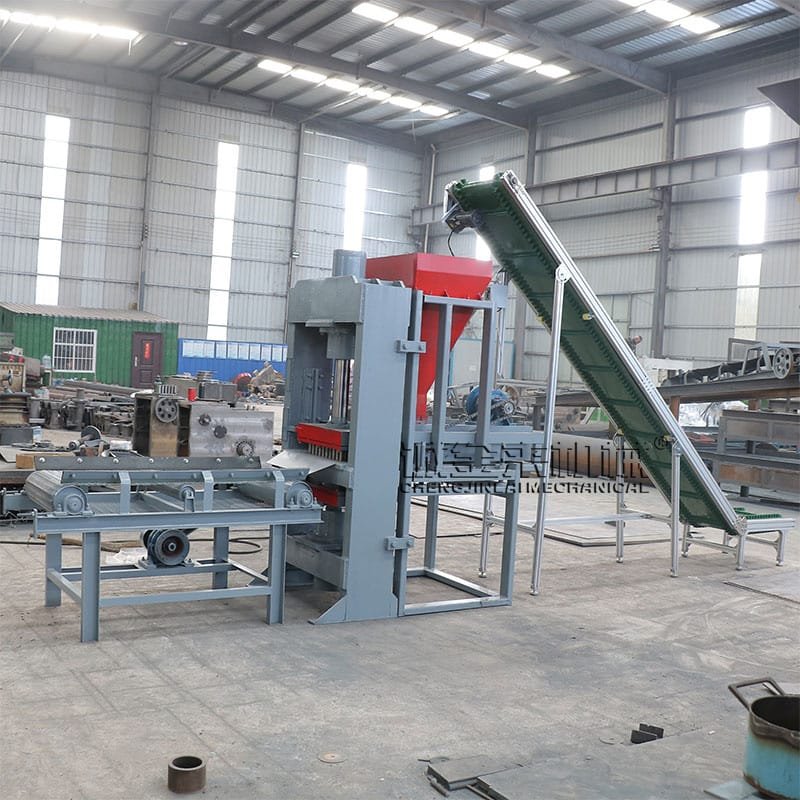
Why Indonesian Buyers Choose the Hydraulic Shisha BBQ Press Machine?
Traditional charcoal tablet production in small Indonesian workshops often relies on manual stamping or low-pressure screw extruders. Those methods can work for cheap BBQ lumps, but they struggle with premium hookah charcoal specifications. The Hydraulic Shisha BBQ Press Machine changes the equation by applying 100 to 200 tons of controlled hydraulic force, forming uniform cubes, rounds, or finger sticks in roughly one second per stroke.
For an Indonesian manufacturer targeting export-grade shisha charcoal, density is everything. High density means slower combustion, less breakage in transit, and stable heat output in the hookah bowl. The hydraulic system on Weiwa’s Hookah Charcoal Briquette Press Machine holds pressure through a configurable dwell time, so the same machine can handle coconut shell charcoal, sawdust char, bamboo char, or blended recipes by adjusting pressure, mold cavity, and binder ratio.
Another reason Indonesian buyers move to hydraulic technology is labor efficiency. With a PLC control panel, one operator can manage feeding, pressing, ejection, and conveyor transfer while the system logs stroke count and fault alarms. In a market where workforce training varies between Java, Sumatra, and Sulawesi factories, that predictability matters.
Market Context: Shisha Charcoal Making Machine in Indonesia
Indonesia produces large volumes of coconut shell annually, and a meaningful portion of that shell previously became agricultural waste. Today, briquette exporters in West Java, Banten, and East Java convert that shell into high-value shisha charcoal. Global buyers in 2026 evaluate briquettes on fixed carbon, ash below 2 percent, moisture under 8 percent, and burn time between 90 and 120 minutes. Meeting those numbers repeatedly requires process control, not just a press.
This is why a Shisha Charcoal Making Machine in Indonesia is rarely a single unit. The competitive plants pair the hydraulic press with a carbonization furnace, charcoal crusher, binder mixer, and heat pump dryer. Weiwa Machinery designs those lines as modular systems, so a client can start with one Hookah Charcoal Making Machine and later add a second press or a larger dryer without rebuilding the layout.
Raw Material Versatility in the Indonesian Market
Beyond coconut shell, Indonesian clients frequently test palm kernel shell, cashew shell, acacia wood, and rice husk char. The Hydraulic Shisha BBQ Press Machine accepts powder below 3 mm when mixed with a starch-based binder and controlled water addition. If the client’s raw material is too coarse, our proposal includes a crusher and a vibrating sieve. If moisture is high, we specify a paddle dryer before mixing. This flexibility lets agro-waste traders enter the charcoal business without importing expensive feedstock.
What Weiwa Shipped: Full Hookah Charcoal Briquette Press Machine Line?
For the recent Indonesia project, the client ordered a coordinated line rather than a standalone machine. The shipment included one main Hydraulic Shisha BBQ Press Machine with dual mold plates, one horizontal carbonization furnace, one charcoal hammer crusher, one binder mixer with water dosing tank, one heat pump dryer with mesh belts, one electric control cabinet, and spare molds. All machines were painted with anti-rust primer for tropical humidity and configured for 380V/50Hz three-phase power, which matches common industrial supply in Indonesian factories.
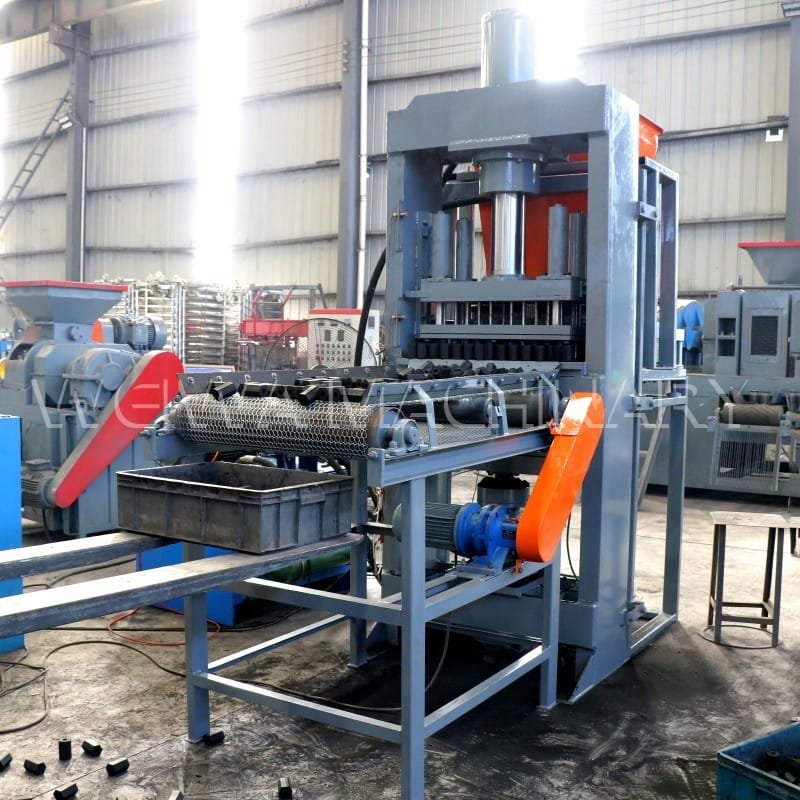
The hydraulic press itself carried a 160-ton rated cylinder, a pressure gauge on the station, a cooling system for the hydraulic oil, and quick-change mold clamps. The PLC allowed the client to set pressing time, return stroke speed, and auto-eject interval. We also pre-installed engraving samples so the client could test logo embossing on the briquette face during commissioning.
PLC Control and Hydraulic Pressure Station
The hydraulic station uses a vane pump with an overflow valve and a digital pressure transmitter. Operators in Indonesia can switch from automatic to manual mode when cleaning or changing molds. The HMI screen displays stroke counter, oil temperature, and current pressure curve. Because power fluctuation is common in some regional industrial zones, the control cabinet includes a voltage stabilizer and surge protection.
380V/50Hz Adaptation for Indonesia
Motors, contactors, and dryer compressors were sourced in 380V/50Hz specification. Conveyor gearboxes were selected for continuous duty in 30 to 35 degrees Celsius ambient temperature. This detail is often overlooked by suppliers reusing Chinese domestic 220V/60Hz panels, but for a Shisha Charcoal Making Machine in Indonesia, correct electrical matching reduces commissioning risk and avoids burned windings during the first week of operation.
How the Hydraulic Shisha BBQ Press Machine Works in Daily Production?
The workflow begins after carbonization and crushing. Charcoal powder under 3 mm is lifted into the binder mixer. There, starch binder and water are added to reach a plastic but non-sticky state. The mixed material is transported to a buffer hopper above the hydraulic press. A feeder shoe pushes a measured dose into the mold cavity. The upper hydraulic cylinder descends, holds pressure for a preset time, and retracts. The lower ejector pushes the formed briquette onto a discharge conveyor. The cycle repeats every one to two seconds depending on shape and fill density.
Because the press forms the briquette in a closed cavity, dimensional tolerance stays tight. For cube shisha charcoal, this means 25x25x25 mm with sharp edges. For round tablets, diameter and thickness variation stays within 0.3 mm. That consistency is what Indonesian exporters need when private-label buyers in Germany or the UAE weigh random samples from a container.
Mold Options and Customization for Indonesian Shisha Charcoal Shapes
Weiwa Machinery treats molds as a product-differentiation tool. The same Hookah Charcoal Briquette Press Machine can run cubic, rectangular, round, hexagonal, convex-concave, and finger shapes by swapping the mold plate. Indonesian clients often start with 25 mm cubes for the Middle East and later add 33 mm round tablets for European shisha cafes. We store mold drawings in CAD and can engrave brand initials, a leaf icon, or a custom pattern on the top face.
Mold material is alloy tool steel with heat treatment to HRC 50 or above. For high-volume runs, we recommend keeping one working mold on the machine and one backup in the warehouse. Lead time for a new custom mold is usually seven to ten working days, and we ship extra seals and ejector pins with every line.
From Coconut Shell to Briquette: Complete Process Flow
A properly balanced line for an Indonesian client looks like this. First, coconut shell or hardwood goes into a carbonization furnace. After cooling, the char enters a crusher and becomes powder under 3 mm. The powder is screened, then blended with binder in a mixer. The wet mix rests for aging, then feeds the hydraulic press. Fresh briquettes carry 18 to 25 percent moisture and must dry to below 8 percent in a heat pump or mesh belt dryer. Finally, the dried briquettes are counted, screened for fines, and packed.
The Hydraulic Shisha BBQ Press Machine sits at the center of that flow. Upstream machines determine powder quality; downstream drying determines moisture compliance. Weiwa’s advantage is that we design all stages together, so the press speed, mixer capacity, and dryer belt length are matched instead of purchased separately from unrelated suppliers.
Packing, Freight, and Customs: Shipping the Line to Indonesia
Export packing for tropical sea freight starts with stretch wrapping the hydraulic press in anti-rust plastic film. The main body is fixed inside a fumigation-certified wooden case with steel brackets. Small parts, molds, and spare gauges go into plywood crates with silica gel bags. The dryer and furnace are wrapped in waterproof fabric and loaded in a 40-foot container with corner protections. We prepare commercial invoice, packing list, certificate of origin, and bill of lading in advance so the Indonesian importer can clear customs at Tanjung Priok, Tanjung Perak, or Belawan without delay.
For this project, the client requested delivery two weeks before their peak season ramp-up. We compressed production to meet the window, shared pre-shipment photos, and sent a loading video showing every crate position. That transparency is part of how Weiwa Machinery reduces buyer anxiety on a first cross-border order.
Installation, Training, and After-Sales Support in Indonesia
After container arrival, our engineer joins a video call with the client’s local technician. We guide base leveling, hydraulic oil filling, electrical wiring, mold mounting, and pressure calibration. The first trial run uses local charcoal powder so the client sees real briquettes before paying for full-scale operation. We also record a commissioning video and send an operation manual in English and Bahasa Indonesia summary tables.
If the client requests on-site service, Weiwa can dispatch an engineer to Indonesia subject to visa and schedule. Spare parts such as seals, pressure gauges, mold inserts, and conveyor belts are available from our parts warehouse with short lead time. Every Indonesian project receives quarterly follow-up on oil change intervals, binder ratio adjustment, and dryer temperature tuning.
Why Work with Weiwa Machinery for Your Hookah Charcoal Project?
Weiwa Machinery was founded in 1990 in Gongyi, Henan, China. Over more than thirty years, we have built briquette presses, carbonization furnaces, crushers, mixers, and dryers for clients in more than 90 countries. Our team handles raw material testing, mold drawing, plant layout in CAD, and full line commissioning. For the Hydraulic Shisha BBQ Press Machine, we do not sell a generic press and walk away. We calculate your daily input, recommend binder formula, simulate workshop footprint, and train your staff to hit export specifications.
Customization is standard practice. We can narrow the machine width for a tight Java workshop, change the HMI language to Bahasa, add a logo embossing plate, or couple the press to an existing screw conveyor. Our technical and after-sales departments stay in contact after the warranty period, because a hookah charcoal plant usually runs for eight to ten years and recipe adjustments never stop.
If you plan to buy a Shisha Charcoal Making Machine in Indonesia, or you already run a charcoal workshop and want to upgrade from manual stamping to hydraulic high-density pressing, the fastest path is to send us your raw material type, target shape, daily tonnage, and available workshop size. We reply with a line proposal, a footprint drawing, and a firm quotation.
Contact Weiwa Machinery
Mobile / WhatsApp: +86 138 3809 3177
Email: info@cjlmachinegroup.com
Website: https://cjljx.com
Factory visit: Gongyi City, Henan Province, China. Airport or railway pickup available on request.
Weiwa Machinery welcomes Indonesian charcoal entrepreneurs, trading companies, and OEM brands to discuss the Hydraulic Shisha BBQ Press Machine, the Hookah Charcoal Making Machine, and the Hookah Charcoal Briquette Press Machine. From single-unit export to turnkey shisha charcoal production line, our engineering team builds the configuration around your market, not around a catalog.


 Wechat

 +8615937143060
