


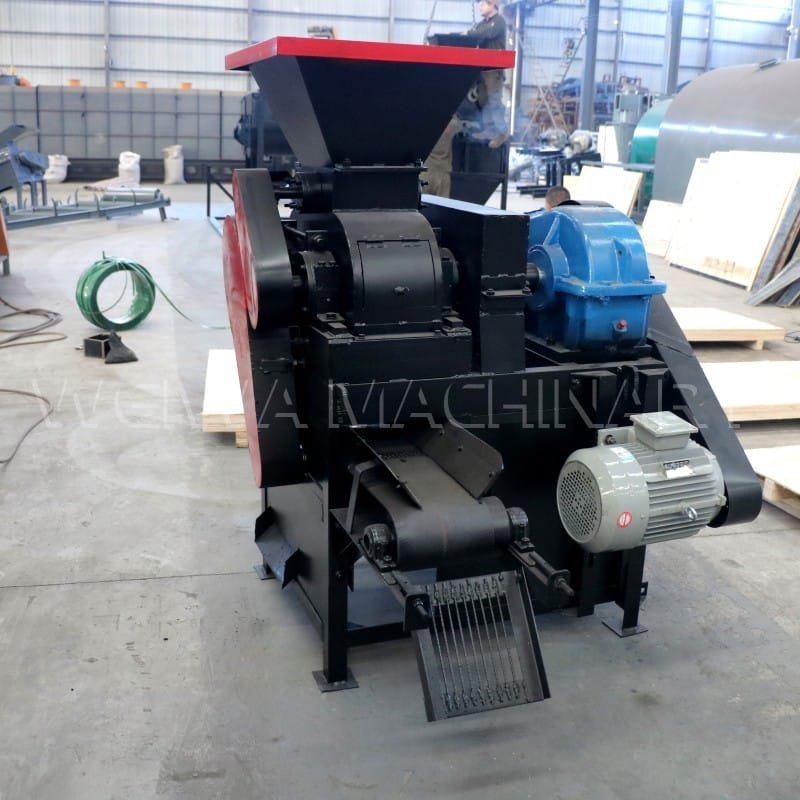
Last month, Weiwa Machinery loaded and dispatched a complete charcoal ball press machine production line to one of our long term partners in central Thailand. This shipment was not just another export order—it marked the beginning of an on site commissioning project where our engineers supervised installation, adjusted roller pressure, and ran the first trial batches of making charcoal balls for Thailand BBQ and shisha market.
Why the Thai Market Is Turning to Machine Made Charcoal Balls?
Thailand has a mature charcoal consumption culture rooted in street food, seafood grills, and increasingly in water pipe or shisha cafés in Bangkok, Phuket, and Chiang Mai. Traditionally many small workshops hand press coconut shell charcoal or simply resell irregular lump charcoal. However, rising labor cost, inconsistent burn time, and the demand for uniform size have pushed local entrepreneurs to invest in a machine for making charcoal balls that can deliver repeatable quality. A properly configured charcoal ball press machine allows the producer to control density, diameter, and shape so that each batch meets the expectations of both wholesale distributors and retail barbecue brands.
Coconut shell charcoal powder is the dominant feedstock in Thailand because of the large coconut processing industry. This material has good fixed carbon but is also slightly fibrous compared with hardwood charcoal dust. Our ball briquette machine uses a pair of alloyed forged rollers with customized pocket shapes—oval, round, or pillow—to accommodate the elasticity of coconut shell fines. Before shipment we tested the same batch of Thai sample powder in our factory to confirm that the pocket depth, reduction ratio, and pre compression zone would give a high forming rate with minimal binder addition.
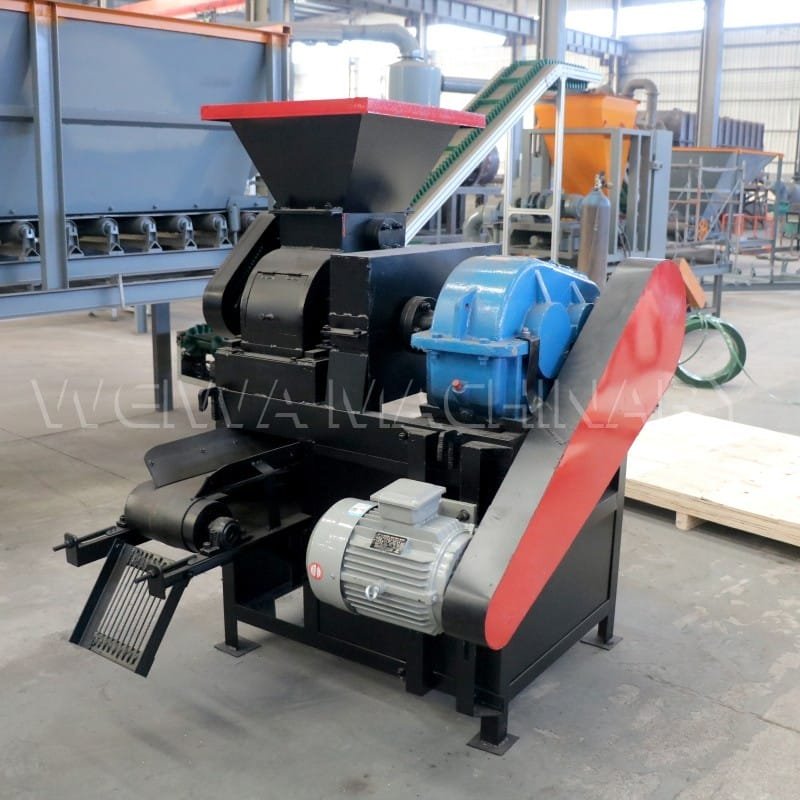
Pre Shipment Customization for the Thailand Project
Raw Material Analysis and Binder Recommendation
The client sent us approximately forty kilograms of crushed coconut shell charcoal with moisture content around nine percent. After laboratory screening we recommended a starch based binder at three to four percent dosage, mixed with warm water to activate gelatinization. For Thai climate conditions where ambient humidity can exceed seventy percent during rainy season, we suggested pre drying the mixed material to a final moisture of eight to ten percent before it enters the charcoal press machine. Too much moisture causes the green briquette to expand and crack after demolding, while too little reduces inter particle friction and lowers the green strength.
Roller Pocket Design for Local Preference
Local BBQ charcoal balls in Thailand are typically 40 mm to 50 mm in diameter, either spherical or slightly elongated oval. We engraved the rollers with 45 mm round pockets arranged in a staggered pattern to increase the effective compression area. The pocket surface was polished to Ra 0.8 to reduce sticking of fine charcoal powder. This configuration is standard on our charcoal ball press machine models exported to Southeast Asia and can be swapped if the client later wants to produce pillow shape or quail egg shape briquettes for the shisha segment.
Power Configuration and Spare Parts Package
The ball briquette machine was equipped with a 22 kW main motor compatible with 415 V / 50 Hz Thai industrial power supply. We added a variable frequency drive to allow soft start and speed adjustment according to feed material bulk density. The spare parts kit included one set of roller shafts, two spare bearings, and a full set of seals and hydraulic fittings. All rotating parts were greased and wrapped in anti rust paper before being fixed inside the machine frame to survive the ocean freight to Laem Chabang Port.
Arrival Unloading and Plant Layout Check
The machine for making charcoal balls arrived in a twenty foot high cube container together with a twin shaft mixer, a batch silo, and a small mesh belt dryer. Our Thai client had prepared a concrete foundation according to the layout drawing we issued two weeks prior to shipment. Upon arrival, Weiwa technicians joined via video call to guide the local team through container unloading using forklifts and chain blocks. Particular attention was paid to the roller assembly which is the core of any charcoal press machine and must be kept vertical and aligned within 0.05 mm to avoid uneven wear.
After positioning the charcoal ball press machine on the damped foundation bolts, the team checked the base level with a precision spirit level, tightened anchor bolts, and connected the main power line through the supplied electrical cabinet. The twin shaft mixer was installed upstream of the silo so that pre moistened charcoal powder would fall evenly into the feeding hopper of the ball briquette machine. A dust hood was added above the hopper to collect airborne fines and channel them back into the cycle, an important detail for clean operation in tropical workshops.
First Trial Run and On Site Commissioning
No Load Test and Lubrication Check
Before any material was introduced, the crew ran the charcoal ball press machine empty for fifteen minutes. They observed bearing temperature, gear meshing sound, and VFD current draw. The hydraulic pre pressure unit was set to the mid range to keep the rollers tightly engaged. No abnormal vibration was detected. Lubrication points were rechecked and the centralized grease system was confirmed to pulse correctly every thirty minutes during continuous operation.
Feeding Mixed Charcoal Powder
The first material run used the Thai client’s own coconut shell charcoal powder premixed with cassava starch binder. The screw feeder delivered the blend into the roller gap of the ball briquette machine at a steady rate. Within seconds, perfectly formed dark balls dropped from the discharge chute. Our engineer gradually increased the main shaft speed from 8 rpm to 12 rpm while watching the filling factor of the roller pockets. At optimal feed rate the forming rate exceeded ninety seven percent, meaning fewer than three balls out of one hundred showed incomplete edges or lamination.
Density and Drop Test Results
We randomly sampled fifty balls from the first production batch and measured average green density at 1.05 g/cm³ before drying. After passing through the mesh belt dryer at 180 °C for two hours, the final density stabilized around 1.10–1.15 g/cm³ with moisture below four percent. A drop test from one meter onto a concrete floor resulted in zero breakage for forty eight out of fifty pieces. These numbers satisfied the client’s target specification for premium BBQ charcoal balls making charcoal balls for Thailand export packaging. The client immediately ordered additional branding stamps to emboss their logo onto the roller pockets in the next batch of spare rollers.
Key Advantages of Weiwa Charcoal Ball Press Machine in Tropical Conditions
A charcoal press machine operating in Thailand faces high humidity, occasional voltage fluctuation, and abrasive fine powder. Weiwa designs its charcoal ball press machine range with the following features that proved valuable during this commissioning:
The roller skin is made from a high manganese alloy steel subjected to deep quenching treatment so that surface hardness reaches HRC 58–62, extending service life even when processing silica rich mineral or charcoal fines. The frame is a welded box structure stress relieved after fabrication to prevent deformation under continuous high pressure. Sealed labyrinth glands protect the bearing housings from charcoal dust ingress, a common cause of premature failure in lower grade ball briquette machine models. The electrical enclosure carries IP55 rating suitable for dusty and humid environments.
From an operational standpoint, the VFD controlled main drive lets the operator slow down when feeding sticky material after rain exposure and speed up when the raw mix is dry and free flowing. This flexibility is essential for a machine for making charcoal balls where raw material moisture can vary from batch to batch depending on sun drying conditions on site.
Typical Process Flow When Using a Charcoal Press Machine for BBQ Balls
Although configurations vary with capacity, a standard line centered on the charcoal ball press machine usually follows this sequence. First, lump charcoal or coconut shell charcoal is crushed to below three millimeters. Second, the powder is conveyed to a twin shaft mixer where binder solution is sprayed and homogenized. Third, the mixed material is stored briefly in a buffer silo to ensure constant head pressure feeding the ball briquette machine. Fourth, the charcoal press machine compresses the material into ball shape. Fifth, the freshly pressed balls are dried to below five percent moisture in a mesh belt or tunnel dryer. Finally, cooled briquettes are screened, counted, and packed.
When helping new clients in Thailand plan their layout, we often recommend allocating extra space between the charcoal ball press machine and the dryer for manual inspection so that off spec pieces can be recycled back to the mixer. This small loop improves overall material yield and keeps the proportion of rejects below two percent.
Operator Training and Maintenance Routine
Initial Training Sessions
Our senior technician conducted a two day training program covering safe startup and shutdown procedures for the charcoal ball press machine, how to interpret pressure gauge readings on the hydraulic unit, how to adjust the gap between rollers when changing pocket inserts, and how to recognize early signs of roller wear. The Thai operators practiced binder preparation, moisture verification with a handheld meter, and cleaning the hopper area at end of shift to prevent hardened residue from blocking the feed screw.
Suggested Daily and Monthly Maintenance
Daily checks include observing the roller bearing temperature with an infrared thermometer, confirming grease supply, and inspecting the tightness of V belt tension. Monthly tasks involve checking the parallelism of the two rollers with feeler gauges, replacing the hydraulic filter if differential pressure exceeds the recommended threshold, and reviewing the wear pattern on pocket edges. Timely rotation of the roller skins—reversing their mounting direction halfway through expected life—can add hundreds of operating hours to a ball briquette machine in continuous production.
Market Feedback from the Thailand Client After One Month
Four weeks after commissioning, the Thai client reported stable daily output matching the rated capacity of the selected charcoal ball press machine model. Local restaurant suppliers who sampled the charcoal balls commented favorably on the uniform ignition time and low ash content. The client has since explored adding a second machine for making charcoal balls to serve growing orders from a regional supermarket chain interested in private label BBQ charcoal. They also inquired about a smaller tabletop charcoal press machine for R&D batches of hexagonal shisha briquettes using the same binder system adapted for finer powdered hardwood charcoal.
This field report reinforces our view that investing in a properly engineered charcoal ball press machine rather than a generic press pays back through reduced reject rates, consistent product appearance, and the ability to adapt quickly to different ball sizes required by the Thai and wider ASEAN market. Whether you plan to start making charcoal balls for Thailand domestic sale or export to neighboring countries, choosing the right ball briquette machine configuration at the outset is critical.
About Weiwa Machinery
Weiwa Machinery (WEIWA MACHINERY) is a professional manufacturer of briquetting and pelletizing equipment with more than 20 years of experience supplying charcoal ball press machine, ball briquette machine, charcoal press machine and complete production lines worldwide. Our factory is ISO certified and exports to over 130 countries including Thailand, Indonesia, Malaysia, Vietnam, India, Turkey, and South Africa. Every machine for making charcoal balls is factory tested before shipment and supported by detailed operation manuals, spare parts availability, and remote or on site technical guidance.
Contact Weiwa Machinery:
Mob / WhatsApp: +86 138 3809 3177
E-mail: info@cjlmachinegroup.com


 Wechat

 +8615937143060
