


Why Peru Is a Natural Market for a Sawdust Extruder?
Peru carries a large forestry and agro-processing base. Eucalyptus and pine sawmills around Piura, Cajamarca, and the Amazonian foothills generate thousands of tons of sawdust every year. Coffee husk from Chincha and corn stalk residue from the central highlands add another steady stream of biomass. Traditionally, much of this waste is burned openly or dumped. A sawdust extruder changes that equation by converting loose powder into uniform fuel rods without chemical binders.
In regions such as Piura, academic studies have already shown that sawdust briquettes can replace up to 55 percent of domestic charcoal and firewood use when properly densified. The calorific value of a well-made stick sits near 19 to 20 MJ/kg, which is more than 20 percent higher than ordinary split wood. For a Peruvian micro-producer, that means fewer trips to the market, less smoke in the kitchen, and a saleable product that survives transport on rough provincial roads.
What Makes the Peruvian Feedstock Different?
Peruvian sawdust is not identical to Southeast Asian rice husk or African cashew shell. Pine and eucalyptus carry higher natural lignin ratios, which helps the screw extrusion stage. But the moisture after rainy-season milling can exceed 35 percent, so the dryer in the line must be sized generously. For this shipment, Weiwa Machinery paired a 1.2 meter rotary dryer with a 37 kW sawdust extruder to keep throughput stable at 300 to 380 kg/h of green sticks even when incoming moisture hit 28 percent.
The Production Line That Shipped to Peru
The exported system followed the standard five-stage biomass charcoal workflow, but every stage was tuned for the client’s warehouse height, voltage, and labor skill level. The configuration is repeatable for other Latin American buyers.

Stage One Crushing and Screening
Raw eucalyptus offcuts and sander dust arrived mixed with bark chips. A 22 kW hammer grinder reduced everything below 5 mm. Oversize pieces were returned by a return auger. Keeping particle size tight matters because a sawdust briquetting machine jams when fiber length varies too much. Uniform powder feeds smoothly into the screw barrel and gives a cleaner hexagonal stick.
Stage Two Controlled Drying
A sawdust extrude machine in Peru cannot work with wet powder. The lignin plasticization stage needs moisture between 8 and 12 percent. Below 5 percent the stick cracks; above 14 percent the barrel slips and the heater coil overheats. The rotary dryer on this line used a 0.4 ton/hour evaporation capacity with a cyclone and a simple oven-dry sampling drawer so the operator could check moisture every two hours without a lab.
Stage Three Extrusion with the Sawdust Extruder
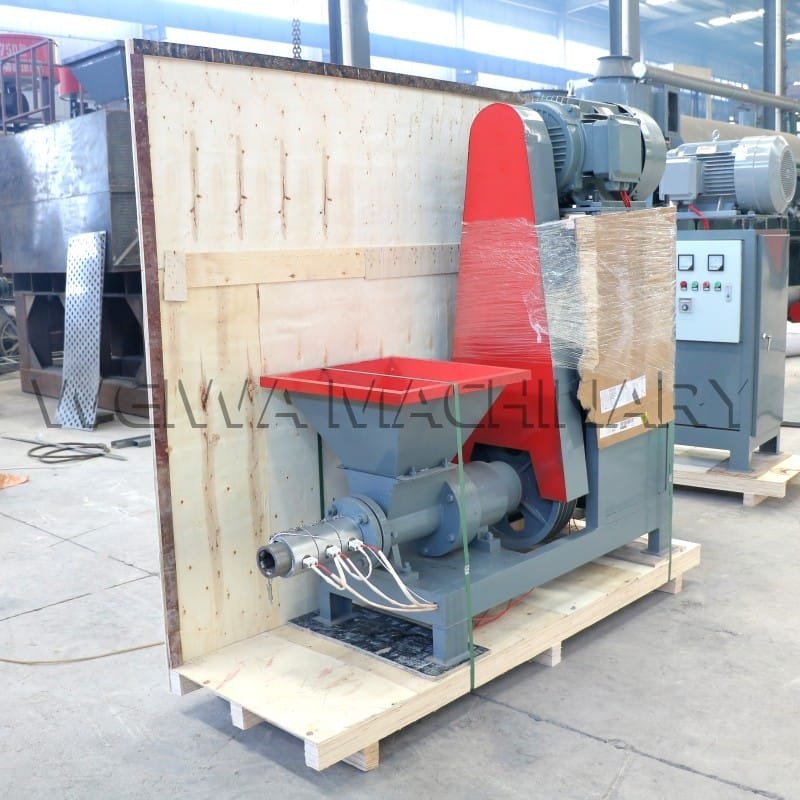
The heart of the plant is the screw sawdust extruder. Inside a 180 mm barrel, a hardened flight screw pushes biomass forward while a ceramic heating ring holds the cone at roughly 280 to 320 degrees Celsius. Under 15 to 18 MPa pressure, natural lignin melts and re-glues the cellulose fibers. No starch, no cement, no molasses. The extruded rod exits the mold at 50 mm diameter with a 15 mm central hole, then cools on a belt into a hollow hexagonal shape.
This is the moment where a sawdust briquette machine earns its reputation. The stick leaves the nozzle at nearly 4.5 grams per centimeter density, around 1.1 ton per cubic meter. That density is why Peruvian distributors prefer machine-made charcoal over lump charcoal from earth kilns: it stacks on pallets, it does not crumble in polypropylene sacks, and it lights with one match when fanned.
Stage Four Carbonization
Green sticks are not charcoal yet. They still contain volatiles. The hoisting carbonization furnace in this Peruvian line runs four barrels at a time. Each barrel holds 80 kg of sticks. Over six hours the temperature climbs from 100 to 550 degrees Celsius. Acetic acid, tar vapor, and wood gas escape through the top flue; most of that gas is routed back to fire the furnace, cutting LPG consumption by almost half compared to a first-generation kiln.
After cooling under nitrogen blanket, the finished charcoal shows fixed carbon above 70 percent, ash below 3 percent, and compressive strength high enough to survive a 1.2 meter drop test. That specification matches what Lima grill houses and Arequipa bakeries ask for when they switch from imported briquettes to local supply.
Stage Five Screening and Bagging
Charcoal from the furnace is screened at 40 mm and 60 mm cuts, then bagged in 10 kg kraft paper with a Weiwa serial QR tag. The client in Peru wanted manual bagging to preserve jobs, so the line stopped short of full robotic palletizing. That is a typical customization request we handle at the free design stage.
Loading Day at the Weiwa Workshop
On the morning of the container load, the 40 foot high cube received nine plywood crates. The sawdust extruder and dryer drum went in first, balanced against the carbonization barrels. Steel skids were welded to the container floor. Each crate carried a Spanish label, a humidity indicator card, and a fumigation stamp because the buyer in Peru required ISPM-15 compliance for Callao port clearance.
Our engineer recorded a 12 minute startup video in the workshop yard, running eucalyptus sawdust through the screw at 320 degrees and producing a 50 mm stick in front of the inspection agent. The video was handed to the client on a USB tag together with the wiring diagram, spare propeller, and mold wrench. That single video later helped the Peruvian team commission the line in 36 hours instead of five days.
Charcoal Science Buyers in Peru Should Understand
Many first-time importers think a sawdust briquettling machine is just a press. It is closer to a small chemical reactor. Three variables decide whether the end product sells.
Lignin Activation Temperature
If the heating ring sits too cold, the stick exits pale and soft. Too hot and the surface scorches while the core stays raw. The Weiwa control panel uses a PID indicator so a Peruvian operator can hold the cone at 300 degrees plus or minus 5 degrees across an eight hour shift. Stable temperature is the difference between a stick that snaps clean and one that powders in the bag.
Moisture Before Extrusion
A sawdust extrude machine in Peru during the garua mist season will fight moisture all day. The rule we give clients is simple: trust the dryer, not the weather. Even if the raw pile feels dry, run it through the rotary drum. A 1 percent moisture error can drop throughput by 15 percent because the screw spends energy boiling water instead of plasticizing lignin.
Mold Geometry
Peruvian buyers often ask for the pentagon with edge or the hollow hexagonal. Both shapes cool faster than a solid round stick and present more surface area for lighting. The mold sleeve on a sawdust extruder is interchangeable in 20 minutes. We shipped this line with three sleeves: 50 mm hexagonal, 70 mm hexagonal with edge, and 45 mm square for the shisha market in Trujillo.
Economic Logic for Peruvian Entrepreneurs
A small line like the one shipped last month runs on three shifts with four workers. Input cost is sawdust that many mills pay you to remove. Output is charcoal sticks priced in Peruvian soles above lump charcoal because the burn time is longer and the smoke is lower. Payback on a 300 kg/h sawdust briquette machine line in a city like Huancayo or Tarapoto typically lands between seven and ten months if the sticks are sold to restaurants rather than to wholesale charcoal yards.
There is also a compliance angle. Peru’s ministry of environment has repeatedly flagged illegal dry-forest charcoal from Piura. Mechanism charcoal made from sawmill waste carries no deforestation footprint. Several municipalities now give tax breaks on machinery import for briquette plants that register as clean-energy microproducers. A sawdust extruder is therefore not only a machine, it is an entry ticket to a regulated fuel market.
Common Mistakes When Importing a Sawdust Briquetting Machine
We see the same errors repeated by Latin American buyers. They underestimate dryer size. They ask for 80 mm sticks when their local market only cooks with 45 mm shisha cubes. They forget voltage: Peru runs 220V three-phase 60Hz in most industrial zones, not 380V 50Hz like China. On this shipment we rewound the motors and fitted a Spanish HMI so the electrician in Callao did not need to read Chinese labels.
Another mistake is skipping the carbonization step. Some buyers think the extruded stick is the final product. It is not. Green sticks smoke and smell. Only after carbonization do you get the black, brittle, high fixed-carbon charcoal that restaurants pay for. A complete line always includes the furnace, even if the buyer initially resists the extra container space.
How Weiwa Machinery Supports the Peruvian Client After Shipping?
Export does not end at the container gate. For this Peruvian order, our team scheduled two online commissioning calls, shared the propeller rebuild drawing, and stocked one set of heating coils in our Lima forwarder’s warehouse for same-week delivery. Spare parts for a sawdust extruder are few: screw flight, heating coil, mold sleeve, bearing seat. We keep those on a 48 hour dispatch promise for any country with more than five installed machines, and Peru crossed that threshold in 2024.
Keyword Note on Search and Buying Intent
When a buyer in Lima types sawdust extrude machine in Peru, they usually already know they want a line, not a single unit. When they type sawdust extruder or sawdust briquette machine, they may still be comparing screw type versus hydraulic type. Our job on the website is to answer both intents on one page: explain the science, show the shipment, link to the product spec, and leave the contact path obvious. That is also why this article repeats the phrases sawdust extruder, sawdust briquette machine, sawdust briquetting machine, and sawdust extrude machine in Peru in natural sentences rather than in a keyword block.
About Weiwa Machinery
Weiwa Machinery is a Henan-based manufacturer of biomass briquette and charcoal production lines with more than 30 years of workshop experience and equipment running in over 130 countries. We design crushers, dryers, sawdust extruders, briquetting presses, and carbonization furnaces as standalone units or as turnkey lines. Every Peruvian or Latin American order receives free line design, Spanish manuals on request, rewired motors for local voltage, fumigated export crates, and video commissioning support. Our factory floor carries ISO and CE documentation and we respond to project inquiries within one working day.
If you are planning a charcoal plant in Peru, Colombia, Ecuador, or Chile and want to know whether your sawdust, coffee husk, or bamboo dust fits our screw extruder, contact us before you book a container. We will size the dryer, pick the mold, and estimate payback with your local fuel price.
Contact: Mob +8613838093177, WhatsApp +8613838093177, Email info@cjlmachinegroup.com


 Wechat

 +8615937143060
