


Early this month at the Weiwa Machinery export warehouse in Gongyi, Henan, our team completed the final inspection and container loading of a complete charcoal making production line destined for a client in Lagos, Nigeria. The shipment included our high-performance Sawdust Extrude Machine, also known in the industry as a sawdust extruder or sawdust briquetting machine, matched with a Biomass Briquette Machine, horizontal carbonization furnace, rotary drum dryer, and wood crusher. This delivery represents more than a routine export. It reflects the growing momentum of Nigeria’s transition toward locally manufactured, clean-burning solid fuel produced from abundant agricultural and forestry residues.
Why Nigeria Is an Ideal Market for Biomass Briquette Machine and Sawdust Extruder Investment?
Nigeria is Africa’s most populous nation and one of its largest consumers of firewood and traditional lump charcoal for domestic cooking, street food vending, and small-scale industrial heating. Despite being a major oil producer, many Nigerian households and businesses face unreliable access to cooking gas and rising prices for imported fuels. At the same time, Nigeria generates vast quantities of biomass waste annually—sawdust from timber mills in Cross River, Edo, and Ogun States; rice husk from Kebbi and Niger States; groundnut shells in Kano; palm kernel shells in the Niger Delta; and corn cobs across the Middle Belt.
Traditionally these residues are either dumped, openly burned, or used inefficiently. A modern biomass briquette machine in Nigeria allows local processors to collect such waste, densify it through a sawdust briquetting machine or biomass extruder, then carbonize the briquettes to produce high-calorific-value charcoal rods or balls. The resulting product burns longer than loose sawdust, emits less smoke than raw wood charcoal, and can be sold at a premium in urban markets such as Lagos, Abuja, Port Harcourt, and Kano. In addition, the Nigerian government has expressed support for renewable energy initiatives and waste-to-energy projects, creating a gradually more favorable policy environment for briquette manufacturers who can demonstrate environmental benefits and job creation.
For Nigerian investors, the combination of cheap and widespread raw material, established local demand for barbecue and cooking charcoal, and the potential to export to neighboring West African markets makes the acquisition of a sawdust extruder and biomass briquette machine a strategically sound move. Our recent shipment to Lagos included a production line sized for approximately 500 to 800 kilograms per hour of raw briquette output, which after carbonization yields roughly 150 to 200 kilograms per hour of finished charcoal depending on feedstock moisture and carbonization method.
Raw Materials Suitable for Sawdust Briquetting Machine and Biomass Extruder in Nigeria
Wood-Based Residues
The most commonly used feedstock for a sawdust extruder is untreated hardwood or softwood sawdust obtained from furniture factories, sawmills, and carpentry workshops. In Nigeria, timber processing clusters in states such as Ogun, Oyo, Edo, Cross River, and Taraba produce substantial volumes of mixed hardwood sawdust which is ideal for the sawdust briquetting machine. The recommended particle size before drying is 3 to 5 millimeters. Particles larger than 5 millimeters should be re-crushed in a hammer mill or wood crusher to ensure even feeding and uniform density in the extruded briquette.
Agricultural Biomass Wastes
Rice husk, rice straw, groundnut shells, cotton stalks, soybean husks, palm kernel shells (pre-ground), bagasse from sugar processing, and corn cobs can all be processed by a well-designed biomass briquette machine or biomass extruder either alone or blended with sawdust. Each material has slightly different lignin content which affects binding behavior during screw extrusion. For instance, rice husk has lower natural lignin compared to hardwood sawdust and may require blending with 30 to 50 percent sawdust to achieve optimal briquette hardness without additives. No binders or chemical glues are required in the screw extrusion process because the thermoplastic lignin released under high temperature and pressure acts as the binding agent.
Moisture and Size Requirements
Regardless of the raw material type, the moisture content entering the sawdust briquetting machine must be between 8 and 12 percent. Material that is too wet will cause the extruder to jam or produce soft, poorly formed briquettes. Material that is too dry may generate excessive friction heat and accelerate screw wear. Particle size should be below 5 millimeters after crushing. These two parameters—moisture and size—are the most frequently overlooked causes of suboptimal performance in new biomass briquette machine in Nigeria installations, and both are addressed in the production line design we supplied.
Complete Charcoal Production Line Process with Sawdust Extruder and Biomass Briquette Machine
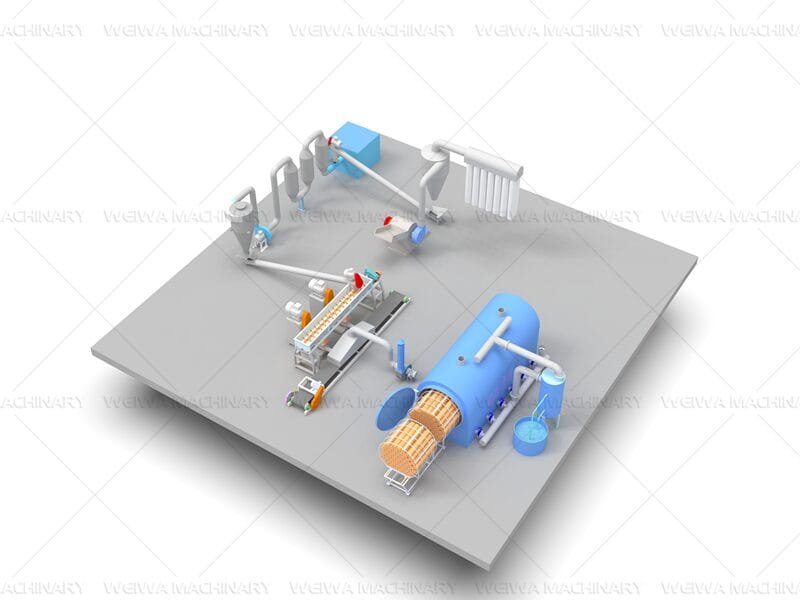
A standard charcoal production line centered on a screw-type sawdust extruder or piston-type biomass briquette machine typically consists of five sequential stages. Each stage is mechanically interconnected by screw conveyors or belt conveyors and can be partially automated depending on the client’s budget and plant scale.
Stage One Crushing and Size Reduction
Raw wood branches, bamboo, stalks, or oversized chips are fed into a wood crusher or hammer mill where rotating blades reduce them to granules of 3 to 5 millimeters. For pre-sized sawdust this step may be omitted, but it remains essential when the feedstock includes larger biomass chunks. The crusher in the Nigeria-bound line was equipped with a cyclone separator and dust collector to protect the operator and minimize material loss.
Stage Two Drying to Controlled Moisture Level
The crushed material is conveyed to a dryer. For small to medium capacity lines we typically recommend an airflow pipe dryer which uses hot air from a burner to rapidly reduce moisture to the target 8 to 12 percent. For larger capacities exceeding one ton per hour of input, a rotary drum dryer offers better stability and lower specific fuel consumption. The dryer on this shipment was configured with a temperature controller and automatic feeding hopper so that the moisture exiting the dryer stays within the narrow band required by the sawdust briquetting machine.
Stage Three Briquetting with Sawdust Extruder or Biomass Briquette Machine
Dried material is fed continuously into the forming chamber of the sawdust extruder. Inside the chamber a high-wear-resistant alloy screw compresses the biomass under pressures exceeding 30 megapascals while a heating ring raises the temperature to approximately 260 to 320 degrees Celsius. The combination of pressure and heat softens the natural lignin which coats the particles and fuses them together as they are forced through a forming die. The extruded rod emerges as a hollow hexagonal or quadrangular section with an inner hole of 15 to 20 millimeters and outer diameter of 50, 60, 70, or 80 millimeters depending on the mold installed. This semi-finished product is sometimes called a green briquette and still contains volatiles that will be driven off during carbonization.
Our biomass extruder models feature a temperature-adjusting indicator, a heavy-duty thrust bearing assembly, and a replaceable screw shaft and sleeve made from surfacing-welded wear-resistant alloy. These design details extend service intervals in abrasive environments such as those encountered when processing rice husk blends. The machine requires no binders, operates on three-phase power, and can run continuously for 16 hours per day with proper cooling and lubrication.
Stage Four Carbonization of Briquette Sticks
The green briquettes are laid in a carbonization furnace—either a batch-type hoisting carbonization furnace or a continuous carbonization furnace depending on throughput. In the absence of oxygen the briquettes are heated to 400 to 600 degrees Celsius, driving off volatile matter and leaving behind fixed carbon in the form of dense black charcoal rods. The carbonization ratio is typically about 3 to 4 kilograms of green briquette to produce 1 kilogram of finished charcoal, varying with feedstock species and final carbonization temperature. The furnace supplied with this Nigeria line was a self-ignition airflow carbonization furnace with a smoke回收 system that recycles combustible gas as secondary fuel, reducing external energy consumption and smoke emissions.
Stage Five Cooling Screening and Packaging
After carbonization the charcoal rods are allowed to cool in a separate cooling chamber or on a ventilated platform to avoid spontaneous re-ignition. They may then be screened for length, visually inspected for cracks, and packed in woven bags or cartons for wholesale or retail distribution. Some Nigerian clients further process the carbonized rods into powdered form for re-pressing into shisha or barbecue charcoal tablets using a separate charcoal ball press machine, but that is an optional downstream step beyond the scope of the basic sawdust extruder production line.
Technical Features of Weiwa Machinery Sawdust Extruder and Biomass Briquette Machine
The sawdust briquetting machine shipped to Nigeria is part of our WM-series screw extrusion line. Key characteristics include:
The main screw and inner sleeve are manufactured from high-chromium alloy steel subjected to carburizing and quenching heat treatment, giving them exceptional resistance to abrasive biomass feeds. The heating coil is externally adjustable so the operator can set the barrel temperature appropriate to the lignin-softening point of the specific feedstock. A central electric control cabinet integrates ammeter, thermal overload protection, and start-stop buttons for the feeder, heater, and main motor. The frame is reinforced welded steel sized to absorb vibration during continuous operation. Forming molds are interchangeable, allowing the same biomass extruder to produce hexagonal, square, or round-section briquettes in diameters from 45 to 80 millimeters.
Typical production capacities range from 180 kilograms per hour for the WM-50 model up to 1200 kilograms per hour for the largest WM-80 model, with motor power from 15 kilowatt to 37 kilowatt depending on configuration. The machine is designed for ease of maintenance—the screw tip, compression sleeve, and heating coil can each be replaced independently without dismantling the entire gearbox.
Our accompanying biomass briquette machine of the roller press type is also available for clients who prefer to first carbonize loose biomass and then press charcoal powder into oval, egg, or pillow shapes. Both technologies have their place in the Nigerian market. Screw extrusion is favored when the goal is to produce mechanism charcoal rods directly from raw sawdust, whereas roller pressing is common in facilities that receive pre-carbonized charcoal fines needing re-compaction with a small amount of binder.
Operating Tips for Biomass Briquette Machine in Nigeria Climate and Conditions
Power Supply and Voltage
Nigeria’s industrial voltage is commonly 415 volt three-phase 50 hertz. All Weiwa machines are configurable to match local electrical standards and are shipped with appropriately rated motors and control components. We recommend installing a voltage stabilizer or surge protector if the supply in your area is prone to fluctuation, as this protects the heater coils and contactors on the sawdust extruder.
Raw Material Sourcing and Seasoning
Establish relationships with nearby sawmills or rice mills to secure a steady supply of dry sawdust or husk. If the material arrives with moisture above 20 percent, budget additional fuel or solar pre-drying time before the mechanical dryer. Consistency of feedstock mix is important—frequent changes between pure sawdust and high-husk blends may require minor adjustment of the heater temperature and feed screw speed to maintain smooth extrusion.
Lubrication and Wear Part Stock
Schedule daily greasing of the main bearings and monthly inspection of the screw wear tip. We advise Nigerian customers to keep at least one spare screw assembly and one inner sleeve on site, particularly in high-throughput operations running two shifts. The heating coil typically lasts six to twelve months under normal use but should be checked periodically for open circuits.
Carbonization Best Practice
Avoid overloading the carbonization furnace. Allow adequate time for the temperature to rise evenly through the stack of green briquettes. Premature opening of the furnace door before the internal temperature has dropped below 60 degrees Celsius can result in partial re-ignition or oxidized charcoal with reduced fixed carbon content.
Business Considerations for Setting Up a Charcoal Line with Sawdust Briquetting Machine in Nigeria
Before purchasing a biomass briquette machine in Nigeria or importing a sawdust extruder from overseas, consider the following practical aspects. Land requirement for a 500 to 800 kilogram-per-hour line is approximately 150 to 250 square meters under roof plus open space for raw material storage and finished goods. You will need a three-phase power connection of adequate capacity, a water source for occasional cleaning, and basic material handling equipment such as forklifts or pallet trucks if operating at scale.
Local labor can be trained to operate the sawdust briquetting machine and dryer within three to five days. Most of the process is continuous once the dryer temperature is set and the extruder is warmed up. The limiting factor is usually consistent raw material supply rather than machine capability. Many successful Nigerian briquette producers start by collecting sawdust from several timber yards within a 30 to 50 kilometer radius, then expand as demand grows.
Pricing of finished charcoal briquettes in Nigerian urban markets varies by city and season but generally commands a noticeable premium over loose firewood and can be competitive with imported or long-distance transported lump charcoal when quality is consistent. Branding, uniform sizing, and low ash content are differentiating factors that help establish a recognisable product in the market.
Environmental and Social Impact of Biomass Extruder Adoption in Nigeria
By converting what would otherwise be waste into a marketable clean fuel, a biomass briquette machine installation contributes to reduced open burning of agricultural residue, lowered pressure on natural forest for charcoal production, and decreased household smoke exposure when the briquettes replace unprocessed wood. Job creation along the value chain—from raw material collection and transport to machine operation, packaging, and distribution—adds further socio-economic benefit to host communities.
While no industrial process is entirely without footprint, the screw extrusion sawdust extruder process we supply does not require chemical binders, and when paired with a properly managed carbonization furnace the visible smoke emission is confined and can be partially combusted in the furnace’s own gas recirculation system. This aligns with growing international interest in sustainable biomass fuel supply chains across West Africa.
Conclusion and Next Steps
The container loaded with our sawdust extruder, biomass briquette machine, dryer, crusher, and carbonization furnace is now en route to Nigeria, where it will be installed and commissioned by our local agent in cooperation with the Weiwa technical team. We believe that the combination of Nigeria’s abundant biomass resources and proven sawdust briquetting machine technology offers a compelling pathway to profitable, locally sourced charcoal production that benefits both entrepreneurs and the environment.
If you are evaluating a biomass briquette machine in Nigeria, comparing sawdust extruder specifications, or planning a complete charcoal production line for your region, our engineers can prepare a customized proposal based on your expected raw material type, available space, and target hourly output. Weiwa Machinery provides free plant layout design, video commissioning guidance, and spare parts support for all exported equipment.
About Weiwa Machinery
Henan Weiwa Machinery Manufacturing Co., Ltd. (WEIWA MACHINERY) is a professional manufacturer with more than 30 years of experience in producing charcoal making machines, biomass briquette presses, carbonization furnaces, crushers, and dryers. Located in Gongyi City, Henan Province, China, we have exported to over 130 countries including Nigeria, Ghana, Kenya, Uganda, Indonesia, India, Vietnam, Mexico, and Brazil. Our factory covers an area of more than 100,000 square meters and is equipped with advanced CNC machining centers and a dedicated R&D team.
We are committed to providing reliable equipment, turnkey production line design, and responsive after-sales service to help global customers succeed in the biomass energy and charcoal manufacturing industry.
Contact us for quotation and technical consultation:
Mob / WhatsApp: +86 138 3809 3177
E-Mail: info@cjlmachinegroup.com


 Wechat

 +8615937143060
