


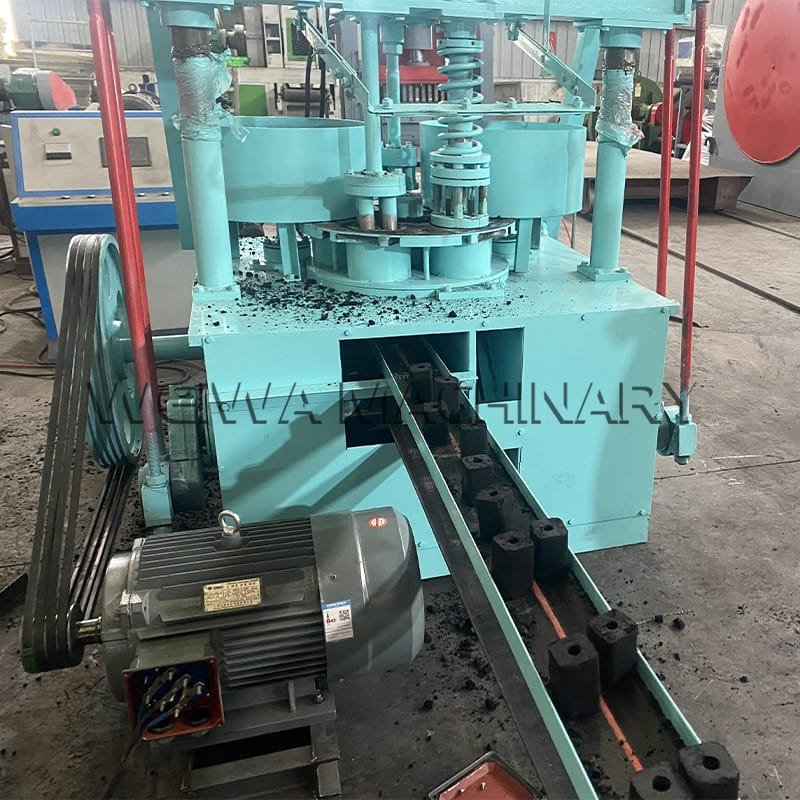
When a long-term business partner from Cote d’Ivoire (Ivory Coast) planned to set up a local charcoal briquette production line for household cooking fuel and small commercial heating, they requested a full factory acceptance test before shipment. As a professional manufacturer of biomass and charcoal processing equipment, Weiwa Machinery arranged an on-site style trial run of our honeycomb briquette charcoal machine, also known in the industry as a coal briquettes making machine or honeycomb punching machine.
Why Cote d’Ivoire Clients Choose the Honeycomb Briquette Charcoal Machine?
In West Africa, especially in Abidjan and Yamoussoukro, urban households and street food vendors rely heavily on charcoal as daily cooking fuel. Loose charcoal powder is difficult to store, dusty to transport, and burns inefficiently. The honeycomb briquette charcoal machine in Cote d’Ivoire market is gaining traction because it converts waste charcoal dust and coal fines into uniform, ventilated blocks that ignite faster, burn longer, and produce less smoke than raw powder. Our Cote d’Ivoire client specifically needed a honeycomb charcoal coal briquette forming machine capable of processing both coconut shell charcoal powder and local anthracite coal dust, with easy mold changeover to produce different diameters for domestic and institutional use.
What Is a Honeycomb Briquette Charcoal Machine?
A honeycomb briquette charcoal machine is a cold-pressing mechanical device designed to compress fine carbonaceous powders—charcoal powder, coal dust, coke powder or biomass carbon—into dense cylindrical or square cakes with multiple through-holes. These holes resemble a beehive pattern, which is why the product is called a honeycomb briquette. Unlike extrusion briquetters that push material through a heated die, the honeycomb punching machine uses a vertical stamping or rotary-table punching system to form each piece under high pressure inside a mold cavity. No external heating is required during shaping, which makes the coal briquettes making machine energy-efficient and suitable for regions with unstable power supply when paired with a voltage stabilizer.
Main Components of the Honeycomb Charcoal Coal Briquette Forming Machine
The typical honeycomb charcoal coal briquette forming machine from Weiwa Machinery consists of five major assemblies. The machine base and frame provide structural rigidity to absorb punching impact. The transmission part includes an electric motor, V-belt pulley, reduction gearbox and crankshaft that convert rotary motion into reciprocating punch movement. The feeding assembly has a hopper with an internal agitator to keep material flowing evenly into the mold barrel. The stamping unit contains the punch head, guide columns, spring return mechanism and mold sleeve that define the briquette shape, diameter, height and number of holes. The discharge section uses a conveyor belt or manual collection tray to remove finished briquettes from the working area. All contact parts are made of wear-resistant alloy steel to extend service life when processing abrasive charcoal and coal powders.
Raw Material Preparation Before the Trial Run
For the Cote d’Ivoire customer trial, we simulated the material conditions expected at their site. Charcoal derived from hardwood was crushed to pass a three-millimeter sieve and mixed with a small portion of local coal fines. Moisture content was adjusted to between eight and twelve percent, which is the optimal range for a honeycomb briquette charcoal machine. A natural starch-based binder was dissolved in water and blended into the powder mixture until the mass exhibited slight cohesiveness but was not overly wet. Proper mixing is critical—if particles are too coarse or moisture is too high, the coal briquettes making machine may produce soft or cracked briquettes; if too dry, the briquette will lack sufficient green strength after ejection.
Factory Trial Procedure for the Cote d’Ivoire Client
Before inviting the Cote d’Ivoire representative to witness the test, our technicians calibrated the honeycomb punching machine using the selected mold—one hundred twenty millimeters in diameter with sixteen ventilation holes, which matches the most common stove size in Ivory Coast. The pre-mixed material was loaded into the hopper of the honeycomb briquette charcoal machine. With the main switch engaged, the rotary table indexed stepwise, the punch descended to compress material inside the mold cavity, then retracted to allow the next cavity to align. Finished briquettes were ejected onto the discharge chute and collected for inspection.
During the formal demonstration attended by the Cote d’Ivoire client via live video link and later by their authorized agent in our workshop, we ran three consecutive batches totaling more than five hundred pieces. The coal briquettes making machine maintained stable stroke frequency at forty to forty-five strokes per minute. No jamming occurred even when we deliberately varied the binder ratio within a reasonable range. The customer特别关注 the surface finish around the honeycomb holes, as poorly formed holes can restrict airflow during combustion and cause incomplete burning. Our honeycomb charcoal coal briquette forming machine produced clean, sharp-edged holes without burrs or partial closure.
Sample Display and Physical Quality Analysis
After the trial run, random samples were taken from the production batch for detailed measurement. The average diameter matched the mold specification with negligible deviation. Height variation among pieces was within two millimeters. Compressive strength testing showed that the briquettes could withstand a drop from adult waist height onto a concrete floor without fracturing—a key requirement for transport over rough roads in Cote d’Ivoire. Density was measured at approximately one point one eight grams per cubic centimeter, which falls within the recommended range for good burn duration while remaining economical on binder usage.
To further demonstrate performance, we conducted a controlled ignition test using a simple clay stove. The honeycomb briquettes lit within four minutes when started with a small amount of kindling, and the flame propagated evenly through all ventilation holes. Once fully ignited, the briquettes burned steadily for more than eighty minutes, emitting noticeably less visible smoke compared to loosely packed charcoal powder. These results satisfied the Cote d’Ivoire client’s evaluation criteria and confirmed that the honeycomb briquette charcoal machine in Cote d’Ivoire applications would deliver reliable end-user satisfaction.

Customization Options Observed During the Trial
Although the demonstration focused on one standard size, the same honeycomb briquette charcoal machine supports quick mold replacement to produce diameters from one hundred to two hundred twenty millimeters, with hole counts of twelve, sixteen, nineteen or twenty-one depending on the mold. Square and hexagonal cross-sections are also available upon request. For the African market, we often equip the coal briquettes making machine with a locally labeled control panel, overload protection relay, and optional diesel-engine drive in case the customer’s facility lacks three-phase electricity. Such flexibility is one reason why Weiwa’s honeycomb punching machine models have been exported to Ghana, Nigeria, Ethiopia, Congo and Cote d’Ivoire.
Workflow Summary for Operating the Honeycomb Charcoal Coal Briquette Forming Machine
Operators who will run the honeycomb briquette charcoal machine in Cote d’Ivoire can follow a straightforward daily routine. First, screen raw charcoal or coal powder to remove oversized particles and foreign debris. Second, blend the powder with binder solution in a wheel mixer or forced mixer until uniform. Third, adjust the hopper gate opening to regulate feed volume. Fourth, start the coal briquettes making machine and observe the first few cycles to confirm proper filling of the mold cavity. Fifth, collect finished briquettes on a flat curing area and allow them to air-dry for several hours before packing or stacking. Routine maintenance involves greasing the guide columns weekly, checking V-belt tension monthly, and inspecting the punch head and mold sleeve for wear every six months depending on throughput.
Why Choose Weiwa Machinery Honeycomb Briquette Charcoal Machine?
Weiwa Machinery has more than twenty years of experience manufacturing charcoal and biomass processing lines, including horizontal carbonization furnaces, continuous carbonizers, crushers, mixers, dryers and honeycomb briquette charcoal machines. Every honeycomb charcoal coal briquette forming machine undergoes a no-load test and a load trial—exactly like the one described above for our Cote d’Ivoire partner—before leaving the factory. We provide operation manuals, spare parts lists, remote video guidance and can dispatch engineers for on-site commissioning when required. Whether you need a single coal briquettes making machine or a complete briquette production line, our team helps you select the right model, customize molds for your local market, and formulate suitable binder recipes for your raw materials.
If you are looking for a proven honeycomb briquette charcoal machine in Cote d’Ivoire or want to see a live trial of our honeycomb punching machine with your own material samples, feel free to contact us:
Weiwa Machinery (Henan Weiwa Machinery Equipment Co., Ltd.)
Mob / WhatsApp: +86 138 3809 3177
E-Mail: info@cjlmachinegroup.com


 Wechat

 +8615937143060
