


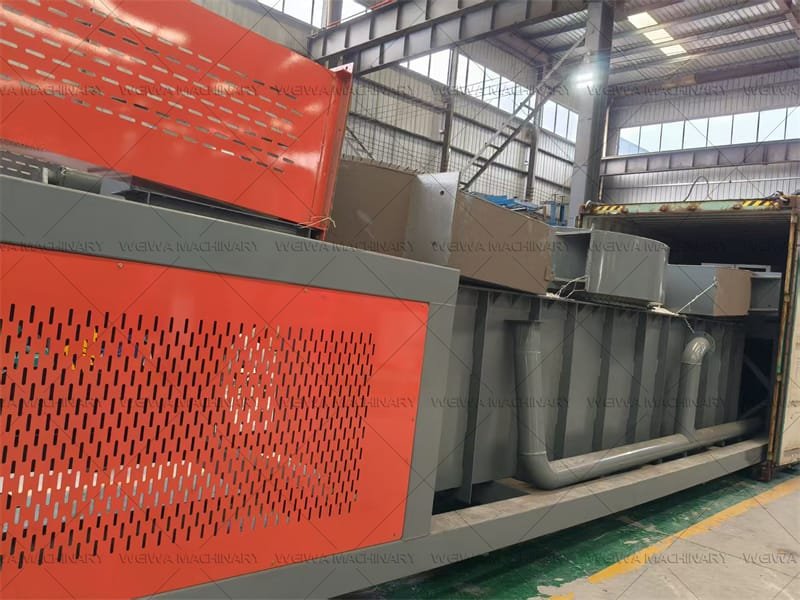
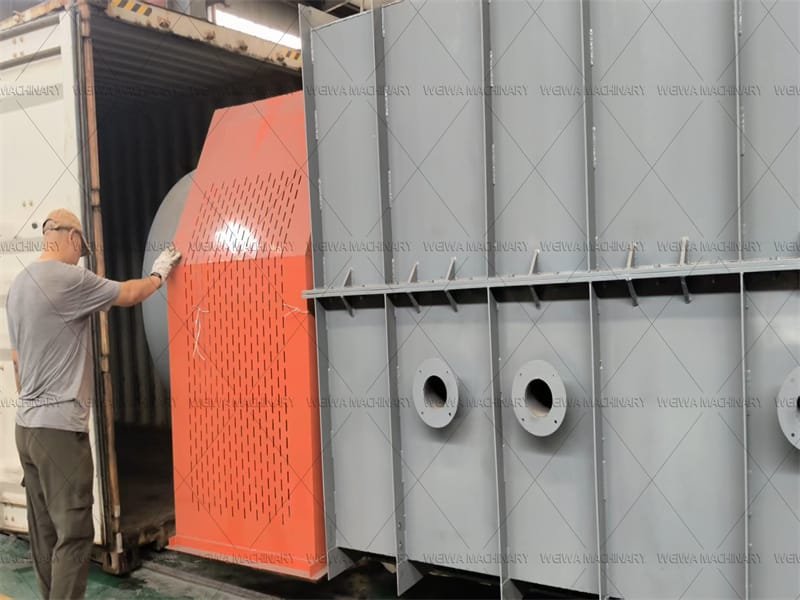
Early this morning, under a clear sky at our production base, the loading of a brand-new continuous carbonization furnace destined for Malaysia was completed. The furnace, securely fastened inside a 40-foot high-cube container, marks another milestone in Weiwa Machinery’s long-standing commitment to delivering advanced pyrolysis and carbonization solutions across Southeast Asia. For Malaysia, where agricultural biomass and organic waste volumes continue to grow, this shipment represents more than industrial equipment—it signals a practical step toward cleaner production, higher-value byproducts, and measurable progress in biochar adoption.
Shipment Site Observations and Equipment Overview
The loading process began before sunrise. Forklifts moved steadily between the assembly workshop and the container yard, while our technical team conducted final inspections on every component of the continuous carbonization furnace. From the feeding system and carbonization host to the condensation and exhaust gas recovery units, each module was checked against our internal quality protocol. Special attention was paid to sealing performance, as air leakage during carbonization directly affects both yield and product quality.
This particular continuous carbonization furnace for Malaysia has been customized to handle a mixed feedstock profile common in tropical regions, including palm kernel shells, coconut shells, and selected woody biomass. The design incorporates an indirect heating structure to ensure stable temperature control and reduce oxygen exposure during pyrolysis. A multi-stage cooling system allows biochar discharge at safe temperatures without compromising carbon content. These features align with what Malaysian operators typically request when sourcing a continuous carbonization furnace for sale that can perform reliably under high-humidity conditions.
Throughout the shipment preparation, our export documentation team coordinated closely with freight forwarders to streamline customs clearance. Commercial invoices, packing lists, and certificates of origin were prepared in parallel with equipment inspection reports. This level of coordination reduces lead time and helps customers start installation sooner after arrival. For businesses evaluating continuous carbonization furnace price, such logistical efficiency often translates into lower total cost of ownership.
Biochar Challenges and Opportunities in Malaysia
Malaysia generates substantial quantities of agricultural residues annually. Palm oil mills alone produce millions of tons of empty fruit bunches, fibers, and shells. While some of these materials are used for boiler fuel, a significant portion remains underutilized or is openly burned, contributing to air pollution and greenhouse gas emissions. Against this backdrop, biochar has emerged as a compelling solution, supported by both environmental policy and private-sector sustainability goals.
One of the core issues facing biochar development in Malaysia is consistency. Small-scale batch carbonization systems often deliver uneven charcoal quality, limiting acceptance among premium buyers such as organic fertilizer producers and soil amendment suppliers. A continuous carbonization furnace addresses this gap by maintaining steady operating parameters, which results in uniform particle structure, predictable fixed carbon levels, and reduced volatile matter. As awareness grows regarding the role of biochar in improving soil water retention and nutrient availability, demand for consistent, scalable production systems continues to rise.
Another challenge lies in emission control. Traditional earth kilns and rudimentary retorts release smoke and tar without effective treatment. In contrast, modern continuous carbonization furnaces integrate flue gas purification and heat recovery mechanisms. These systems recycle combustible gases back into the combustion chamber, lowering external fuel consumption and minimizing visible emissions. For Malaysian plantations and agro-processing hubs seeking to meet ESG standards, such technological upgrades are increasingly viewed as necessary rather than optional.
Economic considerations also shape biochar adoption. The continuous carbonization furnace price must be weighed against the value of the end products. High-quality biochar commands better pricing in horticulture, animal husbandry, and even niche applications such as activated carbon precursors. When the furnace operates continuously with minimal downtime, the payback period becomes more attractive to investors. This economic logic underpins much of the current interest in continuous carbonization furnace for sale across the region.
Technical Advantages Supporting Market Expansion
Weiwa Machinery’s continuous carbonization furnace is engineered to meet the practical demands of tropical markets. The feeding system uses a sealed screw conveyor capable of handling materials with moisture content up to 25 percent without frequent clogging. Inside the carbonization chamber, a specially designed rotating drum ensures thorough material turnover, preventing local overheating and promoting uniform pyrolysis. Temperature sensors placed along the length of the furnace transmit real-time data to a centralized control cabinet, allowing operators to fine-tune heating intensity based on feedstock characteristics.
Energy efficiency remains a key selling point. By recovering and reusing syngas generated during carbonization, the system reduces dependency on external fuels such as diesel or natural gas. In Malaysia, where energy costs fluctuate, this self-sustaining feature improves operational stability. Additionally, the modular design simplifies future capacity expansion. Customers who initially purchase a single unit can later add parallel lines without redesigning the entire plant layout.
Safety features are embedded throughout the system. Pressure relief valves, emergency shutdown interlocks, and insulated outer panels protect personnel and equipment. These aspects are especially relevant for overseas installations, where local safety regulations may differ from Chinese standards. Our technical team prepares detailed operation manuals and provides remote guidance prior to on-site commissioning. Once the equipment arrives, engineers from Weiwa Machinery can travel to Malaysia to supervise installation, train staff, and optimize process parameters based on actual feedstock samples.
Market Outlook for Continuous Carbonization Furnace in Malaysia
The trajectory for continuous carbonization furnace adoption in Malaysia appears strongly positive. Government initiatives promoting circular economy practices encourage the conversion of agricultural waste into value-added products. Several state-level programs offer incentives for biomass utilization projects, indirectly supporting investments in modern carbonization infrastructure. At the same time, multinational corporations operating in Malaysia have set ambitious net-zero targets, creating internal demand for biochar as both a soil enhancer and a carbon sequestration tool.
Geographically, Malaysia’s distribution of palm oil plantations, rubber estates, and coconut groves creates multiple entry points for equipment deployment. Sabah and Sarawak, with their extensive forested areas and biomass resources, present opportunities for large-scale installations. Meanwhile, smaller continuous carbonization furnace units are well suited to cooperative-based models in Peninsular Malaysia, where clusters of smallholders seek shared processing facilities. This regional diversity supports a tiered market strategy, ranging from compact systems to high-capacity plants.
From a competitive standpoint, buyers are becoming more discerning. Price remains important, but long-term reliability and after-sales support increasingly influence purchasing decisions. Companies that can demonstrate proven case studies, provide responsive technical assistance, and maintain spare parts availability tend to win repeat orders. Weiwa Machinery’s three-decade history and established presence in Southeast Asia position us favorably in this evolving landscape. As more Malaysian entrepreneurs recognize the strategic value of owning a continuous carbonization furnace, inquiries about continuous carbonization furnace price and customization options are expected to grow steadily.
Environmental compliance will likely become stricter over the next five years. Anticipating this trend, forward-looking operators are already transitioning away from outdated carbonization methods. A continuous carbonization furnace aligns with upcoming regulatory expectations by offering measurable reductions in particulate emissions and improved thermal efficiency. This alignment reduces regulatory risk and enhances corporate reputation, both critical factors for long-term business viability.
Field Insights from the Loading Process
During the final hours before container sealing, several details stood out. The anti-vibration pads installed beneath the mainframe drew praise from our logistics supervisor, who noted that such measures significantly reduce the risk of structural fatigue during ocean transport. Stainless steel nameplates engraved with equipment specifications and safety warnings were affixed to prominent locations, ensuring clarity for port inspectors and end users alike. Each electrical cabinet was wrapped in moisture-proof film, a precaution particularly relevant for shipments to humid climates like Malaysia.
Our project manager took the opportunity to walk through startup procedures with the customer’s representative via video call. Topics included preheating protocols, feedstock pre-drying recommendations, and routine maintenance intervals. This proactive communication reflects Weiwa Machinery’s emphasis on partnership rather than simple transactional sales. By the time the continuous carbonization furnace reaches Malaysia, the client team will already be familiar with key operational concepts, accelerating the transition from delivery to production.
Observing the container doors close, it became evident how far the industry has progressed since the early days of intermittent kilns. Today’s continuous carbonization furnace embodies precision engineering, environmental responsibility, and economic pragmatism. For Malaysia, embracing this technology means converting liabilities—agricultural waste and emissions—into assets: biochar, renewable energy, and enhanced soil productivity.
Broader Implications for Sustainable Development
Beyond immediate commercial benefits, the deployment of continuous carbonization furnaces contributes to broader sustainability objectives. Biochar applied to degraded soils can improve fertility while sequestering carbon for centuries. In a country like Malaysia, where land use intensity is high and climate resilience is a national priority, such co-benefits resonate strongly with policymakers and civil society. Furthermore, substituting fossil fuel-derived products with bio-based alternatives supports global decarbonization efforts.
Supply chain dynamics also shift positively. Instead of exporting raw biomass at low margins, local enterprises can process materials domestically, retain value, and create skilled jobs. Maintenance technicians, machine operators, and quality control specialists all form part of the ecosystem surrounding a continuous carbonization furnace installation. Over time, these human capital gains reinforce industrial capability and reduce reliance on imported technologies.
It is worth noting that technology transfer does not end with equipment delivery. Weiwa Machinery encourages knowledge exchange through training sessions, technical seminars, and collaborative problem-solving. Such engagement helps Malaysian partners adapt processes to local conditions, whether that involves adjusting residence time for different feedstocks or optimizing cooling rates to achieve specific biochar characteristics. This adaptive approach strengthens the case for investing in a continuous carbonization furnace for Malaysia’s unique agricultural context.
Preparing for Arrival and Commissioning
Once the vessel departs, attention turns to pre-arrival preparations. The customer is advised to prepare a level concrete foundation capable of supporting the furnace weight during operation. Electrical supply lines should be installed according to the specifications outlined in the pre-shipment documentation. Adequate drainage around the plant site prevents water accumulation near electrical components. Our team will review site readiness photographs sent by the client prior to dispatching engineers for on-site support.
Commissioning typically begins with a dry run to verify mechanical movement and control system responsiveness. Following successful dry testing, a gradual introduction of biomass allows fine-tuning of temperature profiles and residence times. Throughout this phase, data logging helps establish baseline performance metrics. Within two weeks of arrival, most clients achieve stable output meeting their target specifications. Continuous carbonization furnace price considerations often factor in this rapid ramp-up capability, which minimizes lost production time.
Spare parts kits accompanying the shipment include critical wear components such as seals, bearings, and heating elements. Having these items on hand shortens repair cycles and avoids extended downtime. For customers concerned about ongoing support, Weiwa Machinery maintains regional inventories and can dispatch replacements quickly. This logistical backbone reinforces confidence in choosing a continuous carbonization furnace for sale from an experienced manufacturer.
Long-Term Value Creation
Investing in a continuous carbonization furnace extends beyond acquiring hardware. It involves entering a relationship centered on continuous improvement. Regular performance reviews, process optimizations, and technology updates ensure that the equipment evolves alongside market requirements. As new applications for biochar emerge—ranging from construction materials to water filtration media—the flexibility of the furnace design allows adaptation without complete replacement.
Financially, the combination of biochar sales, potential carbon credit revenues, and waste disposal savings creates multiple income streams. In Malaysia, where agricultural profitability faces pressure from fluctuating commodity prices, diversified revenue models enhance resilience. A well-operated continuous carbonization furnace can therefore serve as both a cost center reducer and a profit center builder.
Looking further ahead, integration with other biomass conversion technologies offers intriguing possibilities. Co-locating a continuous carbonization furnace with briquetting machines, pellet mills, or activated carbon production lines creates synergistic efficiencies. Shared utilities, unified feedstock handling, and consolidated labor pools amplify returns on investment. Forward-thinking Malaysian entrepreneurs are already exploring such integrated models, positioning themselves at the forefront of the bioeconomy.
Closing Perspective from Weiwa Machinery
This shipment to Malaysia encapsulates many of the strengths Weiwa Machinery brings to international markets. Established in 1990, we have accumulated over thirty years of expertise in designing, manufacturing, and deploying carbonization systems worldwide. Our technical team combines deep theoretical knowledge with hands-on field experience, enabling us to address complex challenges from feedstock variability to emission compliance. Crucially, we do not stop at delivery; our engineers routinely travel to customer sites to guide installation, troubleshoot issues, and transfer operational know-how.
As the container carrying this continuous carbonization furnace makes its way across the South China Sea, we remain focused on the success of our Malaysian partner. Their achievement in turning biomass into valuable biochar will serve as a reference point for others considering similar investments. For companies evaluating continuous carbonization furnace price or comparing suppliers, the real measure lies not in brochure claims but in sustained performance under real-world conditions.
We invite interested parties across Malaysia and Southeast Asia to explore how a continuous carbonization furnace can transform waste streams into economic and environmental assets. Whether you operate a palm oil mill, manage a plantation, or specialize in biochar trading, Weiwa Machinery stands ready to support your ambitions with proven technology and dependable service.
About Weiwa Machinery
Weiwa Machinery was founded in 1990 and has grown into a leading manufacturer in the carbonization and biomass processing industry. With more than thirty years of experience, we combine mature technology with continuous innovation to deliver reliable equipment for global markets. Our technical team provides comprehensive support, including overseas on-site installation guidance, operator training, and long-term maintenance services. We are committed to helping customers convert agricultural and forestry waste into high-value products efficiently and sustainably.
Contact Us
Mob: +8613838093177
WhatsApp: +8613838093177
Email: info@cjlmachinegroup.com


 Wechat

 +8615937143060
