


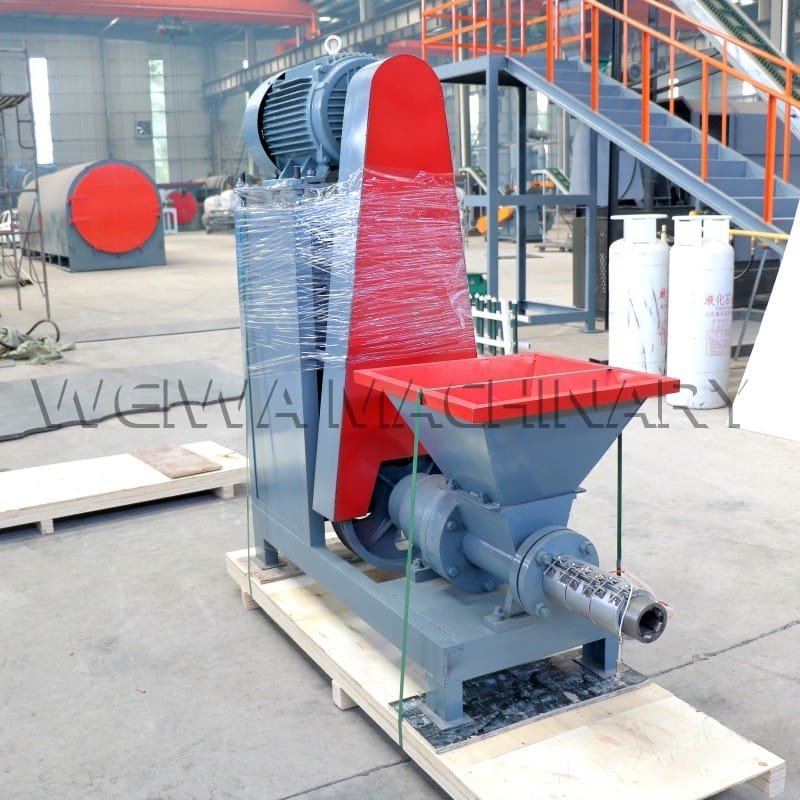
In the heart of West Africa, Ghana stands as a nation rich in natural resources and cultural vitality. Yet, like many developing regions, it faces challenges in securing sustainable, affordable energy sources. At Weiwa Machinery, we believe technology can bridge this gap—and our recent shipment of biomass briquette machines to Ghana is a testament to that mission. This blog takes you to the bustling delivery site, unpacks the science of biomass charcoal production, and explores how our sawdust extruder and briquetting solutions are poised to transform Ghana’s energy landscape.
The Journey Begins Weiwa Machinery Ships Biomass Solutions to Ghana
The sun rose early over the port as our team prepared for a milestone moment: loading a full set of biomass briquette machines bound for Ghana. Crates marked with “Weiwa Machinery – Powering Sustainable Energy” lined the dock, each containing precision-engineered equipment—from sawdust extruders to biomass briquetting machines—designed to turn agricultural waste into clean, efficient fuel. For weeks, our engineers had fine-tuned every component, ensuring the machinery could thrive in Ghana’s tropical climate and adapt to local raw materials like coconut husks, rice straw, and hardwood sawdust.
This shipment isn’t just about hardware; it’s about partnership. We’ve worked closely with Ghanaian entrepreneurs and community leaders to understand their needs: reducing reliance on imported charcoal, curbing deforestation, and creating income opportunities. As the containers were sealed, we knew these machines would soon become catalysts for change.
https://youtu.be/Xt4iLXaRE0w
Why Ghana Needs Biomass Briquette Machines for Charcoal Production?
To grasp the impact of our biomass briquette machine in Ghana, we must first look at the country’s energy reality. Over 60% of Ghana’s population relies on solid fuels for cooking, with traditional charcoal dominating rural and urban kitchens. But traditional charcoal production is devastating: it consumes 3–5 times more wood than sustainable methods, accelerates deforestation, and releases harmful pollutants.
Enter biomass briquettes—an eco-friendly alternative made by compressing organic waste into dense, high-calorific blocks. Unlike traditional charcoal, which requires cutting live trees, biomass briquettes use sawdust, agricultural residues, and other “waste” materials. This shift isn’t just environmental; it’s economic. Farmers can sell crop leftovers instead of burning them, and small-scale producers can run low-cost, profitable briquetting businesses.
Our biomass extruder technology is key here. By applying heat and pressure, it transforms loose sawdust into uniform briquettes that burn longer and cleaner than firewood or traditional charcoal. For Ghana, where energy poverty and environmental degradation are intertwined, this is a game-changer.
How Biomass Briquette Machines Work A Science Breakdown for Ghanaian Producers?
Understanding the mechanics of a biomass briquette machine helps demystify its potential. Let’s walk through the process, tailored to Ghana’s context.
Step 1 Collecting and Preparing Raw Materials
The first step in using a sawdust briquetting machine is sourcing feedstock. In Ghana, abundant materials include sawmill waste from timber industries, coconut shells from coastal regions, and rice husks from northern farms. These materials are dried to reduce moisture content—critical, as excess water prevents proper binding. Our machines include built-in drying guidance, but local producers often use solar dryers or simple kilns to keep costs low.
Step 2 Feeding and Extruding with the Sawdust Extruder
Once prepped, the raw material enters the sawdust extruder. Here, a screw mechanism applies immense pressure, heating the material through friction. This heat softens lignin—a natural polymer in plant cells—which acts as a binder. As pressure builds, the material is forced through a die, emerging as a compact, cylindrical briquette. Our biomass extruder is designed with adjustable dies, allowing producers to customize briquette size (ideal for Ghana’s small stoves) and density.
Step 3 Cooling and Packaging for Market
Freshly extruded briquettes are hot and soft. They cool naturally or via fans, hardening into durable blocks. Unlike traditional charcoal, which crumbles easily, these briquettes retain shape, making them easier to transport and store. In Ghana, where infrastructure can be challenging, this durability reduces losses and ensures consistent quality for buyers.
The Role of Sawdust Extruders in Scaling Ghana’s Green Charcoal Industry
A standout piece of our shipment is the sawdust extruder—a workhorse for small and medium-scale producers. In Ghana, many aspiring entrepreneurs lack access to large industrial machinery, but our compact, user-friendly extruders change that. They require minimal training to operate, run on diesel or electric power (adaptable to Ghana’s energy grid), and have low maintenance needs.
Take, for example, a typical Ghanaian village with a small sawmill. Previously, sawdust was discarded or burned, contributing to air pollution. With a sawdust extruder, the mill owner can now convert this “waste” into briquettes, selling them locally at half the price of imported charcoal. This not only cuts costs for households but also creates jobs—from collection to production to sales.
Moreover, our biomass briquette machine supports circular economy principles. By closing the loop on agricultural and forestry waste, it aligns with Ghana’s commitments under the Paris Agreement and its National Bioenergy Strategy, which aims to increase renewable energy share to 10% by 2030.
On-Site Impact What Ghana Stands to Gain From This Technology
As our team monitored the shipment’s departure, we envisioned the ripple effects in Ghana. For rural families, biomass briquettes mean less time collecting firewood and fewer respiratory illnesses from smoke. For women, who often bear the burden of cooking, cleaner stoves mean safer kitchens. For the environment, reduced tree cutting preserves biodiversity and protects watersheds.
Economically, the sector could generate thousands of jobs. A single biomass extruder unit can support 5–10 workers, from raw material suppliers to distributors. And because briquettes are cheaper than LPG or kerosene, low-income households save money—funds that can go toward education or healthcare.
We’ve already received inquiries from Ghanaian cooperatives eager to adopt the technology. One group plans to set up a community-run briquetting center, using coconut husks from nearby farms. Another aims to partner with schools, teaching students about sustainable energy while producing fuel for campus kitchens. These stories highlight the human side of our machinery: it’s not just equipment, but a tool for empowerment.
Why Choose Weiwa Machinery for Biomass Solutions in Ghana?
At Weiwa Machinery, we don’t just sell machines—we build long-term partnerships. Our biomass briquette machines are backed by a decade of R&D, tested in diverse climates from Southeast Asia to Sub-Saharan Africa. We prioritize affordability, designing equipment that delivers ROI within 12–18 months for most users.
Post-shipment, our support continues. We offer virtual training sessions, troubleshooting guides in local languages, and spare parts supply chains to minimize downtime. For Ghana, we’ve partnered with regional technicians to provide on-the-ground assistance, ensuring smooth operations from day one.
Our focus on sustainability extends beyond machinery. We advocate for ethical sourcing, fair labor practices, and knowledge sharing—values that resonate with Ghana’s vision of inclusive growth.
About Weiwa Machinery
Founded in 1990, Weiwa Machinery has grown into a global leader in biomass processing equipment. Specializing in sawdust extruders, biomass briquette machines, and complete charcoal production lines, we serve clients in over 50 countries. Our mission is simple: empower communities to harness renewable energy, reduce waste, and build resilient economies.
With a team of engineers, agronomists, and sustainability experts, we merge innovation with practicality. Whether it’s a small-scale sawdust briquetting machine for a Ghanaian village or a large-scale plant for an industrial client, we tailor solutions to local needs. At Weiwa, we believe technology should be a force for good—and our work in Ghana is proof of that.
As the containers sailed toward Ghana, we felt pride and anticipation. Soon, those biomass briquette machines will hum to life, turning waste into wealth and smoke into opportunity. For Weiwa Machinery, this is more than a shipment—it’s a step toward a greener, fairer future, one briquette at a time.


 Wechat

 +8615937143060
