


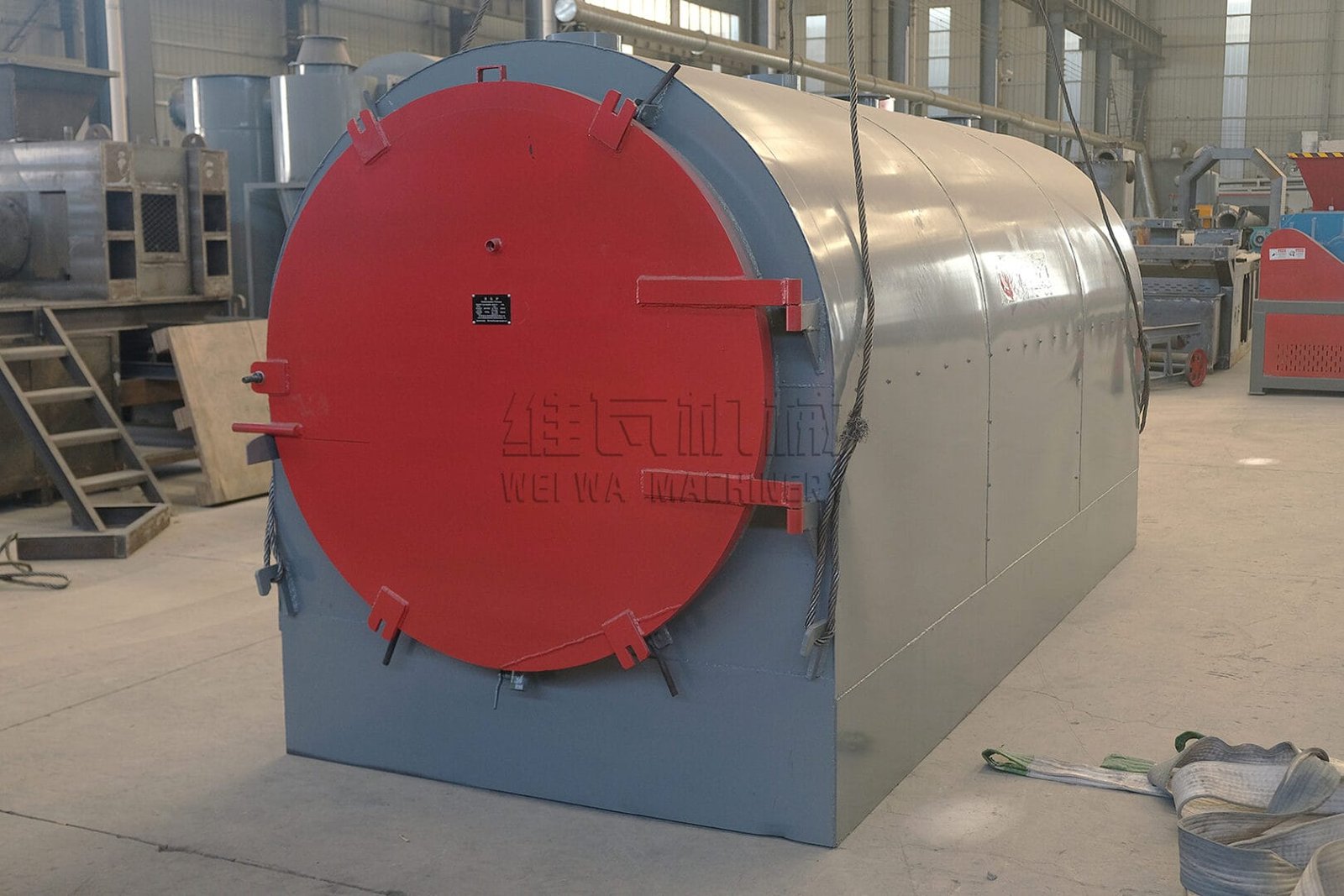
Background of the Malaysia Shipment
The Malaysian buyer operates a small-to-medium biomass yard supplying barbecue charcoal and hookah charcoal intermediaries in Selangor and Johor. Their old fixed brick kiln needed four days per batch, produced heavy smoke, and gave inconsistent charcoal hardness. They contacted Weiwa Machinery asking for a charcoal making machine for Malaysia conditions: high humidity feedstock, limited factory floor space, and strict local concern about smoke complaints from neighboring estates.
What the Malaysian Client Needed?
The shortlist was between a continuous carbonization furnace and a rail-mounted horizontal carbonization furnace. Continuous units favor sawdust and rice husk pellets. The client however had bulky input: coconut shell, palm trunk offcut, and fruit tree branches. A horizontal batch barrel furnace fit better because it accepts cart-loaded bulky biomass without pre-pelletizing.
Why a Horizontal Carbonization Furnace Instead of a Kiln?
A horizontal carbonization furnace keeps the chamber low and horizontal, mounted on rails with a trolley. Workers push the loaded cart in, seal the door, and start indirect heating. Compared with a pit kiln, it removes direct fire contact with raw material, cuts glowing ash loss, and captures flue gas instead of releasing it. For a suburban Malaysian site, that difference decides whether the plant gets a smoke complaint or a repeat order.
Inside the Weiwa Horizontal Carbonization Furnace
The shipped model was the 2.0×4.5 m barrel chamber, 8–10 t batch capacity, 3,500 kg dead weight, carbon steel outer shell with refractory inner lining. It carried the Weiwa smoke recovery kit: cyclone pre-separator, tar condenser, water scrubber, and return-gas blower feeding the burner ring.
Rail-Mounted Barrel Chamber and Cart Loading
Loading is the biggest labor saver. The trolley rolls out, workers stack coconut shell bags and wood log pieces, then push it back. No manual shoveling into a vertical shaft. In the Malaysia trial, two workers loaded one full cart in 38 minutes. A vertical kiln equivalent would have taken four people double the time.
Indirect Heating and 600 °C Heat Hold
Heat comes from a side burner firing around the barrel jacket, not inside the biomass bed. The controller ramped chamber wall temperature to 600 °C and held it. Internal biomass pyrolysis then self-generates combustible volatiles. The client measured stable 580–610 °C jacket temperature across a 14-hour hold cycle.
Gas Purification and Self-Recirculating Combustion
Pyrolysis gas leaves the barrel, passes the tar trap, drops condensate, and returns as clean flammable gas to the burner. After the first 90 minutes of LPG assist, the burner ran on recycled gas only. That is the core fuel-saving loop of the Weiwa horizontal carbonization furnace and the reason many charcoal making machine buyers in Southeast Asia switch away from diesel-heated drums.
On-Site Loading and Export Preparation
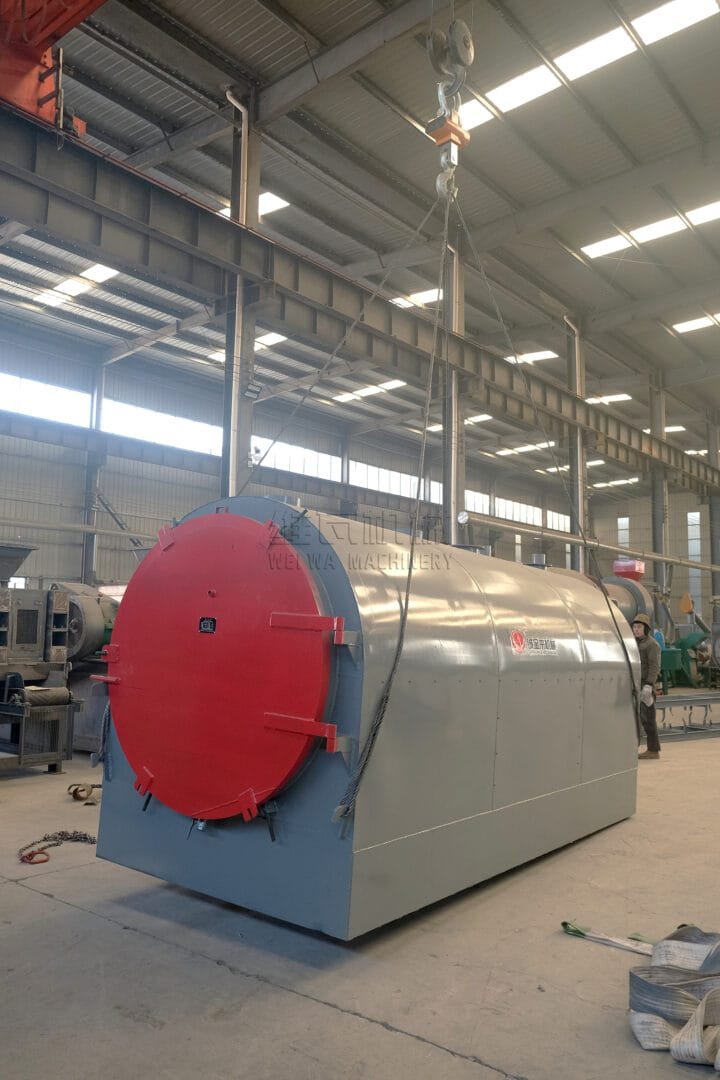
At the Weiwa Gongyi workshop, the furnace passed hydraulic door seal test, burner ignition test, and gas path pressure test. We filmed the container loading so the Malaysian team could preview unloading. Accessories packed included refractory mortar, spare door gasket, thermocouple, control panel labels in English, and a printed layout drawing scaled to the client’s 12 m × 8 m yard.
Factory Inspection Before Container Load
The client joined a live video call during inspection. We rotated the barrel, showed the rail alignment, and ignited a 10-minute flame test on the return-gas burner. They confirmed the paint, the nameplate, and the model code matched the proforma invoice.
Spare Parts and Manuals Packed for Malaysia
Every export unit ships with one spare thermocouple, one burner nozzle, door seal strip, and a tool bag. The manual covers coconut shell, wood log, bamboo, and sawdust briquette cycles. All electrical terms use IEC names so local Malaysian electricians can wire the panel without guessing.
Trial Run Results in Malaysia
The client ran three batches in the first week. Batch one was coconut shell at 22% moisture. Batch two was mixed hardwood log at 18% moisture. Batch three was 70% coconut shell plus 30% oil palm empty fruit bunch stalk.
Coconut Shell and Wood Log Carbonization Data
Coconut shell batch loaded 7.6 t wet, yielded 2.35 t charcoal, giving 30.9% mass retention. Hardwood log batch loaded 8.1 t wet, yielded 2.51 t charcoal, 31.0% retention. These numbers sit in the normal 28–33% range for Weiwa horizontal carbonization furnace field runs in humid climates.
Charcoal Yield and Fixed Carbon Observation
The client knocked samples and reported dense fracture, low powder rate, and metallic sound on impact. A local lab sheet later showed fixed carbon around 68–72% on coconut shell charcoal, which matches shisha-grade demand in the Malaysia and Middle East resale chain. The horizontal carbonization furnace did not over-burn the shell edges because indirect heat avoids hot spots.
Fuel Saving from Recycled Flue Gas
LPG assist ran only for the first 80–95 minutes depending on morning ambient temperature. After that, return gas covered the burner. The client estimated 62% reduction in external fuel cost versus their previous diesel drum kiln. Over a 26-day monthly schedule, that saving alone covered a meaningful slice of labor cost.
Horizontal Carbonization Furnace in Malaysia Market Context
Malaysia produces coconut shell in large volume in Malacca and Negeri Sembilan, bamboo in Pahang, and sawmill offcut in every state with plywood clusters. Many small plants still run earth kilns. The shift toward a horizontal carbonization furnace in Malaysia market is driven by three forces: estate owners refusing smoke complaints, buyers asking for consistent fixed carbon, and freight-friendly compact footprint for rental yards.
Biomass Waste Profile Across Malaysian States
Selangor and Penang buyers often start with coconut shell imported from neighbor states. Johor and Melaka have steady coconut husk and shell supply. Sabah and Sarawak add hardwood offcut and rubber wood stump. A single charcoal making machine for Malaysia must handle this mix without changing the main chamber. The Weiwa horizontal barrel does that because cart loading accepts both bulky shell and cut log.
Charcoal Making Machine for Malaysia Buying Criteria
Through inquiry records from 2024–2026, Malaysian buyers repeatedly ask five questions. Can it take coconut shell without crushing? Does it smoke? How fast is one batch? Can local workers run it after one day training? What is the real charcoal making machine price including sea freight to Port Klang? The horizontal carbonization furnace answers all five with a yes, a no, a 16–20 hour cycle, a one-day handover, and a clear FOB-plus-freight quote from Weiwa.
How Weiwa Supports Malaysian Charcoal Producers?
Weiwa Machinery is not a trading company. The furnace, the burner, the gas pipe, and the control box are built inside our own workshop. That matters for Malaysian buyers because when a solenoid or thermocouple fails, they get the exact part number from the manual and either import it or ask us to courier it.
Layout Drawing and Operator Training
Before shipment we sent a CAD layout showing furnace position, trolley swing radius, water scrubber outlet, and burner LPG inlet. After arrival the client received a 40-minute video call training covering door seal check, first ignition, gas return valve opening sequence, and emergency shutoff. No engineer flight was required for this unit.
After-Sales Response and Spare Part Channel
Whatsapp support runs on the same line as sales so the Malaysia client does not re-explain the machine. Spare part parcels to Kuala Lumpur normally move in 4–6 days via DHL. For common wear items we keep stock matching the 1.0×1.5, 1.5×3.0, 2.0×4.5, and 2.0×6.0 models.
Final Verdict on the Shipment
The horizontal carbonization furnace shipped to Malaysia left the Weiwa workshop as a standard model and returned field proof that it fits the local biomass mix. Trial runs confirmed 30%+ shell retention, self-sustaining gas combustion after warm-up, and low-smoke operation acceptable to a suburban yard. For any investor comparing a charcoal making machine for Malaysia against a brick kiln or a continuous line, the horizontal barrel furnace sits in the sweet spot of batch flexibility, space saving, and payback clarity.
Weiwa Machinery continues to refine rail alignment, door seal compression, and tar condensate recovery based on field reports like this one. The Malaysia unit is now in weekly production. New inquiries from Perak and Kedah are already referencing this shipment.
About Weiwa Machinery
Henan Weiwa Machinery Manufacturing Co., Ltd. designs and builds briquette machines, carbonization furnaces, and full charcoal production lines. The horizontal carbonization furnace is one of our most exported batch models, serving clients in Malaysia, Indonesia, Nigeria, Chile, and Eastern Europe. We work directly from the factory, supply layout drawings, train operators remotely, and ship in 20 ft or 40 ft containers.
Contact Weiwa Machinery:
Mob / Whatsapp: +8613838093177
Email: info@cjlmachinegroup.com
Product reference: https://cjljx.com/products/tanhua/horizontal-carbonization-furnace


 Wechat

 +8615937143060
