


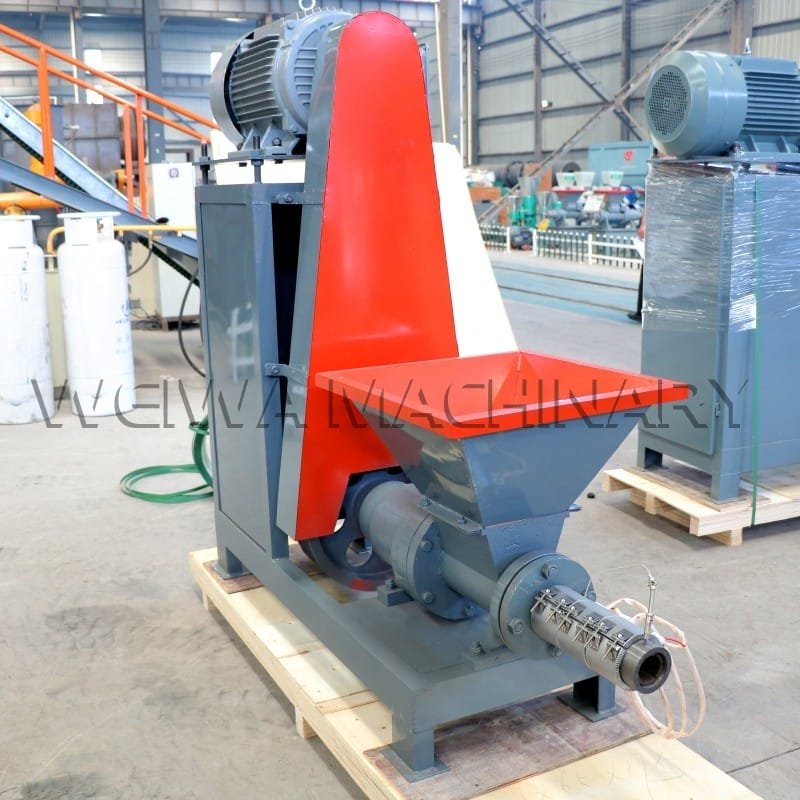
Bhutan has abundant forestry resources, active sawmills, and a growing need for alternatives to traditional firewood. A biomass briquette machine helps local producers compress loose biomass into uniform rods, reduce transport volume, and create feedstock for machine-made charcoal. The sawdust briquetting machine shipped in this project is designed for stable operation under variable moisture conditions, mixed feedstock, and the practical limitations of Himalayan logistics.
Why Bhutan Needs a Biomass Briquette Machine?
Bhutan maintains high forest coverage and a strong agro-forestry tradition, but that abundance also creates large volumes of underused residue. Sawmills around Phuentsholing, Paro and Samdrup Jongkhar generate sawdust, planer shavings and offcut blocks. Farmers in Punakha and Wangdue Phodrang collect rice husk, maize stalk and mustard stem. Cardamom processors and fruit orchards add further woody waste streams.
Without a biomass briquette machine in Bhutan, much of this material is burned openly, dumped, or left to decay. Open burning releases smoke and fine particles, while decaying biomass emits methane. A sawdust briquetting machine changes the equation by turning low-value residue into dense, storable, combustible rods that can later be carbonized into charcoal.
For hotels, bakeries, restaurants, poultry farms and rural households, machine-made charcoal offers longer burn time, lower smoke, easier stacking and better calorific consistency than split firewood. A biomass extruder does not require one fixed raw material. It requires particle-size control, moisture discipline and a reliable screw-forming system.
What Weiwa Loaded for the Bhutan Charcoal Project?
The Bhutan order included a complete pre-carbonization and charcoal preparation line. Weiwa configured the system around the client’s local raw material profile rather than forcing the client to adapt material to a standard machine.
Crushing and Drying Stage
A wood crusher reduces branches, offcuts, bamboo and wood chips into smaller particles. The target feed size is usually below 5 mm, because oversized particles increase screw wear and reduce forming stability. After crushing, an airflow or rotary dryer brings moisture down to the safe briquetting range. For a sawdust extruder, moisture control is not a minor detail. It determines whether the machine produces smooth rods or weak, cracked briquettes.
Sawdust Extruder as the Core Machine
The heart of the line is the sawdust extruder. Dried biomass enters the hopper, passes through the feeding zone, and is pushed forward by a high-strength screw shaft. The heating ring raises the forming temperature, softening natural lignin inside the wood fiber. Under high pressure, lignin acts as a natural binder, so no chemical adhesive is required.
The biomass extruder discharges continuous rods with a hollow center. Common shapes include hexagonal, square and round profiles. Diameter can be configured from around 45 mm to 80 mm depending on mold selection and local market preference. These semi-finished briquettes are strong enough for handling, stacking and transport, yet porous enough for efficient carbonization.
How the Charcoal Production Line Works in Bhutan?
Charcoal production from biomass is essentially a two-stage energy upgrade. The first stage is densification. The second stage is carbonization. A biomass briquette machine handles the first stage, while a carbonization furnace completes the conversion from biomass rod to fixed-carbon charcoal.
From Sawdust to Semi-Finished Briquette
Loose sawdust has low bulk density and burns poorly if used directly. After crushing and drying, the material becomes uniform and flowable. The sawdust briquetting machine compresses it into rods with much higher density. This makes storage, loading and long-distance transport far more economical on Bhutan’s winding mountain roads.
Because lignin provides natural binding, the briquette holds its shape without starch, resin or chemical binders. This is important for food-related charcoal applications, export markets and environmentally conscious buyers. The resulting biomass rod has higher energy concentration than loose sawdust and much better handling performance than raw agricultural waste.
Carbonization Turns Briquettes into Charcoal
After briquetting, the rods enter a carbonization furnace. The furnace heats the briquettes in an oxygen-limited environment. Moisture and volatile compounds are driven off, and the material gradually transforms into carbon-rich charcoal.
Proper carbonization improves calorific value, reduces smoke during final use, and creates the black, brittle, high-fixed-carbon product familiar to charcoal traders. For the Bhutan client, this means local sawdust and forestry residue can become a finished fuel product instead of waste.
Raw Materials Available in Bhutan
One reason a sawdust briquetting machine fits Bhutan well is feedstock diversity. The same production line can process several materials if particle size and moisture are managed correctly.
Sawdust from local sawmills is the most obvious feedstock. Rice husk from paddy areas adds another stream. Bamboo dust from construction and handicraft offcuts is common in South Asian biomass projects. Mustard stalk, maize stalk, tea prunings, coffee husk and fruit-tree trimmings can also be evaluated.
Coniferous wood from Bhutan’s forests contains more resin than hardwood sawdust, so screw wear and heating behavior must be monitored. Weiwa addresses this through wear-resistant screw materials, optimized compression ratio, and pre-testing of the client’s actual raw material before final machine configuration.
Why Sawdust Briquetting Machine Fits Himalayan Conditions?
Mountainous regions face three operational challenges: variable feedstock, limited transport infrastructure, and high importance of fuel density. A sawdust briquetting machine solves all three in different ways.
Variable feedstock is handled through adjustable screens, configurable molds and flexible moisture preparation. Transport limitation is addressed because densified briquettes occupy far less space than loose residue. Fuel-density requirement is met because compressed biomass rods carbonize into charcoal with higher energy content per kilogram than ordinary firewood.
A biomass extruder also supports decentralized production. Small towns, sawmill clusters and cooperative groups can run a compact line, sell semi-finished briquettes, or carbonize them locally. This keeps value inside Bhutanese communities instead of exporting raw residue and importing finished fuel.
Benefits of Biomass Extruder for Local Charcoal Making
The benefits of using a biomass extruder in Bhutan go beyond machinery specifications. The economic and environmental logic is what makes the project meaningful.
First, waste becomes fuel. Second, villages reduce dependence on imported cooking and heating fuel. Third, sawmills monetize a by-product that previously had disposal cost. Fourth, charcoal producers get uniform feedstock for carbonization, which improves yield and product grade. Fifth, machine-made charcoal burns cleaner than poorly controlled earth-kiln charcoal.
From a climate perspective, converting residue into densified fuel prevents open burning and improves combustion efficiency. From a business perspective, it creates a repeatable product that can be packaged, branded and sold to hotels, restaurants, households and regional traders.
Logistics from Weiwa Factory to Bhutan
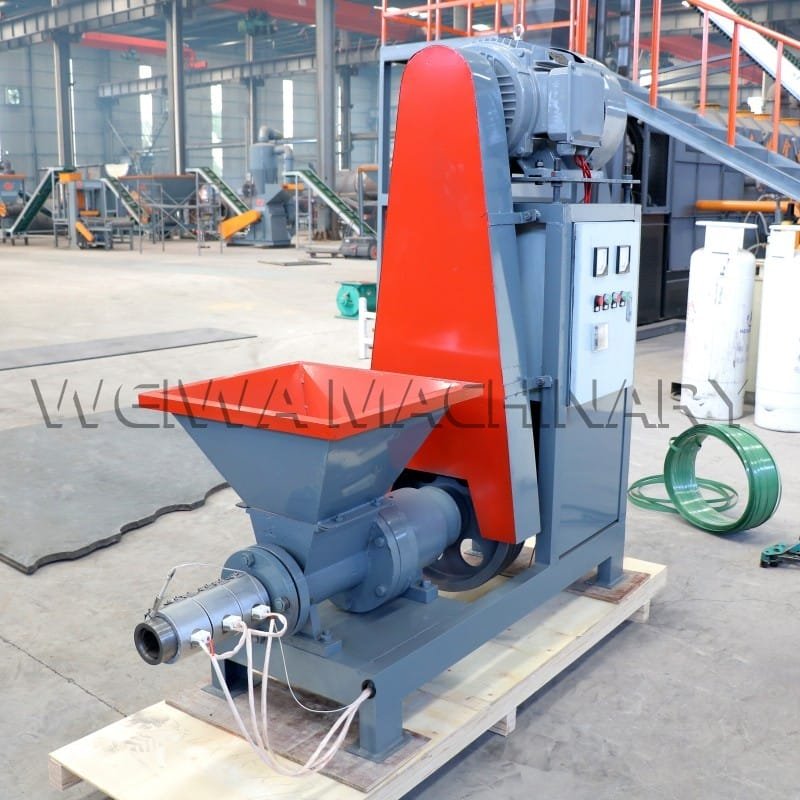
Shipping industrial machinery to a landlocked Himalayan country requires more than loading a container. Weiwa prepared export crates, phytosanitary documentation, equipment manuals, spare-parts lists and packing inspections before departure.
The charcoal line typically moves through a combination of truck, sea or rail, and final road transport to the Bhutan border. Wooden packaging is treated according to international shipping requirements. Sensitive components such as the screw shaft, heating coils and control units are protected against humidity, vibration and rough handling.
After arrival, Weiwa supports uncrating, foundation checking, belt alignment, electrical grounding and first trial run. For this Bhutan project, the client sent photos of crate condition, and Weiwa engineers guided local mechanics through commissioning by video call. The first trial batch used planer sawdust from a nearby sawmill, and the line produced uniform hexagonal rods within the first operating shift.
Why Buyers Choose Weiwa Machinery?
Weiwa Machinery is a Chinese manufacturer and exporter of biomass densification equipment, charcoal production lines, carbonization furnaces, crushers and dryers. We do not only sell machines. We design production layouts based on raw material type, moisture level, target capacity, local voltage and final charcoal application.
Our sawdust extruder range covers small portable units for pilot projects as well as industrial lines for continuous production. We keep screws, sleeves, heaters and common wear parts available for exported models. We provide pre-shipment testing, operation manuals, spare-parts drawings, and after-sales guidance in English.
For Bhutan and similar markets, documentation quality matters as much as machine quality. Border clearance, customs description, packing list accuracy and multilingual manuals directly affect delivery speed. Weiwa treats export documentation as part of the machine, not an afterthought.
Start Your Biomass Briquette Project with Weiwa
If you plan to build a charcoal production line in Bhutan, Nepal, Laos, Ethiopia, Indonesia, India or another emerging biomass market, the right starting point is raw-material analysis. Send us your material type, moisture, available quantity and target output. Weiwa will propose the correct crusher, dryer, sawdust briquetting machine, conveyor system and carbonization equipment for your site.
A biomass briquette machine in Bhutan is more than a piece of equipment. It is the front end of a local clean-energy chain that starts with sawdust and ends with high-quality charcoal. With the right sawdust extruder, local residue becomes fuel, fuel becomes business, and waste becomes value.
Contact Weiwa Machinery for a free production-line design and quotation.
Mob: +8613838093177
Whatsapp: +8613838093177
E-Mail: info@cjlmachinegroup.com


 Wechat

 +8615937143060
