


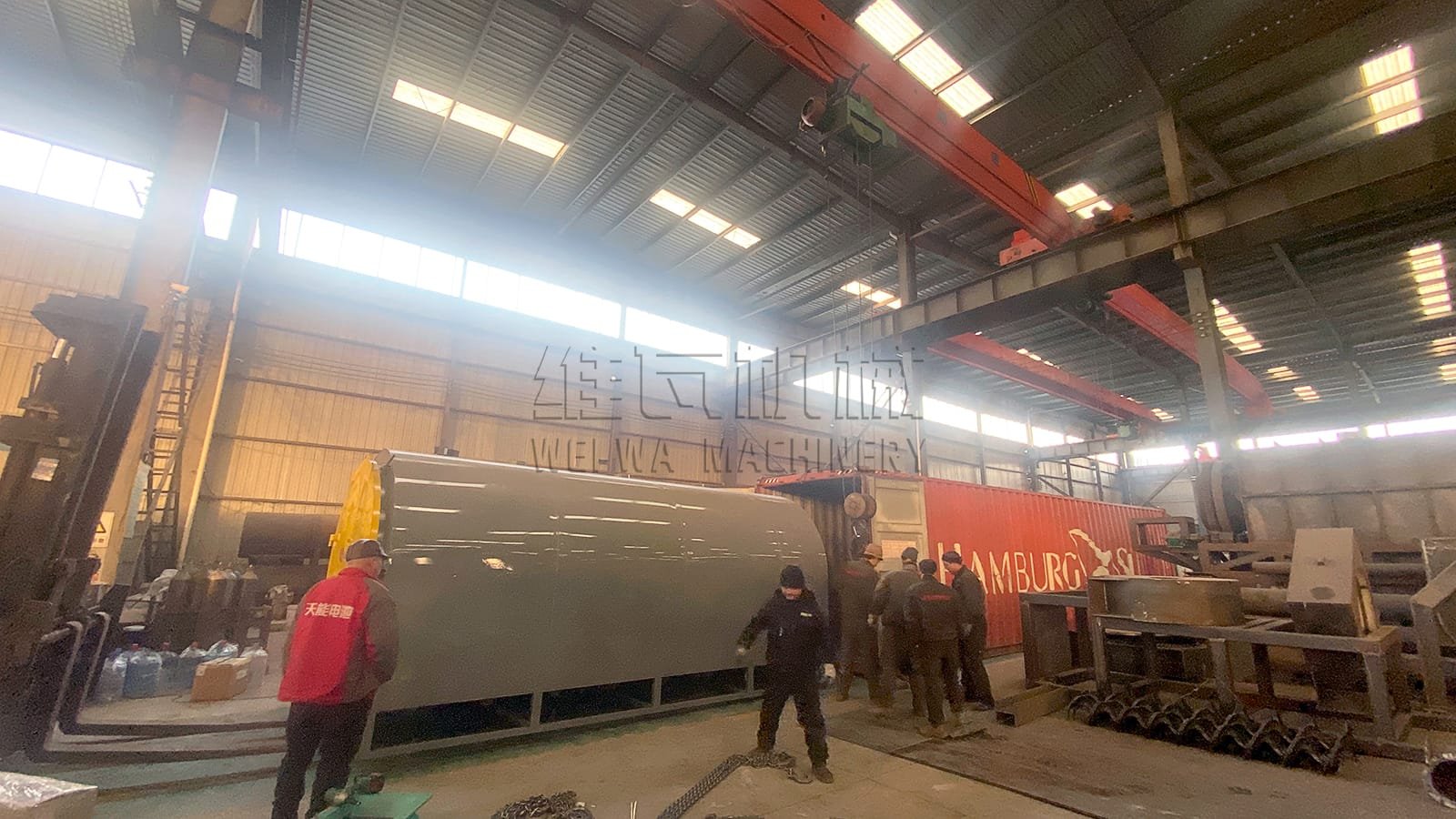
Why South African Producers Are Switching to Modern Making Charcoal Machine Systems?
South Africa has abundant forestry residues and agricultural biomass, yet many small and medium charcoal producers still rely on pit kilns or primitive brick chambers. Those old methods suffer from uneven carbonization, excessive smoke, low fixed carbon in the final product, and poor fuel efficiency. For briquette manufacturers in south africa who supply BBQ charcoal, activated carbon plants, or metallurgical reductant, inconsistent quality means lost contracts. Upgrading to a professional making charcoal machine such as a horizontal carbonization furnace allows producers to control temperature, residence time, and atmosphere inside the chamber, which directly improves charcoal density and fixed carbon percentage.
When you make charcoal from wood in a horizontal furnace, the raw material is loaded into a rotating or sliding barrel-style chamber mounted on rails. Indirect heating raises the temperature gradually to approximately 500 to 650 degrees Celsius under limited oxygen. Volatile compounds are driven off and partially combusted or recycled as combustible gas. The result is uniform pyrolysis throughout the wood log or briquette, producing high-grade charcoal with minimal ash. This process is fundamentally different from open pit burning and aligns with tightening environmental expectations in South African provinces.
Weiwa Horizontal Carbonization Furnace Design and Working Principle
Barrel Chamber and Rail Loading System
The horizontal carbonization furnace from Weiwa Machinery features a horizontally oriented carbonization chamber fabricated from high-temperature resistant steel. The chamber is installed on a rail system so that a loading cart can push the material basket in and pull it out after cooling. This design reduces manual handling and shortens the turnaround between batches. For customers looking for a charcoal making machine for sale in south africa that fits into an existing workshop without major civil works, the horizontal layout requires only a level concrete pad and standard electrical connections.
Gas Purification and Combustible Gas Recirculation
During the charcoal briquette production process, the furnace generates smoke containing tar, wood vinegar, and combustible hydrocarbons. Weiwa equipments integrate a gas purification unit that condenses tar and liquids, then routes the cleaned gas back to the burner as supplementary fuel. This closed-loop approach lowers external fuel consumption and virtually eliminates black smoke emissions. Many briquette manufacturers in south africa choose our furnace specifically for this environmental advantage as well as the reduction in daily operating cost.
Temperature Control and Automation
A centralized control panel monitors inner chamber temperature via thermocouples and adjusts the burner damper accordingly. Operators can set target carbonization temperature and duration depending on whether they make charcoal from wood logs, bamboo, or pre-pressed sawdust briquettes. Alarms notify staff of abnormal pressure or over-temperature conditions. The automation level is ideal for South African factories employing a small crew but aiming for industrial throughput.
Shipment Preparation and Export to South Africa
Prior to export, each making charcoal machine undergoes a factory test run using local-simulated raw material. We check the door seals, gas recirculation path, burner ignition, and thermometer accuracy. The furnace body is wrapped with waterproof woven cloth and secured inside a 20-foot or 40-foot container with steel bracing to prevent shifting during ocean freight. Spare parts including sealing gaskets, thermocouple probes, and burner nozzles are packed in a wooden case marked for easy identification upon arrival in Durban or Cape Town port.
Our South African client, one of the established briquette manufacturers in south africa, requested minor customization to accommodate 220-volt auxiliary circuits alongside the standard 380-volt main power. Weiwa engineers modified the control cabinet accordingly and provided a bilingual English and Afrikaans operation manual. The shipment included a link to a private video showing the loading, pre-shipment test fire, and basic startup procedure so the on-site team could familiarize themselves before the container arrived.
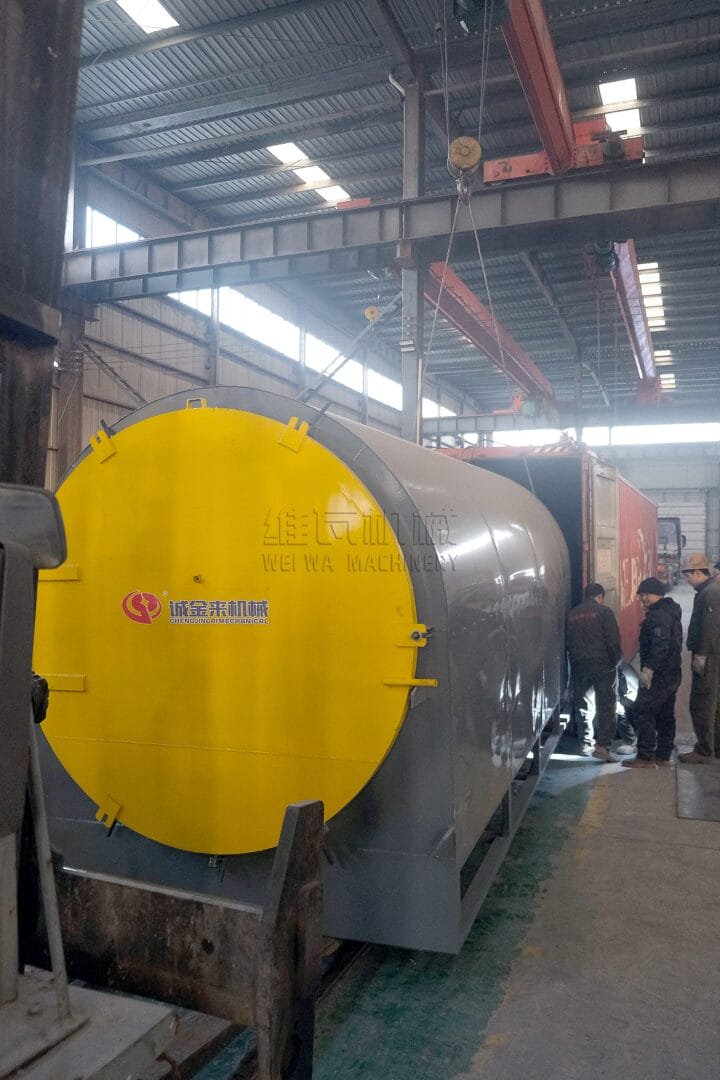
On-Site Installation and Trial Run in South Africa
After clearing customs, the horizontal carbonization furnace was positioned on the prepared foundation and connected to the customer’s existing dust-collection duct. Weiwa remote technical support joined a video call to guide local electricians through wiring verification and burner commissioning. Once the system passed leak checks, the first trial batch was scheduled using mixed hardwood logs typical of the region’s sawmill waste.
Trial Raw Material and Pre-Drying
To make charcoal from wood efficiently, raw material moisture should ideally be below 20 percent. The client air-dried the logs for several days then loaded approximately 800 kilograms into the furnace cart. The pre-drying phase raised internal temperature slowly to drive off surface moisture before the actual carbonization stage began. This staged heating protects the chamber refractory and avoids thermal shock.
Carbonization Phase and Observed Performance
During peak carbonization the furnace stabilized near 580 to 610 degrees Celsius. The gas purification system captured condensate correctly and the recycled gas visibly supported the burner flame, reducing LPG consumption by an estimated 30 to 40 percent compared to the same furnace running without gas recovery. After the programmed soak time, the batch was allowed to cool inside the sealed chamber before extraction.
The resulting charcoal exhibited a metallic ring when struck, dark lustrous fracture surface, and low residual moisture. The client measured a carbonization yield of roughly 33 to 36 percent by weight from the original dry wood, which exceeds typical earth-kiln yields in the region. Fixed carbon content tested above 70 percent, meeting the specification required by local premium BBQ charcoal wholesalers. For charcoal briquette production lines that feed crushed char into a briquetting press, this quality translates to stronger briquettes with higher calorific value.
Advantages of Horizontal Furnace for Charcoal Briquette Production in South Africa
Compared with vertical batch kilns, the horizontal design provides more even heat penetration along the length of the charge basket. This reduces under-carbonized cores in thick logs and prevents over-burning at the edges. The rail-mounted cart system also permits semi-continuous operation when a producer owns multiple baskets—one cools while the next carbonizes. For expanding briquette manufacturers in south africa, this flexibility supports gradual capacity growth without purchasing an entirely new charcoal making machine for sale in south africa.
Another consideration is raw material versatility. Besides hardwood, the same furnace can make charcoal from wood chips compressed into briquettes, coconut shells imported from neighboring ports, or bamboo stalks from smallholder plantations. Being able to process multiple feedstocks hedges against seasonal biomass shortages, a common challenge noted by several South African charcoal entrepreneurs we have spoken with.
Environmental Compliance and Smoke Reduction Benefits
Open charcoal pits emit large quantities of particulate matter and unburned volatiles. By contrast, the Weiwa horizontal carbonization furnace directs all pyrolysis gas through the purification train. Only cleaned flue gas exits the stack, and the visible smoke is negligible. This helps briquette manufacturers in south africa remain compliant with local air quality bylaws and avoid fines or forced shutdowns. In some municipalities proof of low-emission equipment can also assist in obtaining business licenses or green certification valued by downstream corporate buyers.
Comparing Traditional Kilns with a Modern Making Charcoal Machine
Traditional earth kilns may appear low-cost initially but hide significant drawbacks: lengthy carbonization cycles often exceeding 72 hours, weather dependency, unpredictable yield loss during rain, and difficulty controlling final charcoal properties. A purpose-built making charcoal machine such as the Weiwa horizontal furnace typically completes a full cycle including loading cooling and unloading in 8 to 12 hours depending on batch size and moisture. Labor requirement drops because the operator mainly sets parameters rather than tending a fire continuously. Although capital expenditure is higher, the payback period for a busy charcoal briquette production site in South Africa frequently falls within 12 to 18 months thanks to improved yield, reduced fuel purchase, and access to higher-price market segments.
Market Outlook for Charcoal Making Machine for Sale in South Africa
Demand for processed charcoal and briquettes in South Africa is buoyed by the hospitality sector, household braai culture, and industrial users such as foundries requiring carburizing agents. Imports of low-grade charcoal fluctuate with exchange rates, pushing more distributors to consider local production using efficient machinery. Search interest for charcoal making machine for sale in south africa has risen steadily, reflecting this shift. Producers who invest early in certified low-emission plants position themselves to capture both domestic and cross-border markets in the Southern African Development Community region.
Weiwa Machinery has supplied biomass carbonization and briquetting equipment to multiple African countries. Our experience indicates that the horizontal carbonization furnace strikes the right balance between throughput, footprint, and ease of maintenance for most medium-scale South African operations intending to make charcoal from wood or agricultural residues at commercial scale.
Frequently Asked Questions from South African Buyers
What capacity options are available for the horizontal carbonization furnace?
Weiwa offers models handling 500 kilograms to 3 tonnes per batch. Multiple baskets can be rotated for higher daily output. The appropriate model depends on your planned charcoal briquette production volume, available floor space, and preferred batch frequency.
Can the furnace process sawdust briquettes as well as whole wood logs?
Yes. The same chamber carbonizes pre-pressed sawdust briquettes, coconut shells, palm kernel shells, and bamboo. When processing fine biomass such as loose sawdust, we recommend slight pre-compaction or use of a mesh basket to ensure even heat transfer and to facilitate discharge after carbonization.
Is after-sales support available in South Africa?
We provide English-language operation manuals, startup video guidance, and remote troubleshooting via WhatsApp or WeChat. Spare parts are stocked in our main warehouse and can be air-freighted within days. For large orders, on-site commissioning can be arranged subject to mutual agreement.
Conclusion and Next Steps
The successful dispatch and trial of our horizontal carbonization furnace at a South African charcoal briquette production facility demonstrates that modern making charcoal machine technology can dramatically improve yield, reduce smoke, and create a safer workplace compared with traditional kilns. Whether you are an established player among briquette manufacturers in south africa or a new entrepreneur planning to make charcoal from wood for the growing local market, Weiwa Machinery is ready to support you with proven equipment and responsive service. If you are evaluating a charcoal making machine for sale in south africa and would like technical datasheets, a customized proposal, or a video of the furnace in action, please contact our sales team today.
About Weiwa Machinery: Weiwa Machinery (WEI WA MACHINERY) is a professional manufacturer of biomass carbonization furnaces and charcoal briquette production lines, exporting to more than 30 countries. Our product range covers horizontal carbonization furnaces, continuous carbonization plants, charcoal briquette presses, and crushers & dryers. We provide factory-direct pricing, customized solutions, and global after-sales support. Over 2 million end-users trust Weiwa-equipped plants for reliable daily operation.
Mob / WhatsApp: +86 138 3809 3177
Email: info@cjlmachinegroup.com


 Wechat

 +8615937143060
