


Horizontal Carbonization Furnace in India: Why Demand Is Rising
The Indian charcoal and biochar sector has shifted from small pit-kiln operations to enclosed, low-emission systems because buyers in metallurgy, hookah briquette manufacturing, water filtration, and organic farming now require consistent fixed carbon, low ash, and traceable origin. A horizontal carbonization furnace in India answers that shift by replacing open burning with anaerobic dry distillation, recovering pyrolysis gas, and producing uniform charcoal from hardwood, mango wood, cashew shell, coconut shell, and sawdust briquettes.
Several factors explain why the horizontal carbonization furnace for India is gaining ground. First, land pressure in industrial clusters makes the horizontal layout attractive: it occupies less vertical clearance than tall vertical kilns and suits sheds with crane height limits. Second, Indian buyers often run multiple raw materials in one season, so a charcoal making machine that handles both wood logs and shell waste without major retooling reduces capital risk. Third, state-level biomass utilization incentives and port connectivity around Nhava Sheva, Mundra, and Chennai allow Chinese manufacturers like Weiwa to deliver a full furnace in a single 20ft or 40ft container.
When we discuss a horizontal carbonization furnace for India, we are not talking about a generic export model. Voltage, humidity, raw-material moisture, and local labor skill all shape the configuration. The unit shipped this month was tuned for 415V/50Hz, tropical anti-corrosion coating, extra rock-wool insulation for monsoon humidity, and a gas-circulation kit that lets the furnace reuse its own combustible volatiles instead of burning diesel throughout the cycle.
Raw Material Reality in the Indian Market
India does not have one biomass profile. A client in Coimbatore may feed coconut shell and tamarind wood, while a unit near Rajkot may process groundnut shell and acacia branch wood. The horizontal carbonization furnace for wood we built accepts pieces under 20cm in cross-section and moisture under 20 percent, which matches most seasoned Indian hardwood after two weeks of open-yard drying. For greener material, we pair the charcoal making machine with a rotary dryer upstream, but in this shipment the client already operated a covered drying yard, so we focused on furnace sealing and gas recovery.
Shipment Scene: How Weiwa Prepared the Horizontal Carbonization Furnace for India
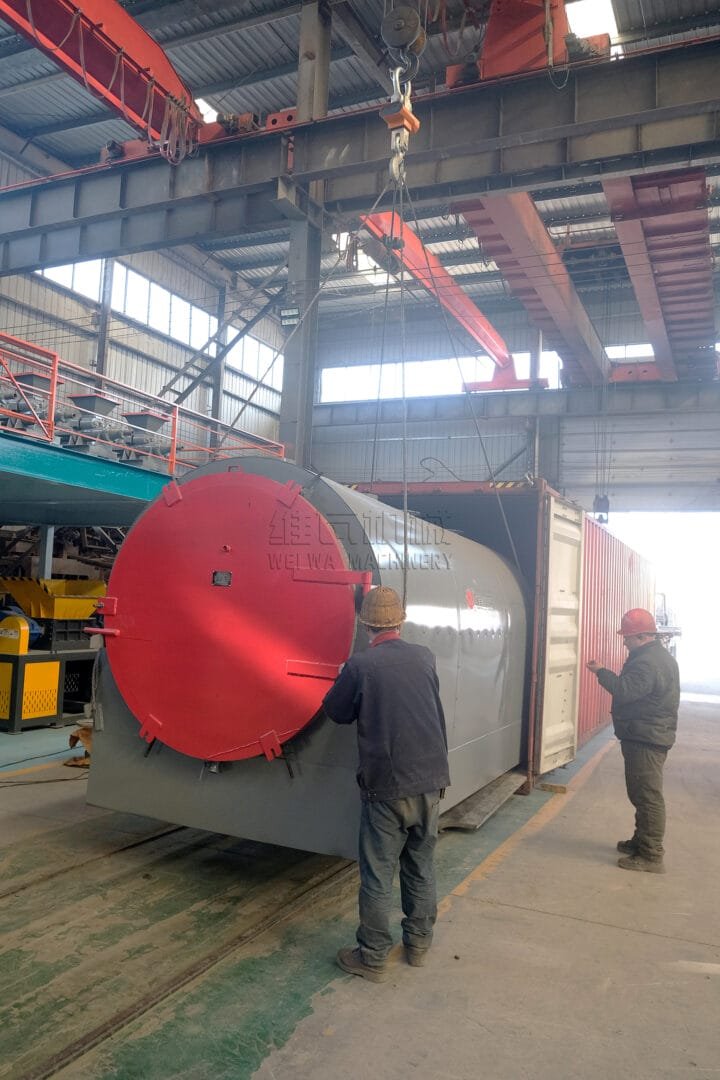
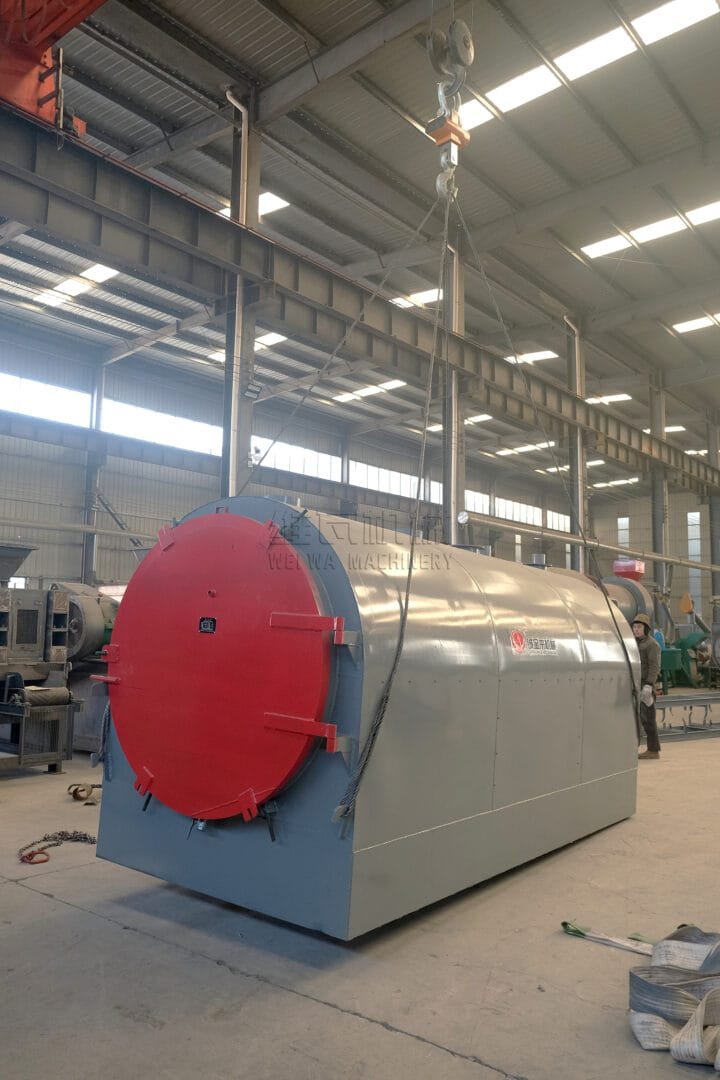
The loading dock scene began at 8:10 AM when our quality inspector tagged the main furnace barrel, the combustion chamber, the gas purification tank, the trolley frame, and the stainless thermometer housing. The horizontal carbonization furnace is modular by design: the cylindrical carbonization tank, the outer insulated shell, the flue-gas return pipe, and the chimney stack travel as separate welded assemblies. This reduces the chance of deformation during ocean freight and lets Indian technicians reassemble the unit in two working days under video guidance.
Before crating, every barrel weld was dye-penetrant checked. The furnace door gasket groove was filled with high-temperature asbestos rope and flame-retardant cotton, because Indian buyers repeatedly tell us door leakage is the main cause of low fixed carbon and long cycle time. Once the pressure test at 0.02MPa held for thirty minutes, the unit moved to the rust-prevention bay. We sprayed zinc-rich primer on exposed carbon steel and wrapped the flange faces in PVC caps. For the horizontal carbonization furnace for India, this step matters more than for dry-climate markets: salt-air transit from Qingdao to Mumbai can condense inside unpacked chambers if desiccant is omitted.
Container Loading and Documentation
The furnace occupied a 40ft high-cube container with the trolley track laid along the left wall and the purification tower secured on a steel skid. We placed six bags of silica gel inside the main barrel and taped a humidity card to the inspection window. Accompanying documents included commercial invoice, packing list, CE declaration, furnace P&ID drawing, Hindi-annotated operation manual, and a pre-clearance note for Indian customs citing biomass recycling machinery under the client’s GST input framework. Our sales engineer shared the Bill of Lading draft with the client’s clearing agent before sailing so the horizontal carbonization furnace for India would not wait at port for paperwork.
The container left the Weiwa workshop bound for Qingdao port, then sailed to Nhava Sheva. Transit time to Mumbai region is typically eighteen to twenty-four days depending on transshipment. For inland destinations such as Hyderabad or Bangalore, we advise clients to budget another four to seven days for road convoy with a low-bed trailer, since the outer shell width exceeds standard pickup dimensions.
What a Horizontal Carbonization Furnace Is and How It Makes Wood Charcoal
A horizontal carbonization furnace is a closed cylindrical retort laid on its side, charged through a front door or rail trolley, and heated from an external firebox or by recirculated pyrolysis gas. Unlike an earth kiln that burns part of the wood to carbonize the rest, the horizontal furnace keeps the wood in anaerobic conditions. The charcoal making machine heats the biomass to 280–450°C, driving off moisture, volatile tar, wood vinegar, and syngas while leaving fixed carbon behind.
In the Weiwa horizontal carbonization furnace for wood, the process has four phases. Preheating dries residual surface moisture and warms the chamber to around 200°C. Anaerobic carbonization begins when yellow smoke appears at the exhaust condenser, signaling volatile release. At that point the operator opens the gas return valve so flammable volatiles travel through the purification tank and ignite under the firebox, cutting external fuel use. The holding phase maintains 320–420°C for two to three hours depending on wood density. Finally, the trolley rolls the hot basket into a sealed cooling chamber where temperature drops below 60°C before the door opens, preventing charcoal ignition.
Energy Recovery Is the Core Selling Point
The reason many Indian buyers switch from vertical kilns to a horizontal carbonization furnace is gas self-sufficiency. Our field data from a 1.5m x 3m barrel show that after the first 80-minute preheat using 25kg of firewood, the furnace sustains itself on recovered gas for the remaining four hours. Over a 24-hour shift with three cycles, the horizontal carbonization furnace for wood consumes roughly 70kg of startup wood instead of 200kg-plus in a non-recovery kiln. That difference pays back the price gap between a basic kiln and a Weiwa charcoal making machine within two to three months in states where firewood costs exceed 6 rupees per kg.
Trial Run Feedback from the Indian Client Site
Although the furnace shipped this month is still in transit, we can share trial-run data from a sister unit commissioned in Gujarat earlier this year for a client processing mixed hardwood and coconut shell. The client ran three batches before our engineer signed off. Batch one used neem and babul wood at 18 percent moisture, batch two used coconut shell, batch three used sawdust briquettes from a local pelletizer.
With the horizontal carbonization furnace set to 380°C peak and 3.5-hour hold, neem-babul mix yielded 28 percent charcoal by weight, fixed carbon 68.4 percent, ash 3.1 percent, and volumetric density 0.42 g/cm³. Coconut shell reached 32 percent yield, fixed carbon 72.9 percent, ash 2.2 percent. Sawdust briquette gave 26 percent yield but required longer cooling because of compact geometry. Across all three runs, the client recorded 31 percent less firewood consumption versus their previous brick kiln and zero visible smoke after the purification tank, which satisfied the local pollution board’s provisional inspection.
Operator Learning Curve
The Indian team had never run a horizontal carbonization furnace before. Our remote session covered door sealing torque, thermometer reading at the basket center, condensate drain timing, and emergency purge. After two supervised batches, the local operator managed the third alone. The feedback we received was that the horizontal layout made basket loading easier than lifting inner pots in a hoist kiln, and the trolley system reduced back strain. For a charcoal making machine in India where labor turnover is real, this ergonomic factor often decides repeat orders.
Horizontal Carbonization Furnace for Wood: Specs and Material Fit
The model dispatched belongs to the Weiwa HC series. The barrel inner diameter is 1.5m, effective length 3m, single-batch charge 0.8–1.2 tons of wood, cycle time 12–14 hours including cooling, power 1.5kW for fans and trolley drive, empty weight 4.6 tons. A larger 4.5m version ships for clients needing 1.5–2 tons per batch. All models accept customization of door orientation, chimney height, and gas burner interface if the client wants to fire the preheat stage with natural gas instead of wood.
Material fit for the horizontal carbonization furnace for wood covers log offcuts under 15cm diameter, branch wood, bamboo, coconut shell, palm kernel shell, rice husk briquette, and sawdust briquette. Loose rice husk is not recommended unless pelleted, because fine particles clog the gas return pipe. We tell every India inquiry: match moisture to your dryer capacity before choosing furnace size, because a horizontal carbonization furnace cannot compensate for wet feedstock, it only exposes the problem faster.
| Model | Barrel Size | Batch Capacity | Cycle Time | Power | Weight |
|---|---|---|---|---|---|
| HC1300 | 1.5x3m | 0.8-1.2t wood | 12-14h | 1.5kW | 4.6t |
| HC1500 | 1.5×4.5m | 1.5-2t wood | 12-14h | 1.5kW | 5.6t |
The table above is crawlable HTML, not an image, so Google can extract specs for snippet use. When we publish a horizontal carbonization furnace for India case study, we keep data in HTML tables exactly for this reason.
Why Indian Buyers Choose Weiwa Charcoal Making Machine Systems?
Weiwa Machinery is not the cheapest option in the catalogue, and we do not pretend to be. Indian buyers choose our horizontal carbonization furnace because the commercial risk of a failed charcoal batch is higher than the saving on a thinner steel shell. Our barrel uses Q245R boiler plate, the insulation layer combines rock wool and refractory brick, and the door seal survives 400°C repeated thermal shock. When a Gujarat client compared three suppliers, the deciding point was our gas recovery drawing and the fact that we answered a single question—how much firewood per ton of charcoal—with a number instead of a range.
For a horizontal carbonization furnace in India, after-sales distance is a real concern. We close that gap with annotated Hindi-English manuals, WhatsApp video troubleshooting, spare-gasket kits sent with every container, and a policy that any client who buys a charcoal making machine from Weiwa can request a factory live-call during their first three batches. The unit shipped this month includes a spare thermocouple, a spare fan capacitor, and a full set of door bolts in a labeled pouch.
Customization for the India Context
Beyond voltage and coating, we adjusted the trolley wheel gauge to match Indian rail-style shed tracks the client already had, added a longer condensate hose for the wood vinegar drum, and painted the outer shell in light grey to reduce heat absorption in summer sheds above 40°C. These are small changes, but they are why a horizontal carbonization furnace for India from Weiwa feels different from a unit reshipped from a domestic model. The charcoal making machine is the same physics; the details are local.
Talk to Weiwa Machinery About a Horizontal Carbonization Furnace for India
If you are running a wood charcoal line in Maharashtra, a coconut shell unit in Kerala, or a briquette factory in Rajasthan and evaluating a horizontal carbonization furnace, the fastest path is to send us your raw-material type, moisture, daily target in tons, and nearest port. We will return a model recommendation, a layout drawing, and a landed-cost estimate including ocean freight to Mumbai or Chennai. The horizontal carbonization furnace for wood is a proven design; the job is to fit it to your yard, not to reinvent the retort.
Weiwa Machinery manufactures horizontal carbonization furnaces, continuous carbonizers, briquette presses, and full charcoal production lines in Gongyi, Henan. With three decades in biomass equipment, we have supplied charcoal making machine systems to Asia, Africa, the Middle East, and South America. Our Indian clients share one pattern: they start with one furnace, then reorder a second within a year after seeing fixed-carbon numbers and fuel savings.
Contact Weiwa Machinery
Mob: +8613838093177
Whatsapp: +8613838093177
E-Mail: info@cjlmachinegroup.com
Product reference: https://cjljx.com/products/tanhua/horizontal-carbonization-furnace
A horizontal carbonization furnace in India is no longer an experimental purchase. It is a measured upgrade from kiln charcoal to factory-grade biochar and fuel charcoal with recoverable gas, documented yield, and a payback period short enough to justify the container freight. The unit we loaded this month will arrive, get reassembled, and start its first batch under the same protocol we applied in Gujarat—and that is the whole point of shipping a charcoal making machine built for the market, not just built to ship.


 Wechat

 +8615937143060
