


Congo Charcoal Market and the Rise of Making Charcoal Balls in Congo
Urban demand in Congo keeps charcoal prices stable even when logistics are difficult. Importers and local entrepreneurs increasingly ask about making charcoal balls in Congo because the raw material is scattered, cheap, and renewable, while the finished product can be branded, bagged, and sold at a premium. A Charcoal Briquette Machine line turns what was once waste into a commodity with consistent size, predictable calorific value, and lower smoke output.
Traditional lump charcoal from uncontrolled kilns drives deforestation. Mechanized briquetting reduces dependence on fresh wood because it reuses charcoal powder that already exists inside the local supply chain. For NGOs, municipal clean-cooking programs, and private SMEs, a charcoal ball press machine is a practical bridge between environmental policy and daily profit. Once the briquettes are uniform, they fit standard 5 kg and 10 kg retail bags, they stack better in warehouses, and they survive long-distance road transport between Congolese provinces.
Why Congo Is a Strong Fit for Briquette Investment?
First, raw material is local. Charcoal traders in Congo already accumulate fines during screening and handling. Second, labor for collection, operation, and bagging is accessible. Third, retail preference is shifting toward clean, low-smoke fuel balls. Fourth, cross-border resale to Gabon, Angola, Zambia, and Cameroon becomes realistic once quality is consistent. A Ball Charcoal Briquettes Machine is not a luxury in this context. It is the missing middle step between charcoal dust and a modern fuel brand.
The payback period for a small-to-medium charcoal ball press machine line in Central Africa is often reported between six and eighteen months, depending on local charcoal prices, raw material accessibility, and bagged product positioning. Finished briquettes made by a Charcoal Briquette Machine command a premium over loose charcoal dust because they are cleaner to handle, produce less ash, and offer more consistent heat. This is the exact economic logic that convinced our Congolese client to move forward with Weiwa Machinery.
What a Ball Charcoal Briquettes Machine Actually Does?
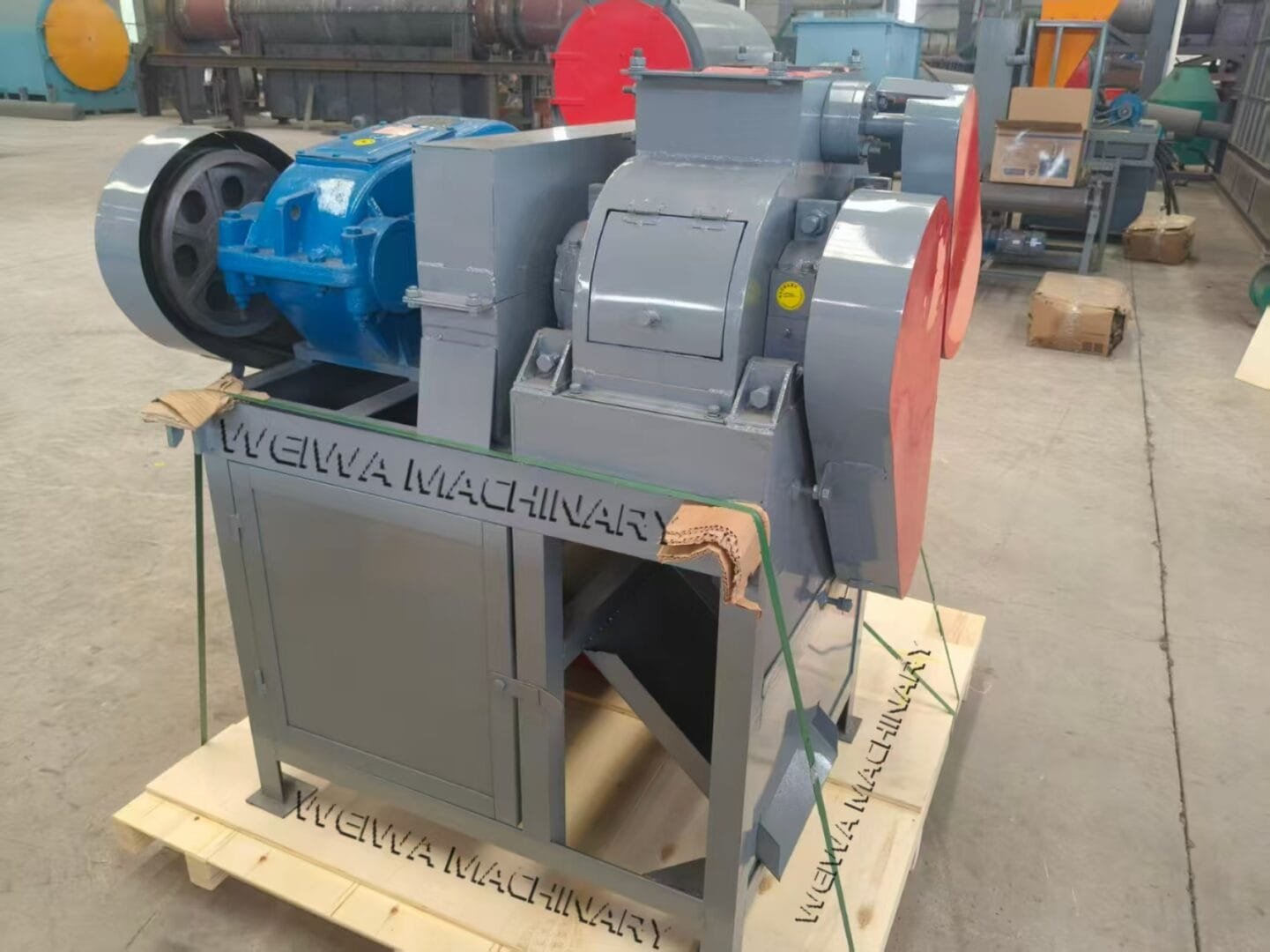
A Ball Charcoal Briquettes Machine is a roller pressing type briquette press designed to form powdered raw materials into shaped briquettes under high mechanical pressure. Unlike screw extruders that push material through a die, the charcoal ball press machine uses two counter-rotating rollers engraved with mold pockets. When properly conditioned powder enters the nip point between these rollers, the increasing pressure compacts the particles until they bond tightly enough to hold the briquette shape upon exit.
This roller technology is the reason a Charcoal Briquette Machine can apply higher pressures and thus produce higher density briquettes than many alternative presses. The briquettes can be designed as oval shape, egg shape, pillow shape, round ball, square shape, or fully customized shapes for branded BBQ fuel. In the Congo project, the client selected pillow and round shapes for both household BBQ and wholesale sacks.
Key Components of a Charcoal Ball Press Machine
The rollers are the core of any charcoal ball press machine. At Weiwa Machinery, we manufacture roller sleeves from high-grade alloy steel, heat-treated for wear resistance, which is a critical feature for abrasive charcoal and coal powders. The pocket shape on the rollers determines the final briquette form. The main frame, reduction gearbox, and pressure-adjustment system, whether mechanical spring or hydraulic, complete the press. A well-built Ball Charcoal Briquettes Machine maintains stable pressure across shifts, minimizing deformed briquettes and maximizing yield.
For clients focused on making charcoal balls in Congo where power supply may fluctuate, we offer both electric motor-driven models and diesel-engine-powered charcoal ball press machine units. This dual-power option is important in provinces where three-phase electricity is unstable but diesel is available for industrial users.
Full Production Line for Making Charcoal Balls in Congo
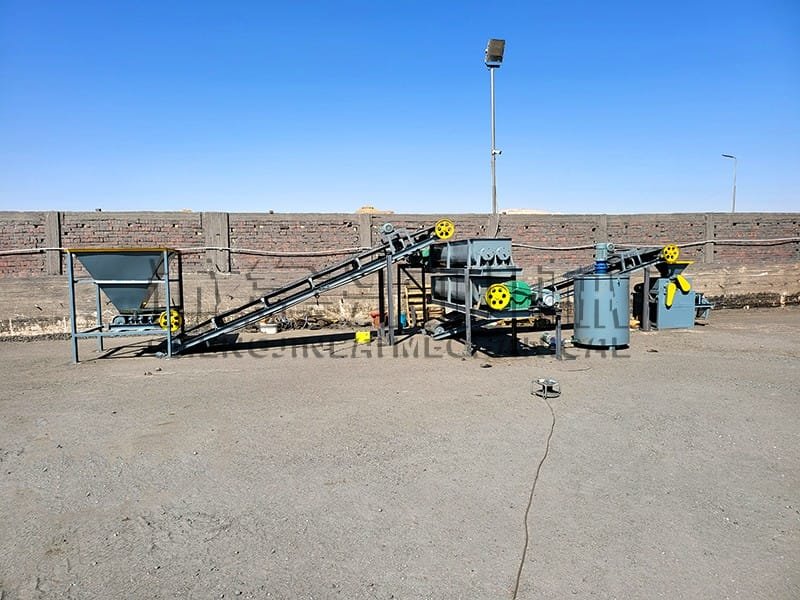
A single Ball Charcoal Briquettes Machine is rarely enough for industrial output. The Congo shipment from Weiwa included a crusher, twin shaft mixer, binder dosing system, the charcoal ball press machine itself, a mesh belt dryer, and a semi-automatic packing unit. This is the standard configuration for making charcoal balls at commercial scale.
The crusher reduces raw charcoal lumps and coarse fines to a uniform powder. The twin shaft mixer blends the powder with appropriate water and binder so the material conditions correctly before pressing. The silo buffers mixed powder and feeds the press continuously. The charcoal ball press machine then molds the material. The mesh belt dryer removes residual moisture, which is especially important in the humid Congo climate where natural sun-drying is too slow for commercial volume. Finally, the packing unit weighs and seals the briquettes into retail or wholesale bags.
Raw Materials That Work with a Charcoal Briquette Machine
The Charcoal Briquette Machine line is not limited to charcoal dust. It also processes coal powder, coke powder, iron powder, magnesium oxide powder, copper powder, chromium ore, lead and zinc scrap, bauxite, nonferrous metal powder, silicon manganese alloy powder, aluminum powder, toner, gypsum, sludge, and desulphurization gypsum powder. In Congo, the most practical feedstock mix is charcoal fines plus carbonized sawdust, coconut shell char, palm kernel shell residue, and cassava stalk carbon.
Usually the briquettes are made into 20 to 80 mm sizes. Their shape can be round, elliptic, squared, pillowed, bread shape, or customized. The correct size depends on the target market. Household cooking prefers smaller pillow or round balls. Wholesale industrial heating may prefer larger oval or square blocks. A flexible Ball Charcoal Briquettes Machine lets the owner change roller sets rather than replace the whole press.
Why the Congolese Client Chose Weiwa Machinery?
Our Congolese client evaluated several suppliers before choosing Weiwa. The comparison points were roller hardness, gearbox design, spare part availability, and factory layout service. They needed a Ball Charcoal Briquettes Machine that could run continuously in high humidity, handle variable charcoal powder fineness, and produce pillow and round shapes for both household BBQ and wholesale sacks.
Weiwa Machinery has over thirty years of working experience in briquette and mining equipment. Our charcoal ball press machine rollers are forged from high-chromium alloy designed to withstand abrasive charcoal powder. Our engineering team provided a factory layout drawing adapted to the client’s available workshop space. The layout planned material flow from crushing to mixing, pressing, drying, and packing without backtracking. That kind of customization reduces installation time and improves daily output.
After-Sales Support for Overseas Charcoal Briquette Machine Projects
Purchasing heavy machinery is a significant investment. We understand the concerns of international clients, especially those setting up operations far from our headquarters. That is why Weiwa maintains a professional after-sales team. From installation guidance via video call to spare part supply and commissioning support, our service extends beyond the point of sale. When the Congolese client receives the container, our technicians will be on standby to assist with alignment, roller gap setting, binder ratio tuning, and dryer temperature calibration.
This support model matters for making charcoal balls in Congo because the difference between a good and a bad briquette is often in the details. Roller pressure too low means crumbling balls. Binder ratio too high means smoke during burning. Dryer temperature too high means surface cracking. Our team helps the client reach stable production quickly instead of learning everything through trial and error.
Business Model for Making Charcoal Balls in Congo
The simplest version of the business starts with a collector network. Charcoal traders, sawmills, and agricultural processors already produce fines. An entrepreneur collects those fines at low or zero cost, carbonizes fresh biomass if needed, crushes and mixes the powder, presses it with a charcoal ball press machine, dries the balls, and bags them under a local brand.
The next level adds a Charcoal Briquette Machine line with mechanized feeding and drying, which raises daily capacity from a few hundred kilograms to one or more tons per hour. At this scale, the product can supply supermarkets, restaurant distributors, mining camps, and cross-province wholesalers. Many Congolese importers currently buy charcoal from rural kilns and resell it in cities. A briquette line lets them add value before the product reaches the urban consumer.
Environmental and Policy Alignment
Making charcoal balls in Congo aligns with clean cooking programs because briquettes reduce the need to cut fresh trees for lump charcoal. They produce less smoke, less ash, and more uniform heat. For government agencies and development partners promoting clean cooking, facilitating adoption of a Ball Charcoal Briquettes Machine supports reforestation and climate goals without asking consumers to switch to expensive imported LPG. The fuel stays familiar. Only the shape, density, and packaging change.
The global bioenergy transition also supports this trend. Modern bioenergy, including solid biomass fuels, is expected to grow sharply by 2030. Charcoal briquettes produced from sustainable biomass can approach carbon neutrality under lifecycle accounting. Industrial buyers subject to carbon pricing increasingly value documented solid biofuel supply chains. A Congolese briquette brand built on traceable charcoal fines and agricultural residue has a stronger story than generic lump charcoal.
Customization Options from Weiwa Machinery
Every client has unique constraints. The Congo client required specific output capacity and preferred pillow-shaped briquettes for the local BBQ market. Our engineering team provided tailored design drawings and planned the entire factory layout to maximize space efficiency. This level of customization ensures the charcoal ball press machine integrates seamlessly into the existing workflow.
We also customize roller pocket shape, press diameter, driving mode, dryer length, and packing format. Hydraulic pressure adjustment models allow precise control over compaction force, which is useful when the raw material blend changes seasonally. Mechanical spring models are simpler and cheaper for stable powder. Electric models suit cities with reliable three-phase power. Diesel models suit remote sites. A Ball Charcoal Briquettes Machine from Weiwa is selected after we analyze the client’s raw material sample, target capacity, available workshop size, and local fuel price.
Technical Strength Behind the Charcoal Briquette Machine
Our Charcoal Briquette Machine frames are constructed from thick, high-tensile steel plates rather than light welded structures. This reduces vibration, lowers noise, and extends the lifespan of moving components. The hardened gearbox reducer ensures smooth transmission of power to the rollers. Heavy-duty bearings support the roller shafts under immense radial force. These details are invisible in a product photo but decisive in a Congolese workshop running two shifts per day.
We apply higher pressures than many standard market alternatives, resulting in denser, harder briquettes that survive long-distance transport across Congo’s vast territory. For making charcoal balls in Congo, transport durability is not a minor feature. Badly pressed balls disintegrate in the sack before reaching Kinshasa or Lubumbashi. Properly pressed balls from a Weiwa charcoal ball press machine arrive intact and ready for retail.
Logistics and Packing for the Congo Shipment
Delivering heavy industrial equipment to Central Africa requires meticulous planning. Small size equipment is packed by wooden case and delivered by LCL shipping. Big size equipment is nude packing delivered by full container load, while small parts are packed into wooden cases. Special packing requirements are accepted according to customer requirement.
For the Congo order, we provided certificates of origin, detailed packing lists, and clear marking for customs clearance. Our experience with similar shipments to Equatorial Guinea, Algeria, Sudan, Tanzania, Zambia, and Ethiopia gave us confidence in navigating Congolese port procedures. Anti-rust oil, plastic wrapping, and steel frame protection were applied to the Ball Charcoal Briquettes Machine rollers and gearbox to prevent humidity damage during ocean transit.
Market Outlook for Ball Charcoal Briquettes Machine in Central Africa
Kenya, Uganda, Tanzania, Ethiopia, and Nigeria are already upgrading from manual presses to semi-automatic and automatic briquette machines. Congo is next because the raw material base is larger and urban charcoal demand is higher. A Charcoal Briquette Machine line in Kinshasa or Brazzaville can source fines from multiple provincial supply chains and sell finished balls into a city market that already understands charcoal as cooking fuel.
The cultural shift toward packaged BBQ charcoal balls is also visible in Congolese urban retail. Supermarkets and street vendors increasingly prefer uniformly shaped briquettes produced by a Ball Charcoal Briquettes Machine because they fit standard packaging and are easier to ignite with minimal smoke. This trend mirrors Kenya, Zambia, and Nigeria, where making charcoal balls has evolved from a cottage industry into a formalized SME sector.
Risk Factors and How to Manage Them
Raw material consistency is the first risk. Charcoal fines vary in moisture, volatiles, and ash content. The answer is a sample test before machine selection and a binder recipe tuned to local powder. Power stability is the second risk. The answer is diesel drive or a buffer generator. Operator skill is the third risk. The answer is video training, English or French manuals, and remote commissioning. Market price is the fourth risk. The answer is branding, bagging, and selling on burn time rather than weight alone.
None of these risks makes the project unviable. They make engineering support mandatory. A charcoal ball press machine is not a vending machine. It is a production system. The owner who treats it as a system, with trained staff and a controlled recipe, will outperform the owner who simply buys the cheapest press and hopes for the best.
How to Start Your Own Charcoal Ball Project with Weiwa?
If you are in Congo or anywhere else in the world and see the potential in the making charcoal balls industry, Weiwa Machinery is a practical partner. Setting up a production line involves selecting the right location, sourcing raw materials, installing machinery, and training staff. Our service begins long before the machine is built.
We provide free consultations to help assess project feasibility. We analyze your raw material samples and recommend the most suitable model of Ball Charcoal Briquettes Machine for your needs. Whether you aim to produce one ton per hour or ten tons per hour, our range of Charcoal Briquette Machines can be scaled to match your ambition. We also supply crushers, mixers, conveyors, and dryers so you receive a turnkey solution rather than isolated machines.
Engineering Drawing and Factory Layout Service
Before production, our design team prepares CAD layouts showing machine positions, conveyor directions, worker paths, raw material inlet, finished product outlet, dryer length, and packing zone. This avoids the common mistake of buying machines first and discovering the workshop is too short, too narrow, or poorly ventilated. For the Congo client, the layout was adjusted to leave space for future expansion from one press to two presses.
We also advise on foundation height, roller change crane clearance, electrical cable routing, and dryer exhaust direction. These details sound minor until a 6-meter mesh belt dryer arrives and does not fit the door. Our customization service exists precisely to prevent that scenario.
About Weiwa Machinery
Weiwa Machinery is a briquette and mining equipment manufacturer with more than thirty years of working experience. We specialize in high-pressure Ball Charcoal Briquettes Machines, charcoal ball press machines, Charcoal Briquette Machines, and complete production lines for coal, charcoal, and mineral powders. Our products are exported to more than 130 countries, including Indonesia, India, Malaysia, Laos, Myanmar, Thailand, Vietnam, Philippines, Pakistan, Sri Lanka, Lebanon, Georgia, Turkey, Poland, Czech Republic, Mongolia, South Korea, Romania, Egypt, Sudan, Tunisia, Algeria, Ethiopia, Tanzania, Equatorial Guinea, Zambia, Mexico, South Africa, and now Congo.
We are not a trading company reselling unknown brands. We build the machines in our own workshop, control the heat treatment of rollers, test the gearbox, and inspect the press before container loading. Our slogan is simple: excellent materials, reliable structure, precision manufacturing, high pressure, and high yield. That is the standard behind every Ball Charcoal Briquettes Machine leaving our gate.
Our team offers customized design drawings, factory layout planning, spare parts supply, and professional after-sales response. If you want to start making charcoal balls in Congo or anywhere else, we can help you choose the right charcoal ball press machine, design the full line, and support commissioning after arrival.
Contact Weiwa Machinery for an inquiry:
Mob: +8613838093177
Whatsapp: +8613838093177
E-Mail: info@cjlmachinegroup.com
You are welcome to visit our factory in Gongyi, Henan. A Charcoal Briquette Machine project is a long-term investment. Seeing the workshop, the roller machining process, and the press test with your own material is the fastest way to build confidence before you import to Congo.


 Wechat

 +8615937143060
