


Why Pakistani Buyers Ask for a Hexagonal Coal Briquette Machine?
In Pakistan, charcoal for grilling is not a generic commodity. Restaurant owners, wholesale dealers, and exporters look for pieces that stack well, ignite predictably, and hold heat for more than an hour. A hexagonal coal briquette machine answers those needs because the six flat sides give the rod structural stability, while the corners create natural air channels when pieces are stacked in a grill or kiln.
The client told our engineer that his customers in Lahore and Karachi preferred hexagonal rods over round sticks. Round sticks roll, break at the edges, and leave uneven gaps in the packing carton. Hexagonal rods lock side by side. That small geometric difference changes how the product ships, displays, and burns.
What the Pakistan Client Brought to the Test?
He arrived with two samples. One was fine coconut shell charcoal powder sifted below 3 mm. The other was a blend of local wood charcoal dust and a small portion of coal powder. Both samples represented what his team could source weekly in Punjab. Our job was to prove that one Charcoal Extruder for Pakistan could handle both feeds and still output clean hexagonal rods.
Understanding the Máquina de extrudencia de carbón Before the Test
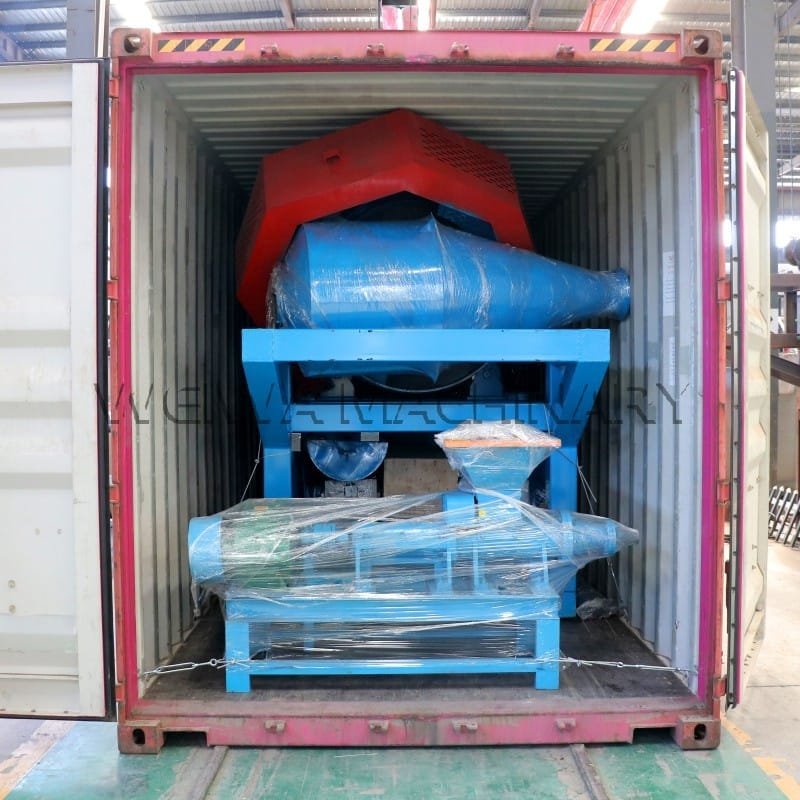
A Charcoal Extrude Machine is not a simple press. It is a continuous screw extrusion unit. Charcoal powder mixed with binder and a controlled amount of water enters the hopper, travels through a forced mixing zone, and is pushed forward by a high manganese alloy propeller mounted on the propulsion shaft. The motor sends power through a triangle belt and a floating coupling into the gearbox, then into the shaft. Pressure builds inside the barrel. When the material reaches the die head, it is squeezed through a hexagonal forming mold and comes out as a solid, continuous rod that is cut to length.
This screw-based design is different from a stamping press. A press forms one piece at a time. An extruder forms a continuous profile. For a Charcoal Extrude Machine for Hexagonal Rod Charcoal, that continuity is the reason the rod keeps the same density from the first cut to the thousandth cut.
Key Components We Checked Before Power On
Before inviting the client to the control panel, our senior engineer inspected four areas:
The carbon steel frame and base were checked for leveling. El 100 percent copper coil motor was tested for idle current. The gearbox was run without load to confirm there was no abnormal noise. The hexagonal die head was measured with calipers to confirm that all six sides were symmetrical and the inner channel matched the ordered rod diameter.
We did not skip this step. A 0.3 mm deviation in a die head can make a hexagonal rod look oval after cooling. The client watched the measurement and compared it with the drawing he signed two weeks earlier.
Material Preparation Behind a Clean Hexagonal Rod
The extruder is only as good as the feedstock in front of it. The trial began not with the machine, but with the powder.
Crushing to Below 3 Millimeters
The client’s coarse charcoal chunks were first sent through our charcoal crusher. The output needed to be under 3 mm. Larger particles create weak spots inside the rod. Smaller particles, down to 0.5 mm, fill the gaps and raise density. After one pass, the sample passed the sieve test.
Mixing Binder and Moisture Control
Próximo, the powder moved to the grinding wheel mixer. We added a starch-based binder at 4 percent and adjusted moisture to around 12 percent. Moisture above 15 percent makes the rod bubble and crack during extrusion. Moisture below 8 percent increases friction and shortens screw life. The mixer ran for nine minutes. The client touched the discharged paste and noted it held shape when squeezed but did not stick to the glove.
Starting the Hexagonal Coal Briquette Machine
With the feedstock ready, we switched on the Charcoal Extrude Machine. The copper motor ramped up smoothly. The triangle belt transferred torque to the gearbox. The floating coupling absorbed the minor misalignment between shafts. Inside the barrel, the high manganese propeller dragged the charcoal paste forward.
The first 40 centimeters of extrudate are normally discarded because the barrel temperature and pressure are still stabilizing. After that, the rod entered the hexagonal die head.
What Came Out of the Die Head?
The rod exited straight, dark, and glossy. The six faces were sharp. The corners were not rounded. The central hole, requested by the client for faster ignition, was centered. We cut a 50 mm sample and dropped it on the steel table. It did not bend. It did not split. The client picked it up and balanced it on his palm.
“This is heavier than what my current supplier sends,” he said.
We weighed ten cut pieces. Average weight per 100 mm rod was 38 grams, roughly 8 percent higher than the samples he showed us from his local market. Higher weight at the same length means higher density, and higher density means longer burn time.
Measuring Trial Run Performance
We ran the machine for 35 minutes continuously. The model was our 160 type, rated at 22 kW and 1.2 a 1.5 tons per hour on charcoal powder.
Output and Stability
During the run, the client timed three one-minute intervals. The machine produced between 19 y 21 cut rods per minute at 50 mm length. No stalling. No pressure drop. The gearbox surface temperature stayed within the normal range thanks to the sealed bearing design.
Surface and Combustion Checks
After cooling for two hours, we performed a simple ignition test on the workshop brick stove. A hexagonal rod reached glowing red in 90 seconds and held visible flame for 74 minutes in a light wind condition. There was no white smoke at ignition, which confirmed the moisture was in the right window. The ash residue was gray and fine, not clumped.
The client recorded the burn test on his phone. For him, the burn time mattered more than any factory specification sheet.
Why the Charcoal Extruder for Pakistan Configuration Worked?
Several design choices made the trial stable.
Screw and Die Material
The propeller uses high manganese alloy. The hexagonal mold uses #45 steel. Both resist wear from charcoal silica. After 35 minutes of running, we removed the die and inspected the inner surface. No scoring. No enlargement of the channel.
Interchangeable Mold Logic
The client asked whether he could later switch to a square or cylindrical rod without buying a second machine. We demonstrated the mold swap. With the coupling loose and the barrel front opened, the hexagonal die came off in four minutes and a cylindrical die went in. This flexibility lets one Charcoal Extrude Machine serve different customer segments in Pakistan without a second production line.
Environmental Fit
The extrusion process itself does not burn the charcoal. It shapes already-carbonized powder. That means no smoke from the machine body, no chimney needed at the shaping stage, and no coal tar release. For a buyer installing the unit inside a suburban workshop in Pakistan, that point removes a major permit headache.
Common Mistakes Buyers Make Before the First Run
During the discussion after the trial, our engineer shared the most frequent issues we see from first-time buyers.
Wrong Powder Size
Some clients think finer is always better. If the powder is too fine and dry, it flows like flour and slips past the screw without building pressure. A blend of coarse and fine below 3 mm funciona mejor.
Wrong Binder Ratio
Too much binder makes the rod soft and slow to ignite. Too little binder makes it crumble after drying. El 3 a 5 percent range with starch or cassava binder fits most charcoal powders.
Skipping the Idle Check
Turning the machine straight to full load after installation damages the coupling. We always run three minutes idle, then five minutes half-feed, then full production.
How the Full Line Fits Together?
The Charcoal Extrude Machine is the core, but not the whole story. For the Pakistan client, the realistic daily line looked like this:
A charcoal crusher reduces lumps below 3 mm. A grinding wheel mixer blends powder, aglutinante, and water. The Charcoal Extrude Machine forms the hexagonal rod. A mesh belt dryer removes surface and inner moisture over 4 a 6 horas. Finalmente, the rods are packed in 10 kg cartons for restaurant supply.
He did not need the dryer during the trial because we air-dried the samples in the courtyard. But for commercial output in Pakistan’s humid monsoon weeks, the dryer is not optional.
Client Decision After the Trial
By the end of the visit, the client confirmed one 160-type Charcoal Extrude Machine with two spare hexagonal die heads, one cylindrical die head, and a matching mixer. He also asked for a 140-type unit quotation for his cousin’s smaller shop in Faisalabad.
More important than the order was his comment: “I came to catch you hiding something. I didn’t see anything hidden.”
That is the point of a factory trial. The machine either shapes the rod or it does not. The screw either holds pressure or it does not. The hexagonal face either stays sharp or it does not.
Technical Recap for Buyers Evaluating a Charcoal Extrude Machine
If you are comparing suppliers, watch these points during your own trial:
Ask for a die measurement report before running. Run the first 30 cm of rod to waste. Weigh cut samples at minute 5, minute 20, and minute 40 to see if density drifts. Burn one rod in open air and time the glow. Open the barrel after the run and check the screw tip. A good Charcoal Extrude Machine for Hexagonal Rod Charcoal should show no screw wear, no die enlargement, and no color change along the rod length.
Model Note
For most Pakistan barbecue charcoal workshops, el 140 type at 15 kW fits 0.8 a 1.0 T/H. El 160 type at 22 kW fits 1.2 a 1.5 T/H. El 180 type fits buyers who already export containers monthly. All three accept the same hexagonal mold base with different screw diameters.
Acerca de Maquinaria de Weiwa
Weiwa Machinery is a briquette and carbonization equipment manufacturer based in China with exports to more than 130 países, including Pakistan, India, Indonesia, Pavo, Egipto, México, and South Africa. Our charcoal extrude machine range covers cylindrical, cuadrado, and hexagonal rod production with interchangeable molds, carbon steel frames, motores de bobina de cobre, and high manganese screws. We support clients with material testing, mold drawing confirmation, video trials, spare parts supply, and engineer guidance by video or on-site visit.
If you want to see your own charcoal powder shaped into hexagonal rod charcoal before placing an order, contact our team. We can run a recorded trial with your sample.
Contacte a Maquinaria Weiwa
Multitud / WhatsApp: +8613838093177
Correo electrónico: info@cjlmachinegroup.com


 Veloz
Veloz

 +8615937143060
