


What a Horizontal de carbonización Actually Is?
A horizontal carbonization furnace is a barrel-style chamber mounted on rails, with a cart-fed door at one end and a sealed discharge hatch at the other. Indirect heating raises the chamber to roughly 500 a 650 degrees Celsius while the biomass stays in an oxygen-limited environment. The design differs from vertical kilns and rotary drums in three practical ways. Primero, loading is mechanical: workers push a charged cart in, close the gasket door, and start the cycle. Segundo, heat distribution is balanced along the barrel, so a 3-meter chamber treats the front and rear batches almost identically. Tercero, the tar and condensate from pyrolysis go into a purification tank, drop their heavy fractions, and return as clean combustible gas to the burners. That loop is the reason a modern carbonization furnace can hold internal temperature near 600 degrees Celsius while burning less than half the firewood an old brick kiln needs.
For a charcoal making machine for India, those traits matter more than they do in a European lab. Indian yards often run mixed feedstock, face monsoon humidity, and operate under state pollution board notices that forbid visible smoke. A horizontal chamber with rail carts, refractory brick lining, and a gas scrubber answers all three pressures at once.
Why the India Market Keeps Asking for Horizontal Carbonization Furnace in India?
India produces massive volumes of carbonizable residue every year. Coconut plantations in Kerala and Tamil Nadu discard shells by the truckload. Bamboo culm waste piles up near Assam and Tripura plywood mills. Sawmills around Saharanpur and Gandhidham stack green wood offcuts. Punjab and Uttar Pradesh burn rice husk and cotton stalk in the open field, drawing fines under the Commission for Air Quality Management Act. A horizontal carbonization furnace in India turns those liabilities into graded charcoal, biochar, and wood vinegar.
The economics are simple. Traditional earth mound kilns return 18 a 22 percent charcoal by weight from hardwood, throw away the gas as smoke, and need four to six days per batch. A closed horizontal furnace returns 28 a 33 percent from the same wood, recovers the gas, and finishes in 10 a 16 horas. For a small producer selling 5 tons of lump charcoal a week, that delta pays back the equipment difference in seven to nine months. For a medium yard feeding activated carbon units, the fixed carbon consistency is the bigger prize.
Weiwa has supplied charcoal making machine lines to Gujarat, West Bengal, Karnataka, and Andhra Pradesh over the past four years. The recurring request is never “the cheapest furnace.” It is “a furnace that passes the local pollution inspection, runs on our mixed waste, and does not need a full-time engineer.” The horizontal model is our answer.
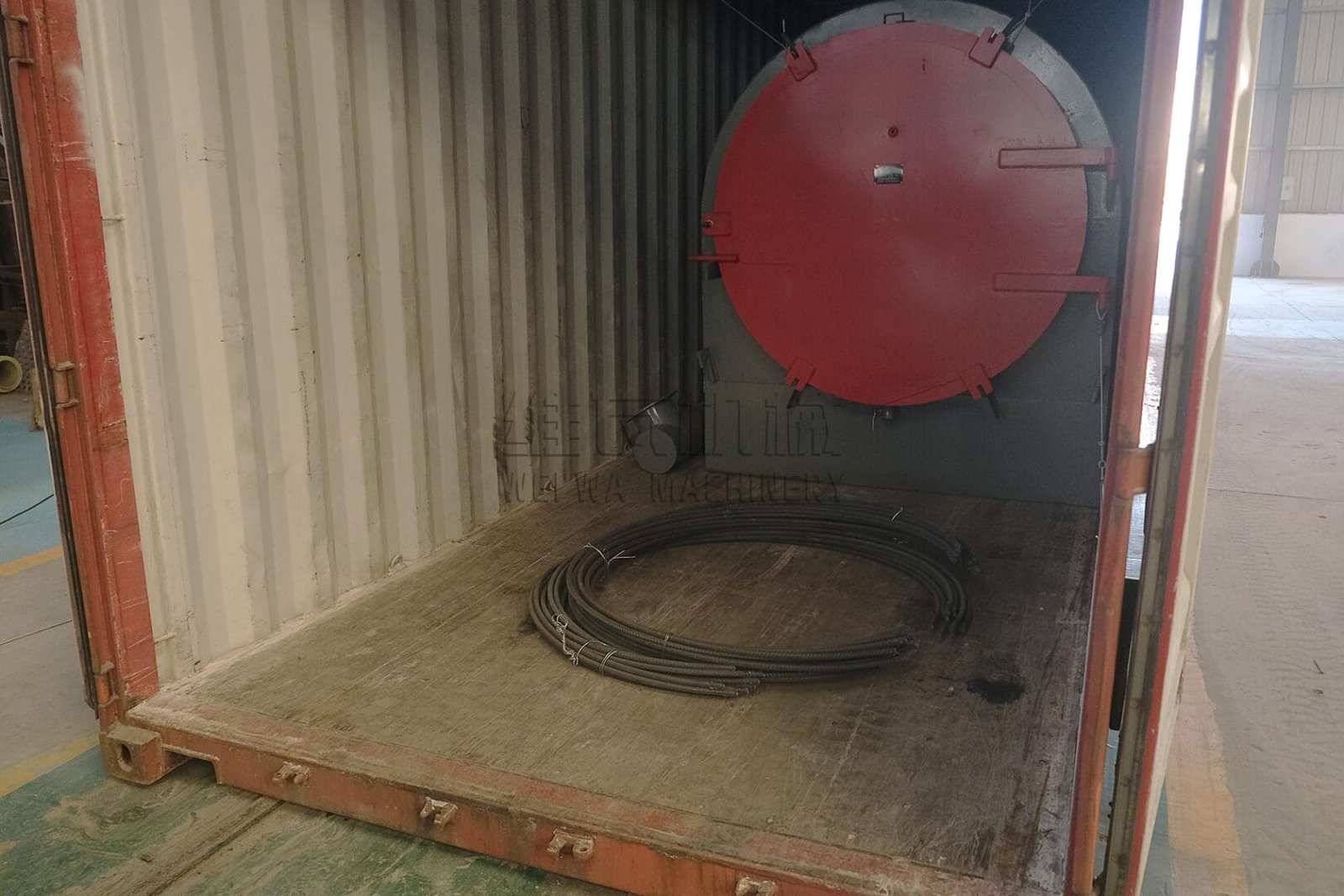
Shipment Scene at the Weiwa Factory
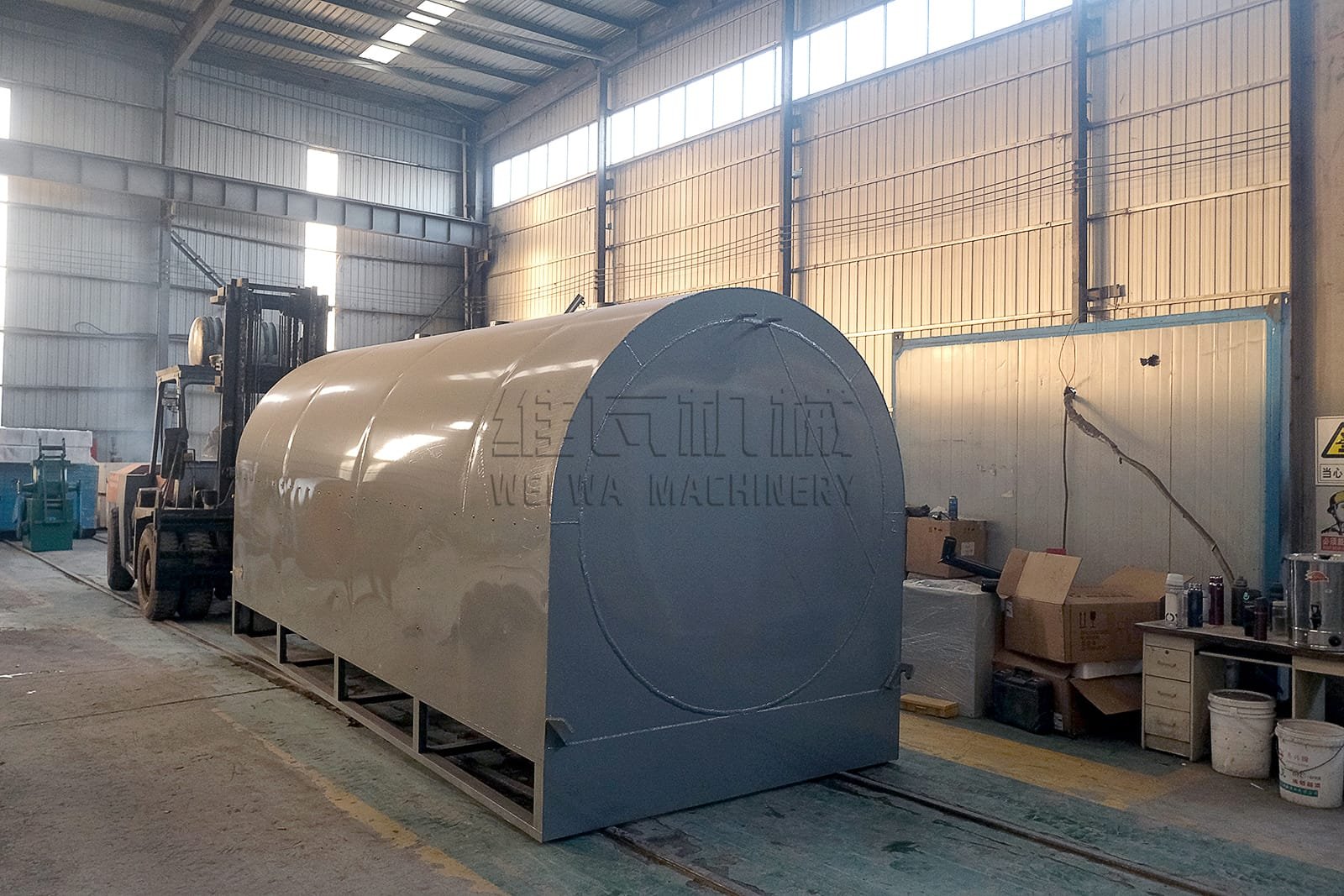
On the morning of the load-out, the furnace body sat on the north bay of our Zhengzhou finishing shop. The barrel was 3.2 meters long with an inner diameter of 1.8 meters, built from 10-millimeter carbon steel plate, lined with 120 millimeters of alumina silicate and firebrick. The rail cart carried a perforated tray rated for 1.2 tons of loose biomass. Auxiliary units stood beside it: the tar separator, the condensate tank, the induced draft fan, the PLC cabinet, and the burner manifold.
Our packing team did five things before the container arrived. They greased the rail wheels and sealed them in plastic. They removed the PLC screen, foam-padded it, and crated it separately. They welded lifting lugs on the barrel saddle. They tagged every bolt bag with a QR code linking to the foundation drawing. They wrapped the whole barrel in two layers of woven geotextile and one layer of PE film because Mumbai humidity can reach 86 percent in July.
When the 40-foot container backed in, the forklift placed the saddle first, then the barrel, then the auxiliaries. Total loaded weight was 4,760 kilograms. The client watched the whole process on a WhatsApp video call. He asked to see the nameplate voltage: 380 volts, 50 hertz, three phase, with control transformer option for 415 volts. He asked to see the burner gas inlet open and close. He asked to see the trial charcoal we had made two days earlier. By late afternoon the doors were sealed, the bill of lading was issued, and the horizontal carbonization furnace was on its way to Nhava Sheva.
Factory Trial Run Before Shipment
We never ship a charcoal making machine to India without a witnessed run. The trial for this unit ran 14 horas y 20 minutos, divided into preheat, dry distillation, high-temperature soak, and controlled cooling.
Feedstock Tested
The client sent a sample kit from India: mango wood offcuts at 14 percent moisture, coconut shell at 9 percent moisture, bamboo strip waste at 17 percent moisture, and sawdust briquettes at 8 percent moisture. We ran them in separate carts, not mixed, so the buyer could see single-material numbers first.
Temperature Curve
The PLC logged chamber temperature every 30 seconds. Preheat from ambient to 200 degrees took 95 minutos. Climb from 200 a 450 degrees took 180 minutes on external firewood only. Arriba 450 degrees the recycled gas lit automatically and external firewood dropped to 30 percent of earlier flow. Soak at 580 a 610 degrees held for 260 minutos. The burner never needed manual intervention after 470 degrees.
Charcoal Quality
Mango wood cart yielded 29.4 percent charcoal by dry weight, fixed carbon 76.2 percent, ash 2.8 percent, volatile matter 21 percent. Coconut shell yielded 31.1 percent, fixed carbon 82.6 percent, ash 1.9 percent. Bamboo yielded 27.8 percent, fixed carbon 71.4 percent. Sawdust briquette yielded 33.6 percent, fixed carbon 74.9 percent, ash 3.4 percent. Every batch was uniform black, rang when tapped, and broke with a conchoidal fracture instead of crumbling.
Gas Recycling Performance
During the soak phase the tar separator returned an average of 58 cubic meters per hour of clean gas to the burner manifold. External firewood consumption after gas ignition fell from 34 kilograms per hour to 11 kilograms per hour. Condensate collected was 41 liters, containing wood vinegar that the client plans to sell to a nearby agri-input dealer. No visible plume left the stack during the entire run. The induced draft fan held negative pressure at minus 12 pascal, so no oxygen leaked into the chamber.
The Indian buyer’s reaction after the video review was that the horizontal carbonization furnace in India would let him shut down two brick kilns and still increase monthly charcoal tonnage. That is the moment a machine stops being a line item and becomes a production decision.
Why India Buyers Choose This Charcoal Making Machine Configuration?
The unit we shipped is not our largest horizontal model, but it is the one most requested for the Indian small-to-medium segment. The reasons repeat across inquiries.
Footprint is the first one. The barrel plus rail occupies 4.1 meters by 2.2 meters. With the separator and fan on one side and the PLC cabinet on the other, the whole line fits a 7-meter by 5-meter shed. Many Indian biomass yards rent 200 a 400 square meter plots, so a compact carbonization furnace wins over a rotary kiln that needs 14 meters of linear space.
Feedstock flexibility is the second. The same cart handles 1-meter bamboo sticks, 200-millimeter coconut shell sacks, and 80-millimeter sawdust briquettes. The client changes only the soak time and the preheat slope on the HMI. No mechanical changeover, no spare barrel.
Smoke compliance is the third. Several Indian states now require biomass carbonization units to show a secondary combustion chamber or gas return proof. Our gas recycling loop satisfies that without adding a separate afterburner, which keeps the capital cost closer to a traditional kiln upgrade than a full pyrolysis plant.
Operator learning curve is the fourth. The trial client assigned two workers with no thermal background. After one supervised cycle they could set the recipe, watch the PID screen, and recognize a normal pressure curve. The HMI has English and Hindi label options, which we enabled before shipping.
Horizontal Carbonization Furnace Versus Traditional Indian Kiln
A traditional mound or brick kiln in India typically runs 4 a 6 días, needs 3 workers, loses gas to the sky, and yields charcoal that varies from batch to batch because the outer wood chars faster than the core. A horizontal carbonization furnace runs 10 a 16 horas, needs 1 operator plus 1 loader, recovers gas, and yields charcoal with fixed carbon spread under 4 percent across a week of runs.
For a charcoal making machine for India buyer who sells to hookah brands, restaurantes, or water filter plants, that consistency is the sales argument. Premium charcoal contracts in Mumbai and Delhi increasingly specify fixed carbon above 75 percent and ash below 3.5 percent. Only a closed furnace holds that spec. A kiln cannot sign that paper.
How Weiwa Adapts the Horizontal Carbonization Furnace for India?
Climate and power shape the build. For west coast India we add epoxy-coated fasteners and a thicker door gasket because salt air corrodes mild steel in 18 meses. For south India we pre-wire a 415-volt transformer and label the cabinet in English plus Tamil or Malayalam on request. For north India we insulate the gas return pipe with 50-millimeter rock wool because winter ambient drops to 4 degrees and un-insulated pipe condenses tar inside the line.
Voltage fluctuation is real, so the PLC cabinet gets a surge isolator and a 30-second ride-through UPS for the controller only. The cart wheels get sealed bearings because yard dust in India is finer than Henan loess. None of these are expensive upgrades, but together they decide whether the horizontal carbonization furnace in India still runs clean at month 24.
Internal Link Map for This Blog
Readers who land here from a search for horizontal carbonization furnace usually also compare models, check the India wood processing case, or price a full line. The relevant pages on our own site are the horizontal carbonization furnace product page, the earlier India wood processing shipment report, the wider carbonization furnace series, and the general charcoal making machine catalog. Linking them helps Google see the topical cluster and helps a buyer move from education to quotation without leaving the domain.
What the India Client Plans to Do After Commissioning?
On arrival the client will pour the foundation using our drawing, lift the barrel onto the saddle with a 5-ton mobile crane, connect the fan and PLC, and run an empty heat cycle for two hours. Then he will load mango wood offcuts for the first commercial batch. His target is 6 batches per week, roughly 7.2 tons of charcoal, blended from wood and coconut shell, sold partly as lump charcoal to Pune restaurants and partly as feedstock to a Nashik activated carbon micro-plant. He estimated payback at eight months including freight and duty.
This is the pattern we see across charcoal making machine for India inquiries: not a giant factory, but a 300 a 800 square meter yard, one furnace, one briquette press maybe later, and a owner-operator who watches WhatsApp groups for biomass surplus. The horizontal furnace fits that shape better than any vertical or rotary alternative we build.
Common Questions India Buyers Ask Before Ordering
Can the furnace run only on its own gas? Not fully. Arriba 450 degrees the recycled gas covers 60 a 70 percent of heat demand, but startup still needs firewood or LPG. Can it take wet wood? Up to 18 percent moisture yes, above that the dry phase stretches and yield drops. Can one worker run it? Loading needs two hands for the cart, but the HMI and burner are one-operator. Does Weiwa send an engineer? For India we do remote video commissioning plus optional on-site visit; most clients choose video plus a local electrician. Spare parts? Door gasket, fan belt, thermocouple, and PID relay are the only wear items in year one.
Closing Notes on the Horizontal Carbonization Furnace in India
The unit on that truck is now in transit, but the trial data, the packing sheet, and the foundation drawing are already in the client’s folder. That is how Weiwa treats a horizontal carbonization furnace order: not as a product handoff, but as a production line handover. For any Indian buyer comparing a charcoal making machine on price alone, the better comparison is batch time, fixed carbon spread, gas recycling ratio, and after-sales response on a Sunday evening. The furnace we shipped scored on all four.
If you are evaluating a carbonization furnace for Maharashtra, Tamil Nadu, Kerala, or Gujarat, the fastest path is to send us your feedstock moisture and weekly tonnage. We will size the barrel, run a sample trial on your material at our shop, and share the numbers before you pay a deposit. That is the same process this Maharashtra client went through, and the reason the container left with his sticker on the door.
Contact Maquinaria de Weiwa
Weiwa Machinery designs and exports biomass carbonization equipment, Prensa de briqueta, and drying lines. Our horizontal carbonization furnace series ships to India, Indonesia, Ghana, Sudáfrica, Filipinas, and Latin America with voltage, language, and climate adaptations per order. For specifications, trial videos, or a custom quote on a horizontal carbonization furnace in India configuration, reach our sales team directly:
Móvil: +8613838093177
WhatsApp: +8613838093177
Correo electrónico: info@cjlmachinegroup.com


 Veloz
Veloz

 +8615937143060
