


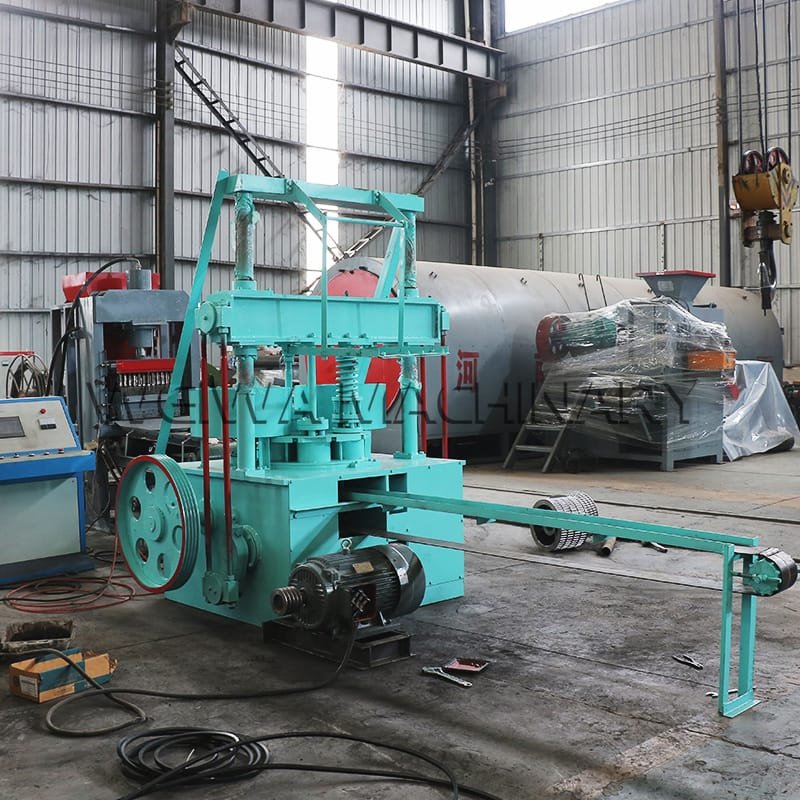
What a Honeycomb Briquette Charcoal Machine Actually Does?
A honeycomb briquette charcoal machine converts loose carbonaceous powder into structured solid fuel. The feedstock is not limited to charcoal dust. Polvo de carbón, anthracite fines, polvo de coca, biomass residue, carbón de la cáscara de arroz, and furnace slag blends all pass through the same rotary mold table. The punch head presses the material once for shaping and once for release. The result is a cylindrical or round cake with vertical holes, commonly called honeycomb due to the beehive pattern.
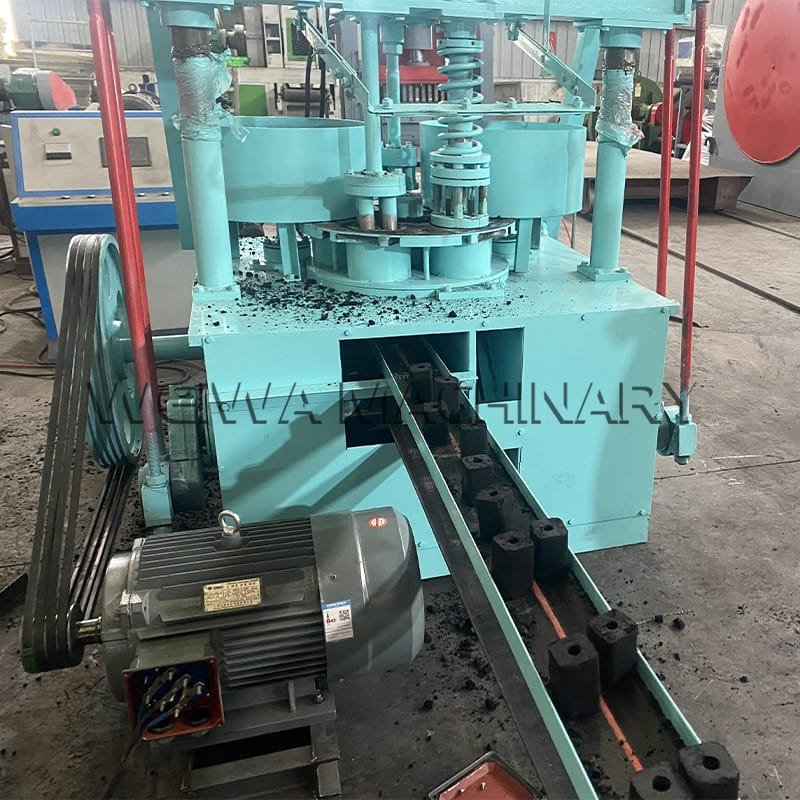
The holes are not decoration. They raise the exposed surface area, allow air to travel through the core, and give uniform ignition from the top down. In Indian households using chulhas or small tandoor heating, this means faster lighting, steadier heat, and less smoke than lump coal or loose dust.
Why the Honeycomb Shape Outperforms Loose Powder?
Loose coal powder blows away, wets easily, and burns unevenly. A honeycomb briquette holds its form, resists crumbling, and sustains combustion for 90 a 180 minutes depending on diameter and density. For a dealer in Punjab or a charcoal trader in Gujarat, that difference decides repeat orders.
Why India Buyers Request Pre-Shipment Inspection?
When an India client imports a honeycomb briquette charcoal machine in India configuration, he is not buying a photo. He is buying downtime avoidance. Ocean freight from China to Nhava Sheva or Chennai takes weeks. Customs, voltage conversion, and local technician training add cost. A failed punching shaft or wrong mold pitch can stall a production line for a month.
Our India client sent us his raw material sample in advance. It was a mix of 70 percent hardwood charcoal dust and 30 percent low-grade coal fines, moisture around 11 percent. Based on that, we recommended our 140-type honeycomb charcoal coal briquette forming machine with a 7.5 kW motor, 32 a 45 golpes por minuto, and a 140 mm round mold with 19 agujeros.
How the Honeycomb Charcoal Coal Briquette Forming Machine Works?
The machine body contains five functional zones. The hopper receives screened powder. The auger pre-compresses material into the rotary mold barrel. The transmission shaft drives the rotary table. The punch head descends twice per cycle. The first stroke forms the cake; the second releases it onto the discharge belt.
Pressure is mechanical, not hydraulic, which reduces leakage risk in dusty environments. The mold barrel is interchangeable. One honeycomb punching machine can switch from 120 mm household cake to 220 mm industrial block by swapping the barrel and punch head only.
Rotary Table and Punch Head Alignment
During inspection we ran a dial gauge test on the rotary table. Run-out was within 0.15 mm. The punch head center matched the mold cavity center within 0.2 mm. This precision prevents half-punched cakes, which are the most common complaint in low-cost punching machines sold online.
Live Sample Run During the India Client Inspection
We filmed the entire trial at 140 mm mold setting. The client watched remotely while our technician fed his exact raw mix. Within the first ten minutes the machine produced 380 pieces. We bagged 30 random samples and measured them in front of the camera.
Average green density reached 1.18 g/cm³ before drying. After 24-hour natural curing the samples stabilized at 1.08 g/cm³. Drop test from 1.2 meters showed zero fracture on 28 de 30 pieces. The two micro-chipped edges came from over-dry surface powder, not from machine defect, and we corrected it by raising binder moisture from 9 a 11 percent.
Sample Appearance and Hole Uniformity
Every hole aligned vertically. Inner wall smoothness was consistent. The client specifically asked for 19-hole pattern because his retail customers in Maharashtra recognize that pattern as premium household honeycomb. Our honeycomb punching machine supports 12, 16, 19, y 21 hole molds without changing the main shaft.
Briquette Quality Checks We Showed the Client
Inspection is not only about the machine running. It is about the object the machine creates. We documented four checks.
Primero, diameter tolerance. All 30 samples measured between 139.6 mm and 140.3 mm. Segundo, height consistency. Height ranged 71 a 73 mm against a 72 mm setpoint. Tercero, ignition time. Using a standard wood-fire starter, average top-surface ignition happened in 95 seconds. Cuatro, burn continuity. One 140 mm cake sustained visible flame for 112 minutes in still air.
These numbers matter to an India buyer because municipal fuel rules in several states now favor low-smoke compressed briquettes over loose coal. A coal briquettes making machine that cannot prove burn time will lose distributor trust.
Honeycomb Punching Machine Customization for Indian Fuel
Indian raw material is rarely uniform. Moisture swings between Rajasthan dry powder and Kerala humid dust. We offered the client three adjustable points. Punch stroke depth controls final compression. Hopper auger speed controls fill rate. Mold taper angle controls release friction.
For his mix we set stroke depth to 38 mm, auger at medium, and mold taper at 1.5 degrees. The same honeycomb punching machine can later serve a harder anthracite blend by deepening stroke to 42 mm and slowing the rotary table to 32 golpes por minuto.
Voltage and Local Service Notes
We built his unit for 415 V / 50 Hz / 3 fase, which matches most industrial supply in India. Control box uses CE-rated contacts. Spare punch heads, springs, and mold barrels were packed separately in a phytosanitary wooden case. We also recorded a 12-minute Hindi-subtitled operation video for his local worker training.
Coal Briquettes Making Machine Range from Weiwa
The inspected 140-type is our mid-volume model. Weiwa also produces 160-type, 220-type, and 260-type coal briquettes making machine units. Capacity scales from 0.8 ton per hour to 4 tons per hour. Larger units use 11 kW or 15 kW motors and double-bearing punch guides. All share the same mold philosophy: one shaft, many barrels.
For India clients who start with manual feeding, we supply single-hoppers. For clients scaling to full production, we integrate crusher, secadora, mezclador, and conveyor into one line. The honeycomb briquette charcoal machine is the finishing press, not the whole story, and we design around the raw material first.
Why Global Buyers Choose Weiwa Machinery?
Weiwa Machinery has shipped briquette and charcoal equipment to more than 130 países. Our honeycomb briquette charcoal machine in India market alone has reached Maharashtra, Tamil Nadu, Uttar Pradesh, and West Bengal. Buyers return not for the lowest price but for pre-shipment transparency. Every export unit passes a running test with the client’s own material when samples arrive in time.
We photograph the punch head, the mold barrel, the motor nameplate, and the finished samples. We send the video before we send the invoice. That is how a long-distance purchase becomes a normal business routine.
Acerca de Maquinaria de Weiwa
Weiwa Machinery is a Chinese industrial equipment manufacturer focused on briquetting, charcoal processing, and biomass compaction systems. We design honeycomb charcoal coal briquette forming machine models for household fuel, BBQ export, and small boiler supply. Our factory handles custom voltage, custom mold shape, and container-load packing with rust-proof coating.
If you are evaluating a honeycomb punching machine or a coal briquettes making machine for the Indian market, contact our project team before ordering. We will ask for your raw material, target diameter, daily ton goal, and local voltage. Then we propose one model, not ten.
Contact:
Multitud: +8613838093177
Whatsapp: +8613838093177
Correo electrónico: info@cjlmachinegroup.com
Product reference: https://cjljx.com/product/honeycomb-charcoal-briquettes-machine


 Veloz
Veloz

 +8615937143060
