


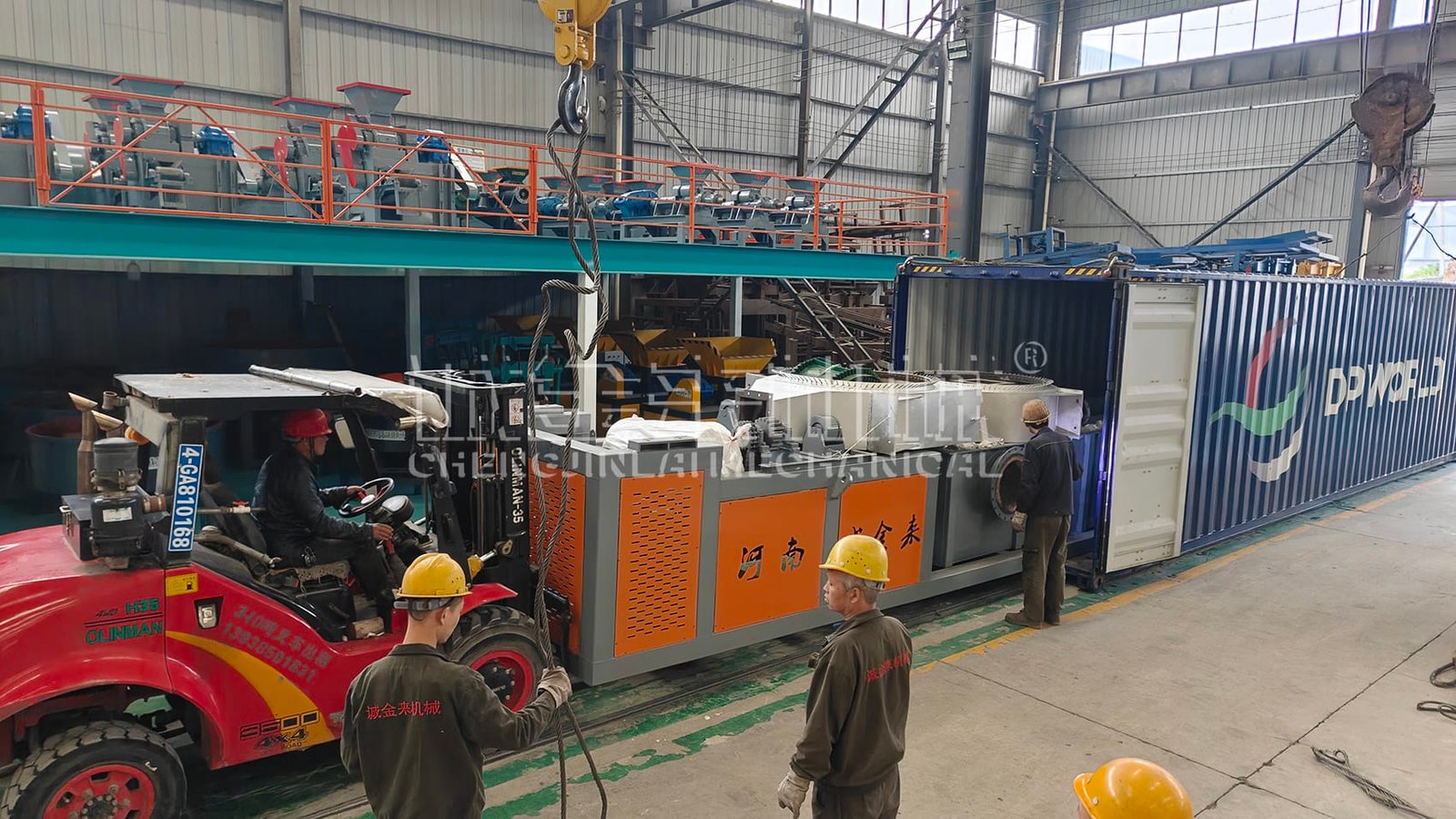
What a Horno de carbonización continua Actually Is?
A continuous carbonization furnace is a rotary pyrolysis system built for non-stop biomass-to-charcoal conversion. Unlike batch kilns that require cooling, unloading, reloading, and reheating, this machine accepts dried feedstock from one end and discharges cooled charcoal from the other while operating at target temperature for days. The Weiwa design uses a double-cylinder rotary body. The inner drum removes surface and bound moisture during pre-drying. The outer drum holds the oxygen-limited carbonization zone where biomass transforms into charcoal at roughly 500 a 600 grados Celsius. Material moves forward by spiral flight and drum rotation, so there is no need to pause feeding or discharging.
The continuous carbonization furnace recovers volatile gases released during pyrolysis. Those gases mainly contain carbon monoxide, metano, and hydrogen. After passing through a condensation and purification stage, the combustible portion is reignited as secondary fuel in the burner. That closed-loop heat cycle cuts external diesel or coal consumption and removes most visible smoke. For a Nigerian buyer comparing a continuous carbonization furnace price against three secondhand batch ovens, the math is not only about output per hour. It is about fuel saving, labor shift reduction, and charcoal grade consistency across every bag.
Double Cylinder Rotary Structure Explained
The inner drying drum and outer carbonization drum share one inclined shaft. Biomass enters the higher end, tumbles through the drying section, drops into the carbonization section, and exits through a water-cooled discharger. Because the two stages are separated, wet agricultural residue such as cassava stalks or high-moisture sawdust can be pre-treated upstream and still carbonize evenly. In the Nigeria unit we shipped, the client paired the furnace with a rotary dryer and a 30-mesh screening unit, so palm kernel shell and coconut shell fragments move through the line without bridging.
Why Gas Recovery Matters in the Nigerian Context?
Nigeria has abundant biomass but unstable diesel pricing. A continuous carbonization furnace that burns its own syngas reduces exposure to fuel markets. During our pre-shipment trial, the furnace ran on coconut shell and sawdust mixture at 300 kilograms per hour and sustained carbonization zone temperature without auxiliary burner support after the first 40 minutos. Final charcoal showed moisture under 8 percent and fixed carbon above 75 percent. Those numbers matter for Nigerian buyers supplying shisha distributors in Kano or barbecue charcoal exporters in Port Harcourt, because premium buyers test fixed carbon before signing contracts.
Inside the Weiwa Factory Before Shipment
The dispatch to Nigeria followed the same protocol we apply to all export orders. After final welding inspection, the furnace body underwent 72 hours of no-load rotation. Sealing rings, reducer gears, thermocouple sleeves, and the gas duct flange were checked against the client’s voltage requirement of 415V/50Hz three-phase. The combustible gas pipe was pressure tested with nitrogen. The screw feeder was run with dummy biomass to confirm pitch and speed matched the agreed 800 kg/h model.
Our technical team recorded a full video trial using palm kernel shell, because that is the dominant feedstock at the client’s site. Palm kernel shell from Ondo and Rivers State is oily, denso, and prone to incomplete carbonization in earth kilns. In the continuous carbonization furnace, the shell stayed in the hot zone long enough to reach uniform black core without over-burning the outer surface. Discharge temperature after the water jacket dropped below 50 grados Celsius, which prevents spontaneous re-ignition during bagging.
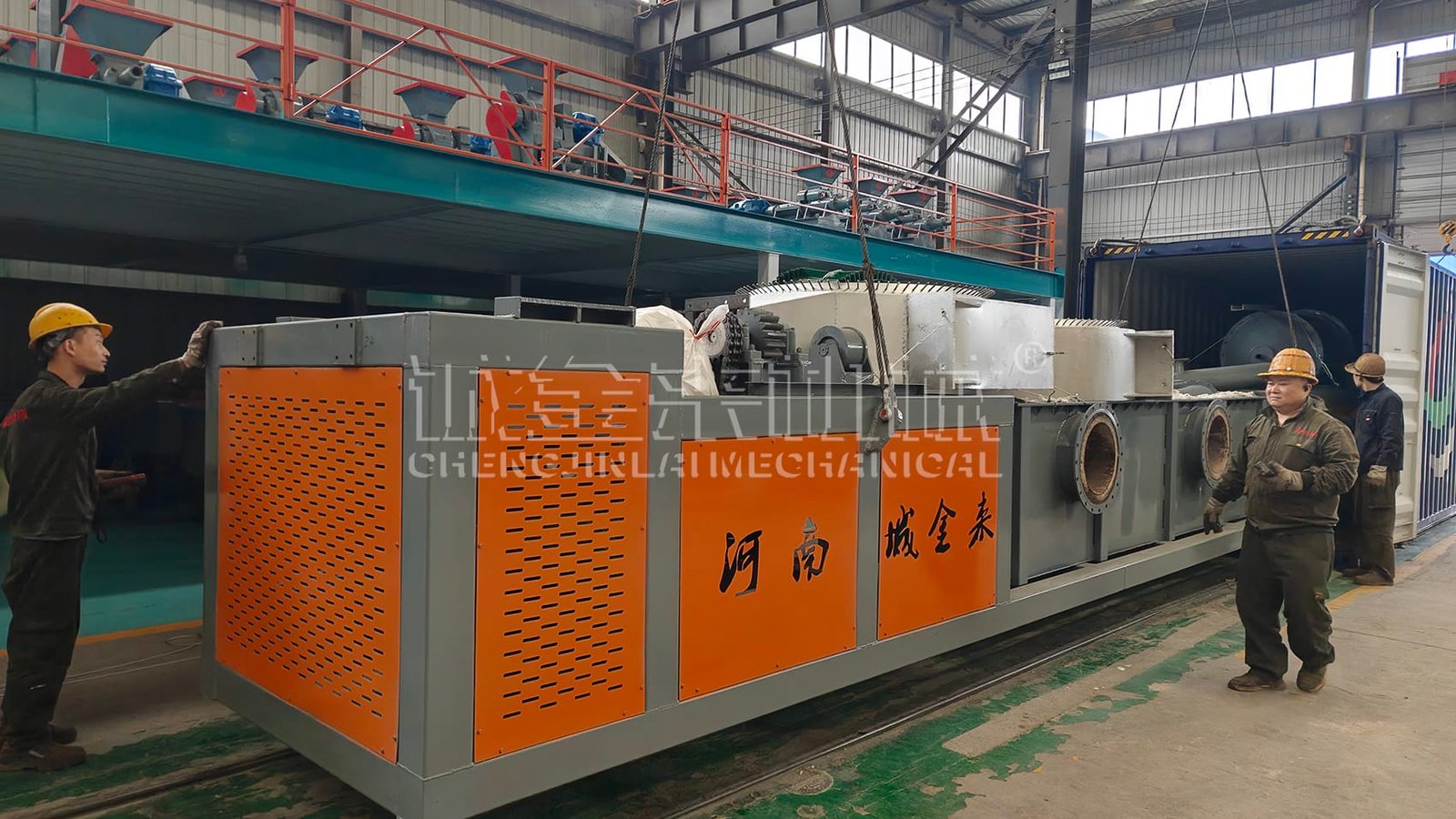
Container Loading and Spare Parts Strategy
The main furnace occupied one 40-foot high cube container. A second container held the cyclone, condenser, burner skid, electric control cabinet, spare seals, and wear plates. For Africa-bound machines, Weiwa always ships an extra set of refractory bolts and thermocouple rods, because local sourcing of high-temperature parts is slow. The client also received a laminated wiring diagram, a Chinese-English operation manual, and a WhatsApp troubleshooting channel connected to our Gongyi factory, not a reseller.
Before the containers left Zhengzhou, we bolted yellow warning plates on every rotating joint and painted the discharge hood with heat-resistant silver coating. The Nigerian client requested custom labeling in English and pidgin-friendly icons for local operators, so the control panel used START, FEED, PURGE, and EMERGENCY STOP instead of symbolic buttons alone.
Why Nigeria Is a Strong Market for Continuous Carbonization Furnace Adoption?
Nigeria consumes more charcoal than any other country in West Africa. Independent market reports estimate national wood charcoal consumption at 4.9 million tons in 2026, with Lagos, Abuja, Ibadan, and Kano driving urban demand. Encima 90 percent of that charcoal still comes from informal earth kilns with conversion rates below 20 percent. That gap is the commercial opening. A continuous carbonization furnace in Nigeria does not only make charcoal faster. It replaces a low-yield, high-deforestation method with a measured process that turns agricultural waste into sellable fuel.
The country generates massive volumes of biomass residues. Rice husk from Kebbi and Niger State, coconut shell from Lagos and Ogun coastal belt, sawdust from Calabar and Sapele sawmills, and palm kernel shell from the Niger Delta are all available year round. Most of this material is either burned openly or dumped. A charcoal making machine in Nigeria that accepts mixed biomass lets processors buy low-cost residue and sell high-grade charcoal back to the same cities that produced the waste.
Feedstock Reality Across Nigerian States
Lagos and Ogun clients usually work with coconut shell and imported hardwood offcuts. Rivers and Akwa Ibom clients lean on palm kernel shell. Kaduna and Kano processors collect groundnut shell and cotton stalk. The continuous carbonization furnace we build handles all of these, but throughput changes with bulk density. Palm kernel shell runs close to nameplate capacity. Cáscara de arroz, because of low bulk density, needs pre-compaction or slower feed. We explain this during quotation, because hiding the variance leads to bad commissioning and angry buyers.
Regulatory Pressure and Export Aspirations
Nigerian state governments are slowly tightening open-burning rules. Al mismo tiempo, Middle East and European buyers now ask for fixed carbon certificates and moisture sheets before importing Nigerian charcoal. A batch kiln cannot document residence time or temperature curve. A continuous carbonization furnace with PLC logging can. For Nigerian entrepreneurs targeting export lanes through Lagos port, the furnace is not just equipment. It is the compliance layer that makes the export paperwork believable.
Continuous Carbonization Furnace Price in the Nigeria Buying Context
Continuous carbonization furnace price varies with capacity, dryer inclusion, gas cleaning level, and voltage customization. For Nigeria, most serious inquiries fall between 800 kg/h and 1500 kg/h models. The price band typically sits above a batch kiln but below a fully automated briquette-to-roasting plant. Nigerian buyers should not compare only the furnace tag. They should calculate landed cost: machine FOB China, freight to Lagos or Tin Can, clearing and haulage to site, foundation concrete, generator backup, and first three months of spare parts.
Weiwa quotes in two ways. The first is an ex-factory quote for the furnace only. The second is a turnkey line quote covering feeder, secadora, furnace, discharger, dust removal, and control cabinet. For the recent Nigeria order, the client chose the turnkey 800 kg/h configuration because their operators had no previous pyrolysis experience. The continuous carbonization furnace price inside that package looked higher on paper, but the client avoided buying incompatible standalone dryers from three different suppliers, which is the most common way Nigerian charcoal startups waste capital.
Hidden Cost Items Buyers Forget
Foundation steel, chimney height approval from local environmental officers, and a 200 kVA generator for rural sites are not in the machine price. Neither is the cost of a 3-meter concrete platform that keeps the discharger above flood level in Niger Delta locations. When we discuss continuous carbonization furnace for Nigeria, we send a site-prep drawing before deposit, so the client builds the foundation while the machine is in transit. This compresses commissioning time from six weeks to nine days.
Charcoal Making Machine in Nigeria Versus Imported Alternatives
Many Nigerian buyers first see a charcoal making machine in Nigeria through secondhand Indian or Turkish batch ovens. Those machines are cheap but labor-heavy. A four-person crew can manage one batch kiln. The same crew can manage two continuous lines if the feeder and discharger are automated. The salary difference between one furnace and one automated line favors the line within four months.
Weiwa does not claim the continuous carbonization furnace is the cheapest option. We position it as the option that survives year two. Earth kilns collapse. Batch ovens warp. A properly lined double-drum furnace with ceramic fiber insulation and water-cooled discharge runs for years if the client respects the 15 percent moisture inlet rule. Nigerian humidity makes moisture control the number one cause of low fixed carbon. That is why we insist on a dryer in every tropical order.
After-Sales in the West Africa Time Zone
Our Nigerian client receives remote commissioning through WhatsApp video and a local agent in Lagos who stocks seals and thermocouples. Weiwa engineers join the call at 9 a.m. Nigeria time, which is 4 p.m. Gongyi time. Spare part air freight from Zhengzhou to Lagos takes three days. For a continuous carbonization furnace buyer, this matters more than a slightly lower price from a supplier with no Africa response window.
Market Outlook for Continuous Carbonization Furnace in Nigeria 2026 a 2030
We expect Nigerian demand for continuous carbonization furnace units to grow at double-digit annual rate through 2030. Three forces push this. Urban charcoal consumption keeps rising because cooking gas prices remain volatile. Agricultural waste monetization is now a state-level talking point in Ogun, Oyo, and Rivers. And young Nigerian processors who visited Indonesia or Turkey return home wanting the same rotary furnace they saw abroad, not the kilns their fathers used.
El 800 kg/h a 1000 kg/h segment will dominate early adoption. Later, 1500 kg/h and 2000 kg/h plants will appear near Port Harcourt and Calabar where palm kernel shell logistics are easiest. We also see interest in coupling the continuous carbonization furnace with a briquette press, so fines from coconut shell carbonization become pillow briquettes for European barbecue importers. That combined line turns one biomass stream into two SKUs.
Risks That Could Slow Adoption
Forex volatility affects import machinery payment. Poor road haulage from Lagos to Kano damages unsecured components. Some buyers underestimate generator sizing and blame the furnace for voltage trips. None of these are furnace defects. They are project-management gaps. Weiwa mitigates them by sending a pre-installation checklist and refusing to ship until the client confirms foundation and power readiness.
How Weiwa Configures a Furnace for Nigerian Conditions?
Every continuous carbonization furnace for Nigeria receives tropical adjustments. Electrical cabinets get IP55 rating and anti-mold coating. Bearings get high-temperature grease rated for 40-degree ambient workshop heat. The gas duct gets extra wall thickness because palm kernel shell ash is abrasive. The control system stores English and Chinese labels, but we add Yoruba and Hausa safety terms on the physical machine stickers if the client requests.
Capacity is never promised on marketing guesswork. We ask for a 5-kilogram feedstock sample and run it in our Gongyi trial room. Only after measuring moisture, bulk density, and carbonization curve do we confirm the model number. This protects the buyer from ordering a 1200 kg/h machine that physically cannot process fluffy rice husk at that rate. The continuous carbonization furnace price we send is therefore tied to a tested number, not a brochure number.
Commissioning Sequence on Arrival
When containers reach the Nigerian site, the sequence is foundation check, main body placement, dryer alignment, gas pipe welding, electrical connection to client generator, no-load rotation, and finally 8-hour coconut shell trial. Only after charcoal samples pass fixed carbon and moisture review does Weiwa sign off. The recent Lagos-bound client already passed the factory trial in China, so their on-site run will focus on feeder calibration and local biomass mixing ratio.
Field Notes From the Dispatch Day
On loading day, the Gongyi workshop ran two shifts. The furnace drum was wrapped in woven film, then shock-proof blanket, then steel frame, because Lagos port handling is not gentle. The burner skid was bolted to a wooden crate with desiccant bags inside, since ocean humidity corrodes untreated steel. The control cabinet traveled upright with foam blocks between relays. Our QC inspector stamped the inspection sheet with the order number NGA-CCF-0426, which the client can trace against the certificate of conformity.
One detail worth mentioning: the Nigerian buyer asked for a manual gate on the feeder in addition to the variable-speed screw, so workers can stop feed instantly during power fluctuation. Weiwa added it at no extra charge because in Nigeria, generator changeover gaps are real. That is the kind of field adaptation that separates a continuous carbonization furnace built for export from one copied from a domestic batch design.
Closing View on the Nigeria Charcoal Shift
The continuous carbonization furnace shipped this month is not a one-off sale. It is part of a wider movement where Nigerian charcoal producers stop competing on who has cheaper labor and start competing on who has consistent calorific value, clean documentation, and reliable weekly tonnage. Cities like Lagos will not accept dirty smoky charcoal forever. Distributors in Abuja already reject batches above 10 percent moisture. The furnace is the tool that lets a small Ogun processor meet those specs without hiring a chemist.
Weiwa Machinery will keep publishing trial data, shipment records, and Nigerian feedstock results so buyers can plan with numbers instead of rumors. A continuous carbonization furnace is a long-cycle investment. The right way to buy it is to understand pyrolysis temperature, gas recovery, moisture limits, and true landed cost before paying deposit. The wrong way is to chase the lowest continuous carbonization furnace price and discover six months later that the machine cannot handle palm kernel shell at rainy season moisture.
Acerca de Maquinaria de Weiwa
Weiwa Machinery is a biomass equipment manufacturer based in Gongyi, Zhengzhou, Henan, Porcelana. We design and export continuous carbonization furnaces, Prensa de briqueta, secadores rotativos, and wood crushers to clients in Nigeria, Arabia Saudita, Indonesia, Pavo, Kenia, and Ghana. Our double-cylinder rotary furnaces are built for 24-hour operation, recuperación de gas combustible, and tropical site conditions. Each export unit is trial-run on the client’s actual feedstock before container loading.
We do not outsource our core drum welding. We do not rename batch ovens as continuous systems. And we do not disappear after Telegraphic Transfer clears. Nigerian buyers can reach our team directly by phone or WhatsApp at +86 13838093177, by email at info@cjlmachinegroup.com, or through the product page at cjljx.com/products/tanhua/continuous-carbonization-furnace. For a continuous carbonization furnace price tailored to your state, feedstock, and target tonnage, send a 5 kg sample and your site power profile. We reply with a tested configuration, not a generic PDF.
Weiwa Machinery treats every furnace as a production line, not a metal barrel. The Nigeria shipment leaving our yard this quarter carries that standard across the ocean, into Lagos port, and onto a concrete foundation where it will run its first coconut shell trial under African sky.


 Veloz
Veloz

 +8615937143060
