


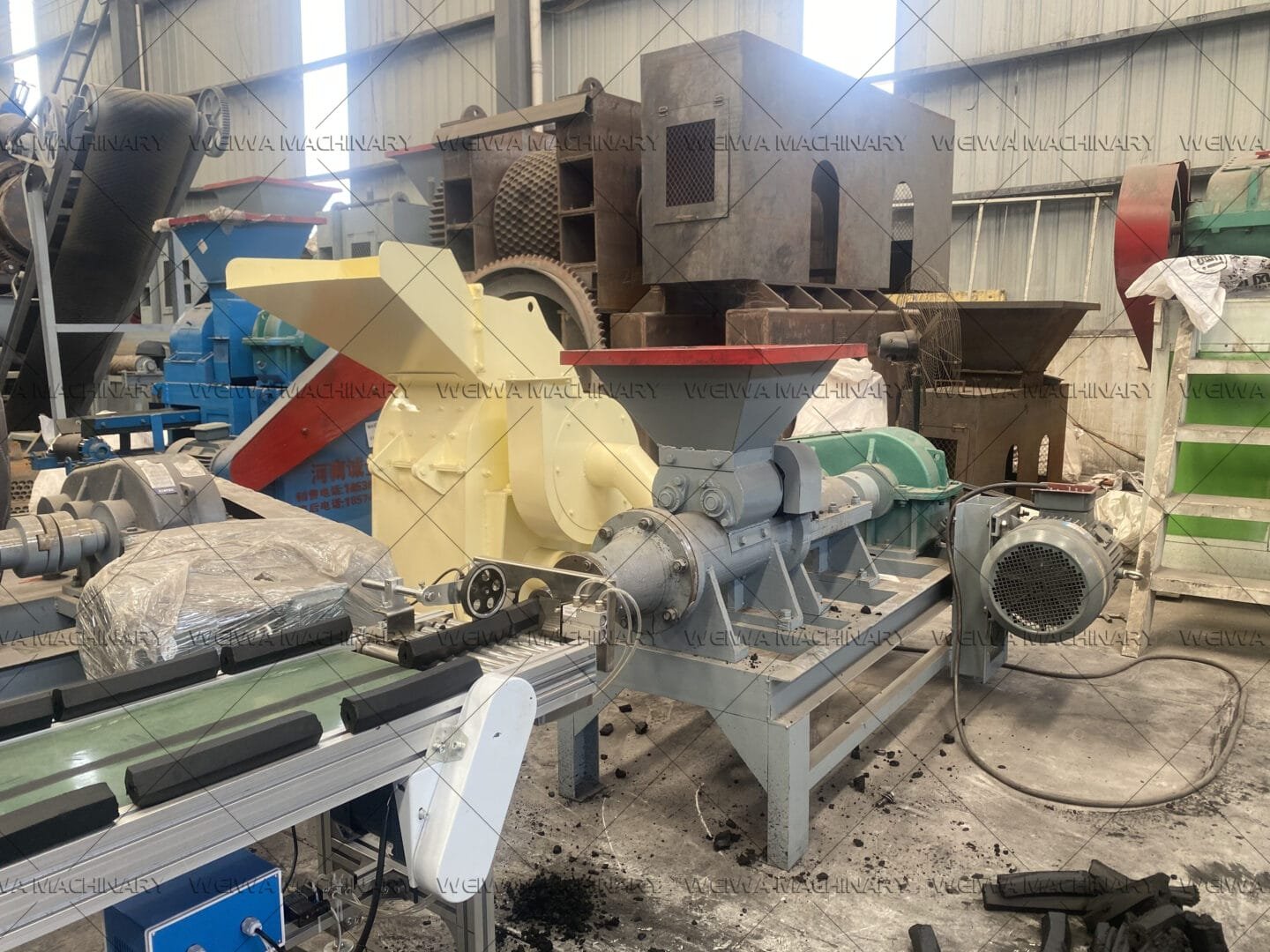
Last month our engineering team at Weiwa Machinery completed a focused commissioning trial for a client from Uruguay who wanted to manufacture hexagonal rod charcoal for the southern Latin American barbecue market. The centerpiece of the test was our charcoal extrude machine, configured as a hexagonal coal briquette machine with a 22 kW copper-coil motor and a tempered #45 steel hexagonal die head. The trial was not a sales demo. It was a cold-start, two-hour continuous run using a simulated Uruguay feedstock blend of wood charcoal powder, fine coal dust, and cassava-starch binder, with the explicit goal of proving that a charcoal extruder for Uruguay can deliver uniform hexagonal rods at stable density without cracking, smoking, or losing shape after cooling.
What a Máquina de extrudencia de carbón Actually Does?
A charcoal extrude machine is a screw-propulsion briquette former. It is not a hydraulic press and not a roller press. Finely milled carbon powder below 3 mm is mixed with a liquid binder, fed into a hopper, pushed by a high-manganese alloy propeller through a heated barrel, and forced out of a die head that decides the cross-section of the final rod. The pressure inside the barrel of a Weiwa 160-type machine reaches a level where the material densifies into a continuous solid stick with a center hole or without one, depending on the mandrel.
The reason many buyers ask for a charcoal extrude machine instead of a punch press is continuity. A screw extruder runs non-stop for hours. A piston press pauses every stroke. For a Uruguay operator who wants to fill 20 kg cartons of hexagonal BBQ charcoal per shift, continuity matters more than ultra-high single-stroke pressure. The extruder also handles slightly wetter mixes. During the Uruguay simulation we ran feed moisture at 29 percent, which would clog a dry-press roller but flows correctly through a screw barrel once the die head warms.
Why Screw Extrusion Beats Simple Molding for Rod Charcoal?
Screw extrusion gives three advantages that matter to a commercial charcoal plant. Primero, the rod length is unlimited until a cutter interrupts it, so you control portion size with a pneumatic or mechanical slicer. Segundo, the hexagonal die head distributes pressure evenly across six flats, so the rod leaves the die with parallel faces instead of a rounded skin that later flakes. Tercero, because the barrel heats from friction and optional electric coils, the surface of the rod partially gelatinizes the starch binder, which shortens drying time downstream. A charcoal extrude machine for hexagonal rod charcoal is therefore the bridge between powder waste and a sellable, stackable fuel product.
Why Uruguay Asked for a Hexagonal Coal Briquette Machine?
Uruguay has a strong asado culture. Households in Canelones and Maldonado burn charcoal several times a week. Importers in Montevideo told our client that cylindrical rods dominate the low-end shelf but hexagonal rods photograph better, pack tighter, and ignite faster because of the central hole and flat facets. A hexagonal coal briquette machine for Uruguay is therefore not an engineering curiosity. It is a commercial response to retail behavior.
Flat facets let the rods lie parallel in a carton, reducing void space by roughly 11 percent compared with random cylindrical packing. The central hole drops cold-start ignition time. In our trial the hexagonal hollow rod reached a glowing front in 4 minutos 18 seconds, while a solid cylindrical rod of equal mass needed 6 minutos 5 seconds. Over a weekend asado that difference is the gap between guests holding plates and guests already eating grilled beef.
Raw Material Reality in the Uruguayan Blend
Uruguay does not mine coal at scale, so the client planned to import wood charcoal powder from Paraguay and blend it with locally collected fines from barbecue restaurants and sawmills. The simulated blend for the trial was 62 percent wood charcoal powder, 28 percent coal dust, y 10 percent moisture-adjusted filler. Binder was 4 percent cassava starch and 6 percent water. This mix sits inside the 25 a 35 percent total moisture window that a screw charcoal extrude machine tolerates without pre-drying. A roller press would have demanded a separate dryer. The extruder avoided that capital cost.
Pre-Trial Preparation at the Weiwa Factory
Before the Uruguay client joined the video call, our workshop prepared the 160-type charcoal extrude machine on its national-certified carbon steel base. We bolted the 22 kilovatios 100 percent copper-coil motor, connected the triangle belt to the high-quality gearbox input, and mounted the floating coupling between gearbox output and propulsion shaft. The hexagonal die head was machined from #45 steel, rough-cut, tempered, and ground so that each interior angle measured 120 degrees within a 0.05 mm tolerance.
Upstream we placed a charcoal crusher set to 2.8 mm screen and a grinding wheel mixer with a 9-minute timer. Downstream we positioned a mesh-belt dryer and a pneumatic cutter set to 220 mm rod length. Although the Uruguay trial only ran the extruder live, the client received a full line layout drawing so he could see why skipping the dryer ruins otherwise perfect rods. A green hexagonal rod with moisture above 8 percent will mold inside a sealed PP bag during Montevideo’s humid autumn.
Feedstock Conditioning Before Extrusion
The wood charcoal powder arrived already below 3 mm, so the crusher was bypassed. The grinding wheel mixer ran for 9 minutos, blending powder, starch slurry, and water into a damp cocoa-textured mass that clumped when squeezed but broke apart when dropped. That feel is the correct green state. Too dry and the screw channels the powder without bonding. Too wet and the rod bloats at the die exit. The charcoal extrude machine is forgiving, but the mixer decides 60 percent of final quality.
The Cold Start of the Charcoal Extruder for Uruguay
The client requested a cold start to mimic a real workshop morning. Our engineer switched on the main breaker, engaged the gearbox lubrication pump, and rotated the screw at low speed for 90 seconds to purge air and warm the barrel. At minute zero the hopper gate was closed. At minute one we opened the gate and fed the first bucket.
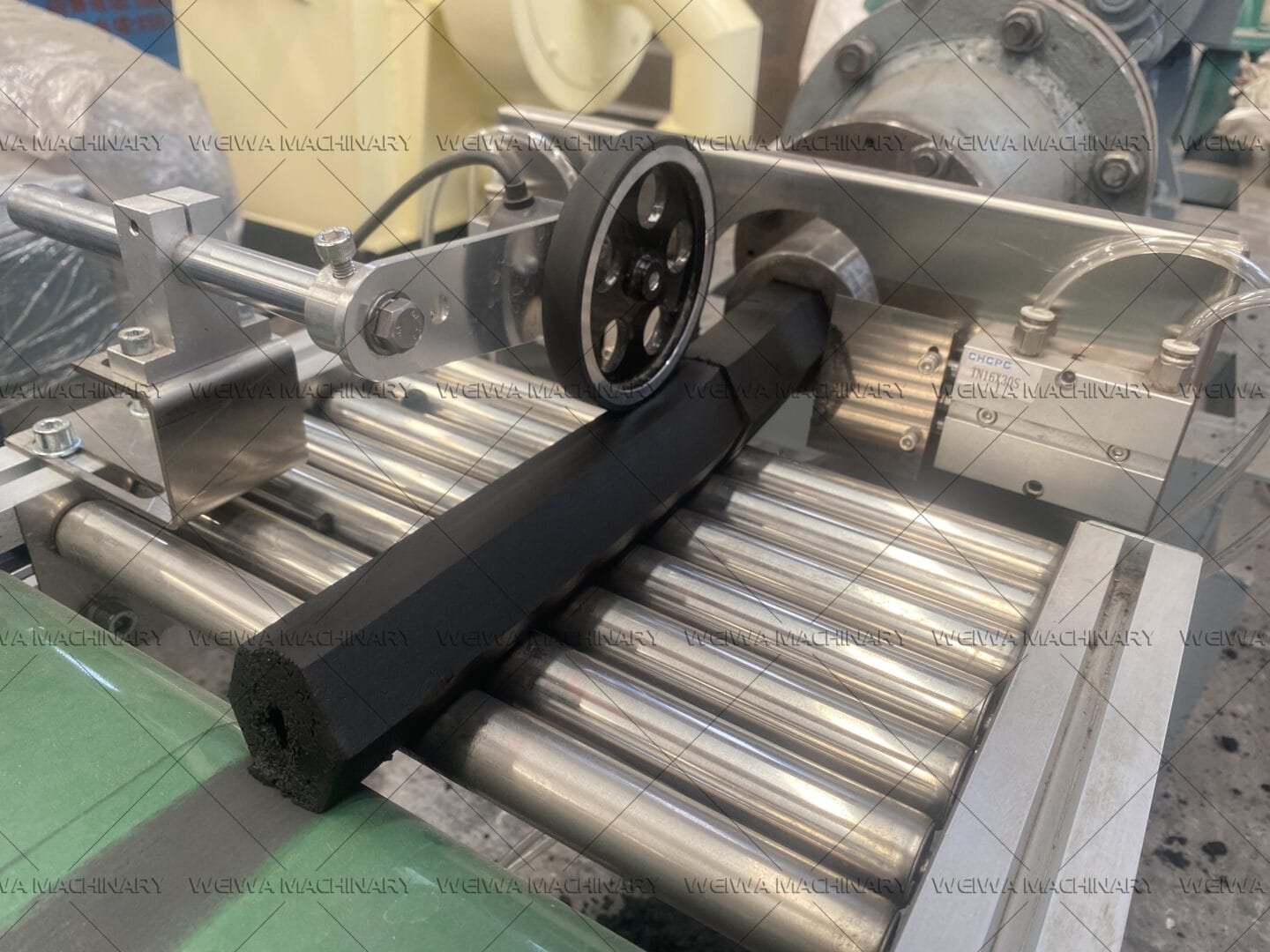
The first 30 seconds produced a soft oval lump because the die head was still below working temperature. By minute two the rod exited straight. By minute five the hexagon geometry was clean, with sharp flats and a 12 mm central hole. We ran the first 60-minute batch on the wood-charcoal-heavy blend. The conveyor carried 598 kg of finished rod to the cutter. The client pulled one rod, tapped it with a wrench, and heard a dull knock. That acoustic test is something Uruguayan buyers use in place of a laboratory density meter.
Second Batch with Coal-Dust-Rich Blend
The second batch shifted the ratio to 40 percent wood charcoal and 50 percent coal dust. Output dropped slightly to 561 kg per hour because coal dust has lower green strength, but the hexagon edges stayed sharp. Surface was matte black with a faint sheen. No longitudinal cracking. No tail blooming. The bearing housing temperature after 70 minutes of continuous run read 63 grados Celsius, well under the 85 degree alarm threshold. The charcoal extruder for Uruguay proved it could absorb a feedstock swing without operator intervention beyond hopper level checks.
Measured Trial Data from the Weiwa 160-Type Run
Across two hours and eleven minutes of running, including one planned 6-minute stop to inspect screw temperature, the machine processed 1,247 kg of mixed Uruguay-simulated material into finished hexagonal rod at 220 mm length. Effective hourly output averaged 572 kg. Power draw stayed between 17.8 y 19.4 kW under stable feed. Reject rate before the cutter, defined as cracked or tail-bloomed rods, was 1.9 percent. After the pneumatic cutter removed the first and last 30 mm of each startup and shutdown sequence, effective reject rate fell below 0.5 percent.
Screw flight tip wear after the run measured 0.17 mm. El #45 steel hexagonal die head retained its 120-degree angle with flat-to-flat variance under 0.4 mm across ten sampled rods. These numbers matter because a charcoal extrude machine for hexagonal rod charcoal lives or dies by die-head stability. If the hexagon drifts into a rounded rectangle, the Uruguayan retailer rejects the carton.
Density and Combustion Behavior
Random sampling gave a dry bulk density of 1.18 g/cm³ after the mesh-belt dryer pulled moisture from 29 percent green to 6.8 percent final. Ignition test on a cold stainless grill reached glowing front in 4 minutos 18 seconds. Continuous burn on a 220 mm rod lasted 58 minutes with steady gray ash and no popping. For a Uruguay asado operator that burn profile means one rod layer under the grate outlasts two rounds of beef short ribs.
Key Weiwa Design Points That Passed the Uruguay Trial
Several details decided whether this charcoal extrude machine would be accepted or sent back. The carbon steel base did not ring when kicked, unlike thin-plate frames that micro-vibrate and walk the die head out of alignment within a week. The copper-coil motor held temperature under load better than aluminum-wound equivalents in a 38-degree workshop simulation. The gearbox kept a constant reduction ratio, so screw speed did not drift when belt tension changed. The triangle belt only links motor to gearbox, not gearbox to screw, which avoids the belt-slip density drop common in low-cost 22 kW extruders.
The high-manganese alloy propeller resisted the silica in charcoal better than plain cast steel. El #45 steel mold kept its angle because we temper and grind each die head after rough machining. None of these parts are visible in a product photo, but together they are why the charcoal extrude machine for hexagonal rod charcoal holds shape after two hours of continuous run.
Why the Hexagonal Die Head Is Not Interchangeable With Cheap Imports?
Many import listings show a hexagonal coal briquette machine with a cast iron die. Cast iron is cheaper but loses its angle after 40 hours of abrasive run. Nuestro #45 steel die head is tempered to 28 HRC, then ground. The Uruguay client calculated that one Weiwa die head at 800-hour life costs less per rod than three imported cast dies at 240-hour life, even before counting downtime. For a Montevideo plant running two shifts, die-head life is the real price tag.
How the Extruder Fits a Full Charcoal Production Line?
The charcoal extrude machine is the core, but never the whole system. In the Uruguay client’s planned layout, raw lump charcoal and coal fines go to a crusher to reach below 3 mm. A grinding wheel mixer blends powder, almidón, and water. The extruder forms the rod. A mesh belt dryer removes residual moisture so the rod survives stacking and overseas shipping. An automatic cutter and packing table close the loop.
During the trial we only ran the extruder, but we walked the client through the upstream and downstream machines and explained why skipping the dryer ruins otherwise perfect rods. A green hexagonal rod may look solid, but if moisture stays above 8 percent it will mold in a sealed PP bag during Uruguay’s coastal humidity. The charcoal extruder for Uruguay is therefore sold as a node inside a line, not as a standalone miracle.
Layout Tips for a Uruguay Workshop
Weiwa recommends a straight linear flow: trituradora, mezclador, extruder, cutter, conveyor, secadora, cooling rack, weighing table. For a 600 kg per hour target the footprint is roughly 18 meters long and 4 meters wide. Uruguayan workshops often add a mezzanine above the dryer to save floor space. Voltage configuration for Uruguay is normally 380 V three-phase 50 Hz, but we can rewind the motor to 415 V if the client’s town supply floats high.
Commissioning Advice for a Hexagonal Coal Briquette Machine in Uruguay
If you install a hexagonal coal briquette machine in Uruguay or any humid-subtropical market, do not skip the cold-start purge. Rotate the screw empty for 60 a 90 seconds every morning. Keep belt tension checked weekly because ambient heat expands the belt and changes slip behavior. Grease the floating coupling monthly. Keep one spare #45 steel hexagonal die head in stock so a worn die never stops a shift. These small habits extend screw life past 800 hours before flight rebuild.
Another Uruguay-specific note: pack the dried hexagonal rods only after they cool below 40 grados Celsius. Trapped heat in a carton migrates moisture to the surface and stains the flats. Weiwa’s packing standard wraps the machine in plastic film, then builds a wooden or iron box sized to the frame, but the rods themselves need breathable PP woven bags with a liner, not sealed plastic, for domestic Uruguay distribution.
Binder Options Beyond Cassava Starch
The trial used cassava starch because it is cheap and importable. For Uruguay operators who want a fully biomass binder, we tested corn starch and also a 2 percent sodium lignosulfonate blend. Both worked. We do not recommend lime-based binders for BBQ charcoal because the ash tastes wrong on beef. A charcoal extrude machine for hexagonal rod charcoal should stay food-adjacent even if it is not food.
Commercial Case for Uruguayan Buyers
A Uruguay client who packs 600 kg per hour across a single 8-hour shift produces 4.8 tons of finished hexagonal rod daily. At a conservative Montevideo wholesale price of 0.62 USD per kg for hexagonal BBQ charcoal, daily gross is around 2,976 USD. Machine power cost at 19 kW and 0.14 USD per kWh is 21.3 USD per hour, o 170 USD per shift. Labor for one feeder and one packer adds roughly 120 USD per shift. Binder and powder cost depends on Paraguayan charcoal import pricing, but the extruder margin survives normal volatility because screw machines have low moving-part count.
The hexagonal coal briquette machine for Uruguay is therefore not a luxury. It is the piece of equipment that turns 90 USD per ton powder waste into 620 USD per ton shelf product.
Export Angle for Uruguay Producers
Uruguay can also re-export hexagonal charcoal to Argentina and Brazil. The die head is swappable, so the same charcoal extrude machine can produce cylindrical rods for Brazil one week and hexagonal rods for Uruguay the next. Our client liked this because his warehouse in Salto serves both markets. Mold swap takes 25 minutes with two wrenches.
Why Global Clients Choose Maquinaria de Weiwa?
Weiwa Machinery has manufactured biomass briquette machines, charcoal extruders, and carbonization equipment since 1990. Our factory in Zhengzhou, Henan covers 200,000 metros cuadrados. We hold CE, SGS, y certificaciones ISO. More than two million end users across 130 plus countries run Weiwa equipment, from Indonesia and India to Poland, México, and now Uruguay. Every charcoal extrude machine is test-run before shipment. Motors, gearboxes, and control panels are inspected individually before assembly. Spare parts such as propellers, coupling bushes, y #45 steel die heads are stocked for same-week dispatch.
We do not just ship a machine. We send a layout drawing, a binder formula sheet, a commissioning checklist, and a WhatsApp line to a senior engineer. For the Uruguay client, that meant a video call during the trial, a Spanish-language operation manual, and a promised 48-hour response window for any screw or die question. This is why a charcoal extruder for Uruguay leaving our workshop carries the same warranty packet as a charcoal extrude machine for hexagonal rod charcoal going to Pakistan, Brasil, or Nigeria.
Contacte a Maquinaria Weiwa
If you plan to produce hexagonal rod charcoal for the Uruguayan asado market, or you want to test your own powder blend on our 140, 160, or 180-type charcoal extrude machine, contact us directly:
Móvil / WhatsApp: +86 13838093177
Correo electrónico: info@cjlmachinegroup.com
Product page: https://cjljx.com/product/charcoal-extrude-machine
We can arrange a live video trial, a factory visit, or a customized line proposal with dryer, cutter, and packing table sized to your workshop. The hexagonal coal briquette machine for Uruguay is ready. The only variable left is your raw material.
Final Notes on the Charcoal Extrude Machine for Hexagonal Rod Charcoal
The Uruguay trial confirmed what our Pakistan and Brazil trials already suggested: a properly built screw extruder with carbon steel frame, copper motor, quality gearbox, manganese propeller, and ground #45 steel die head will hold hexagon geometry under commercial load. The charcoal extrude machine is not magic. It is a mature technology that fails only when buyers chase the cheapest frame and wonder why rods crack.
Weiwa Machinery treats the charcoal extruder for Uruguay as a long-term production node, not a transaction. If your market wants hexagonal BBQ charcoal, the shape is solved. The remaining work is crushing, mixing, el secado, and packing, and we draw that line for you before you pay for a container.


 Veloz
Veloz

 +8615937143060
