


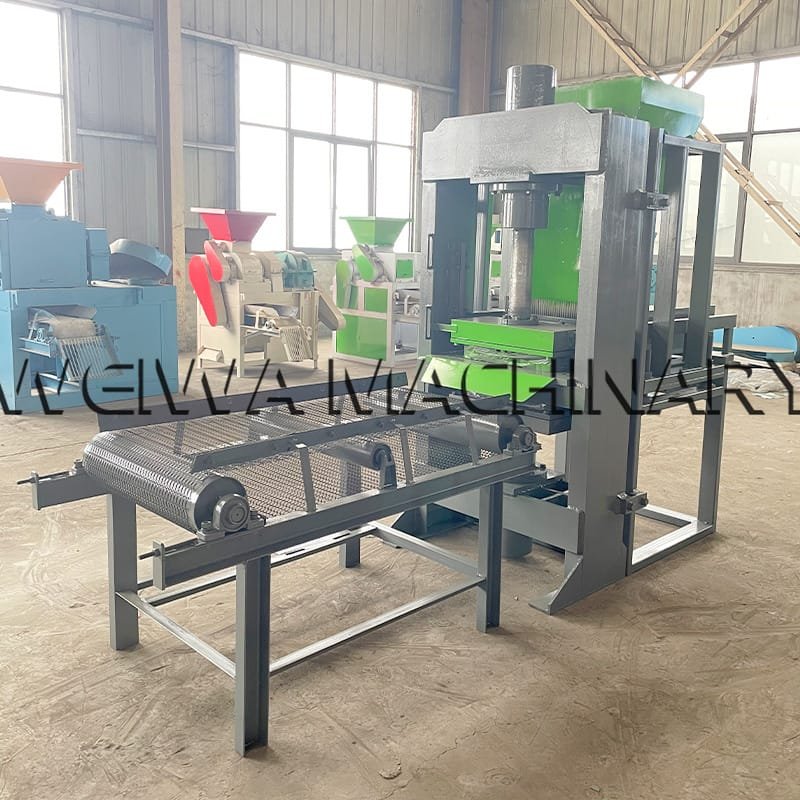
Morocco Charcoal Market and the Shift to Hydraulic Briquette Machine
Morocco is one of the most stable and quality-sensitive charcoal importer and producer markets in North Africa. Unlike pure low-price bulk markets, Moroccan buyers and brand owners care about cube uniformity, low ash, long burn time, and smokeless ignition because many of their end customers resell to cafes, hoteles, and EU-oriented shisha lounges. A hydraulic briquette machine for Morocco is not just a compressor. It is the core device that decides whether a local factory can move from selling loose powder to selling branded, high-density cubes.
The hydraulic press briquetting machine applies 100 a 200 tons of static pressure through a PLC-controlled cylinder. That level of force produces shisha charcoal with a smooth surface, sharp edges, and a density that survives shipping from Fez to Marseille. For a Morocco investor, this means entering a segment where price per kilogram is higher and buyer loyalty is stronger.
Factory Trial of Hydraulic Press Briquetting Machine with Morocco Client
We invited the client to stand next to the hydraulic briquette machine on the shop floor. Our team prepared his material in five stages: carbonized coconut shell crushing, sieving below 3 mm, binder mixing with starch and water, aging for twenty minutes, and feeding into the hopper. The PLC panel showed pressure, stroke count, and cycle time. We started at 120 montones, then moved to 160 montones, then 185 montones. En 160 montones, the hydraulic briquette press produced 25 mm square cubes with a matte but clean face. En 185 montones, density increased but cycle time slowed slightly, so we settled at 170 tons as the sweet spot for his recipe.
Raw Material Preparation for Morocco Samples
One concern for any hydraulic briquette machine for Morocco is raw material variance. Morocco has coastal cities importing coconut shell charcoal from West Africa and inland workshops using local olive tree prunings, almond shell, and pine offcuts. We tested three blends. Blend A was 80 percent coconut shell charcoal and 20 percent wood charcoal. Blend B was 60 percent coconut shell and 40 percent olive pit carbon. Blend C was 100 percent local hardwood charcoal fines collected from a Fez workshop. All three reached acceptable cube hardness after binder tuning, which proved the hydraulic press briquetting machine is not locked to one feedstock.
Pressure Tuning on the Hydraulic Briquette Press
Pressure is not a single number. It is a curve. The Morocco client watched the PLC screen while we adjusted pre-pressure, main pressure, dwell time, and ejector delay. Pre-pressure removed air from the powder. Main pressure fused particles. Dwell time allowed micro cracks to close. Ejector delay prevented bottom edge chipping. After tuning, cube weight stayed within plus or minus one gram across 400 consecutive pieces, which matters for export carton labeling.
Mold Change and Shape Customization
The client pressed three shapes in one day: classic square shisha, 33 mm round BBQ disc, and a custom hexagonal cube for his private label. Switching molds took eighteen minutes including cleaning the lower ejector. Our hydraulic briquette press accepts cubic, redondo, hexagonal, finger shape, and fully customized cavity geometry. For Morocco, where Turkish and Indonesian cubes already sit on shelves, shape differentiation is part of brand positioning, not a luxury.
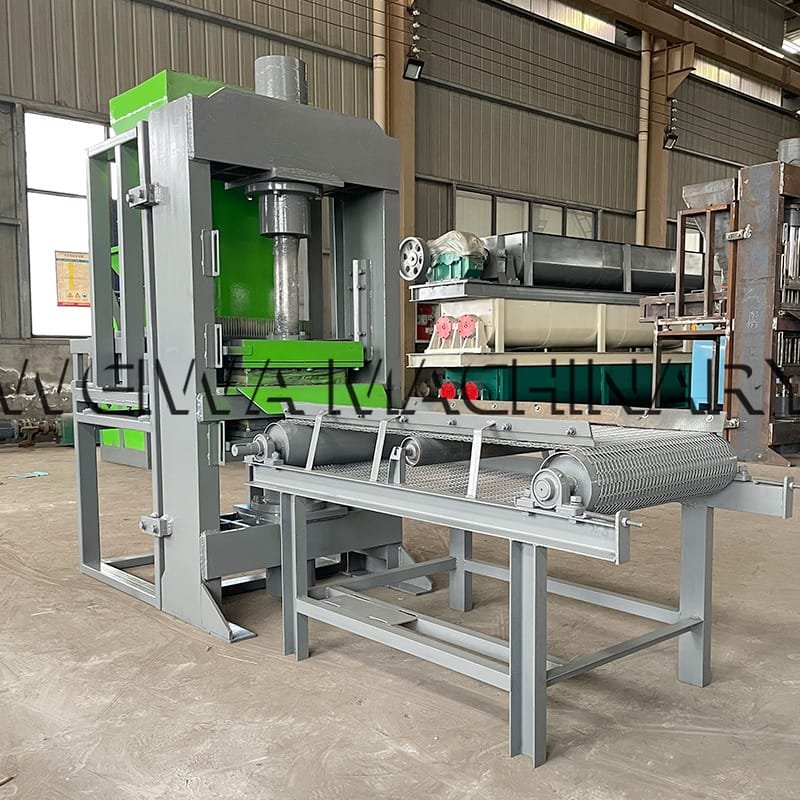
Por qué Hydraulic Briquette Machine Outperforms Mechanical Press for Shisha?
Morocco clients often ask why we recommend a hydraulic briquette press instead of a roller ball press. The answer is product positioning. Roller presses are excellent for oval BBQ balls at high volume. Screw extruders are good for cheap stick charcoal. But when the target is 25 mm square shisha tablets, hexagonal hookah cubes, or finger-shape BBQ charcoal with a premium finish, the hydraulic press briquetting machine gives better edge definition and less cracking.
In our factory trial, the Morocco client’s coconut shell blend reached a tablet hardness that did not chip after a one-meter drop test, which is a common quality check for export cartons. A mechanical punch press often leaves internal pores because impact force rebounds. A hydraulic briquette machine builds force, holds it, and releases it slowly, so fine particles slide and lock instead of shattering.
Market Potential of Hydraulic Briquette in Morocco
The phrase hydraulic briquette in Morocco is not just an export keyword. It describes a real shift. Moroccan shisha cafes increasingly reject lump charcoal that sparks and smells. Supermarkets in Casablanca and Agadir now stock 1 kilogram boxes of machine-made cubes. Barbecue culture around Marrakech rooftops and coastal seafood grills demands consistent ignition. A local hydraulic briquette machine for Morocco turns low-cost fines into a product that competes with Turkish and Indonesian imports on the shelf.
Shisha Lounge and BBQ Demand in Casablanca and Marrakech
Casablanca and Rabat have dense shisha lounge networks supplying middle-income consumers who expect quick-lighting, low-smoke charcoal. Marrakech and Agadir add tourism-driven BBQ demand where chefs pay more for uniform discs that cook fish evenly. A single hydraulic press briquetting machine running two shifts can feed several city distributors if paired with a dryer and weighing unit. The Morocco client estimated his wholesale margin between loose powder waste and branded cubes covered labor, aglutinante, and power with room for reinvestment.
Using Olive Shell Almond Shell and Coconut Shell Powder
Morocco does not need to import all feedstock. Olive shell from Meknes, almond shell from Beni Mellal, and pine offcut from the Atlas region are available as carbonization input. Coconut shell charcoal still arrives from Ivory Coast and Nigeria, but blending it with local biomass lowers cost per ton. The hydraulic briquette press handles mixed powders because pressure and dwell are adjustable per recipe. This flexibility is why hydraulic briquette in Morocco fits both import-substitution and export-grade strategies.
How to Build a Small Hydraulic Briquette Line for Morocco Workshop?
A single hydraulic press is not a business. The business is the line around it. For the Morocco client we proposed a 500 kilogram per hour layout: horno de carbonización, hammer crusher, rotary sieve, double shaft binder mixer, buffer silo, the hydraulic briquette machine, mesh belt dryer, and semi-automatic weighing machine.
Workshop space needed was about 120 square meters for a 500 kilogram per hour line, with separate rooms for crushing and drying to avoid cross contamination of charcoal dust. We gave the client a CAD drawing showing material flow from intake on the north wall to packed bags on the south wall, minimizing manual carrying. Morocco runs mainly on 380V 50Hz three-phase, so we configured the hydraulic briquette press panel with a surge protector and a 15 percent tolerance transformer for rural voltage drop.
The dryer deserves special attention. Moroccan coastal humidity prevents sun drying at commercial scale. A heat pump dryer with PLC control brought cubes from 18 percent moisture to below 6 percent in seven hours. Dried cubes passed the snap test and showed no surface crazing after 48 hours in open air. Without proper drying, even a perfect hydraulic briquette machine for Morocco will ship fragile goods.
Why Choose Weiwa Machinery for Your Hydraulic Briquette Project?
Weiwa Machinery has more than thirty years of experience in charcoal and briquette equipment manufacturing. We are not a trading company reselling unknown presses. Our team engineers the hydraulic pump station, PLC cabinet, mold set, and cylinder seals together so the hydraulic press briquetting machine performs in 40 degree summer workshops and dusty winter rooms alike.
We provide customized service including design drawings, site planning, mold customization, raw material testing, and on-site installation. Our after-sales team responds with spare parts kits, video troubleshooting, and English or French communication when needed. For the Morocco client, we intentionally ran the hydraulic briquette press for two hours non-stop to show heat stabilization. Oil temperature rose from 28 a 46 degrees and stayed there thanks to the cooler. The client noted this mattered more than maximum tonnage claims on a brochure.
If you are evaluating a hydraulic briquette machine for Morocco, send us your raw material photos, moisture level, target shape, and daily ton goal. We will run a trial on a similar hydraulic briquette press, record pressure curves, and send you cube samples before you place an order. Welcome to visit our factory in Gongyi, Porcelana. We pick clients up from Zhengzhou airport and rail station.
Contact us for a quotation and workshop plan:
Multitud / WhatsApp: +8613838093177
Correo electrónico: info@cjlmachinegroup.com
Maquinaria de Weiwa, three decades of briquette line experience, professional after-sales, customized design drawings, and site planning. Contact us today to get your hydraulic briquette press inquiry processed.


 Veloz
Veloz

 +8615937143060
