


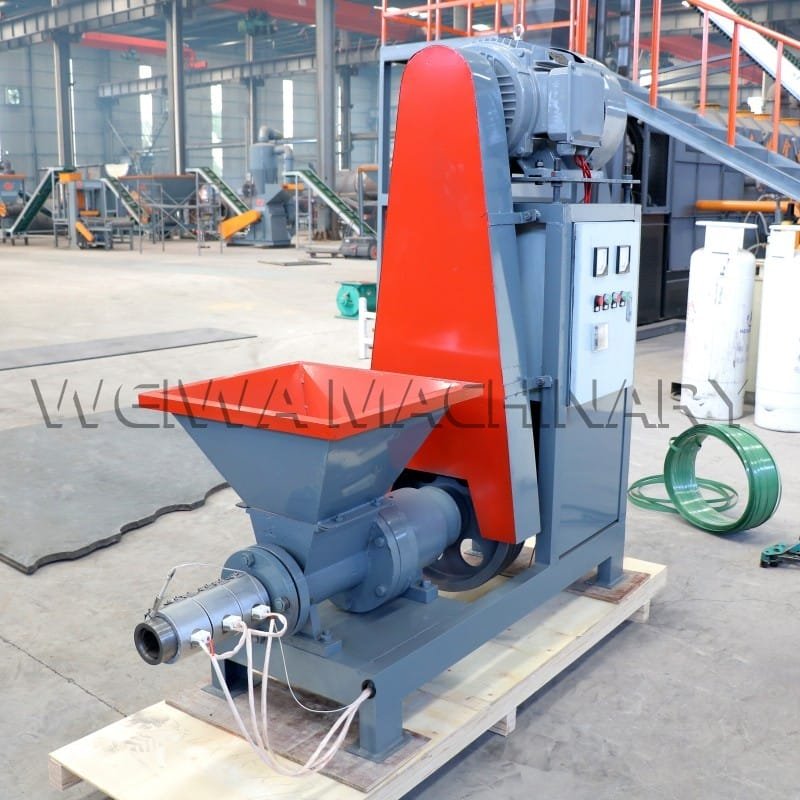
Why Mexico Buyers Are Searching for a Máquina extrusora de aserrín?
Mexico sits in a specific biomass position. The country produces large volumes of agricultural residue from sugarcane, café, corn, and forestry offcuts, while at the same time importing finished charcoal for urban barbecue consumption and exporting value-added briquettes to the United States and Central America. A charcoal making machine is no longer viewed as a single standalone gadget. Mexican investors treat it as a small factory: grinder, secadora, máquina extrusora de aserrín, carbonization kiln, cooling, and packing. The middle step, screw extrusion, is where most first-time buyers underestimate complexity.
When a buyer types sawdust extruder in Mexico into Google, they are rarely looking for a picture. They are looking for proof that the machine survives Mexican humidity, runs on 220V or 440V three-phase depending on state, and converts bagasse or pine sawdust into a dense rod that will not crumble in a masonry kiln. That is exactly the brief our Monterrey-area client gave us before ordering.
Weiwa does not sell the extruder as a toy. The sawdust extruder machine is the mechanical heart of the line. It receives dried biomass under 12 percent moisture, compresses it through a heated barrel, and forces it through a mold to form a hollow hexagonal or square stick. No binder chemical is added. The lignin released under friction heat acts as the glue. This matters in Mexico because additive-free charcoal sells at a premium in organic and restaurant supply channels.
What a Charcoal Making Machine Line Includes Before Export?
A charcoal making machine project is a chain. The extruder is only as good as the material fed into it. For the Mexico order we supplied five functional zones.
Raw Material Preparation for Tropical Biomass
Mexican feedstock is seasonal. In Veracruz and Chiapas the client planned to use coffee husk and sugarcane bagasse. In Jalisco the backup material was pine sawdust from furniture workshops. All of these behave differently. Bagasse is fibrous and springy. Coffee husk is light and dusty. Pine sawdust is oily compared to hardwood. We designed the line so the hammer mill output passed a 3 a 5 mm screen, because anything coarser than 5 mm creates voids inside the briquette and reduces calorific value.
Screw Extrusion and Lignin Bonding Basics
The sawdust extruder machine uses a large alloy screw rotating inside a barrel wrapped by a heating ring. Barrel temperature is held near 280 a 320 degrees Celsius depending on feedstock. At that point the natural lignin in the wood fiber softens. The screw applies continuous pressure of roughly 80 a 150 MPa at the die. The material exits as a glowing stick, then cools and hardens into a black briquette preform. Later it goes into a kiln for oxygen-limited carbonization.
Many Mexican buyers ask whether they can skip the dryer and feed 20 percent moisture sawdust. The answer is no. Arriba 12 percent moisture the screw slips, the barrel overheats, and the briquette surface blisters. Our Mexico client initially wanted to save on a dryer. After a video call showing a failed trial from another supplier, they accepted the rotary dryer as non-negotiable.
How the Mexico Trial Run Was Prepared?
Before any container leaves our Zhengzhou workshop, Weiwa runs a loaded trial. For this Mexico-bound charcoal making machine we ran two separate trials: one with pine sawdust from a local Henan workshop, and one with imported Mexican bagasse samples the client couriered to us. Running on the client’s actual feedstock is the only honest way to quote performance.
Factory Load Test in China Before Container Loading
We mounted the sawdust extruder machine on a steel base, connected a 75 kW main motor with a 6 kW heating ring group, and ran a 4 prueba continua de una hora. The first hour is always discarded because the barrel thermals are stabilizing. Hours two through four are recorded. We log amp draw, barrel temperature curve, die pressure by visual stick compaction, and output weight every 15 minutos.
During the pine sawdust run the extruder produced between 480 y 520 kg per hour of 70 mm hexagonal sticks. During the bagasse and coffee husk mix the output dropped to 360 a 410 kg per hour, expected because bagasse has lower bulk density and higher springback. We did not hide this from the client. The commercial proposal listed both numbers so the Mexico team could size their warehouse and kiln capacity correctly.
Voltage, Humidity and Bagasse Adjustment for Mexico
Mexican industrial voltage varies by state. The client site near Saltillo uses 440V 60Hz three-phase. We rewound the motor and selected a Siemens-compatible inverter compatible with 60Hz operation. Control panel labels were printed in Spanish. The heating ring was tuned to ramp slower because Mexican winter humidity in the north is lower than Henan summer, meaning the barrel reaches setpoint faster and can overshoot if the PID is copied blindly from China settings.
For bagasse we widened the feeder hopper and added a agitator shaft. Without that agitator, fluffy bagasse bridges above the screw throat and causes intermittent feeding. This is a small mechanical detail that separates a sawdust extruder machine for sale that ships once from one that runs for five years.
Trial Run Results from the Sawdust Extruder in Mexico
The container arrived, foundation was poured, and our remote engineer joined the commissioning on WhatsApp video. The first Mexican trial used pine sawdust purchased from a local carpentry cluster. Below are the observed numbers, not catalog claims.
Briquette Density and Calorific Value
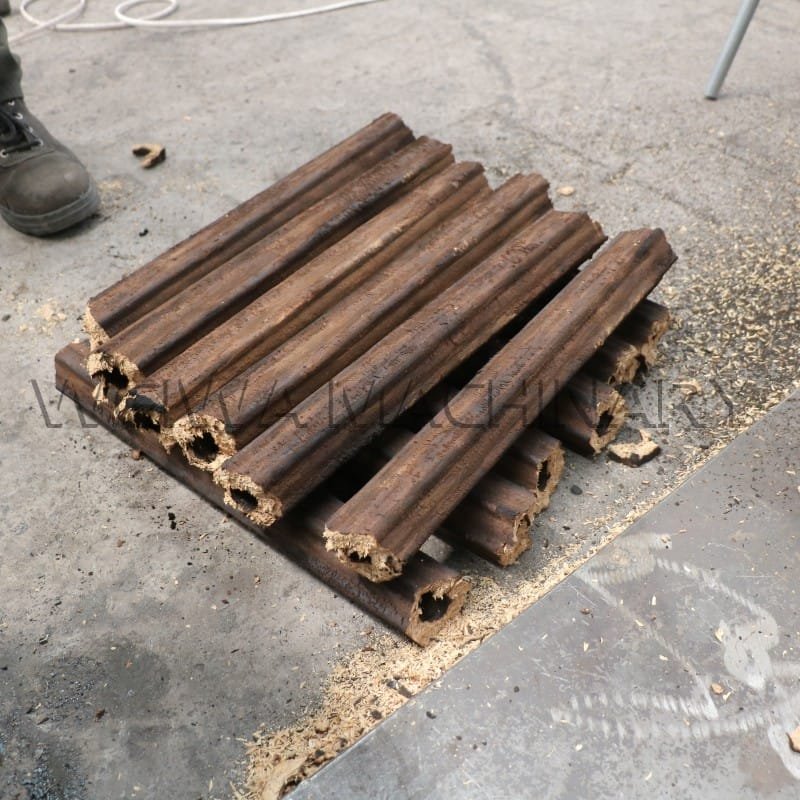
Sticks measured 70 mm outer diameter with a 18 mm central hole, hexagonal. Green briquette density reached 1.15 a 1.25 g/cm3. After carbonization in a batch masonry kiln over 72 horas, the charcoal stick density stabilized near 0.85 g/cm3 with carbon content around 68 a 72 percent. Calorific value of the carbonized product tested 7100 a 7400 calorías/kg, roughly 20 percent higher than split firewood and noticeably cleaner than lump charcoal made from unknown tropical hardwood.
The client’s quality concern was fracture rate. During the first 30 minutes of Mexican commissioning, fracture rate was 9 percent because the cooling rack was placed in direct wind. We advised enclosing the cooling zone. Fracture rate dropped to 2.1 percent on day two. A charcoal making machine is half hardware and half process discipline.
Hourly Output and Motor Load Stability
With pine sawdust at 9 percent moisture, the Mexico line sustained 460 a 500 kg/h at 62 a 68 amps on the main motor. Heating ring draw stayed at 5.4 a 5.9 kilovatios. No thermal trip occurred during an 8 hour shift. The screw tip temperature sensor logged a stable 305 degree Celsius barrel exit. For bagasse-heavy weeks the client now knows to schedule 330 a 380 kg/h and not promise more to downstream kilns.
Carbonization Match with Local Kilns
The extruded stick is not charcoal yet. The Mexico client uses three stationary kilns of 1.2 tons each. One extruder shift of 8 hours feeds roughly 3.2 tons of green sticks, matching one and a half kiln cycles per day. This balance was designed deliberately. Many suppliers oversize the extruder and leave the kiln as the bottleneck. Weiwa sizes the charcoal making machine line so the slowest step, carbonización, sets the rhythm.
Sawdust Extruder Price Logic for Mexico Importers
The phrase sawdust extruder price means different things to different people. A 22 kW bare extruder without electrical panel, without spare screw, without dryer, can appear cheap on Alibaba. A Mexico-ready line with Spanish panel, 440V motor, bagasse agitator, spare alloy screw, and factory trial video costs more. Both are real. The difference is total cost of first ton.
What Changes the Price of a Sawdust Extruder Machine?
Motor power is the first lever. 22 kW machines sit in one band. 55 kW and 75 kW heavy models sit in another. Barrel and screw material is the second lever. We use a tungsten-alloy screw tip on Mexico-bound units because bagasse silica wears a plain carbon steel tip in three weeks. Die mold machining tolerance is the third lever. A loose die gives you 5 percent more output but 15 percent more fracture. Mexican freight and customs form the fourth lever. A 20-foot container from Qingdao to Manzanillo in 2026 carries its own volatility.
Weiwa quotes a sawdust extruder machine for sale as a line, not a裸 machine. The Mexico client paid in the upper mid band of the global range for screw extruders, which industry market reports place broadly between USD 2500 and USD 35000 depending on output and configuration. Our value was not the lowest number. It was the trial run on Mexican bagasse before payment cleared.
Hidden Costs Mexican Buyers Forget
Spanish labeling is not free. Foundation concrete is not free. Forklift unloading at Veracruz or Altamira is not free. A 75 kW extruder pulls a cable thickness most small workshops in Mexico do not have installed. Buyers must budget a transformer if the local grid is weak. We include a pre-installation checklist in Spanish with every charcoal making machine export, but the civil works remain the client’s scope.
Why Choose Weiwa Machinery for Charcoal Making Machine Projects?
Weiwa Machinery is not a trading company that rebrands random Zhengzhou stock. We engineer biomass densification equipment, run loaded trials, and document them. Our sawdust extruder machine series covers 22 kilovatios, 37 kilovatios, 55 kilovatios, y 75 kW drives with interchangeable square, pentagonal, and hexagonal dies from 50 a 80 mm. We have shipped to over 130 countries including Indonesia, India, Malasia, Vietnam, Pavo, Polonia, Sudáfrica, and Mexico. The Mexico trial described above is not a marketing story. The bagasse samples are still in our lab drawer.
When a Mexican buyer searches sawdust extruder in Mexico, they rarely find a local service center. The realistic model is remote commissioning plus stocked spare screws. We keep alloy screw tips and heating coils in our export warehouse and ship them by DHL to Latin America in 4 a 6 días. That after-sale rhythm matters more than a 200 dollar discount on the machine.
Talk to Weiwa About a Sawdust Extruder Machine for Sale
If you are planning a charcoal making machine line in Mexico, send us your main raw material, moisture level, available voltage, and target tons per month. We will propose a grinder, secadora, máquina extrusora de aserrín, and kiln match, then run a trial on your material in China before you pay the balance. You can see the extruder working on video, measure the stick, and decide.
Weiwa Machinery contact details:
Multitud / WhatsApp: +8613838093177
Correo electrónico: info@cjlmachinegroup.com
We answer in English and Spanish. For Mexican buyers we can also connect you with a previous client near Monterrey who agreed to show their line to serious investors. A sawdust extruder machine for sale should not be bought from a PDF alone. It should be bought after you see bagasse become a stick, and a stick become charcoal.


 Veloz
Veloz

 +8615937143060
