


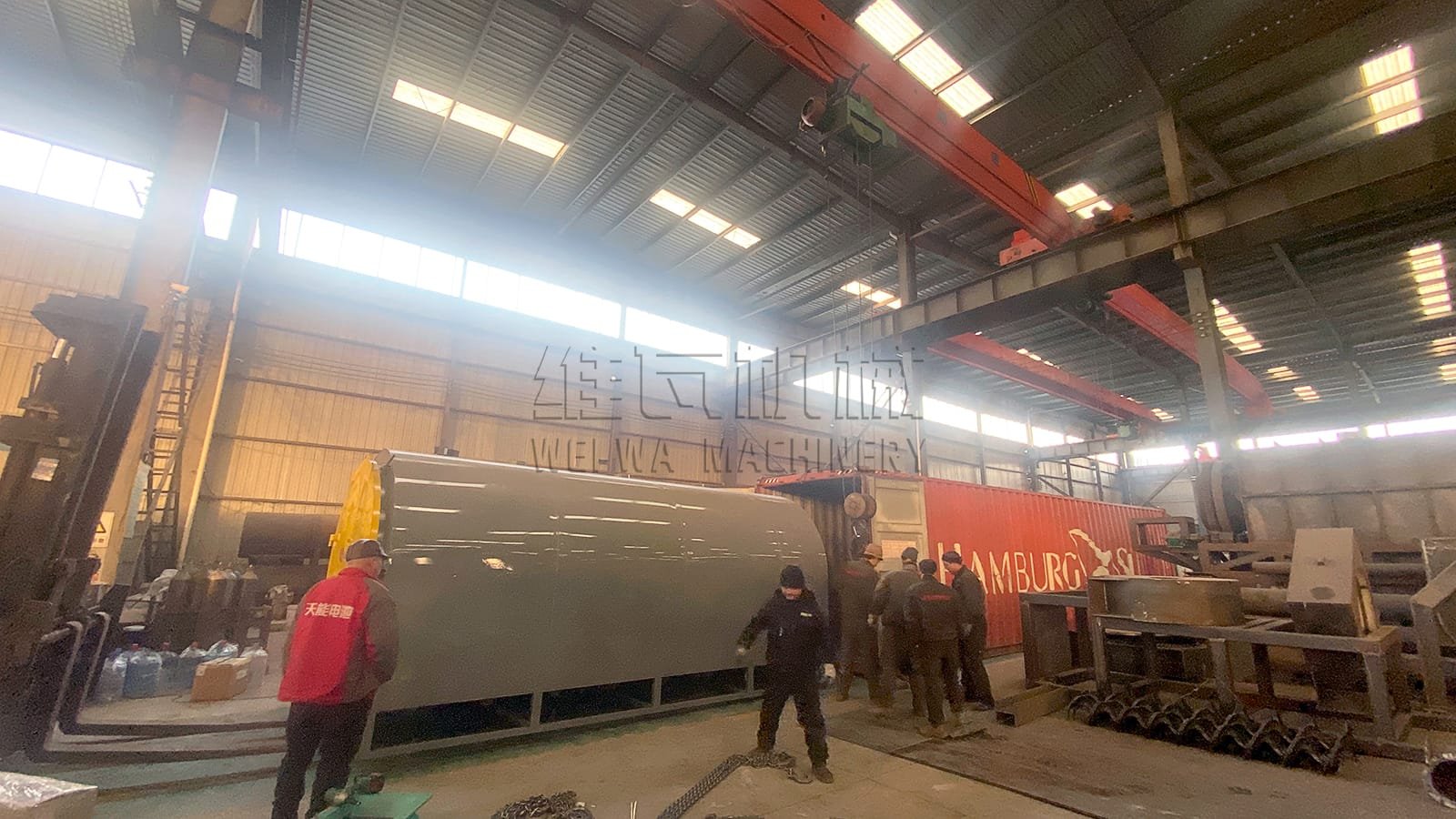
Background of the South Africa Charcoal Market and Biomass Resources
South Africa has abundant forestry residues, invasive alien wood species, sawdust from timber mills, coconut shells imported through ports, bambú, cáscara de arroz, y bagazo de caña de azúcar. Many entrepreneurs are exploring charcoal briquette production as a value-added solution to convert low-cost biomass waste into high-demand barbecue and industrial fuel. Traditional earth kilns and primitive brick pits suffer from low yield, excessive smoke, inconsistent carbon content, and inability to meet environmental requirements. This is why more briquette manufacturers in south africa are switching to continuous or batch-type making charcoal machine systems. The horizontal carbonization furnace we shipped is purpose-engineered for precisely these local raw materials and regulatory expectations.
When South African clients search for a charcoal making machine for sale in south africa, they typically prioritize three things: high charcoal yield per ton of raw material, compliance with smoke-emission limits, and reasonable payback period. Our horizontal design addresses all three through indirect heating, a built-in gas purification and recycling loop, and a rail-mounted barrel chamber that simplifies loading and unloading compared to fixed vertical kilns. Throughout this article you will see why this machine is becoming the preferred choice for charcoal briquette production facilities ranging from startup workshops to medium-scale factories that need to make charcoal from wood efficiently.
What Is a Horizontal Carbonization Furnace and How Does It Work?
A horizontal carbonization furnace is a batch-type pyrolysis unit consisting of one or more horizontally oriented cylindrical chambers mounted on rails. Raw material—such as wood logs, split timber, bamboo segments, cáscara de coco, or pre-formed sawdust briquettes—is loaded onto a cart and pushed into the sealed chamber. The furnace is then closed and heated indirectly. As the temperature rises to approximately 280–350 °C, initial devolatilization begins. Between 400–600 °C under oxygen-limited conditions, the lignocellulosic structure undergoes carbonization, leaving behind fixed carbon-rich charcoal.
Indirect Heating and Closed-Loop Gas Recycling
The defining advantage of Weiwa’s horizontal carbonization furnace is its advanced gas purification system. Volatile compounds—mainly tar, wood vinegar, and combustible syngas—are drawn from the chamber, passed through a condensation and purification unit, and separated. The cleaned combustible gas is redirected to the burners beneath the furnace as supplemental fuel. This recirculation reduces external energy consumption by up to 30 percent compared to furnaces that vent all pyrolysis gas. For South African operators concerned with both fuel cost and environmental regulation, smokeless operation is a decisive benefit when selecting a making charcoal machine for daily production.
Temperature Control and Uniform Heat Distribution
Our furnace body is insulated with high-density refractory material. Multiple thermocouples monitor the inner chamber temperature in real time, allowing the operator to follow an optimized heating curve depending on whether the goal is to make charcoal from wood logs or carbonize denser sawdust briquettes for charcoal briquette production. Uniform heat distribution avoids local over-burning and under-carbonized zones, which are common complaints with improvised kilns. The result is charcoal with fixed carbon content typically between 70 y 85 percent, low ash, and consistent size retention.
Pre-Shipment Preparation and Export Packing for South Africa
Exporting heavy industrial equipment to South Africa requires strict quality control and protective packing. Before the horizontal carbonization furnace left our factory, the following steps were completed:
Primero, the main chamber, gas purification tank, combustion chamber, and control cabinet underwent individual pressure and electrical function tests. Welds were dye-penetrant inspected. Segundo, all moving parts—rail wheels, cart axles, damper actuators—were lubricated and cycled through full travel to confirm freedom of movement. Tercero, the entire set was hot-tested with a small batch of hardwood to verify that the furnace could reach target carbonization temperature within the specified time and that the gas recycling loop functioned without leakage.
For ocean freight, the furnace body was wrapped in waterproof woven cloth and foam padding, then secured to the container floor with heavy-duty steel bands and wooden chocks. Ancillary items—exhaust pipes, condensation tanks, spare seals, tools—were boxed in plywood crates clearly labeled for the client. A full English operation manual, wiring diagram, and preventive maintenance schedule were enclosed, together with a digital copy sent by email in advance so the South African team could review installation procedures before arrival.
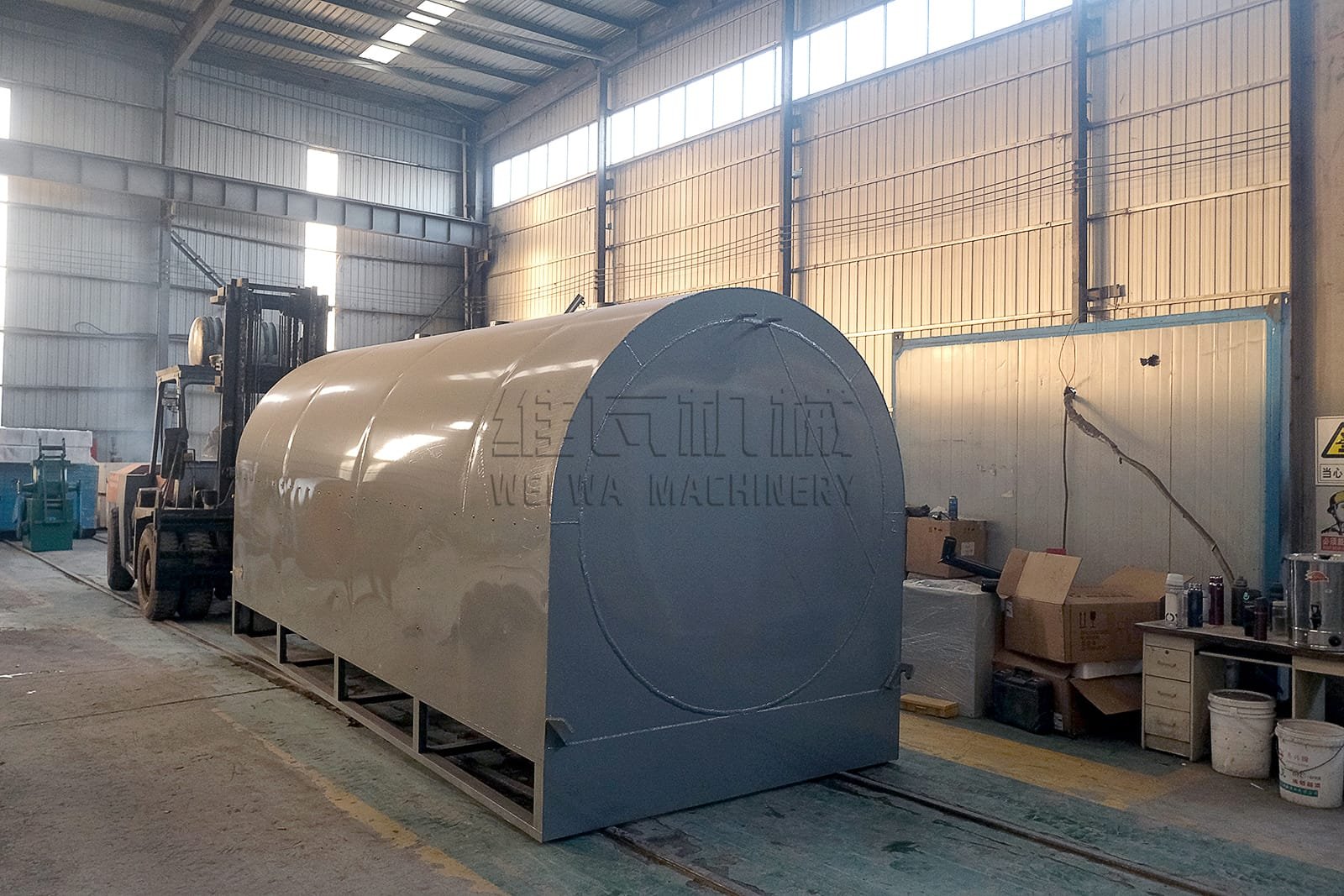
On-Site Trial Run Results Making Charcoal from Wood and Sawdust Briquettes
Although the formal commissioning will take place after the container arrives in Durban and clears customs, we performed a comprehensive trial run in our workshop simulating South African conditions—using mixed eucalyptus wood logs and commercial sawdust briquettes typical of charcoal briquette production feedstock.
Carbonization Time and Yield Data
For hardwood logs approximately 8–12 cm in diameter, the complete cycle—including pre-drying, ramp to 550 ° C, holding for carbonization, and natural cooling—averaged 6 a 8 hours depending on moisture content. Input mass of 1000 kg green wood (aprox. 20 percent moisture) yielded 280–320 kg of finished charcoal, representing a typical yield of 28–32 percent which is significantly higher than pit kilns that often drop below 20 percent. When processing pre-dried sawdust briquettes, the yield improved to 33–35 percent thanks to lower volatile residual moisture and more uniform packing density inside the chamber.
Charcoal Quality Parameters
Random samples from the trial batch were tested for fixed carbon, volatile matter, humedad, and ash according to ISO 12476 guidelines adapted for charcoal. Fixed carbon averaged 78 percent, volatiles below 18 percent, moisture after cooling and sealing below 5 percent, and ash under 3 percent for clean hardwood. The charcoal exhibited a metallic ring when struck, deep black cross-section without unburned white center, and low dust generation during handling—qualities that briquette manufacturers in south africa require before proceeding to the briquetting stage of charcoal briquette production.
Smoke Emission and Environmental Compliance
Throughout the trial, no visible smoke escaped the stack because all pyrolysis gas passed through the purification system. The condensate (wood vinegar) collected in the receiving tank can be stored for further applications such as bio-liquid fertilizer or disposed of safely per local regulations. This smokeless operation is one of the strongest selling points of our charcoal making machine for sale in south africa in markets with tightening air-quality enforcement.
Raw Materials Suitable for the Horizontal Carbonization Furnace in South Africa
One of the reasons briquette manufacturers in south africa favor this model is its flexibility regarding input biomass. The following materials have been successfully processed in our test center and by overseas clients:
Wood logs and branches – indigenous and plantation species such as eucalyptus, pino (resinous types require slightly longer pre-drying), acacia, and invasive wattle after debarking or sizing. To make charcoal from wood efficiently, diameter should ideally be between 5–20 cm; oversized logs can be sawn to fit the chamber length.
Bambú – splits or whole culms under 15 cm diameter carbonize exceptionally well and produce high fixed-carbon bamboo charcoal popular in niche Asian and eco-fuel markets.
Coconut shells – widely available through African coastal ports; shells produce very dense charcoal with high energy value, ideal for subsequent crushing and re-forming into premium barbecue briquettes in a charcoal briquette production line.
Sawdust briquettes / biomass rods – if you already operate a screw briquetting press, the extruded sawdust rods can be directly carbonized in the horizontal furnace, turning low-value dust into high-value char for resale or further pressing.
Agricultural residues – rice husk, cáscara de maní, tallo de algodón, elote (pre-compacted or in mesh baskets) can also be carbonized, though fine powders should be contained in perforated trays to avoid clogging the gas channels.
Why This Making Charcoal Machine Fits the South African Market?
Choosing a making charcoal machine is a strategic decision for any South African investor evaluating charcoal briquette production. Below are the key reasons why Weiwa’s horizontal carbonization furnace stands out as a charcoal making machine for sale in south africa that balances upfront investment with operating cost:
Compact footprint with high throughput ratio – unlike continuous rotary kilns that demand large foundations and complex feeding systems, the horizontal batch furnace occupies a modest concrete pad and can be operated by a crew of two to three once the process is understood.
Fuel savings through gas recycling – the self-sustaining combustion loop means after the initial fire-start phase, the furnace largely heats itself using its own syngas, directly lowering the cost per kilogram of charcoal produced.
Escalabilidad – multiple furnace bodies can share a common gas purification and exhaust system, allowing a plant to start with one unit and expand as market demand grows, which is attractive for growing briquette manufacturers in south africa.
Ease of training and maintenance – mechanical components are accessible; wear parts (seals, dampers, thermocouple tips) are standard规格 and replaceable locally or from our spare-parts kits. The PLC control panel displays temperature curves and alarm messages in English, simplifying operator training.
Alignment with sustainability trends – utilizing invasive woody biomass or sawmill offcuts to make charcoal from wood in a smokeless, high-yield furnace appeals to eco-conscious buyers and can support corporate social responsibility narratives for larger South African agribusinesses entering the charcoal sector.
Integration with a Complete Charcoal Briquette Production Line
The horizontal carbonization furnace is typically the first stage in a full charcoal briquette production workflow. Después de la carbonización, the charcoal is crushed to powder (usually 3–5 mm mesh), mixed with a binder if required, and fed into a briquette press (screw type or hydraulic punch type) to form hexagonal bars, pillows, or round briquettes. The final product is dried or cooled and packaged for retail or bulk export.
Weiwa Machinery supplies complementary equipment—crushers, wheel mixers, screw briquette presses, and mesh belt dryers—so South African clients can source an entire plant from one technical partner. When you inquire about our charcoal making machine for sale in south africa, we normally ask for your anticipated daily input tonnage, preferred raw material, target briquette shape, and available workshop dimensions so we can propose a matched configuration rather than an isolated furnace.
Frequently Asked Questions from South African Buyers
Is the horizontal carbonization furnace difficult to install on site?
Installation is straightforward. The furnace sits on a level concrete foundation with anchor bolts. The gas purification tank is connected via flanged ducting. We provide detailed layout drawings, utility requirements (power rating for fans and control panel, water for condensation if applicable), and remote video guidance during the first assembly. Most experienced local technicians can complete installation within 3–5 days.
Can I process freshly cut green wood or must it be pre-dried?
You can process green wood directly, but higher moisture content extends the pre-drying phase and slightly increases fuel use during the initial heating segment. For maximum efficiency and shortest cycle time, we recommend air-drying or kiln-drying wood to below 20 percent moisture before carbonization—especially if your business model emphasizes high daily throughput for charcoal briquette production.
What after-sales support does Weiwa provide for South Africa?
We offer 12-month warranty on the main body and 6 months on electrical components, lifetime technical consultation, spare parts stock recommendation lists, and remote troubleshooting via photo/video. For large orders we can dispatch an engineer subject to mutual agreement on visa and cost terms. All documentation—commercial invoice, packing list, certificate of origin, Bill of Lading—is prepared to facilitate South African customs clearance.
How does this compare to a continuous charcoal making machine?
Continuous machines process smaller particle biomass (serrín, cáscara de arroz) in a screw or rotary mechanism and can run non-stop. The horizontal batch furnace is better suited to whole wood logs, bambú, and coconut shells which would jam in a screw feeder. Many briquette manufacturers in south africa actually operate both: a horizontal furnace for logs/shells and a continuous plant for fine sawdust, depending on feedstock mix.
What is the approximate payback period for a small South African plant?
Payback varies with local charcoal price, raw material cost, labor, and utilization rate. Under conservative assumptions—processing 1 ton of dry wood per day, 30 percent yield, selling char at local wholesale rates—many of our clients recover their equipment investment within 12–18 months. We can run a customized ROI worksheet during discussion.
Conclusion – Partner with Weiwa Machinery for Your Charcoal Business in South Africa
The successful dispatch of our horizontal carbonization furnace to South Africa underscores Weiwa Machinery’s commitment to delivering proven making charcoal machine solutions worldwide. Whether you plan to make charcoal from wood registro, process coconut shells, or integrate the furnace into a larger charcoal briquette production line, our equipment is engineered for yield, eficiencia, and environmental compliance. If you are a briquette manufacturers in south africa evaluating a charcoal making machine for sale in south africa, we invite you to contact our team for a tailored quotation, trial-run video, and plant layout design.
Acerca de Maquinaria de Weiwa
Maquinaria de Weiwa (Wei WA Machinery) is a professional manufacturer of biomass carbonization and charcoal production equipment, exporting to more than 30 countries including South Africa, Sudeste Asiático, el Medio Oriente, y sudamerica. Our product range covers horizontal carbonization furnaces, continuous carbonization kilns, charcoal briquette presses, trituradores, mezcladores, y secadoras. With in-house R&D, strict QC, and responsive after-sales service, Weiwa has become the trusted first choice for over 2 million customers worldwide.
Contáctenos:
Multitud / WhatsApp: +86 138 3809 3177
Correo electrónico: info@cjlmachinegroup.com
Website: https://cjljx.com
Product Page: Horizontal de carbonización


 Veloz
Veloz

 +8615937143060
