


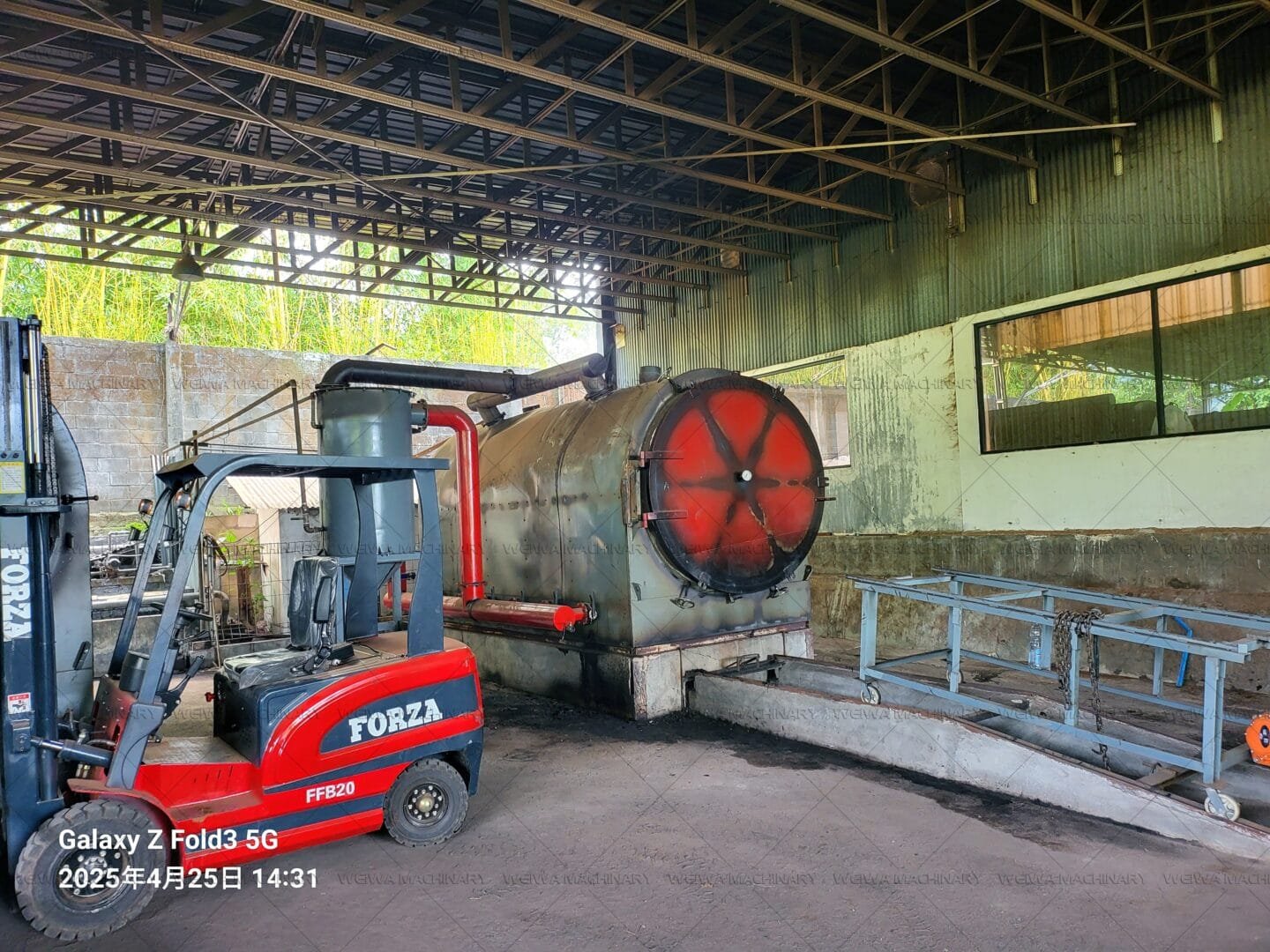
Why Malaysia Became a Priority Market for Weiwa Carbonization Equipment?
Malaysia has abundant biomass resources. Palm waste, cáscara de coco, rubber wood offcut, fruit tree branches, sawdust from furniture zones and empty fruit bunch residue are available in several states. Many small and medium producers still rely on earth kilns or concrete block kilns. Those methods can make charcoal, but they usually need long cycle times, create visible smoke, deliver uneven hardness, and make it difficult to prove environmental compliance to local authorities or export buyers.
A horizontal carbonization furnace enters this market as a middle path. It is not as complex as a fully continuous plant, but it is far more controlled than an open kiln. For Malaysian buyers who want batch flexibility, cart loading, reusable pyrolysis gas and cleaner operation, the horizontal barrel design often makes more sense than either extreme.
Weiwa Machinery has supplied briquette machines, sistemas de secado, shisha charcoal presses and carbonization equipment to multiple countries. The Malaysian inquiry pattern, sin embargo, has a clear shape: the buyer has biomass, wants charcoal for BBQ or hookah markets, has limited skilled labor, and cannot afford a giant continuous line. That is exactly where a charcoal making machine for Malaysia should be evaluated seriously.
Malaysian Feedstock Reality
Coconut shell from coastal states is dense and high in fixed carbon, but whole shells carbonize slowly if moisture is high. Hardwood offcuts from pallet and furniture workshops are bulky. Bamboo grows fast and carbonizes differently from hardwood. Agricultural residue is seasonal and often needs pre-drying. A good carbonization furnace must accept these materials without forcing the client to build a completely new pretreatment plant on day one.
The horizontal carbonization furnace shipped in this case was specified for coconut shell, wood log pieces and mixed biomass. The client did not want to pelletize everything. They wanted to load carts, seal the door, start indirect heating, recover gas, and produce uniform charcoal with less manual labor.
Regulatory and Neighbor Pressure
In suburban or village-industrial zones, smoke complaints can stop production. Malaysian buyers increasingly ask about flue gas, tar condensate, water scrubbing and combustible gas return. A modern charcoal making machine is no longer judged only by charcoal output. It is judged by whether the plant can run without becoming a nuisance to nearby estates, factories and residential areas.
That is why Weiwa emphasizes the gas-purification loop. Pyrolysis gas leaving the barrel passes through separation and cleaning stages, drops tar and condensate, and returns as flammable gas to the burner. After warm-up, external fuel demand drops. Smoke at the stack becomes minimal under normal operation. For a Malaysian site, this difference can decide whether the project expands or gets shut down.
Workshop Dispatch Scene at Weiwa Machinery
The dispatch started in the Weiwa workshop in Gongyi, Henan. Technicians checked the barrel chamber, refractory lining, rail trolley, door seal, gas pipes, burner ring, control cabinet and safety valves. The horizontal carbonization furnace was already painted, but before paint it had passed door-seal testing, gas-path pressure testing and burner ignition testing.
Loading a horizontal barrel furnace is different from loading a vertical machine. The barrel length consumes much of the container diagonal. The heavy end, usually the sealed discharge door with graphite packing, must be supported correctly. The skid must keep rail alignment intact during ocean transport. If the flange face deforms, the first Malaysian batch can leak oxygen and scorch the charcoal.
Weiwa used a fabricated cradle, steel bands, pine spacers, rubber pads and desiccant bags inside the chamber. The control cabinet was boxed separately. PID controller, thermocouples and relays should never travel inside a humid steel chamber. The container was booked as FCL rather than shared LCL because a charcoal making machine is a precision thermal vessel, not general cargo.
Final Quality Checks Before Container Load
The Malaysian client joined a live video inspection. We rotated the barrel, showed rail alignment, opened the door seal, and ran a short flame test on the return-gas burner. The nameplate, model code, voltage version, spare-part list and English labels were verified against the proforma invoice.
For export to Malaysia, Weiwa prepared a layout drawing scaled to the client yard, English control labels, IEC electrical terms, refractory mortar, spare door gasket, spare thermocouple, burner nozzle and a tool bag. The manual covered coconut shell, wood log, bamboo and sawdust briquette cycles. Local electricians and mechanics should be able to maintain the machine without decoding translated abbreviations.
From Gongyi to Port Klang
The furnace left the workshop, moved to the port, and sailed toward Port Klang. From Port Klang, a Malaysian freight forwarder arranged flatbed transport to the client yard. The buyer prepared a concrete pad, a stable power supply and a water source for cooling and scrubbing stages. Because the unit is horizontal and rail-mounted, a tall crane is not always required. With a forklift and several workers, the skid can be positioned on the pad within half a day.
This logistics story matters for SEO and for buyers. Many search queries are not only about specifications. They are about delivery, spare parts, voltage, instalación, training and whether the supplier truly exports to Malaysia. A charcoal making machine for Malaysia must be documented as a complete project, not just a product photo.
What a Horizontal de carbonización Actually Is?
A horizontal carbonization furnace is a barrel-style thermal chamber mounted on rails. The chamber lies horizontally. The operator loads biomass into a trolley or basket, pushes the cart into the barrel, seals the door, and starts indirect heating. The raw material does not sit in direct flame. Heat transfers through the chamber wall and surrounding jacket, gradually driving off moisture and volatile matter.
As biomass heats, it releases pyrolysis gas. That gas contains combustible components. Instead of venting it as pollution, the Weiwa system captures, cools, separates tar and condensate, cleans the gas, and sends it back to the burner. The burner then helps maintain chamber temperature near 600 ° C. External fuel is mainly needed during start-up. After the gas loop stabilizes, the furnace moves toward self-sustaining combustion.
This is the reason many producers upgrade from kilns. A traditional earth kiln loses much of that energy as smoke. A horizontal carbonization furnace turns part of the smoke into fuel. For a Malaysian charcoal yard with rising LPG or diesel cost, that loop protects margin.
Indirect Heating Versus Direct Fire
Direct-fire carbonization means flame touches or surrounds the raw material aggressively. It can be cheap to build but hard to control. Indirect heating keeps the heat source separate from the biomass bed. Temperature rises more evenly. Charcoal structure stays more complete. Fixed carbon improves. Ash problems from flying embers reduce.
In the Malaysia trial, the jacket temperature was ramped gradually and held in the 580 a 610 °C range. The biomass inside did not burn like firewood. It carbonized under controlled oxygen-limited conditions. The result was black, denso, low-smoke charcoal rather than half-burnt wood and grey ash.
Rail-Mounted Barrel and Cart Loading
The rail and trolley system is one of the most underrated advantages. Bulky coconut shell bags, crooked wood logs and bamboo sticks are awkward to drop into a vertical shaft. With a horizontal chamber, workers fill the cart at a comfortable height, push it in, and lock the door.
In the Malaysian trial, two workers loaded one full cart in under 40 minutos. A vertical kiln equivalent would likely need more people and more climbing, shoveling or basket lifting. Over weeks, that labor difference changes the economics of a charcoal making machine for Malaysia more than a small difference in machine price.
Gas Purification and Self-Recirculating Combustion
The gas path included cyclone pre-separation, tar condensation, water scrubbing and return-gas blowing. After the first warm-up period with auxiliary fuel, the burner ran partly on recycled pyrolysis gas. The client observed lower external fuel use and much less visible smoke than their previous kiln.
This matters for marketing too. Malaysian buyers supplying BBQ charcoal or hookah charcoal intermediaries need consistent product. Buyers abroad ask about heavy metals, ash content, fixed carbon and odor. A cleaner carbonization process supports cleaner charcoal branding.
Horizontal Carbonization Furnace in Malaysia Versus Traditional Kilns
Traditional kilns are familiar. Farmers and small entrepreneurs know them. But familiarity is not the same as profitability. Earth and brick kilns often need several days per batch. They depend heavily on operator instinct. They lose charcoal to oxidation. They smoke. They struggle to document process data for buyers who demand specification sheets.
A horizontal carbonization furnace in Malaysia is not magic. It still needs dry enough feedstock, correct loading density, proper sealing and patient temperature control. But it replaces guesswork with measurable parameters: chamber temperature, gas pressure, door seal integrity, condenser temperature, burner flame stability and cool-down time.
Batch Flexibility for Mixed Biomass
Malaysian biomass is rarely uniform. One month the client has coconut shell. Another month rubber wood. Another month bamboo and sawdust briquettes. A continuous carbonization line often prefers uniform particle size and steady feed. A horizontal batch furnace accepts variation better.
The operator can run coconut shell in batch one, hardwood offcut in batch two, and briquetted sawdust in batch three. Recipes change. Temperature curve changes. But the machine stays the same. For a Malaysian startup charcoal plant, that flexibility reduces risk.
Space and Investment Balance
A full continuous charcoal plant can be excellent for large throughput, but it needs more land, more civil works, more conveyors, more dosing equipment and more skilled control. A horizontal carbonization furnace needs a concrete pad, a trolley lane, a gas treatment skid, a water source and a control cabinet.
For many Malaysian buyers, the horizontal model sits in the sweet spot: more controlled than a kiln, less capital-heavy than a continuous factory. That is why searches for charcoal making machine for Malaysia often end with a batch barrel furnace rather than a giant rotary or continuous system.
On-Site Trial Results in Malaysia
After unloading and installation, the client ran several batches. The first batch used coconut shell with relatively high moisture. The second used mixed hardwood log offcut. The third used a blend of bamboo and sawdust briquette. Each batch followed the same principle: dry as much as site conditions allow, load evenly, seal tightly, heat gradually, hold temperature, recover gas, cool safely, then discharge.
The client reported that charcoal pieces kept better shape than from the old kiln. Smoke during normal operation was far lower. External fuel demand dropped after warm-up. Labor was easier because cart loading replaced manual basket lifting. The yard supervisor noted that temperature data made it easier to repeat good batches.

Coconut Shell Trial
Coconut shell is the star feedstock in many Malaysian charcoal projects because it produces high-density charcoal favored by hookah and BBQ markets. The challenge is shell thickness. Whole shells carbonize from outside inward. If heating is too fast, the surface burns while the center stays woody.
The horizontal carbonization furnace handled this by gradual ramp and indirect heat. The client avoided abrupt flaming. Shell retention improved. Broken fraction dropped. The finished coconut shell charcoal had good ringing sound when struck, dark fracture surface, low powder ratio and stable appearance across the batch.
Hardwood Offcut Trial
Mixed hardwood from pallet and furniture workshops often contains nails, paint spots or moisture variation. The client pre-sorted obvious contamination, cut oversized pieces, and loaded the cart with gaps for heat penetration. The furnace produced uniform lump charcoal suitable for BBQ resellers.
The key lesson was loading pattern. If the cart is overloaded, heat cannot move through the middle. If the cart is too loose, energy wastes on empty space. The Malaysian operator improved batch quality simply by adjusting load density after the second run.
Bamboo and Sawdust Briquette Trial
Bamboo carbonizes faster than hardwood and can generate more volatile gas. Sawdust briquettes are denser and more uniform. Running them together required a slightly different temperature curve and ventilation balance. The Weiwa burner and gas return system absorbed the extra volatiles instead of letting them escape as smoke.
This trial proved an important point: a horizontal carbonization furnace in Malaysia is not a single-recipe machine. It is a controllable thermal system. The machine stays stable; the recipe changes with the feedstock.
Charcoal Making Machine for Malaysia Buying Criteria
Many Malaysian inquiries begin with price. Price matters, but it is the wrong first question. The better first questions are: what raw material do I have, what moisture is realistic, how many workers can I employ, how much land do I have, what charcoal grade does my buyer want, and what emission limits affect my area.
A charcoal making machine should be selected around those answers. Weiwa often recommends the horizontal carbonization furnace when the client has bulky biomass, batch production needs, limited pelletizing budget, and a strong need to control smoke.
Moisture Management
High moisture is the silent profit killer. Wet shells and wet wood waste force the furnace to spend external fuel on boiling water instead of making charcoal. Malaysian buyers near coastal areas especially must plan for sun drying, roofed storage, airflow stacking or a rotary dryer.
In the shipped project, the client improved results after reducing average moisture. The furnace did not change. The feedstock preparation changed. Anyone researching a horizontal carbonization furnace in Malaysia should budget for drying infrastructure as seriously as for the furnace itself.
Door Seal and Oxygen Control
Carbonization is not combustion of the product. It is thermal decomposition under limited oxygen. If the door seal leaks, oxygen enters, the charcoal glows, fixed carbon drops, and ash rises. The Weiwa chamber uses graphite-packed flange surfaces and compressed door seals to keep the chamber tight.
During Malaysian commissioning, the technician reminded the operator to check the seal before every batch. This five-minute habit prevents expensive batch loss. A charcoal making machine for Malaysia must be easy enough to maintain daily and precise enough to protect product quality.
Spare Parts and Local Maintenance
Thermocouples, door gaskets, burner nozzles, solenoid valves and refractory mortar are wear items. Weiwa ships common spares with the container and keeps matching stocks for popular models. Malaysian clients can also source generic industrial parts locally if the manual uses standard IEC names.
Good SEO content answers real buyer anxiety: what breaks, how fast can I get the part, do I need an engineer flight, can my local electrician wire it. The answer for this shipment was no engineer flight, clear drawings, video training, and spare parcels that normally move fast to Kuala Lumpur, Penang, Johor and Selangor addresses.
Energy Saving Logic That Malaysian Buyers Notice
The strongest commercial argument for a horizontal carbonization furnace is not only charcoal quality. It is operating cost. Traditional kilns throw away the energy inside the smoke. Weiwa’s closed-loop design captures that energy.
Pyrolysis gas forms as biomass heats. Instead of releasing it, the system condenses tar, collects condensate, scrubs impurities, and returns clean flammable gas to the burner ring. After start-up assistance from LPG or diesel, the burner increasingly runs on its own process gas.
For a Malaysian charcoal yard facing fuel price fluctuation, this loop improves resilience. Every cubic meter of recovered gas is one less cubic meter of purchased fuel. Over months, the saving can be large enough to change payback calculations.
Tar and Condensate Handling
Tar is not just waste. It is a byproduct that must be managed safely. The Weiwa system separates tar and condensate into collection points. The client must dispose of or reuse them according to local rules. Some users explore tar as boiler fuel after further treatment. Others send it to approved industrial waste handling.
The blog should not pretend tar is free money. Responsible SEO content tells the buyer the truth: the gas loop saves fuel, but byproduct management is part of running a professional charcoal making machine in Malaysia.
Temperature Hold Near 600 ° C
The shipped furnace held jacket temperature in the 580 a 610 °C band during the main hold phase. That range supports deep carbonization without pushing the batch into destructive oxidation. The controller, thermocouple and burner modulation work together.
Malaysian operators new to controlled carbonization often expect a switch-on-switch-off machine. In reality, the skill is curve management: warm-up, moisture removal, main carbonization, gas-rich peak, temperature hold, cool-down and safe discharge. A horizontal carbonization furnace teaches this skill faster than a fully automated line because the operator sees each stage.
Comparison With Other Charcoal Making Machines
Buyers should not worship one machine type. Each has a place. The right choice depends on throughput, feedstock uniformity, labor, land, budget and environmental pressure.
Earth or Brick Kiln
Low capital cost. Familiar. Flexible feedstock. But long cycle, heavy smoke, inconsistent quality, high charcoal loss, poor data, and weak compliance story. Suitable for very small rural trials, not for branded charcoal export.
Vertical Carbonization Furnace
Smaller footprint. Easier to stack in tight yards. But loading bulky shells and logs is harder. Heat distribution can be less uniform if charging is poor. Door and bottom discharge design varies widely by manufacturer.
Continuous Carbonization Machine
High automation, steady output, good for sawdust, cáscara de arroz, EFB pellet and uniform granular feed. But higher capital, more engineering, stricter feed-size requirement, and harder for first-time Malaysian entrepreneurs.
Horizontal de carbonización
Balanced option. Accepts bulky biomass, cart loading, indirect heating, gas recovery, batch recipe change, moderate footprint, lower automation cost than continuous plants, better quality and smoke control than kilns. For many Malaysian SMEs, this is the practical winner.
Site Preparation for Malaysian Buyers
Before the container arrives, the buyer should prepare the ground. A level concrete pad supports the barrel cradle and rail. A straight trolley lane allows loading and discharge. A separate area houses the gas treatment skid, water tank, pump and condenser.
Power supply must match the control cabinet version. Water supply supports scrubbing and cooling. Fire safety tools must be present. Roofed raw material storage protects feedstock from rain. Finished charcoal needs a cool, dry, spark-safe storage room.
Weiwa sends a layout drawing before shipment. The Malaysian client in this case received chamber position, trolley swing radius, scrubber outlet, burner LPG inlet, electrical panel location and maintenance clearance. Good preparation cuts installation time from days to hours.
Labor Requirement
One horizontal furnace does not need a big team. Two workers can load, one can monitor the panel, and one can handle discharge and packaging. As the plant adds a second or third chamber, labor grows gradually rather than suddenly.
This scalability suits Malaysian family businesses. Start with one horizontal carbonization furnace, prove the market, then add chambers, a crusher, a mixer, a charcoal briquette press and a screening unit. The charcoal making machine becomes the core of a full line.
Training and Remote Support
Weiwa trains Malaysian clients by video call. Topics include door seal check, first ignition, gas return valve sequence, condenser water flow, emergency shutoff, thermocouple reading, batch log keeping and safe discharge.
Because the same WhatsApp line handles sales and support, the client does not repeat the machine history to five different agents. For overseas buyers, this continuity is as valuable as steel thickness.
Product Quality Buyers Can Sell
Malaysian charcoal usually targets three channels: BBQ lumps, hookah or shisha cubes, and industrial or activated-carbon feedstock. Each channel wants different specs, but all want consistency.
BBQ buyers want low smoke, long burn, low spark, low ash and clean smell. Hookah buyers want uniform cube size, low ash, stable heat, low odor and food-safe handling. Activated carbon producers want high fixed carbon, low impurity and predictable raw charcoal structure.
A horizontal carbonization furnace cannot guarantee market success by itself. But it gives the operator repeatable batches. Repeatability is what turns a backyard kiln into a brand.
Fixed Carbon and Ash Control
Fixed carbon rises when carbonization is deep enough and oxidation is controlled. Ash rises when air leaks, when fines burn, or when contaminated feedstock enters the chamber. The Weiwa design reduces direct oxidation, supports even heating, and lets the operator log each batch.
Malaysian clients who want premium export charcoal should pair the furnace with feedstock sorting, moisture control, mesh screening and honest lab testing. The machine gives control. The business system gives margin.
From Charcoal to Briquette Line
Many Malaysian entrepreneurs start by selling lump charcoal, then move into briquettes. The horizontal carbonization furnace produces base charcoal. Then a crusher reduces it, a wheel mill or double-shaft mixer blends charcoal powder with binder, a briquette press forms shapes, a dryer removes moisture, and a screener grades the product.
This is where Weiwa’s wider machinery range helps. The buyer is not stranded after one machine. They can grow from a single carbonization furnace into a complete charcoal making machine ecosystem.
Common Mistakes Malaysian First-Time Buyers Make
The first mistake is buying the cheapest furnace without checking door seal design, refractory quality, gas path layout and control system. Steel price alone does not determine performance. Thermal design does.
The second mistake is ignoring feedstock moisture. Even the best horizontal carbonization furnace struggles with soaking-wet shells. Drying is not optional in tropical climates.
The third mistake is expecting charcoal quality to fix itself. Machine plus untrained labor still makes bad charcoal. Capacitación, batch logs and discipline matter.
The fourth mistake is underestimating tar, condensate and wastewater. A responsible charcoal making machine for Malaysia needs a planned byproduct handling routine.
The fifth mistake is choosing continuous equipment too early. Continuous lines reward uniform feed and professional operation. A first-time Malaysian SME often does better with one well-run horizontal batch furnace.
Why Weiwa Horizontal Carbonization Furnace Fits the Malaysian SME?
Weiwa builds the furnace, quemador, gas pipe, control box and trolley system inside its own workshop. That integration helps with spare parts, drawings and after-sales logic. When a thermocouple or solenoid fails, the client can match the part number from the manual instead of guessing.
The horizontal model fits Malaysian SMEs because it respects reality: bulky biomass, humid weather, limited engineers, neighbor sensitivity, export ambition, and a budget that cannot absorb a massive continuous plant on day one.
It also respects growth. One furnace becomes two. Lump charcoal becomes briquettes. Local supply becomes export supply. The machine is not the end of the project. It is the thermal heart of the project.
Export Experience and Trust
Weiwa Machinery has exported briquette machines, carbonization furnaces and biomass equipment to many countries and regions. The Malaysian shipment added one more field reference. But more important than the shipment photo is the trial data: stable temperature hold, self-sustaining gas combustion after warm-up, lower smoke, better shell retention, and easier labor.
Field proof beats brochure claims. That is why this blog focuses on the Malaysia site, not only the factory.
Opciones de personalización
Chamber size, cart size, burner type, scrubber capacity, condenser design, panel language and spare-part kit can be adjusted. Malaysian clients may request LPG start-up, diesel backup, larger tar tank, extra thermocouple ports, or shisha-grade cooling configuration.
A charcoal making machine for Malaysia should not be a copy-paste container from another project. Palm belt, coconut belt, rubber wood belt and bamboo belt all behave differently.
Environmental Story Malaysian Buyers Can Use
Charcoal has an image problem when linked to deforestation and open burning. A modern horizontal carbonization furnace changes the narrative when paired with waste biomass.
Cáscara de coco, serrín, bamboo thinnings, rubber wood offcut and empty fruit bunch residue are already generated by agriculture and wood industries. Converting that residue into charcoal captures value from material that might otherwise rot, burn openly or occupy landfill space.
The gas recovery system reduces external fuel demand. The sealed chamber reduces open smoke. The batch log supports quality documentation. None of this makes the plant automatically green, but it gives Malaysian owners a defensible story for buyers, banks, regulators and community leaders.
Smoke Complaint Reduction
In the Malaysian trial, the client’s old kiln drew complaints during wet-season batches. The horizontal furnace still needs correct operation, but normal runs produced far less visible plume. The neighbor-pressure risk dropped.
For suburban yards in Selangor, Johor, Penang, Perak or Kedah, that reduction can be the difference between quiet production and repeated visits from local authorities.
Waste-to-Value Economics
If the raw material is currently treated as waste, charcoal revenue is upside. If the raw material is purchased, then moisture, transport and storage costs must be controlled. The horizontal carbonization furnace improves conversion efficiency, but it cannot fix a bad feedstock purchase price.
Malaysian entrepreneurs should model the full chain: collection, el secado, transporte, carbonización, cooling, aplastante, briqueting, packaging, freight and export margin. The furnace is one node in that chain.
How to Evaluate a Supplier, Not Just a Machine?
Many websites sell similar photos. The buyer should ask harder questions. Does the supplier build the furnace or just trade it? Can they explain the gas path clearly? Do they provide layout drawings? Do they train remotely? Do they keep spares for your model? Can they show a similar Malaysia or Southeast Asia case?
Weiwa’s answer set includes factory-built assemblies, export packing videos, English manuals, IEC electrical terms, model-specific spare kits, remote training, and repeated Southeast Asian shipments. That answer set matters more than a low thumbnail price.
Red Flags in Charcoal Machine Sourcing
Red flag one: no gas path diagram. Red flag two: no door seal detail. Red flag three: no refractory specification. Red flag four: manual only in Mandarin with no English electrical terms. Red flag five: cannot explain startup fuel versus self-sustaining gas mode. Red flag six: promises unrealistic cycle time for whole coconut shell.
A serious horizontal carbonization furnace supplier talks about heat curves, sealing, alquitrán, condensate, safety and training. A weak supplier talks only about cheap FOB price.
Questions Malaysian Buyers Should Send to Any Supplier
What is the chamber size and batch capacity? What is the recommended moisture limit? What burner fuel is needed for start-up? How long until gas recirculation sustains the burner? What refractory and insulation are used? What is the door seal method? What spares ship in the container? What is the power supply version? What training is included? What is the container type and loading method? Can you show a similar Malaysia project?
If the supplier answers all ten clearly, the buyer is probably speaking to a real manufacturer. If the supplier dodges, move on.
Case Recap: Horizontal Carbonization Furnace in Malaysia
The shipped unit left Gongyi after hydraulic door-seal testing, burner ignition testing and gas-path pressure testing. It traveled by sea to Port Klang, transferred by flatbed, and was installed on a prepared concrete pad. The Malaysian team ran coconut shell, hardwood offcut, bamboo and sawdust briquette batches.
Results worth repeating: smoother loading, tighter door seal, stable 580 a 610 °C hold, self-sustaining gas combustion after warm-up, lower smoke than the old kiln, better shell retention, and easier operator training. The client moved from doubt to weekly production.
This is the kind of story Google rewards when it is written naturally. Not keyword spam, but real dispatch detail, real feedstock discussion, real trial observation, and real buying guidance for the Malaysian market.
What the Client Liked Most?
They liked cart loading because it saved backs and time. They liked the gas return because it saved fuel. They liked the door seal check because it protected batches. They liked the video training because no engineer flight was needed. They liked the English labels because local electricians could work confidently.
In short, the horizontal carbonization furnace in Malaysia succeeded because it matched local constraints instead of fighting them.
What Weiwa Improved After the Trial?
Field feedback matters. After the Malaysian run, Weiwa reviewed rail alignment tolerance, door-compression feel, condenser cleaning access, control-label clarity and tar tank sizing. Small improvements compound. A manufacturer that ignores field reports stagnates. A manufacturer that listens ships better machines six months later.
New inquiries from other Malaysian states began referencing this shipment. That is how industrial equipment brands grow: one documented project becomes the trust anchor for the next ten inquiries.
Future of Charcoal Making Machine for Malaysia
Malaysia’s biomass economy will keep expanding. Palm residue, coconut processing waste, rubber wood, bamboo plantations and furniture sawdust are not disappearing. Charcoal demand from BBQ, narguile, metallurgy and activated carbon sectors remains steady.
The winners will not be the ones with the loudest ads. They will be the ones who control moisture, seal the chamber, recover the gas, train the operator, grade the product, and document the batch. A horizontal carbonization furnace is a tool for that discipline.
From Single Furnace to Factory
The natural growth path is clear. Start with one carbonization furnace. Add raw material drying. Add crushing and mixing. Add briquette pressing. Add screening and packaging. Add dust collection. Add lab testing. Add export documentation.
Weiwa can support that path because the product range covers briquette machines, dryers, trituradores, mezcladores, presses, screens and carbonization equipment. The Malaysian buyer does not have to relearn a new supplier at every stage.
Why Batch Still Wins for Many Malaysian SMEs?
Continuous looks modern. Batch looks old. But batch with gas recovery, sealed chamber, rail loading and data logging is not old technology. It is mature technology adapted for SMEs.
For Malaysian entrepreneurs with variable feedstock and limited capital, batch discipline beats continuous complexity. The horizontal carbonization furnace proves that a simpler form factor can still deliver export-grade charcoal.
Buying Process With Weiwa Machinery
The process starts with feedstock photos and moisture estimate. Weiwa proposes chamber size, burner type, gas treatment capacity and layout drawing. The buyer confirms site power, water, pad size and target product. Proforma invoice follows. Production, inspection, packing and container booking proceed.
Before loading, the buyer receives spare-part list, manual, layout drawing and inspection video. After arrival, remote training covers installation check, first ignition, gas return sequence and safety shutdown. Spare parcels can be couriered when wear items are needed.
This process is not glamorous. It is exactly what a serious charcoal making machine for Malaysia should look like.
Lead Time and Shipping Notes
Lead time depends on chamber size, refractory curing, panel build and spare-part kit. Ocean transit to Port Klang depends on season and feeder schedule. Buyers should plan commissioning after the pad, power and water are ready, not before.
Weiwa recommends FCL for horizontal barrels. Shared containers invite damage. A warped flange or bent rail costs more than the freight saved.
After-Sales That Actually Reaches the Client
WhatsApp support on the same line as sales means the Malaysian client does not retell the machine story to a new agent every time. Photos, short videos, thermocouple readings and door-seal questions can be answered quickly.
For common wear parts, Weiwa keeps stocks matching popular models. For electrical parts, the manual uses standard industrial names so local suppliers can help if courier delay happens.
Key Takeaways for Malaysian Charcoal Investors
A horizontal carbonization furnace is not a miracle box. It is a controlled thermal system. It works best when feedstock is sorted and reasonably dry, door seal is checked, gas path is maintained, operator is trained, and batches are logged.
For Malaysian conditions, it often beats traditional kilns on smoke, labor and consistency. It often beats continuous lines on capital risk and feedstock flexibility. That is why the horizontal model keeps appearing in serious charcoal making machine for Malaysia discussions.
Weiwa’s Malaysia shipment proved the practical points: cart loading saves labor, indirect heating protects charcoal structure, gas recovery cuts fuel, sealed operation reduces smoke, and remote training removes the engineer-flight bottleneck.
When You Should Choose This Machine?
Choose it if you have coconut shell, hardwood offcut, bamboo or mixed biomass. Choose it if you want batch flexibility. Choose it if smoke complaints worry you. Choose it if you cannot yet justify a full continuous plant. Choose it if you want a machine your team can actually learn.
When You Should Wait or Choose Another Machine
Wait if your feedstock is always wet and you have no drying plan. Choose a continuous line if you already have uniform sawdust, rice husk or EFB pellet and large stable throughput. Choose a simpler kiln only if your budget is extremely small and quality is not yet important.
Honesty in content builds rankings and trust. Google’s algorithms improve at detecting real experience. Buyers definitely detect it.
Acerca de Maquinaria de Weiwa
Weiwa Machinery is a factory-based manufacturer of briquette machines, hornos de carbonización, dryers, trituradores, mezcladores, charcoal presses and complete charcoal production lines. The company designs and builds equipment for wood, cáscara de coco, bambú, serrín, agricultural residue and other biomass materials.
Weiwa Machinery has become the first choice for more than 2 million customers across many countries and regions. The team supports clients with model selection, layout drawing, export packing, remote training, spare parts and after-sales service.
The horizontal carbonization furnace is one of Weiwa’s most exported batch carbonization models. It serves small- and medium-scale producers who need balanced heat distribution, indirect heating, gas purification, self-recirculating combustion, low maintenance and high charcoal yield.
Weiwa Machinery is not only a machine seller. It is a project partner for charcoal entrepreneurs in Malaysia and across Southeast Asia, África, Latin America and Eastern Europe.
Contacte a Maquinaria Weiwa
Multitud / WhatsApp: +8613838093177
Correo electrónico: info@cjlmachinegroup.com
Product reference: https://cjljx.com/products/tanhua/horizontal-carbonization-furnace
If you are evaluating a charcoal making machine for Malaysia, send your raw material photos, moisture level, available space and target product. Weiwa Machinery will propose a horizontal carbonization furnace configuration and layout drawing before you place any order.


 Veloz
Veloz

 +8615937143060
