


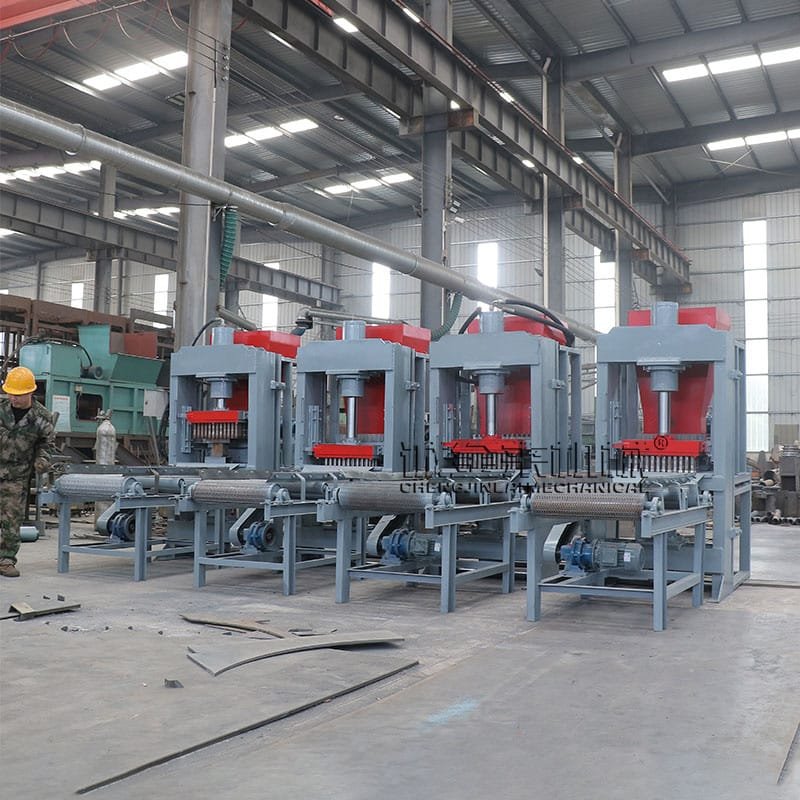
Awal tahun ini, a charcoal entrepreneur from Sri Lanka visited Weiwa Machinery’s production base in Gongyi, Cina. His goal was clear. He wanted to upgrade from low-pressure manual briquette equipment to a complete Hydraulic Shisha Bbq Press Machine Product Line that could compress coconut shell charcoal powder into uniform BBQ briquettes with a finer texture, tighter structure, and cleaner combustion. After a three-day factory test and material analysis session, he confirmed the Hydraulic Shisha BBQ Press Machine was the right core machine for his new production hall near Colombo.
Why the Sri Lanka Client Switched to a Hydraulic Press for BBQ Charcoal?
In Sri Lanka, coconut shell charcoal is abundant, but the local BBQ market is shifting. Buyers no longer accept dusty lump charcoal or brittle hand-pressed cakes. Restaurants, resort kitchens, and export agents want briquettes that ignite fast, hold shape during transport, and burn with low smoke. The client’s previous mechanical punch press produced acceptable cubes, yet the edges chipped, the center stayed porous, and the burn time fluctuated batch by batch.
He evaluated three options before talking to Weiwa. The first was a larger screw extruder. It offered high hourly volume but generated internal friction heat that dried the surface while leaving the core under-compacted. The second was a rotary tablet press. It gave good shape accuracy but limited pressure, sekitar 40 ke 60 ton, which was not enough for 25 millimeter BBQ cubes made from coarse coconut shell fines. The third was our Hydraulic Shisha BBQ Press Machine with a 200 ton dual-pump station. After seeing a live demo on coconut shell powder blended with cassava starch, he chose the hydraulic route.
The deciding factor was particle binding. Hydraulic static compression pushes fine charcoal particles together slowly. Air escapes, binder activates evenly, and the microstructure becomes tight. That is exactly what makes the finished BBQ piece feel smooth, sound crisp when tapped, and glow evenly instead of flaming up and dying out.
Sri Lanka Raw Material Profile We Tested
The client brought two samples. The first was coconut shell charcoal crushed to 80 ke 100 mesh. The second was a mix of coconut shell and cinnamon wood charcoal, because cinnamon processing waste is locally available in southern Sri Lanka. Both batches had moisture around 9 percent after oven drying. We blended 4 percent tapioca starch as binder and ran a pre-mix moisture target of 11 persen.
Our technicians explained that hydraulic pressing tolerates slightly wider moisture windows than screw extrusion, but for BBQ briquettes the sweet spot remains 10 ke 12 persen. Di bawah 9 persen, the binder does not gelatinize. Above 13 persen, the cake sticks to the mold and the ejected piece blisters during drying.
How Weiwa Hydraulic Shisha BBQ Press Machine Produces Finer and Denser Output?
The Hydraulic Shisha BBQ Press Machine shipped to Sri Lanka uses a dual-stage hydraulic system. A low-pressure pump moves the ram fast to fill the cavity. A high-pressure pump builds static force up to 200 tons and holds it for a preset dwell time. This two-step motion is the foundation of fine texture. Fast approach avoids powder segregation. Slow compression lets micro-particles slide into voids instead of breaking.
Most competitors advertise tonnage only. Weiwa focuses on pressure curve and mold geometry. For the Sri Lanka line, we tuned the approach speed, holding time, and ejection delay on the PLC panel so the same machine could produce 25 millimeter BBQ cubes in one shift and 33 millimeter concave shisha rounds in the next shift after a mold swap.
Pre-Compression Chamber Reduces Air Pockets
Before the main ram acts, the feeding system delivers a metered charcoal dose into a pre-compression chamber. A small auxiliary cylinder lightly compacts the powder. This step removes trapped air. When the main hydraulic head descends, the material does not spring back. The result is a briquette with bulk density above 1.05 grams per cubic centimeter, compared to 0.82 ke 0.90 from the client’s old punch press.
Denser briquettes absorb less humidity during monsoon storage. For a Sri Lanka buyer shipping to Maldives or UAE, this density gap directly reduces breakage claims.
Hardened Alloy Mold with Polished Cavity
The BBQ cube mold was CNC machined from hardened alloy steel and mirror polished inside each cavity. Lower friction means the charcoal surface stays matte and closed, not scratched. A closed surface burns with a stable flame front. A scratched surface exposes loose fines that flash and create smoke.
We also embossed the client’s brand initials on the top face of each cube. Hydraulic ejection is gentle enough to keep the embossing sharp, which helped the client position the product as a branded BBQ brick rather than a generic commodity.
PLC Controlled Pressure and Dwell for Batch Consistency
Every raw material batch in Sri Lanka varies slightly in mesh distribution. The PLC records pressure, cycle time, and reject count. The operator adjusts holding time from 1.2 ke 2.0 seconds depending on how oily the coconut shell charcoal feels. This adaptive control is why the Hookah Charcoal Briquette Press Machine from Weiwa keeps density variance under 3 percent across a full container load.
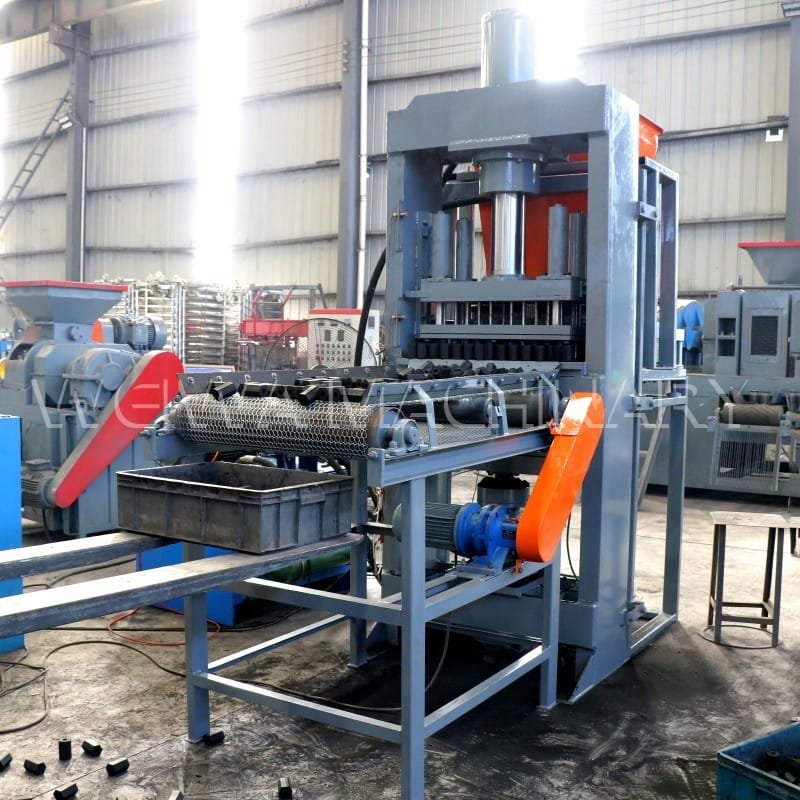
Full Shisha Charcoal Making Production Machine Layout for the Sri Lanka Factory
A press alone is not a business. The Sri Lanka client purchased a connected Shisha Charcoal Making Production Machine sequence so that one worker could manage crushing, Percampuran, pressing, and drying.
The flow started with a horizontal carbonization furnace for fresh coconut shells. Next came a hammer mill crusher with a 3 millimeter screen. Then a double shaft mixer with binder dosing tank. The mixed material rested for twenty minutes in a curing silo, which improved binder film formation. After curing, the material fed the hydraulic press through a variable speed screw conveyor. Ejected cubes dropped on a mesh belt dryer heated by a biomass burner. Final moisture fell below 5 persen.
Because the client also wanted to serve the hookah market, we placed a second mold set nearby. Within fifteen minutes, the line switched from BBQ cubes to 40 millimeter diameter shisha tablets. This dual-purpose design increased his return on machine investment without doubling floor space.
Why the Same Line Makes BBQ and Hookah Charcoal?
BBQ and shisha charcoal share the same science. Both need fine powder, correct binder, controlled moisture, and high static pressure. The only differences are shape, ketebalan, and pack size. BBQ cubes are thicker and need slightly higher tonnage. Shisha tablets are thinner and need faster cycle speed. The Weiwa hydraulic power unit handles both by changing PLC recipe numbers, not mechanical parts.
For the Sri Lanka client, this meant he could run BBQ briquettes from November to April, the peak tourist grilling season, and switch to hookah tablets from May to October for lounge and export orders.
Burn Test Results That Convinced the Sri Lanka Buyer
During the factory acceptance test, we lit both the old punch-pressed sample and the new hydraulic-pressed BBQ cube side by side. Ambient temperature was 24 Derajat Celcius. Each piece weighed 18 grams.
The old sample reached full glow in 75 seconds but developed a central crack at 6 minutes and collapsed at 38 menit. Total usable burn time was 41 menit. Ash content after burn was 4.8 percent of original mass.
The new hydraulic cube from the Hydraulic Shisha BBQ Press Machine reached full glow in 68 seconds, showed no crack at 10 menit, and kept a stable glowing face until 57 menit. Usable burn time was 61 menit. Konten abu adalah 3.1 persen. The client measured a 49 percent longer burn time and a 35 percent reduction in ash, which matched our Thailand and Indonesia trial ranges.
Longer burn time is not just a number. In Sri Lanka beach resorts, it means one BBQ brick grills a full seafood plate without reload. For the exporter, it means the product clears Middle East buyer specifications that require minimum 55 minute burn on 20 gram cubes.
Smoke and Odor Observation
Both samples used the same binder, yet the hydraulic cube smoked for 4 seconds at ignition while the old sample smoked for 11 seconds. The finer internal structure left fewer trapped volatiles. The client noted the hydraulic cube had a cleaner startup, which matters for indoor resort kitchens and hookah cafes alike.
Engineering Details Behind the Hookah Charcoal Making Machine
Weiwa’s Hookah Charcoal Making Machine is built around four subsystems that the Sri Lanka team inspected closely.
The hydraulic pump station uses a 15 kilowatt motor paired with a cooling radiator. Sri Lanka ambient temperatures reach 34 degrees in the dry zone, so cooling prevents oil viscosity drop during 10 hour shifts. The PLC cabinet is dust sealed and mounted away from the press frame to avoid vibration error. The mold base uses a quick clamp system. The discharge conveyor has a variable speed belt so cured briquettes do not knock against each other before they enter the dryer.
Every press is load tested at 110 percent rated pressure before painting. The Sri Lanka unit carried a 220 ton test load for 30 minutes with zero frame deflection recorded on the dial gauge.
Safety and Maintenance for Tropical Operation
Hydraulic oil in tropical climates degrades faster. We specified ISO 46 anti-wear oil with a 2000 hour change interval, extended by a spin-on filter at the return line. The client’s maintenance staff was trained to read the pressure gauge, reset the PLC alarm, and swap molds without removing the main cylinder. Spare seals, a spare mold, and a tool kit were packed in the same container.
Comparing Hydraulic Press with Other Briquette Technologies
Many first-time buyers ask why not use a roller ball press or a screw extruder for BBQ charcoal. Roller presses are excellent for round balls at high volume, but they apply rolling shear, which can leave a seam line on the briquette. Screw extruders are continuous, but friction heat can pre-ignite binder spots and cause uneven color. Hydraulic presses sacrifice some cycles per minute in exchange for uniform static force and silent operation.
For premium BBQ cubes and hookah tablets where appearance and burn curve matter more than raw tons per hour, the Hydraulic Shisha Bbq Press Machine Product Line remains the most controllable platform. The Sri Lanka client runs 8 seconds per cube cycle, which gives him around 700 kilograms per hour of 18 gram cubes, enough to fill one 20 foot container every nine working days.
When Hydraulic Is Not the Right Choice?
If a buyer only makes 3 millimeter diameter hookah sticks at 3 tons per hour, a multi-station rotary tablet press is better. If a buyer makes 40 millimeter oval BBQ balls for open fire pits and price competition is fierce, a roller press wins on cost per ton. Weiwa advises clients on this during the quotation stage instead of pushing one machine type.
Customization and Plant Layout Service from Weiwa Machinery
The Sri Lanka project included a 2D plant layout drawn to the client’s rented hall dimensions, 18 meters by 9 meters. We placed the crusher near the inlet, the mixer in the middle, the hydraulic press on a reinforced concrete pad, and the dryer along the wall with exhaust going out through a cyclone. Walking distance between stations was under 4 meters so two workers could cover the whole line.
We also supplied a 3D design drawing showing electrical conduits, binder tank height, and mold storage shelf position. The client used the drawing to get local council approval before ordering steel for the roof. This engineering support is part of every Weiwa export project, not a paid extra.
Mold Customization for BBQ and Hookah Formats
For Sri Lanka, the first mold was 25 oleh 25 oleh 22 millimeter cube with chamfered edges. The second mold was 40 millimeter diameter by 13 millimeter concave round with a 6 millimeter center dimple, a popular shisha shape in Colombo lounges. Both molds shared the same base plate, so the swap needed four hex bolts and a PLC recipe change.
Weiwa in-house mold workshop can also engrave logos, batch numbers, or Arabic letters for Middle East buyers. Lead time for a custom mold set is 7 working days after drawing confirmation.
Kemasan, Pengiriman, and After-Sales for the Sri Lanka Order
The hydraulic press was wrapped in anti-rust paper, then stretch film, then fixed inside a plywood box with steel brackets. The dryer and mixer went loose in the container with foam corner protection. The Sri Lanka client received the container at Colombo port 19 days after sailing from Qingdao.
Weiwa assigned one Chinese engineer and one English-speaking Sri Lankan agent for remote commissioning. The line started producing saleable cubes on day 4 after arrival. The engineer stayed online daily for two weeks, then moved to monthly follow-up calls.
Spare parts stock recommended for the first year included one hydraulic seal kit, two cutter blades for the crusher, one PLC touch panel, and one spare cube mold. This stock value was under 2 percent of the total line cost, which the client accepted as insurance against downtime in peak season.
After-Sales Team and Response Commitment
Weiwa Machinery runs a dedicated export after-sales group with 30 plus years of field experience across Africa, Asia Tenggara, dan Timur Tengah. For the Sri Lanka client, we committed to a 24 hour email or WhatsApp response, A 72 hour video diagnosis, and spare part dispatch within 5 working days. Critical parts such as PLC modules and hydraulic valves are kept in stock in our Gongyi warehouse.
Market Outlook for BBQ Charcoal in Sri Lanka and Nearby Islands
Sri Lanka’s tourism recovery pushes resort kitchens to standardize grilling fuel. Maldives resorts import almost all BBQ briquettes, and Sri Lankan producers sit closer to coconut shell supply than Indian or Vietnamese competitors. A hydraulic line that makes branded 5 kilogram BBQ brick cartons can target both local supermarkets and Maldives boat transfers.
Pada saat yang sama, the hookah cafe culture in Colombo and Negombo is growing among young consumers. The same Shisha Charcoal Making Production Machine line can feed both channels, smoothing cash flow across seasons. We estimate a payback period of 10 ke 14 months for a 700 kilogram per hour line if local coconut shell charcoal powder is sourced below 180 dollars per ton.
Quality Benchmark for Export Grade BBQ Briquettes
Buyers in GCC countries typically ask for cube density above 1.0 gram per cubic centimeter, moisture below 5 persen, ash below 4 persen, ignition under 90 seconds, and burn time above 55 minutes on an 18 ke 20 gram piece. The Weiwa hydraulic press with pre-compression and polished mold meets these numbers consistently, which is why the Sri Lanka client already booked a second line option for 2027.
Tentang Mesin Weiwa
Henan Weiwa Machinery Manufacturing Co., Ltd. has more than 30 years of experience in designing and building briquette presses, tungku karbonisasi, Crushers, mixer, dan pengering. Our equipment runs in over 90 negara. We are not a trading company. We are a manufacturing base in Gongyi, Henan, with in-house CNC machining, hydraulic assembly, mold processing, and a 15 person after-sales engineering team.
We provide free custom mold design, 3D plant layout drawings, raw material formula advice, and on-site or remote commissioning. Whether you need one Hydraulic Shisha BBQ Press Machine, a full Hookah Charcoal Making Production Machine line, or a combined BBQ and shisha plant like our Sri Lanka client, we plan the project around your hall size, bahan mentah, and target market.
If you are evaluating hydraulic charcoal equipment, send us your raw material photo, moisture level, target shape, and daily ton requirement. We will return a layout drawing and a quoted configuration within three working days.
Hubungi Mesin Weiwa
Massa: +8613838093177
Whatsapp: +8613838093177
E-mail: info@cjlmachineGroup.com
Situs web: https://cjljx.com/product/hydraulic-shisha-bbq-press-machine
We welcome factory visits in Gongyi. Airport and railway station pickup can be arranged. Our technical team will run a live press trial on your own material if you send a 20 kilogram sample in advance.


 Wechat wechat

 +8615937143060
