


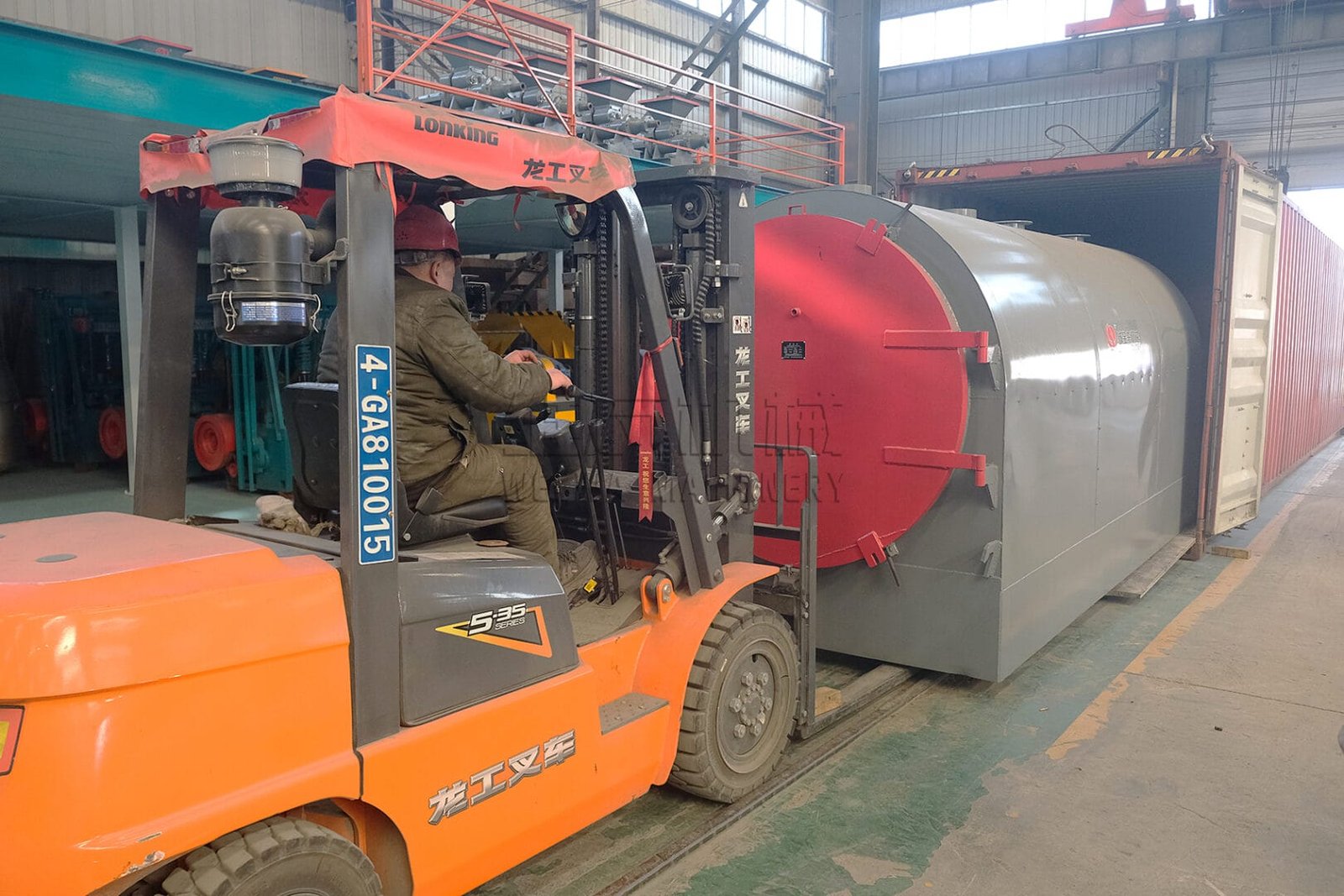
The horizontal carbonization furnace in Ghana will serve a small to medium scale producer who previously relied on earth pit burning and imported lump charcoal for repacking. Their goal is to convert local wood logs, bamboo offcuts, Kerang kelapa, and sawdust briquettes into uniform barbecue grade charcoal with fewer laborers and a cleaner workshop. This blog explains how the machine was prepared, what the trial run revealed, and why the charcoal making machine category is gaining momentum across West Africa.
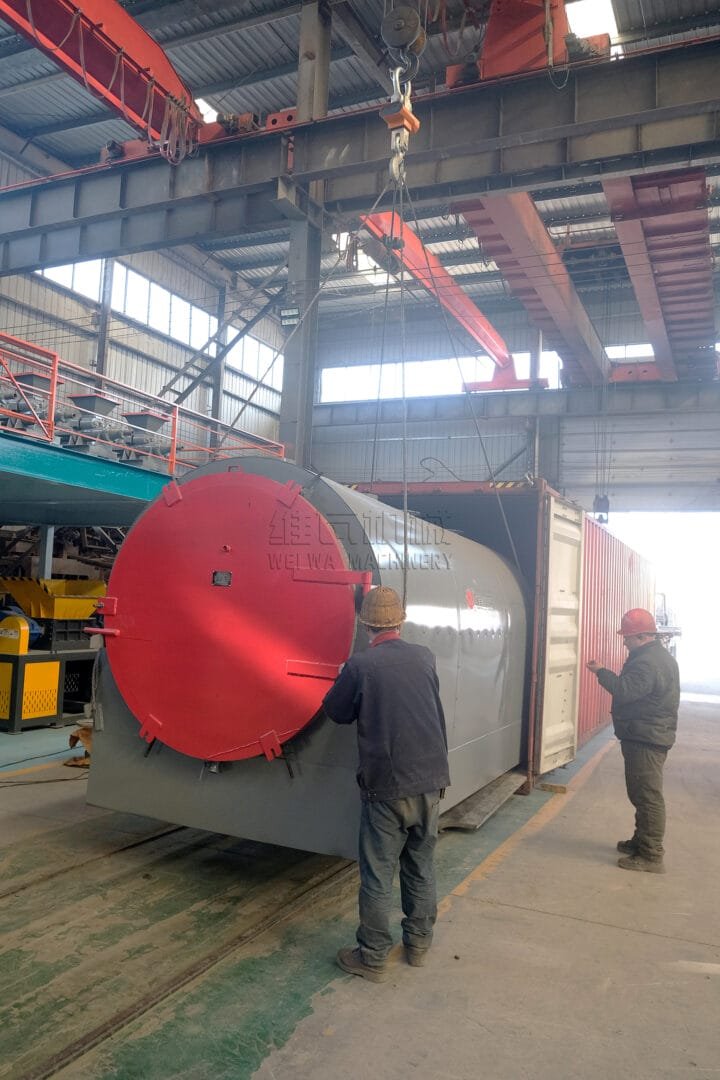
Inside the Weiwa Loading Bay Before the Ghana Shipment
Ruang pemuatan di Weiwa Machinery diatur berdasarkan satu prioritas: the horizontal carbonization furnace for Ghana had to arrive undamaged, pre tested, and ready for commissioning within seven days of unloading. Badan tungku utama, rail mounted barrel chamber, menara kondensor, kipas angin yang diinduksi, dan kabinet kontrol dipentaskan secara terpisah, dibungkus dengan membran tahan air, dan dipasang pada rangka selip baja. Berbeda dengan tempat pembakaran batu bata tradisional, this unit does not require on site masonry. Setelah fondasinya rata, ruang barel digulung ke posisinya, saluran gas terhubung, dan catu daya dihubungkan ke panel kontrol.
Sebelum tungku masuk ke dalam wadah, our quality team ran a no load heating cycle and a short wood chip trial. The purpose was not only to check welds and seals but also to capture baseline data for the Ghana client. We recorded ramp up time, respons pembakar, laju tetesan kondensor, dan kurva suhu di dalam laras. Angka-angka tersebut dicetak di kantong manual sehingga teknisi lokal di Ghana mengetahui secara pasti seperti apa pengoperasian normal pada hari pertama.
Weiwa Machinery treats the moment of shipment as part of the product. Mesin pembuat arang yang datang dalam keadaan bingung, berkarat, atau salah kabel menciptakan bulan pertama yang buruk. Tim ekspor kami memotret setiap titik pengangkatan, beri label pada setiap flensa pipa, dan menerjemahkan daftar periksa komisioning ke dalam bahasa Inggris yang sederhana. Untuk pesanan Ghana, we also added a one page quick start sheet covering tropical humidity precautions, since coastal Ghana presents higher moisture exposure than our inland Chinese workshop.
How the Tungku karbonisasi horizontal Works for Ghana Feedstock?
Tungku karbonisasi horizontal dibangun di sekitar ruang tong silinder yang dipasang pada rel. Bahan mentah dimasukkan ke dalam gerobak atau didorong langsung ke dalam tong, lalu pintunya ditutup. Ruangan tersebut dipanaskan secara tidak langsung, artinya nyala api tidak pernah menyentuh kayu. Alih-alih, pembakar di luar tong memanaskan dinding baja, and the wood inside undergoes pyrolysis in a low oxygen environment. Desain ini berbeda dengan tanur vertikal atau gundukan tanah tetap karena distribusi panas lebih merata di sepanjang tong.
Indirect Heating and 600C Self Sustaining Cycle
Selama persidangan Weiwa, tungku mencapai suhu ruang internal mendekati 600 derajat Celcius menggunakan kombinasi kayu bakar starter dan gas proses daur ulang. Tungku karbonisasi horizontal dilengkapi dengan sistem pemurnian gas yang menangkap tar, cuka kayu, dan kondensasi dari aliran asap. Setelah digosok, gas mudah terbakar yang telah dibersihkan dikembalikan ke kompor. Setelah siklus termal stabil, permintaan bahan bakar eksternal turun tajam. Dalam simulasi uji coba Ghana, after the fourth hour the burner consumed mostly recycled gas rather than fresh firewood.
This self sustaining loop matters for Ghana charcoal makers because firewood is not free. Buying or harvesting extra wood just to fire a kiln defeats the purpose of processing agricultural residue. The Weiwa horizontal carbonization furnace turns the smoke that older kilns waste into the heat that drives the next batch. That is why our engineers describe it as a closed thermal cycle rather than a simple steel drum.
Gas Purification and Tar Recycling
The purification tower on this charcoal making machine uses a spray cooling stage followed by a condenser and a tar separation stage. The liquid fraction is collected in a drum and can be stored for further refining or disposed of under local environmental guidance. The gas fraction travels through the induced draft fan back to the combustion chamber. Our Ghana client was specifically concerned about smoke complaints from neighbors. The trial run produced a faint white plume during startup and essentially no visible smoke after the gas loop engaged.
For a horizontal carbonization furnace in Ghana, smoke control is not only an environmental issue. It is a community relations issue. Many charcoal yards operate near residential zones or shared access roads. A machine that smells like burning plastic will not survive long in a populated district. Weiwa Machinery calibrates the fan speed and spray pressure so the combustible gas burns cleanly rather than escaping untreated.
Factory Trial Run Results Before Shipping to Ghana
The pre shipment trial used a mixed batch of 320 kilograms dry weight: 60 percent tropical hardwood offcuts, 25 percent coconut shell, Dan 15 percent sawdust briquette. We chose this blend because the Ghana client estimated a similar ratio in his weekly feedstock. The batch was loaded cold, tertutup, and ignited using a small LPG torch at the burner nozzle.
Temperature inside the barrel crossed 200 degrees Celsius at minute 95, 400 degrees at minute 165, and stabilized near 580 ke 610 degrees between hour 5 and hour 9. Total cycle time was 11 jam dan 20 minutes including cooldown. Hasil akhir arang adalah 96 kilograms, representing a yield of 30 percent on dry input. Charcoal pieces showed uniform black cross sections with no glassy overheating zone and no pale under carbonized core. The client later viewed the trial video and approved the loading.
Another detail from the trial: the rail mounted barrel allowed one worker to pull the cart out after cooldown without shoveling. Untuk operasi di Ghana dimana biaya tenaga kerja meningkat dan pekerja muda lebih memilih pekerjaan yang lebih bersih, this ergonomic advantage is part of the sales story. Mesin pembuat arang seharusnya tidak hanya menghasilkan arang saja. It should make the workshop tolerable.
Why Ghana Charcoal Makers Prefer This Charcoal Making Machine?
Ghana sits in a interesting position for biomass processing. The country has steady supplies of cocoa farm prunings, coconut from the coast, serbuk gergaji dari cluster furnitur di Kumasi, and hardwood logs from plantation thinning. Pada saat yang sama, traditional charcoal burning faces criticism for deforestation and inconsistent quality. A horizontal carbonization furnace gives the producer a middle path: keep using local biomass, but stop depending on rainfall, wind direction, dan keberuntungan.
The charcoal making machine category includes many shapes, from small portable retorts to continuous rotary kilns. The Weiwa horizontal model fits the gap between those two extremes. It is not as cheap as a 200 dollar drum retort, but it does not require the civil engineering of a rotary plant. A standard version processes 800 ke 1000 kilograms of wood per batch and fits inside a 40 foot container. For a Ghana entrepreneur who already owns a pickup truck and a small shed, that footprint is realistic.
Saat kita membahas tungku karbonisasi horizontal di Ghana, the conversation is rarely about one machine. It is about replacing guesswork with meters. The Weiwa unit shows chamber temperature, condenser pressure, fan status, and burner flame on a single panel. The Ghana client requested two extra thermocouples at the barrel ends so he could confirm heat uniformity. Our team installed them and logged the data during trial. Both ends stayed within 18 degrees of each other at peak temperature, which is acceptable for lump charcoal.
Raw Materials Available in Ghana and Expected Yield
Weiwa Machinery does not sell a furnace and walk away. During the consultation phase, our sales engineer asked the Ghana buyer to send photos of his raw material stack and moisture reading. The moisture meter showed 14 percent on seasoned offcuts and 22 percent on fresh coconut shell. We advised a two day open air pre dry for the coconut shell and a denser packing pattern for the hardwood.
Expected yields vary by feedstock. Potongan kayu keras kering biasanya kembali 28 ke 33 persen arang menurut beratnya. Coconut shell returns slightly higher, sekitar 32 ke 36 persen, because of its density. Briket serbuk gergaji jatuh ke dalam 30 ke 34 kisaran persen jika briket itu sendiri dibuat pada tekanan yang benar. Agricultural residues such as maize cob or cassava stalk are possible but yield lower, closer to 20 ke 25 persen, and require tighter barrel packing. The horizontal carbonization furnace handles all of them, but the operator controls the economics by sorting feedstock first.
In Ghana, many first time buyers assume charcoal yield is fixed by the machine. It is not. Hasil panen ditentukan oleh kelembapan, kepadatan, kualitas penyegelan, dan disiplin cooldown. The Weiwa trial report shared with the Ghana client lists all four variables so he can train his team instead of blaming the steel.
Installation and After Sales Support for Ghana Clients
After the horizontal carbonization furnace arrives at Tema or Accra, the client needs a level concrete pad of roughly 6 meters by 4 meters, A 220 volt single phase connection for the fan and panel, and a forklift or crane capable of lifting 2.5 ton. Weiwa Machinery sends the foundation drawing in advance. Our technical staff join the commissioning call on WhatsApp video, watch the first empty cycle, and then approve the first wood batch.
Spare parts for this charcoal making machine are intentionally simple. Door gasket, thermocouple, condenser spray nozzle, fan bearing, and control relay cover 90 percent of field issues. We ship one spare kit with every Ghana order. The client in this case also purchased a second condensate collection drum and a local voltage stabilizer after our engineer flagged intermittent rural grid voltage.
Weiwa Machinery keeps a digital folder per machine serial number. Every horizontal carbonization furnace we export has a record of its steel batch, weld inspection, trial curve, and container number. If the Ghana client calls six months later with a temperature drift, we compare his live reading to the factory baseline. That continuity is part of why over two million customers worldwide have chosen Weiwa brands across briquette presses, Crushers, pengering, and carbonization equipment.
Tentang Mesin Weiwa
Weiwa Machinery is a manufacturer and exporter of biomass processing equipment, with deep experience in charcoal making machine systems, horizontal carbonization furnace designs, wood crushers, rotary dryers, and briquette production lines. Our factory focuses on practical machines for small and medium producers who need predictable output rather than laboratory perfection. The horizontal carbonization furnace shipped to Ghana reflects that philosophy: rail mounted barrel, indirect heating, gas recycling near 600 Derajat Celcius, and a control panel a non engineer can learn in one morning.
We export to Africa, Asia Tenggara, Latin America, and Eastern Europe. In every market we adapt the furnace to local feedstock, local voltage, and local humidity. For Ghana, that meant extra condensate capacity, English labeled valves, and a trial run using tropical wood blends. We do not believe in one size fits all steel.
If you are evaluating a horizontal carbonization furnace in Ghana, or comparing charcoal making machine suppliers, we invite you to review the product page and request a custom proposal. Weiwa Machinery answers technical questions directly, shares trial videos, and prepares layout drawings before payment.
Hubungi Mesin Weiwa:
Seluler / Whatsapp: +8613838093177
E-mail: info@cjlmachineGroup.com
The furnace is now at sea. The trial data is in the client folder. The next charcoal batch in Ghana will not depend on wind, luck, or a neighbor complaining about smoke. That is the Weiwa standard for a horizontal carbonization furnace export.


 Wechat wechat

 +8615937143060
