


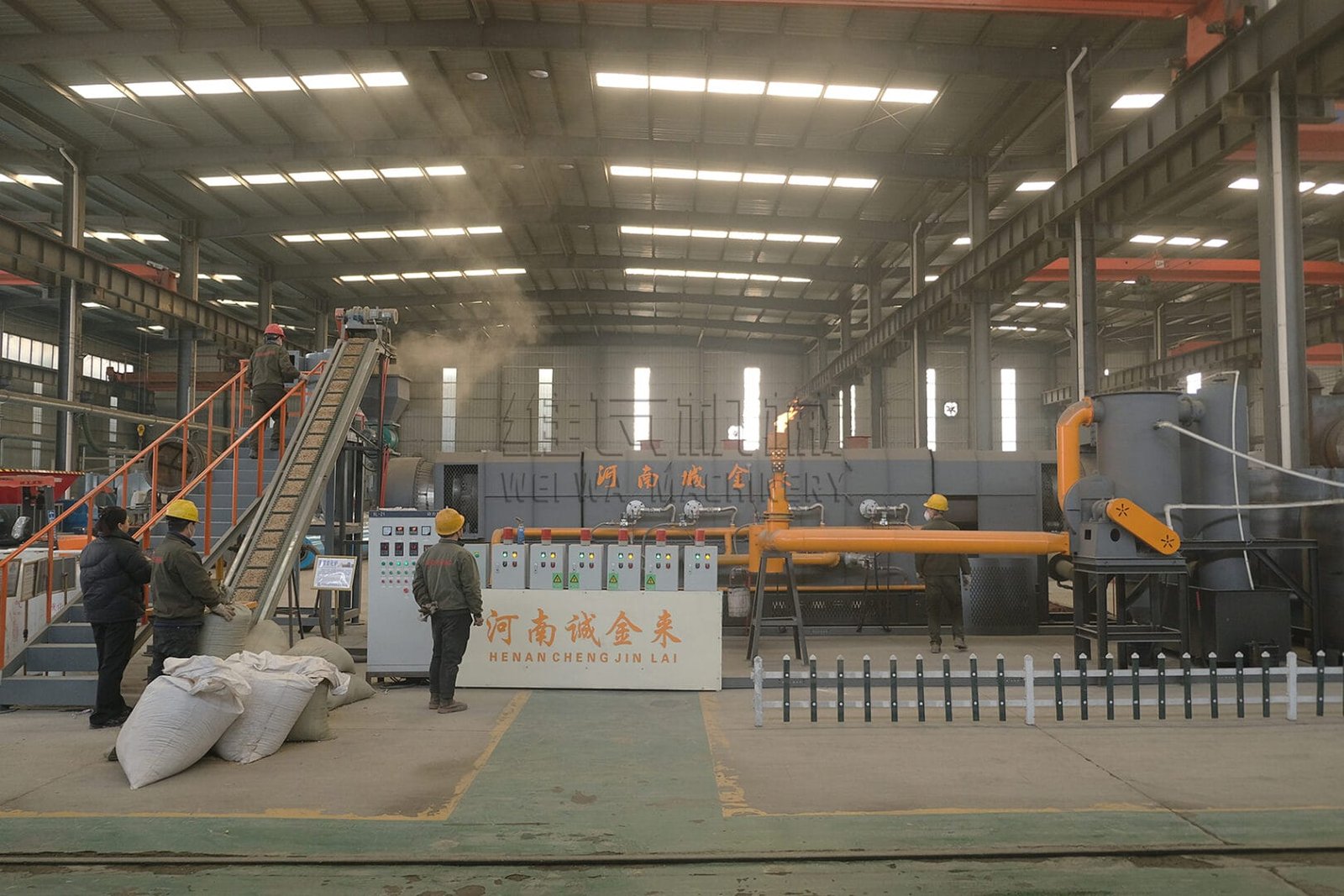
A tungku karbonisasi berkelanjutan is the core equipment for modern biomass-to-charcoal production lines, and recently Weiwa Machinery had the privilege of completing a full trial run for a client based in Saudi Arabia who intended to process large volumes of palm leaves into premium shisha charcoal using a hydraulic press. This project represents a growing trend across the Middle East where abundant agricultural waste such as date palm fronds is transformed into value-added hookah charcoal through energy-efficient pyrolysis technology.
Why Saudi Arabia Needs a Continuous Carbonization Furnace for Palm Leaves?
Saudi Arabia produces massive amounts of date palm fronds and dry palm leaves annually as agricultural by-products. Traditionally these were burned in open fields or left to decompose, creating both air pollution and wasted potential. With the domestic and export demand for high-quality shisha charcoal rising across Gulf countries, many Saudi entrepreneurs are seeking a continuous carbonization furnace for Saudi Arabia that can handle palm leaves reliably at industrial scale. Batch-type kilns are labor intensive, difficult to control for uniform fixed carbon content, and ill-suited for 24/7 operasi. By contrast a tungku karbonisasi berkelanjutan allows uninterrupted feeding of dried palm leaves, stable temperature zones, Pemulihan gas yang mudah terbakar, and automatic discharge of biochar—making it the logical choice for Saudi conditions where throughput and consistency matter.
Palm Leaves as Raw Material for Charcoal Making Machine
Palm leaves are fibrous, low in moisture after sun drying, and contain sufficient lignocellulosic content to yield good charcoal when subjected to oxygen-limited pyrolysis between 400 °C and 600 ° C.. Prior to entering the Mesin Pembuat Arang carbonization section, palm leaves are typically shredded to below 30 mm and pre-dried to under 15 percent moisture to ensure smooth conveying and complete carbonization. Itu continuous carbonization furnace is for palm leaves processing because the rotary drum design gently tumbles light fibrous material without bridging or clogging—a common issue with heavier woody biomass in some batch ovens. Our Saudi client confirmed that shredded palm leaves flowed evenly through the feeder, experienced uniform residence time inside the dual-drum furnace, and exited as fine-textured black charcoal with low ash and high fixed carbon.
Overview of Continuous Carbonization Furnace Design
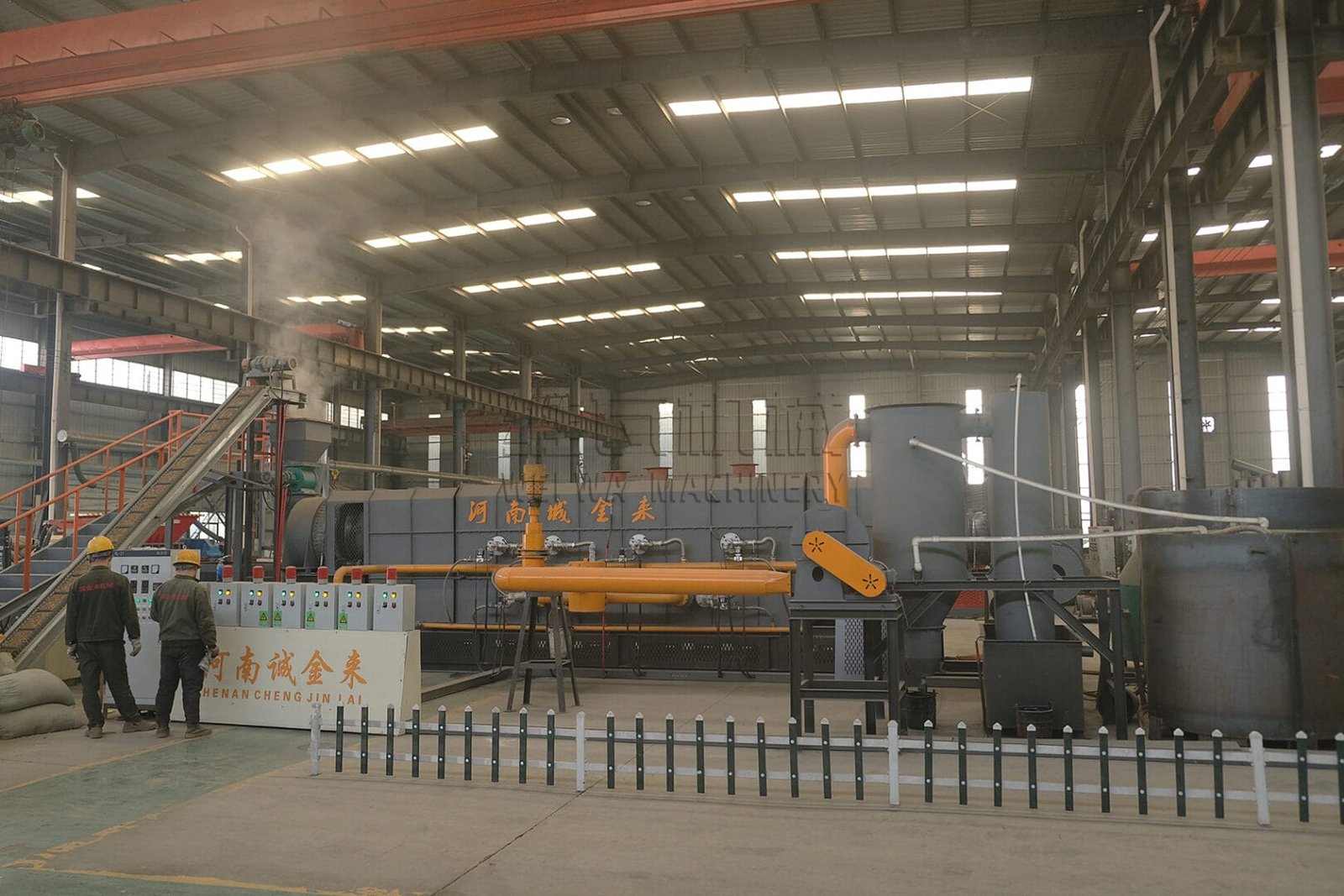
The Weiwa tungku karbonisasi berkelanjutan employs a double-cylinder rotary configuration consisting of an inner drying drum and an outer carbonization drum. Biomass spirals forward along the drum axis while being heated indirectly from the combustion chamber. Temperatures in the carbonization zone are normally maintained at 500–600 °C depending on feedstock type and desired charcoal characteristics. A critical feature appreciated by our Saudi customer is the combustible gas recovery system: volatiles released during pyrolysis—mainly carbon monoxide, metana, and hydrogen—are ducted through a purification unit and reintroduced as secondary fuel to the burner. This self-sustaining heat cycle reduces external energy consumption and aligns with environmental expectations for reduced smoke emissions. The furnace can run continuously for days, which is essential for commercial charcoal plants supplying hookah lounges and distributors across the Kingdom.
Key Specifications Relevant to Saudi Palm Leaf Projects
Typical models offered by Weiwa Machinery process 500 kg/h to 2000 kg/h of qualified biomass input. For palm leaves the effective hourly throughput is adjusted based on bulk density and moisture. The main furnace body is constructed from high-temperature resistant steel with ceramic fiber insulation to minimize heat loss in desert climates. An automated screw feeder regulates material inflow so the continuous carbonization furnace in Saudi Arabia never becomes overcharged. A water-cooling discharger lowers charcoal temperature below 50 °C before collection, preventing re-ignition and preserving porous structure important for shisha charcoal adsorption properties. All electrical components are housed in a dust-protected PLC cabinet with optional English/Arabic labeling for ease of local operation.
Trial Run Procedure for the Saudi Client
Before shipment the complete Mesin Pembuat Arang line—including crusher, pengering, tungku karbonisasi berkelanjutan, cooling screw, charcoal silo, and hydraulic shisha charcoal press—was assembled in our factory for a witnessed trial. Saudi representatives joined via live video and later visited in person. The trial simulated actual conditions: shredded palm leaves at approximately 12 percent moisture were fed into the system at a controlled rate of 800 kg/jam. The pre-drying section raised internal material temperature to drive off residual humidity, after which the leaves entered the high-temperature pyrolysis zone. Within thirty minutes the furnace reached stable carbonization temperature and began emitting combustible gas which was routed back to the burner.
Observed Results from the Palm Leaf Carbonization Test
Charcoal discharged from the cooling system showed uniform black coloration, fixed carbon content above 70 percent on dry basis, ash content below 3 persen, and negligible uncarbonized fibers. The resulting biochar was then pulverized and mixed with a small percentage of natural binder before being fed to the hydraulic press to form 25 mm × 25 mm × 25 mm shisha cubes. The hydraulic press compacted the material at adjustable pressure to achieve densities preferred by Middle Eastern smokers—typically between 0.9 g/cm³ and 1.1 g/cm³—producing cubes with clean edges, low dust, and even ignition behavior. The Saudi client confirmed the charcoal met their quality benchmark for low spark, long burn time, and minimal odor, which are essential for hookah use. Based on trial data they proceeded to order a full production line centered on our continuous carbonization furnace for Saudi Arabia deployment.
Integration of Tungku karbonisasi berkelanjutan with Hydraulic Shisha Charcoal Press
A Mesin Pembuat Arang plant usually does not stop at carbonization. To manufacture market-ready shisha charcoal the carbonized output must be crushed into powder, sieved, blended with food-grade binders such as cassava starch or guar gum, and molded by a hydraulic or mechanical briquette press. Itu tungku karbonisasi berkelanjutan connects seamlessly to this downstream process because it delivers a steady stream of cooled charcoal rather than intermittent batches. Conveyors transfer charcoal to the grinding unit; from there the powdered char goes to a double-shaft mixer where binder solution is added; the wet mixture is fed to the hydraulic press which stamps individual tablets or cubes according to customized molds. For the Saudi market cube and round tablet shapes are both common, and our press supports quick mold changeover. The synchronization between continuous pyrolysis and hydraulic pressing eliminates buffer storage bottlenecks and improves overall equipment effectiveness.
Why the Continuous Carbonization Furnace is for Palm Leaves and Not Just Wood?
While a tungku karbonisasi berkelanjutan can process wood chips, serbuk gergaji, batok kelapa, KULUT NAS, bambu, dan jerami, it is particularly advantageous for palm leaves because of the light fluffy nature of the feed. In a batch kiln palm leaves tend to mat together, restricting airflow and causing uneven carbonization. In the rotating drum of our furnace the leaves are constantly turned, exposed to hot gases, and advanced at a calibrated speed so every particle receives adequate dwell time in the pyrolysis zone. This ensures the continuous carbonization furnace is for palm leaves conversion into consistent charcoal rather than partially charred clumps. Additionally the gas recycling system compensates for the slightly different volatile composition of palm-leaf pyrolysis gas compared to hardwood, maintaining stable furnace temperature without additional diesel or LPG once the process is initiated.
Environmental and Economic Benefits for Saudi Investors
Deploying a continuous carbonization furnace in Saudi Arabia to utilize palm leaves delivers multiple benefits. Environmentally the alternative to open burning is significant reduction in PM2.5 and CO₂ emissions; instead of uncontrolled combustion the biomass is pyrolyzed in an oxygen-starved environment with flue gas cleaned through a spray tower or cyclone before discharge. Economically the raw material cost is extremely low or even negative if farmers pay for frond removal, while the end product—premium shisha charcoal—commands strong prices locally and in neighboring GCC states. The energy self-sufficiency achieved by recycling pyrolysis gas lowers operating expense per ton of charcoal produced. Because the Mesin Pembuat Arang line runs continuously the labor requirement per ton is lower than batch kiln operations, improving ROI for Saudi entrepreneurs targeting medium to large scale output.
Customization Options from Weiwa Machinery
Weiwa Machinery understands that each Saudi client may have different site constraints, utility availability, or finished-product specifications. Therefore our continuous carbonization furnace for Saudi Arabia orders can be customized in drum diameter and length to match required capacity, fitted with extra dust removal stages to meet local environmental codes, equipped with a larger pre-dryer if raw palm leaves are not pre-sun-dried, and paired with hydraulic presses of varying tonnage (MISALNYA., 60-ton, 100-ton, 200-ton). We also provide layout drawings, foundation plans, and container loading diagrams so customers can prepare the workshop in advance. Arabic-speaking technical support is available through our international sales engineers to bridge any language gap during installation and commissioning.
Installation Commissioning and After-Sales Support
After the trial run approval the tungku karbonisasi berkelanjutan dan lengkap Mesin Pembuat Arang line were packed in seaworthy frames and shipped to Saudi Arabia. Upon arrival Weiwa technicians guided the client remotely via video and supplied detailed bilingual manuals. For larger projects on-site commissioning can be arranged. Spare parts kits—including seals, bantalan, termokopel, and mesh screens—are recommended to keep as stock. Our after-sales team follows up periodically to review operating parameters, troubleshoot anomalies, and suggest optimizations such as adjusting feed rate or binder ratio for seasonal variations in palm leaf moisture content. This ongoing partnership ensures the continuous carbonization furnace in Saudi Arabia continues performing to specification years after startup.
Frequently Asked Questions about Palm Leaf Charcoal Lines
Prospective buyers often ask whether palm-leaf charcoal is suitable for barbecue as well as shisha. The answer is yes—after proper carbonization in the continuous carbonization furnace is for palm leaves application the biochar can be briquetted as lump charcoal or mixed with binders for extruded BBQ briquettes, though shisha grade typically requires finer milling and hydraulic pressing. Another common question is how much land is needed; a standard 800–1000 kg/h line with tungku karbonisasi berkelanjutan, pengering, penghancur, pengaduk, and hydraulic press typically fits inside a 300–400 m² covered workshop plus outdoor raw material storage. Power demand is modest—mainly motors for conveyors, drum rotation, fans, and hydraulic unit—and can be supplied by standard industrial three-phase supply available in most Saudi industrial zones.
Conclusion – Partner with Weiwa Machinery for Your Charcoal Project
The successful trial run demonstrated that a Weiwa tungku karbonisasi berkelanjutan coupled with a hydraulic shisha charcoal press provides a technically sound and commercially viable route to convert Saudi Arabia’s abundant palm leaves into high-value hookah charcoal. Whether you are a new investor exploring biomass utilization or an established charcoal trader upgrading from batch kilns, our Mesin Pembuat Arang solutions are engineered for durability, efisiensi, and compliance with modern environmental standards. If you are searching for a dependable continuous carbonization furnace for Saudi Arabia or want to know if the continuous carbonization furnace is for palm leaves processing right for your raw material, contact Weiwa Machinery today for a tailored proposal and factory visit invitation.
Tentang Mesin Weiwa
Weiwa Machinery has over 30 years of experience in manufacturing biomass carbonization and briquetting equipment. We provide professional after-sales service, customized machine configurations, and factory layout planning drawings to help you build an efficient production line. From single tungku karbonisasi berkelanjutan units to complete Mesin Pembuat Arang plants, we serve clients worldwide including the Middle East, Asia Tenggara, Afrika, dan Eropa.
Contact us now for a quotation:
Massa / Whatsapp: +86 138 3809 3177
E-mail: info@cjlmachineGroup.com
Situs web: https://cjljx.com


 Wechat wechat

 +8615937143060
