


Why Somalia Is a Practical Market for a Sawdust Briquetting Machine?
Somalia sits in a region where traditional charcoal made from whole trees remains a dominant household fuel. Urban kitchens, tea stalls, and bakeries burn charcoal daily. Pada saat yang sama, agricultural residuals such as maize stalks, sorghum straw, groundnut shells, sesame husk, and sawmill offcuts are often left in fields or burned openly. A sawdust briquetting machine closes that loop: it takes dispersed biomass and upgrades it into uniform, high-density fuel rods.
The country also imports very little finished charcoal from abroad because freight cost destroys margins. Local production is the only scalable answer. A biomass extruder installed near a timber yard, a farm cooperative, or a municipal waste point can run on materials that are either free or cheap, then sell the output at urban retail prices. That arbitrage is what makes the project bankable.
Local Feedstock Options for a Biomass Extruder
During the pre-shipment call with the Somali buyer, we mapped his feedstock basket. Di dalam 40 km of his proposed site he identified four steady streams. Pertama, sawdust from two small furniture workshops. Kedua, maize cob and stalk residue from nearby farms. Ketiga, sesame husk purchased from a grain aggregator. Fourth, fallen acacia branches collected during land clearing. None of these require chemical binders. Under heat and pressure the natural lignin inside the fiber softens and acts as the glue.
This matters because imported binders raise cost and complicate combustion. Our sawdust extruder is built around binder-free screw compression, which keeps the recipe simple for operators who may not have a chemistry background.
What the Somalia-Bound Charcoal Line Actually Contains?
The dispatched line follows the standard five-stage route we deploy in East Africa, Timur Tengah, and parts of Latin America. Stage one is size reduction. A hammer mill takes stalks, cabang, and offcuts down to under 5 mm. Stage two is drying. A rotary drum dryer pulls moisture from around 35 percent down to 8–12 percent, which is the safe window for extrusion. Stage three is the core screw pressing inside the biomass briquette machine. Stage four is cooling and stacking. Stage five, optional but recommended for charcoal rather than half-carbonized briquettes, is carbonization in a sealed furnace.
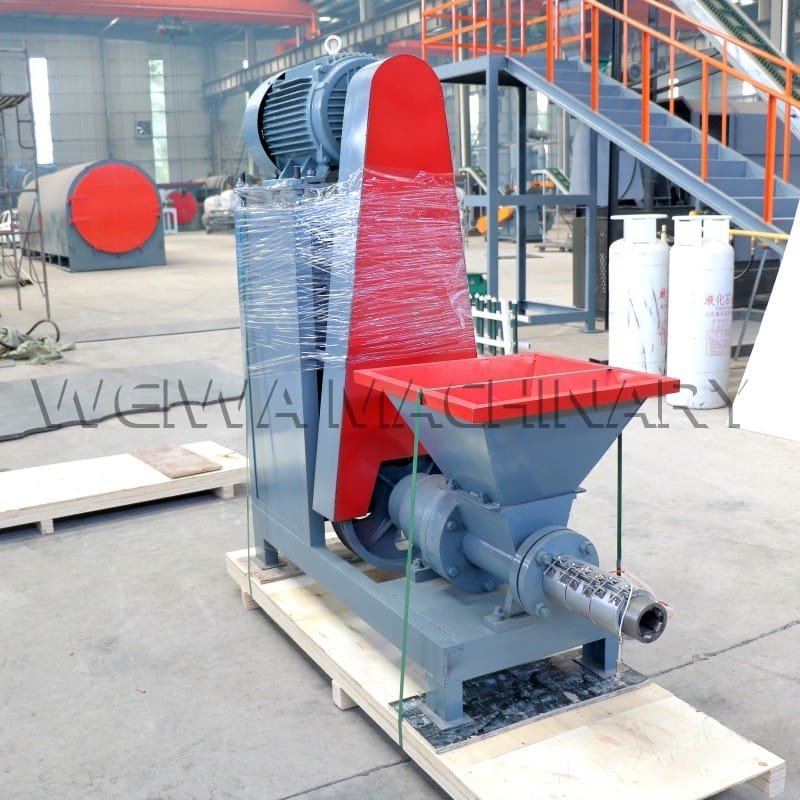
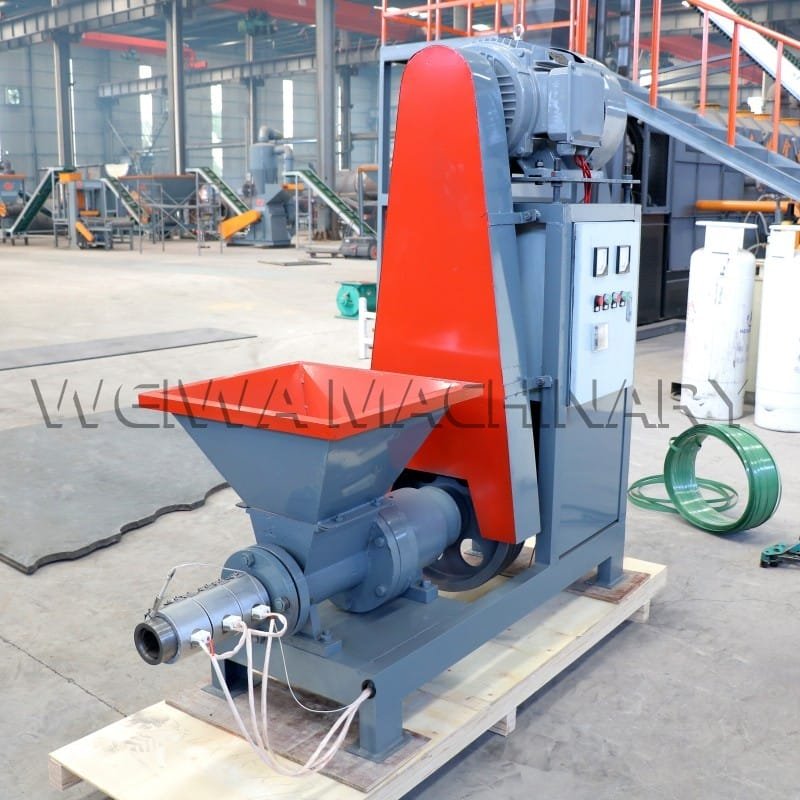
On the loading day, our engineer checked every bolt on the sawdust extruder gearbox, ran a no-load test on the 37 kW motor, and verified the heating collar reached stable temperature before shutdown. The dryer cyclone and the carbonization furnace chimney were disassembled for container packing. Steel skids were welded under the heavy units. Vibration dampeners were added because the client’s site has a compacted sand foundation rather than a concrete slab.
Key Specification Choices for the Somali Buyer
We did not sell the biggest model. We sold the right model. The client selected a 50 mm hexagonal hollow die, which gives a familiar stick shape to local charcoal users while keeping throughput near 300 kg per hour. The biomass briquette machine runs on 380 V three-phase, which matches the generator set he already owns. The dryer uses a burn chamber that can fire on the same briquette offcuts, so he is not locked into diesel for drying.
Control was kept semi-automatic rather than fully PLC-driven. In our experience, a sawdust briquetting machine in remote towns performs better when the panel is simple, spare contactors are easy to source, and a local electrician can trace the wiring without a laptop. High-tech is not always high-value when the nearest service city is six hours away.
The Charcoal Science Behind a Biomass Briquette Machine
Many buyers think charcoal is just burned wood. In reality, a biomass extruder changes the physics before carbonization even begins. Loose sawdust has a bulk density around 200–250 kg per cubic meter. After screw compression at 250–300 °C, the same material becomes a rod with density above 1.1 tons per cubic meter. That density is why briquette charcoal burns longer than lump charcoal and why it survives handling on rough rural roads.
Inside the barrel, friction and the heating ring raise temperature until lignin flows. Lignin is the polymer that holds plant cell walls together. When it softens, it coats the cellulose fragments and fuses them. No starch, no clay, no molasses. The sawdust extruder simply reorganizes what the plant already contains.
From Green Briquette to Black Charcoal
The rods leaving the machine are brown and still contain volatiles. They are not yet charcoal. In the carbonization furnace, temperature climbs past 400 °C under low oxygen. Volatile compounds such as methanol, acetic acid, and tar escape as smoke that can be burned off in a secondary chamber. What remains is fixed carbon, a black rigid skeleton with calorific value typically 20–28 percent higher than seasoned firewood.
A biomass briquette machine therefore does half the job. The extruder builds the shape and density; the furnace removes the smoke. Together they deliver a product that lights faster, throws steadier heat, and produces less ash than open-pit charcoal made from whole branches.
Operating Reality in the Somali Context
Equipment performance on a Chinese factory floor is not the same as performance in a Somali compound with dust, panas, and intermittent power. We briefed the buyer on three operational facts. Pertama, feed moisture must be measured daily with a handheld meter, not guessed. A sawdust briquetting machine jams when moisture creeps above 14 persen. Kedua, the screw and inner sleeve are wear parts; we shipped two spare screws because acacia dust is more abrasive than pine sawdust. Ketiga, the carbonization furnace should never be opened during the active pyrolysis window, or the rods will oxidize into ash instead of charcoal.
Our biomass extruder ships with a temperature indicator on the barrel, but we still recommend the operator learn to read sound and smell. A healthy extruder hums with a steady rhythmic chug. A starving extruder chatters. A wet extruder groans and pushes out cracked rods. These cues beat any dashboard when the screen glare is too strong at noon.
Dust Control and Site Layout
The buyer planned to place the mill under a shade net and the dryer in the open yard. We adjusted the layout so the prevailing wind carries dust away from the carbonization area. A biomass briquette machine line generates fine dust at the mill inlet and light smoke at the dryer stack. Separating the two zones protects the electric panel and keeps workers from standing in recirculated fines.
We also marked the foundation points. The sawdust extruder weighs close to 900 kg and vibrates forward under load. Anchoring it to a 150 mm concrete pad with chemical bolts prevents walking. If the client later moves to a permanent shed, the same skid can be lifted with a forklift.
Economic Logic for Charcoal Projects in Somalia
A charcoal line is not purchased for prestige. It is purchased for margin. In Somalia the input side is often negative cost because farmers pay to clear stalks. The output side fetches predictable cash because charcoal is not seasonal the way vegetables are. A biomass briquette machine converts a disposal problem into a tradable good.
Assume one ton of dry mixed biomass yields roughly 350–400 kg of extruded rods, which after carbonization becomes around 280–320 kg of finished charcoal. If retail price in a regional town sits at a few dollars per kilogram, the daily math becomes interesting even at 8-hour shifts. The sawdust briquetting machine does not print money, but it does stabilize revenue against firewood price shocks.
Why Binder-Free Extrusion Wins on Total Cost?
Some charcoal technologies demand cassava flour, tetes, or bentonite. Those binders cost money and dilute calorific value. A biomass extruder that relies on lignin needs none of them. The only consumables are electricity or generator fuel, screw wear parts, dan tenaga kerja. For a first-time operator in Somalia, fewer inputs mean fewer things to negotiate, toko, and spoil.
Weiwa sizes the heating collar wattage so that once the barrel is hot, power draw drops because friction sustains temperature. The biomass briquette machine is not a cold-start hog if the operator batches production instead of stopping and starting every hour.
Loading Day Observations at Weiwa Machinery
Back at our yard, the container arrived at 9:12 am. The dryer drum went in first because it is the longest item. The sawdust extruder followed on its side skid, barrel pointing toward the door for easier unloading. The hammer mill was strapped to the left wall. Carbonization furnace sections were nested. Spare dies, a full set of heaters, and the control box rode in a padded crate marked fragile.
Before sealing, our QC inspector photographed the nameplate on the biomass briquette machine, the motor insulation grade, and the dryer support rollers. The Somali buyer received those photos on WhatsApp while the vessel was still being nominated. Transparency at this stage prevents the classic overseas dispute where a client thinks a 22 kW unit was sent instead of 37 kW.
After-Sales Path After the Container Lands
Once the equipment clears the port, the buyer gets remote commissioning through video, a wiring diagram in English, and a 40-minute call with our technician to set the dryer flame height. The sawdust briquetting machine screw gap is preset, but we ask the client to run on soft pine sawdust for the first two shifts before switching to acacia mix. This seasons the sleeve and reveals any feed hopper bridging early.
Weiwa keeps common spares in stock for 50 mm and 80 mm dies. A biomass extruder in Somalia can thus be back online within days of a worn screw, rather than waiting a month for ocean freight.
Choosing Between a Sawdust Extruder and Other Briquette Presses
Buyers sometimes confuse piston presses, roller presses, and screw extruders. A piston press pulses material into a mold and suits coal powder. A roller press squeezes between drums and suits soft biomass cubes. A sawdust extruder is a continuous screw that heats while it pushes, which is why it makes hollow hexagonal rods rather than solid pillow briquettes.
For charcoal stick production in Somalia, the screw type wins because the hollow center improves carbonization uniformity. A solid briquette of the same diameter takes longer to pyrolyze and often chars outside while staying raw inside. The biomass briquette machine with a hollow die solves that thermal gradient.
When a Client Should Not Buy This Line?
We turn down projects too. If a buyer only has wet fresh leaves and no dryer budget, a sawdust briquetting machine will fail. If a buyer wants white smoke-free operation but refuses a secondary combustion chamber, the furnace will annoy neighbors. If a buyer expects one worker to run mill, pengering, ekstruder, and furnace simultaneously, quality will drop. The Somalia client passed these filters because he already owned a generator, had a drying yard, and hired two assistants.
Carbon and Environmental Angle for Donors and NGOs
Although this shipment is commercial, the same biomass extruder configuration interests aid programs. Replacing tree-cut charcoal with stalk-based briquettes lowers pressure on acacia woodlands. A biomass briquette machine line can be written into a clean-cooking proposal because the fuel burns with less visible smoke at the household stove, especially after carbonization.
Weiwa does not sell carbon credits, but we provide calorific test reports and ash-content figures so a project owner can talk to verifiers. A sawdust extruder is a hardware layer; the credit layer sits on top of measured emission savings.
FAQ on Biomass Briquette Machine in Somalia
Can a biomass briquette machine run on maize stalks alone?
Ya, but stalks are fibrous and springy, so they need fine milling and slightly lower feed speed. Mixing 30 percent sawdust improves lubrication inside the barrel of the sawdust extruder.
How long does a screw last in a sawdust briquetting machine?
With acacia dust and proper moisture control, a hardened screw lasts 150–250 operating hours before the tip needs rebuild. Softwood sawdust can double that life.
Is carbonization mandatory for Somalia charcoal sales?
Not legally mandatory, but commercially expected. Brown extruded rods smoke heavily and are not accepted as charcoal in town markets. The biomass extruder makes the precursor; the furnace makes the saleable good.
What power is needed for the full line?
Roughly 45–55 kW peak when dryer fan, mill, and extruder run together. A 75 kVA generator gives headroom. The biomass briquette machine itself draws 37 kW on this Somalia unit.
Tentang Mesin Weiwa
Weiwa Machinery is a Chinese manufacturer and project designer for charcoal and biomass densification equipment. We build sawdust extruders, mesin briket biomassa, rotary dryers, hammer mills, shisha charcoal presses, and continuous carbonization furnaces. Our lines run in more than 130 countries across Africa, Asia, Timur Tengah, and Latin America. Every order includes free line design based on your raw material moisture, ukuran, and target capacity.
For the Somalia shipment and similar projects, we offer pre-shipment video inspection, container loading photos, English manuals, remote commissioning, and spare-part kits matched to your die size. If you are evaluating a biomass briquette machine in Somalia or comparing a sawdust briquetting machine against imported lump charcoal economics, our team can model the payback with your local fuel price.
Hubungi Mesin Weiwa
Massa / Whatsapp: +8613838093177
E-mail: info@cjlmachineGroup.com


 Wechat wechat

 +8615937143060
