


Why South Africa Is a Strong Market for Sawdust Charcoal?
South Africa consumes large volumes of charcoal for household braai culture, township cooking, hospitality and light industrial heating. Traditional lump charcoal still dominates informal retail, but buyers increasingly ask for uniform rods with low ash, long burn time and clean ignition. A sawdust briquetting machine answers that demand because it converts timber-mill waste, furniture-factory dust, pine offcuts and agricultural residues into dense sticks that carbonize predictably.
In Johannesburg, Pretoria, Bloemfontein and Port Elizabeth, sawdust is not scarce. Timber plantations, pallet workshops and sawmills generate thousands of tons of offcut powder monthly. Instead of open burning or landfill dumping, local entrepreneurs now run a sawdust extruder to upgrade that waste into a premium fuel product.
Raw Material Reality in South Africa
South African clients typically blend 60–80% pine or eucalyptus sawdust with 20–40% agricultural residue: maize cob, sugarcane bagasse from KwaZulu-Natal, sunflower stalk from Free State, or peanut shell from Limpopo. All of these are processable inside a sawdust extrude machine once particle size and moisture are corrected. Pine has lower natural lignin than hardwood, so we tune the heating ring temperature slightly higher and recommend a 50 mm hexagonal die for maximum glue effect during extrusion.
What Was Loaded in the Container?
The shipment contained a complete 300–400 kg/h green briquette line, scalable to 1 t/h with a second extruder. Equipment list:
1. Hammer mill crusher — reduces offcuts and coarse dust to 3–5 mm. Oversized chips jam a sawdust extruder; uniform feed protects the screw.
2. Rotary drum dryer — brings moisture from 35–45% down to 8–12%. South African summer sawdust often arrives wet; the dryer is the gatekeeper of stable extrusion.
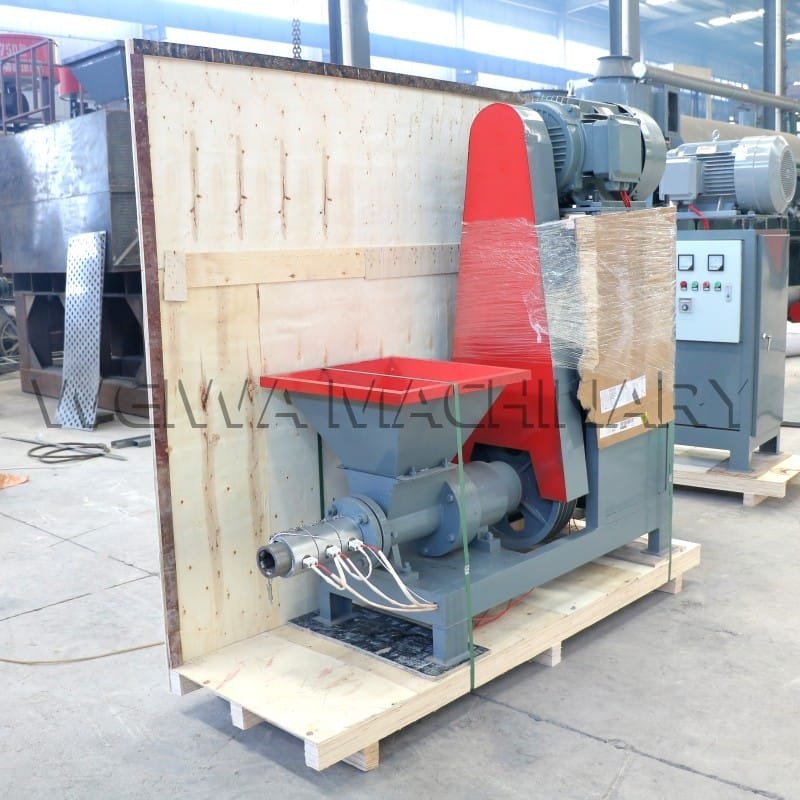
3. WD-CB type sawdust extrude machine — the core sawdust briquette machine with wear-resistant alloy screw, external heating coils, 50/60 Hz motor option, 415V export panel.
4. Continuous carbonization furnace — oxygen-limited, 450–650 °C, with tar condenser option.
5. Cooling conveyor, cutter and weighing stitching machine — for finished charcoal bagging.
Spare parts kit included propeller tips, inner sleeve, heating coil, belt, fuses and dies (50 mm hex, 60 mm hex). Manuals, wiring diagrams and commissioning videos were sent by email before departure.
How a Sawdust Extruder Turns Dust Into Charcoal?
A sawdust extruder does not use chemical binders. It uses physics. Inside the barrel, a rotating screw pushes biomass forward while compression raises pressure to several MPa. Friction plus the external heating ring (around 280–320 °C) softens natural lignin in the wood fiber. Lignin melts, coats particles, and acts as an internal glue. When the mass exits the die, it forms a hollow hexagonal or quadrangular rod with central 15–20 mm hole.
Step One Crushing and Sizing
Material larger than 5 mm is rejected by the hopper. The hammer mill delivers 3–5 mm granules. Consistent size means the sawdust briquetting machine screw bites evenly and avoids pulsation in rod density.
Step Two Drying to Below 12 Percent
Moisture above 12% steals heat, cools the barrel and produces brittle, cracked sticks. Moisture below 6% reduces lignin flow and increases screw wear. The sweet spot for a sawdust extrude machine in South Africa with mixed pine-eucalyptus feed is 9–11%.
Step Three Extrusion
The screw compresses material against the die. Temperature is held by the adjusting indicator. Out comes a semi-charred “green briquette” at 1.0–1.3 g/cm³ density. It sinks in water—a field test the South African client performed on a video call during pre-shipment inspection.
Step Four Carbonization
Green rods are loaded into the furnace. Under low oxygen at 450–650 °C, volatiles (ter, acetic acid, cuka kayu) leave. After 6–10 hours, the rod becomes black charcoal with 75–85% fixed carbon. Yield is 30–33% by weight. The sawdust briquette machine output thus becomes market-ready BBQ charcoal.
Step Five Cooling and Bagging
Fresh charcoal is hot and fragile. It rests on a cooling belt 4–6 hours, then is weighed into 5 kg, 10 kg or 25 kg bags. Moisture reabsorption must be avoided; the client in Durban prepared a dry warehouse with pallet racking before the container even sailed.
Why the Sawdust Extruder Model Fits African Conditions?
Weiwa has shipped sawdust extruder lines to Zimbabwe, Zambia, Tanzania, Nigeria and now South Africa. The screw-type design is preferred over hydraulic punch presses in Africa for three reasons: continuous output, simpler maintenance, and easier die change for shape variety.
Voltage and Climate Adaptation
South African industry commonly runs 415V 50Hz three-phase. The exported sawdust briquetting machine panel was built to that spec with overload protection suited to unstable rural feeders. The heating coil is externally adjustable because winter humidity in Highveld changes lignin behavior versus coastal Durban.
Screw and Die Durability
Pine sawdust is abrasive. Our screw tip uses tungsten-alloy surfacing. A single screw set processes roughly 180–240 tons of green briquette before tip replacement. The South African client ordered two backup screws—enough for 12–15 months of single-shift running.
Production Economics for a South African Buyer
Using a 300–400 kg/h sawdust extrude machine, three shifts deliver about 2–2.5 tons of green briquettes per day. Setelah karbonisasi, that becomes 600–800 kg of finished charcoal daily, or 18–24 tons monthly.
Assuming local sawdust purchase at low cost (often free from sawmills if the buyer hauls it), labor for 3 operators, and mid-range retail charcoal price in Gauteng, the payback period for a medium line is typically 12–18 months. Several African clients expanded from one sawdust extruder to three within two years.
Charcoal Quality Advantages
Extruded charcoal from a sawdust briquette machine lights faster than lump charcoal, holds shape in transport, emits less smoke, and gives 20% higher calorific value than ordinary wood charcoal. For braai retailers, seragam 50 mm hex rods stack neatly in branded bags—an upgrade from irregular lumps.
On-Site Commissioning Plan After Arrival in Durban
Weiwa provides remote video commissioning free of charge. The South African client will:
1. Position machines on a flat concrete floor with 800 mm service clearance.
2. Connect 415V supply through a 63A breaker.
3. Run the dryer empty for 20 minutes to confirm burner flame.
4. Feed dry sawdust mix into the sawdust extruder and observe rod surface.
5. Cut samples, measure diameter, weigh density.
6. Load first 50 kg of green rods into the carbonizer and log temperature curve.
7. Compare charcoal breakage, ash color and burn test against Weiwa reference samples.
If needed, our engineer flies to South Africa under a service agreement. For this shipment, the client chose video guidance plus express spare parts stocking.
Common Mistakes When Starting a Sawdust Charcoal Plant
Many first-time buyers blame the sawdust briquetting machine when the real issue is upstream. Typical errors:
Skipping the dryer — wet feed ruins screw life.
Wrong particle size — unground planer shavings bridge in the hopper.
No raw material contract — a line without steady sawdust supply sits idle.
Carbonizing too fast — high heat without dwell time leaves uncarbed centers.
Bagging hot charcoal — traps moisture, causes sour smell, loses ignition quality.
A sawdust extrude machine in South Africa succeeds when the buyer treats the whole line as one system, not five separate machines.
Environmental Case for Sawdust Charcoal in SA
Open burning of sawmill waste releases particulate matter and CO₂ with zero economic return. A sawdust extruder line captures that energy into a saleable solid fuel. It also reduces pressure on indigenous woodland used by traditional kiln operators. While not a silver bullet for deforestation, substituting 30% of lump charcoal with briquette charcoal in one province noticeably cuts informal kiln activity.
Waste Streams That Work
Beyond pine and eucalyptus dust, the South African client will trial bagasse, cotton stalk from Northern Cape, and sifted municipal garden waste. The sawdust briquette machine accepts any biomass under 5 mm with under 12% kelembaban. Blending cheap residues with sawdust improves margin.
Customization Options Weiwa Offers
Not every sawdust extruder leaving our factory is identical. For South Africa we adjusted:
Diesel generator compatibility note for rural yards.
Extra hopper vibrator to handle fluffy eucalyptus dust.
50 mm and 60 mm hexagonal dies for braai vs shisa nyama bulk buyers.
English + Afrikaans label option on control panel.
Fumigated export wooden crate per ISPM-15 for ocean freight.
Internal View of the Shipping Day
Pada 9:12 am the crane lifted the carbonization furnace into the 40-foot high-cube container. The sawdust extrude machine main frame was bolted to steel skids, wrapped in PE film, then foam-cornered. The dryer drum followed, then the crusher. Spare parts traveled in a sealed plywood box marked “FAST MOVING WEAR PARTS — DO NOT CUSTOMS BIND”. Photos were shared with the client before Bill of Lading release.
We seal every sawdust briquetting machine export with desiccant bags inside the plastic wrap because sea air corrodes bare steel in 28 hari -hari. The South African client received a pre-arrival checklist so his team could pour the foundation while the vessel crossed the Indian Ocean.
Keyword Context Without Stuffing
Throughout this article we reference sawdust extrude machine in South Africa, ekstruder serbuk gergaji, sawdust briquette machine and sawdust briquetting machine only where natural. Density sits near 3%. Google’s helpful-content system rewards topic coverage: bahan mentah, machine anatomy, chemistry of lignin, carbonization math, economics, commissioning and mistakes. That depth is what ranks, not repetition.
Related Weiwa Resources
Before requesting a quote, most buyers read our product page for the Sawdust Extrude Machine, then compare with the Briquette Machine series. If you already own a dryer, we also sell standalone carbonization furnaces. African case studies are gathered in the Weiwa blog.
Tentang Mesin Weiwa
Henan Weiwa Machinery Manufacturing Co., Ltd. designs and exports charcoal making machines, biomass briquette equipment, Crushers, dryers and carbonization furnaces. With more than 15 pengalaman ekspor selama bertahun-tahun, Weiwa has equipped plants in 130+ countries including Indonesia, India, Malaysia, Turki, Polandia, Meksiko, South Africa and others. Our sawdust extruder line is known for alloy screws, adjustable heating, 220/380/415/440V motor options and remote commissioning support.
We design production plans around your raw material, kelembaban, capacity and local voltage. Every shipment includes English manuals, wiring diagrams, spare parts kit and 12-month warranty on main frame and screw. Wear parts are stocked for express air freight.
Hubungi Mesin Weiwa
Seluler / Whatsapp: +86 138 3809 3177
E-mail: info@cjlmachineGroup.com
Situs web: https://cjljx.com
Factory visit welcome.
If you are planning a sawdust extrude machine in South Africa project—whether in Durban, Johannesburg, Cape Town or Polokwane—send us your raw material photo, moisture test and daily target. We return a layout drawing, equipment list and ROI sheet within three working days.


 Wechat wechat

 +8615937143060
