


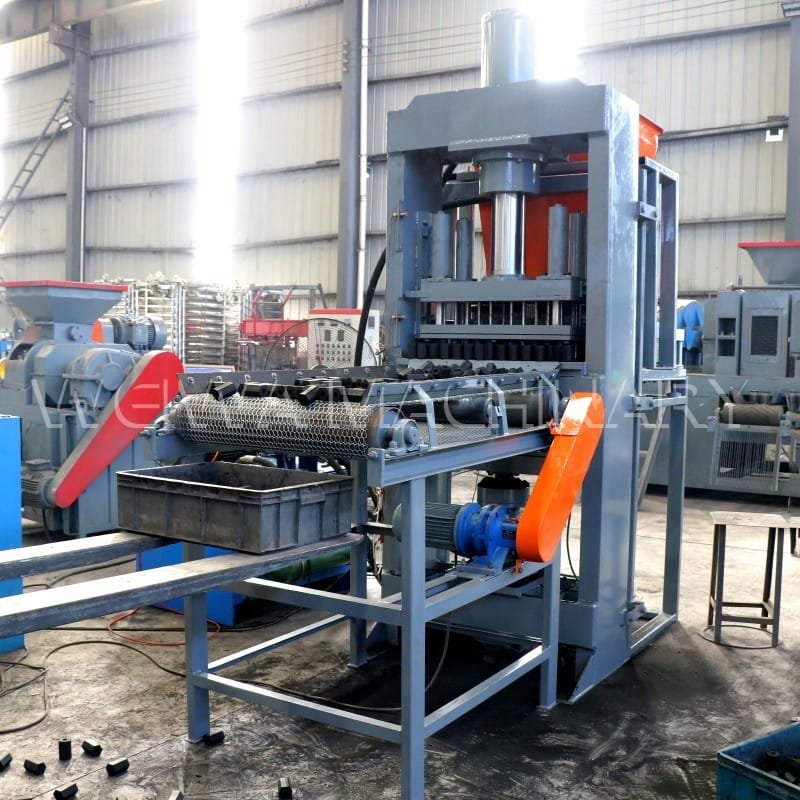
Why We Ran a Hydraulic Briquette Press Machine Trial for Nigeria?
Nigeria is the most populated country in Africa. Urban centers like Lagos, Abuja, Kano, Ibadan, and Port Harcourt consume massive volumes of solid fuel every day. Many families still cook with firewood or loose lump charcoal. Street food vendors, suya grills, and BBQ restaurants need steady heat. Pada saat yang sama, batok kelapa, Palm Kernel Shell, serbuk gergaji, Debu arang, and coal fines are available in large volumes across the country.
The problem is simple. Loose powder has almost no commercial value. Lump charcoal keeps getting expensive. A hydraulic briquette machine closes that gap. It compresses low-value powder into uniform, high-density briquettes that burn longer, break less during transport, and sell at a better margin.
Our Nigerian client already had a small manual charcoal shop. He wanted to scale up but refused to buy a machine he had never seen working. So we invited him to the factory, prepared his requested mold shape, adjusted the pressure curve, and ran the hydraulic press briquetting machine with local-style charcoal powder mixed with cassava starch binder.
Hydraulic Cylinder and Pressure Station
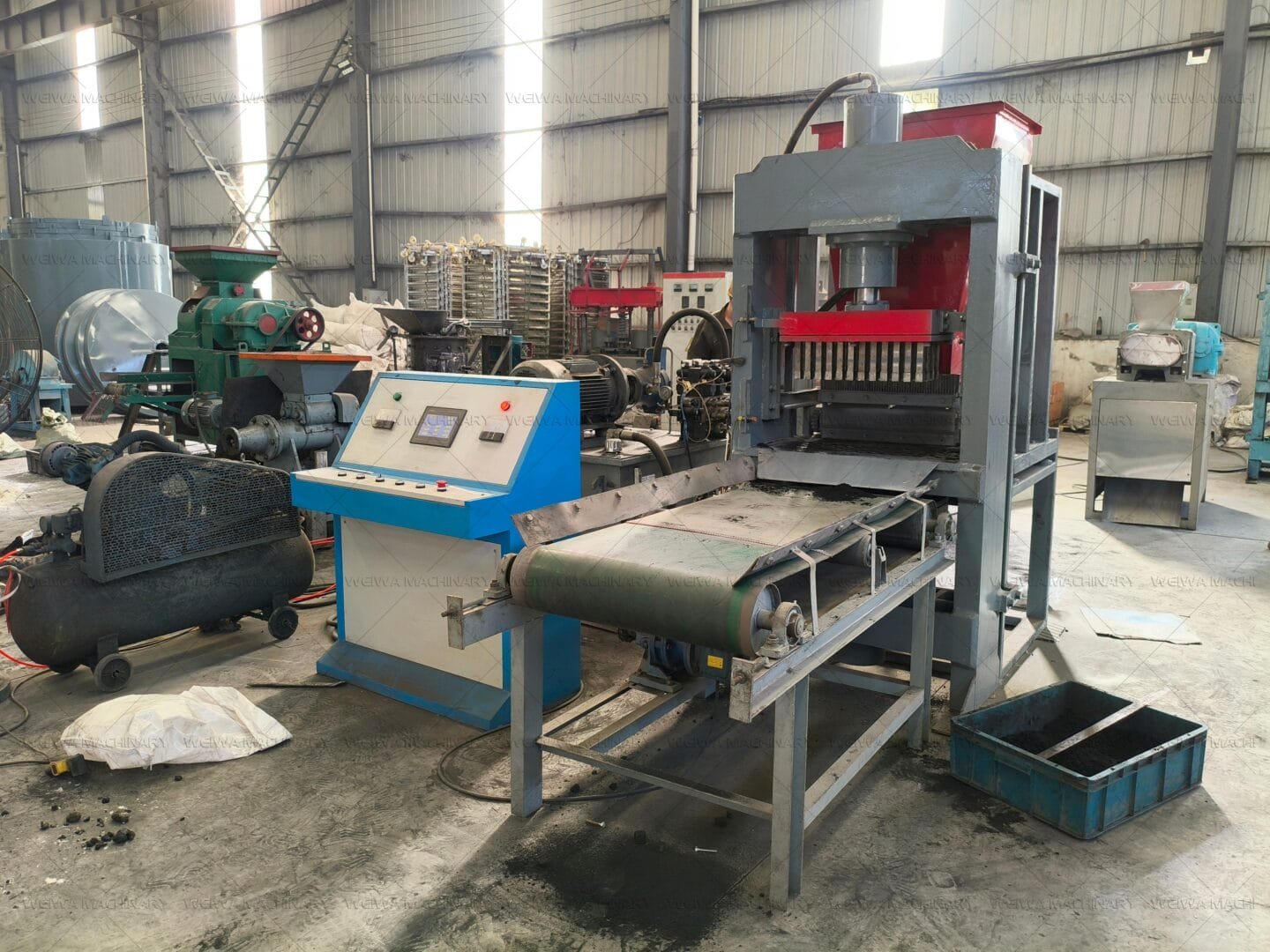
The core of the hydraulic briquette press is the hydraulic station. Our unit used a 200-ton main cylinder with a cooling system, pressure gauge, and safety relief valve. Unlike mechanical eccentric presses, the hydraulic system delivers static, controllable force. That matters for shisha charcoal because the block needs high density without cracks.
Selama persidangan, we set the pressure to 160 tons for the first batch and increased to 185 tons for the second. The client touched the finished block and immediately noticed the difference. The briquette did not crumble. The edges were sharp. The surface was smooth.
PLC Control and Mold Change
The hydraulic briquette machine for Nigeria we tested used a Siemens-logic PLC panel. The operator can set pressing time, return speed, and cycle count. The mold was a 33-cavity finger shape. We also showed a round 25 mm mold and a 22 mm hexagon mold. Switching molds took less than twenty minutes.
For Nigerian buyers, mold flexibility is critical. Lagos buyers may want finger shisha sticks. Northern states may prefer round BBQ balls. A hydraulic press briquetting machine with quick-change molds lets one machine serve multiple product lines.
How the Hydraulic Press Briquetting Machine Works in Practice?
The working principle looks simple but the engineering details decide the quality. Pertama, charcoal chunks or coconut shell charcoal are crushed below 3 mm. Then the powder goes into a binder mixer with water and a natural binder. After uniform mixing, the material is fed into the hopper manually or by belt.
Inside the hydraulic briquette press, the rear pusher pushes the material into the cavity. The upper hydraulic head descends with static pressure. The powder compacts into a solid briquette. The lower head ejects the block onto the discharge belt. One cycle takes roughly one second under PLC timing.
Because the force comes from hydraulic oil instead of a rotating roller, the hydraulic press briquetting machine produces sharper shapes and higher single-block density. That is why hookah charcoal and premium BBQ sticks are often made on hydraulic presses rather than roller presses.
Static Pressure Versus Roller Pressure
A roller briquette machine presses powder between two spinning rollers. It is great for high-volume ball briquettes. A hydraulic briquette press uses vertical static compression. It is better when the client needs finger shape, cube shape, or customized shisha size with very low dust.
We explained this difference to the Nigeria client before the trial. He chose hydraulic because his target market was shisha lounges and middle-class BBQ users, not bulk industrial balls.
Raw Materials Nigerian Clients Can Process
One reason hydraulic briquette in Nigeria has strong potential is feedstock diversity. The same hydraulic briquette machine can process many powders after crushing and mixing.
Charcoal Powder and Coconut Shell Waste
Coconut shell charcoal is common in coastal Nigeria. After carbonization and crushing, it becomes premium shisha raw material. Charcoal powder from broken lump charcoal can also be recycled instead of discarded.
Coal Fines, Coke Dust, and Mineral Powder
Beyond cooking fuel, a hydraulic press briquetting machine can press coal dust, bubuk kokas, oksida besi, bubuk aluminium, and mineral fines. Some Nigerian metal workshops already use hydraulic briquetters to recycle metal powder. The same press technology simply uses a different mold and pressure curve.
Biomass Residues and Agro Waste
Serbuk gergaji, KULUT NAS, Palm Kernel Shell, and bamboo waste can be carbonized first, then crushed into powder. This gives Nigerian rural cooperatives a path to collect farm waste, carbonize it locally, and press it into cooking briquettes.
Nigeria Market Potential for Hydraulic Briquette Machine
We estimate the Nigerian briquette equipment segment is still early but accelerating. Several forces push demand for hydraulic briquette machine for Nigeria.
BBQ Charcoal and Household Cooking Fuel
Lagos and Abuja have a growing food service economy. Suya vendors need consistent heat. Middle-class homes want cleaner cooking than firewood. Imported gas prices push families back to solid fuel. Dense briquettes made by a hydraulic briquette press burn slower than lump charcoal and create less smoke when formulated correctly.
Shisha Lounges and Hookah Market
Shisha culture is strong across West Africa. Lounge owners prefer uniform 22–25 mm finger sticks with low ash. A hydraulic press briquetting machine delivers that consistency better than manual hammers or low-cost lever presses.
Environmental Pressure and Waste Recycling
Nigeria loses large tree cover to firewood demand. Government agencies and development programs promote clean cooking. Briquette production supports that narrative because it uses waste powder instead of fresh wood. A hydraulic briquette machine for Nigeria is therefore not only a profit tool but also an environmental story for grants and cooperative funding.
Payback Period for a Small Nigerian Line
In our discussion with the client, a 300–500 kg/h hydraulic briquette press line with crusher, pengaduk, press, and dryer can often reach payback in twelve to eighteen months in Lagos or Ogun State, assuming local briquette retail pricing and stable raw material supply. The math improves when the buyer collects charcoal dust cheaply from existing charcoal depots.
What the Nigeria Client Checked During the Trial?
The client did not just watch the machine run. He tested four things.
Pertama, kepadatan. He weighed ten finger sticks and compared them with his current supplier’s product. Weiwa’s hydraulic briquette press gave 18–21 g per stick at 185 ton, with uniform weight.
Kedua, surface quality. He checked for cracks, edge chips, and powder residue. The hydraulic press briquetting machine produced clean ejection because the lower head pushed the block fully out of the cavity.
Ketiga, mold change time. Our technician swapped from finger mold to round mold in 17 menit. The client noted this would let him serve two customer segments with one machine.
Fourth, PLC behavior. He pressed the auto button and let the machine run ten cycles. Pressure, dwell time, and eject timing repeated without deviation. For a Nigerian buyer who hires local operators, PLC stability reduces training cost.
Why Choose Weiwa Hydraulic Briquette Press for West Africa?
Weiwa Machinery has more than thirty years of experience in briquetting equipment. We do not treat Nigeria as a generic export destination. We adapt voltage, pendinginan, rust protection, and binder suggestion to tropical conditions.
Our hydraulic briquette machine for Nigeria ships with plastic film wrapping, wooden or steel frame packaging, and optional container loading. Spare molds, seals, and PLC relays can be sent separately to reduce downtime. Our after-sales team answers WhatsApp videos, shares commissioning drawings, and guides local electricians on motor connection.
We also provide customized design. If a client has a 200 square meter warehouse in Kano or a 400 square meter plot in Aba, we draw the production flow, mark crusher position, mixer height, press footprint, dryer length, and walking path. This prevents the common mistake of buying machines first and discovering the line does not fit the shed.
For the Lagos client, we proposed a 500 kg/h layout: carbonization furnace if he starts from shell, penghancur, double shaft mixer, hydraulic press briquetting machine, mesh belt dryer, and cooling conveyor. He can start with the press and mixer only, then add dryer later. The hydraulic briquette press does not force him to buy the full line on day one.
After-Sales and Spare Parts
Our professional after-sales team handles English and French communication. Common wear parts such as mold inserts, hydraulic seals, and sensor switches are stocked in our factory. For Nigerian orders, we usually send one extra mold and one seal kit inside the container.
Customization and Factory Layout
Every hydraulic briquette machine for Nigeria can be modified in pressure tonnage, mold cavity count, PLC brand, belt width, and control language. We send the client a CAD layout before production. After payment, we update the layout with real machine dimensions and foundation holes.
Many African clients worry about installation. We solve this by sending clear foundation drawings, cable color photos, and a commissioning video recorded on the same machine serial number before painting.
Hydraulic Briquette in Nigeria Is a Long-Term Trend
We do not see hydraulic briquette in Nigeria as a one-time purchase wave. Urban fuel demand, waste recycling policy, and youth entrepreneurship all point the same direction. A hydraulic press briquetting machine is a capital asset that runs for years. The first machine builds trust. The second order usually adds a dryer or a second press.
Our Lagos visitor booked his machine after the trial and asked for a 650-series hydraulic station drawing for future expansion. That is the pattern we see across West Africa. The trial removes doubt. The local market removes hesitation.
Tentang Mesin Weiwa
Weiwa Machinery is a Chinese manufacturer with more than thirty years of working experience in charcoal briquette machines, hydraulic press briquetting machines, tungku karbonisasi, Crushers, mixer, dan pengering. We serve more than ninety countries and have supplied over two million customers worldwide with briquetting solutions.
Our advantages are practical. We have a professional after-sales team that replies fast on WhatsApp and email. We provide customization service including mold shape, pressure tonnage, voltage, and PLC language. We provide design drawings and factory layout planning so clients can prepare the foundation before the container arrives. Whether you need one hydraulic briquette press or a full shisha charcoal production line for Nigeria, we can plan the right configuration.
If you are a Nigerian entrepreneur, charcoal trader, cooperative leader, or equipment importer, contact Weiwa Machinery for a free consultation and customized quote.
Hubungi Mesin Weiwa
Massa: +8613838093177
Whatsapp: +8613838093177
E-mail: info@cjlmachineGroup.com
Pabrik: Jalan Huangshan, Zijing Road, Gongyi, Zhengzhou, Henan, Cina


 Wechat wechat

 +8615937143060
