


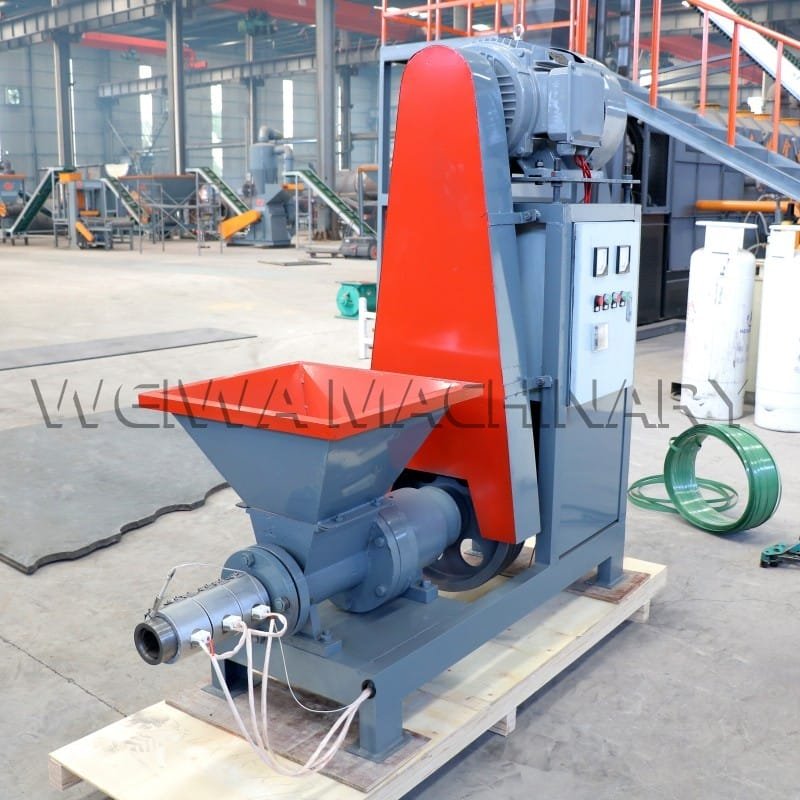
As global demand for clean, renewable, and affordable energy continues to rise, especially in developing regions like Africa, biomass energy solutions are gaining momentum. Di antaranya, charcoal briquettes produced from agricultural residues such as sawdust, Batang panen, and wood chips are becoming a popular alternative to traditional firewood and fossil fuels. Pada Mesin Weiwa, we are proud to support this transition by providing advanced mesin ekstruder serbuk gergaji and complete Jalur produksi briket arang—recently putting our equipment to the test in Zimbabwe with outstanding results.
The Rising Need for Biomass Fuel in Zimbabwe and Beyond
Zimbabwe, like many countries in sub-Saharan Africa, faces challenges related to deforestation, indoor air pollution, and limited access to clean cooking fuels. Traditional firewood and charcoal production contribute significantly to forest degradation, while also posing health risks due to smoke emissions during combustion.
To combat these issues, there is a growing interest in sustainable charcoal alternatives made from agricultural waste such as sawdust, sekam padi, coffee husks, and sugarcane bagasse. These raw materials are often abundantly available as by-products of local agriculture and woodworking industries but are underutilized. By converting this waste into dense, high-calorific-value charcoal briquettes, communities can generate income while reducing environmental harm.
Di sinilah Mesin Weiwa comes in. Kita mesin ekstruder serbuk gergaji and integrated charcoal briquette production line enable local producers to transform raw biomass into market-ready fuel products efficiently and sustainably.
Understanding the Sawdust to Charcoal Briquette Process
Our production process transforms loose, low-density biomass materials into compact, high-density charcoal briquettes through a series of mechanical and thermal treatments. Though the term “sawdust extruder” may suggest a single machine, it actually refers to a critical component within a broader sawdust charcoal making machine system or Jalur produksi.
Let’s break down how the process works, particularly as demonstrated during our successful trial run in Zimbabwe:
Melangkah 1: Persiapan Bahan Baku
The journey begins with collecting suitable biomass materials. In Zimbabwe, common feedstocks include sawdust from local timber mills, crop residues such as maize stalks, and other fibrous agro-waste. The raw material is first shredded or ground down to a uniform size, typically between 3–5 mm in diameter, to ensure smooth feeding into the system.
Melangkah 2: Drying the Biomass
Proper moisture content is crucial for effective briquetting. Raw biomass usually contains 30–60% moisture, but our process requires it to be reduced to below 12%. In Zimbabwe, we utilized a rotary dryer (or solar drying methods where appropriate) to bring the moisture level down, ensuring optimal conditions for the next stage.
Melangkah 3: Briquetting Using the Sawdust Extruder Machine
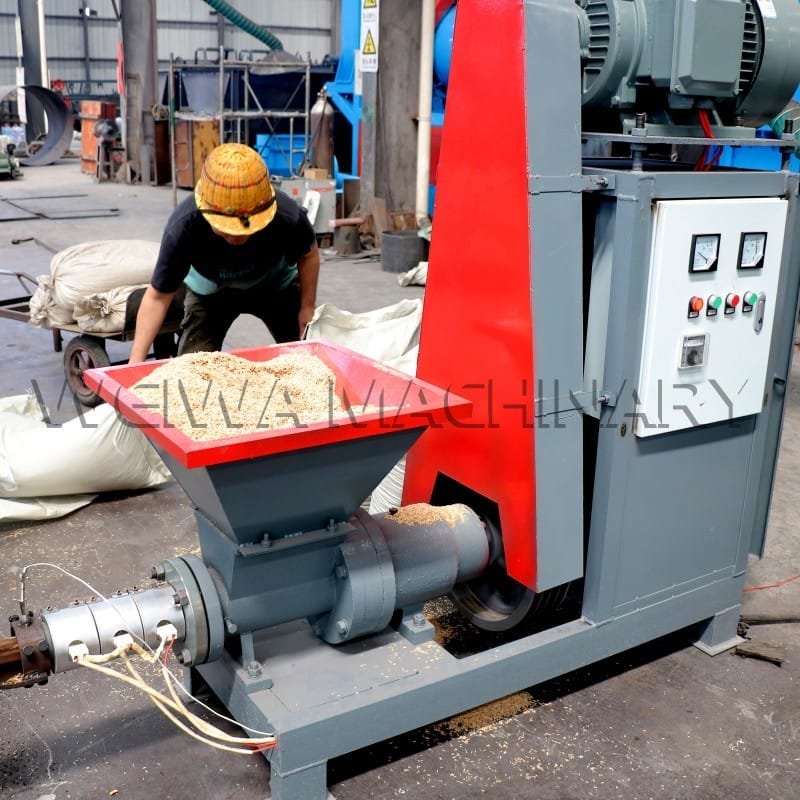
This is the heart of the operation. Kita mesin ekstruder serbuk gergaji—also known as a wood briquette press or mesin briket biomassa—uses high temperature and pressure to compress the dried biomass into solid fuel.
Di dalam mesin, a large screw forces the material through a heated die. As the biomass travels through the chamber, natural lignin (a polymer found in wood) acts as a binding agent. Under intense pressure and heat (typically 150–300°C), the lignin softens and binds the particles together without the need for any additional chemicals or binders.
The result is dense, solid fuel rods or briquettes with a smooth surface and high structural integrity. These can be formed into various shapes—such as square, heksagonal, or hollow cylindrical designs—to meet market preferences. In Zimbabwe, we produced briquettes with diameters ranging from 45 mm to 80 mm, depending on client specifications.
Melangkah 4: Karbonisasi (Optional but Recommended)
While the briquettes produced immediately after extrusion are already usable as solid fuel, carbonizing them turns them into true charcoal briquettes with enhanced burning properties. Carbonization involves heating the briquettes in a closed kiln or retort at temperatures between 400–700°C in an oxygen-free environment. This process removes volatile compounds, leaving behind nearly pure carbon.
The end product is a clean-burning, long-lasting charcoal briquette with high calorific value—over 20% more efficient than regular firewood or uncarbonized briquettes. It produces minimal smoke and ash, making it ideal for household cooking, Restoran, dan bahkan aplikasi industri.
On-Site Trial in Zimbabwe: What We Achieved
Our team recently shipped a complete sawdust extruder production line to a client in Zimbabwe, including a grinder, pengering, briquette extruder, and carbonization unit. The goal was not only to install the machinery but to provide hands-on training, oversee the first production runs, and ensure the system met local operational conditions.
Here’s what we accomplished:
- Smooth Operation from Day One: Thanks to our intuitive machine design and comprehensive training, the Zimbabwean team was able to operate the entire line with minimal supervision. Itu mesin ekstruder serbuk gergaji performed exceptionally well, consistently producing dense briquettes without clogging or jamming.
- High-Quality Output: The briquettes had a uniform shape, smooth surface, and excellent density. When carbonized, they achieved a burning time of up to 3–4 hours with steady heat output—far surpassing traditional charcoal in efficiency.
- Local Material Adaptability: We tested various local biomass sources, including sawmill waste, maize cobs, and groundnut shells. All materials were successfully processed into sellable fuel products, confirming the versatility of our equipment.
- Strong Community Interest: The trial site attracted attention from local entrepreneurs, LSM, and government representatives, all eager to learn about replicating the model in other regions. This underscores the potential for mesin pembuat arang serbuk gergaji to drive economic development and environmental conservation across Africa.
Why Choose Weiwa Machinery for Your Biomass Energy Project?
Having served clients in over 130 countries—including Indonesia, India, Malaysia, Kenya, Tanzania, and now Zimbabwe—Mesin Weiwa has built a reputation for reliability, inovasi, dan dukungan pelanggan. Kita mesin ekstruder serbuk gergaji and Jalur produksi briket arang are designed with the following advantages:
- Teknologi yang Dipatenkan: Our machines incorporate proprietary designs that improve efficiency, reduce wear, and enhance durability.
- Ce, SGS, Bersertifikat ISO: Quality and safety are guaranteed through internationally recognized certifications.
- Solusi yang dapat disesuaikan: We work closely with each client to tailor the system to their raw materials, production goals, and local conditions.
- Dukungan komprehensif: From installation and training to after-sales service and spare parts, we provide end-to-end assistance to ensure your success.
A Brighter, Cleaner Energy Future Starts with Sawdust
The success of our sawdust extruder production line trial in Zimbabwe highlights the transformative potential of biomass energy technologies in Africa. By converting locally available waste materials into valuable fuel products, communities can achieve energy independence, reduce deforestation, and create sustainable livelihoods.
Pada Mesin Weiwa, we are committed to supporting this vision by providing high-quality, terjangkau, and easy-to-operate mesin pembuat arang serbuk gergaji and complete production lines. Whether you’re a small-scale entrepreneur or a large biomass project developer, we have the expertise and equipment to help you succeed.
Contact Us Today to Start Your Biomass Energy Journey
If you’re interested in learning more about our mesin ekstruder serbuk gergaji, mesin briket arang di Zimbabwe, or any other part of our biomass solutions, don’t hesitate to reach out. We offer free consultations, customized production plans, and ongoing support to ensure your project thrives.
Telepon/WhatsApp: +8613838093177
E-mail:info@cjlmachinegroup.com
Alamat:Jalan Huangshan, Zijing Road, Gongyi, Zhengzhou, Henan, Cina
Mesin Weiwa – Engineering a sustainable future, one briquette at a time.


 Wechat wechat

 +8615937143060
