


Why Nigeria Is a Strong Fit for a Screw Type Sawdust Briquette Machine?
Nigeria generates large volumes of agro-forestry residue every year. Sawn timber mills around Lagos, Ogun, Edo, and Cross River push out tonnes of mixed sawdust. Cocoa farms in the southwest, palm plantations in the southeast, and shea and mango processors in the north all create combustible waste that is usually burned openly or left to rot. Pada saat yang sama, charcoal remains a primary cooking and small-business fuel across the country. A sawdust briquette machine closes the loop by converting that waste into a higher-value solid fuel.
Urban demand is also shifting. Barbecue culture, street food, and hotel kitchens prefer lump-free charcoal that lights quickly and holds heat. The hollow-core rod produced by a sawdust extruder gives better draft during combustion, which is why many Nigerian distributors now ask specifically for extruded briquette charcoal rather than loose biomass logs.
Feedstock Reality in Nigerian States
In practice, the raw material basket for a Nigerian client is wider than pure sawdust. Our engineering team regularly sees mixtures of sawdust with rice husk, groundnut shell, coconut coir dust, debu bambu, and shredded cassava stems. The sawdust briquetting machine handles blended feed well, provided two conditions are met. Particle size stays under five millimetres after crushing. Moisture stays between eight and twelve percent after drying. When those two variables are controlled, the screw chamber runs smoothly and the die life extends significantly.
What Was on the Truck Leaving for the Nigerian Client?
The production line we prepared for this shipment followed the standard five-stage Weiwa layout. We did not use bullet lists in the plant drawing because the flow is linear and better explained as a chain.
Stage one is size reduction. A wood crusher with cyclone and dust hood takes branches, pallets, and oversized chips down to three to five millimetre granules. Stage two is drying. An airflow pipe dryer with automatic feeder lowered moisture from around thirty-five percent to ten percent using a diesel burner and temperature controller. Stage three is the core forming step. The sawdust extruder receives the dry material through a variable-speed hopper, heats the barrel to roughly two hundred eighty degrees Celsius, and rotates a high-chromium screw at pressure above thirty megapascals. Stage four is carbonization. Green briquettes are loaded into a self-ignition airflow furnace where volatile matter escapes and fixed carbon remains. Stage five is cooling and bagging. Charcoal rods rest on a ventilated platform, are inspected for cracks, cut to length, and packed into woven sacks.
Technical Notes on the WM Series Sawdust Extruder
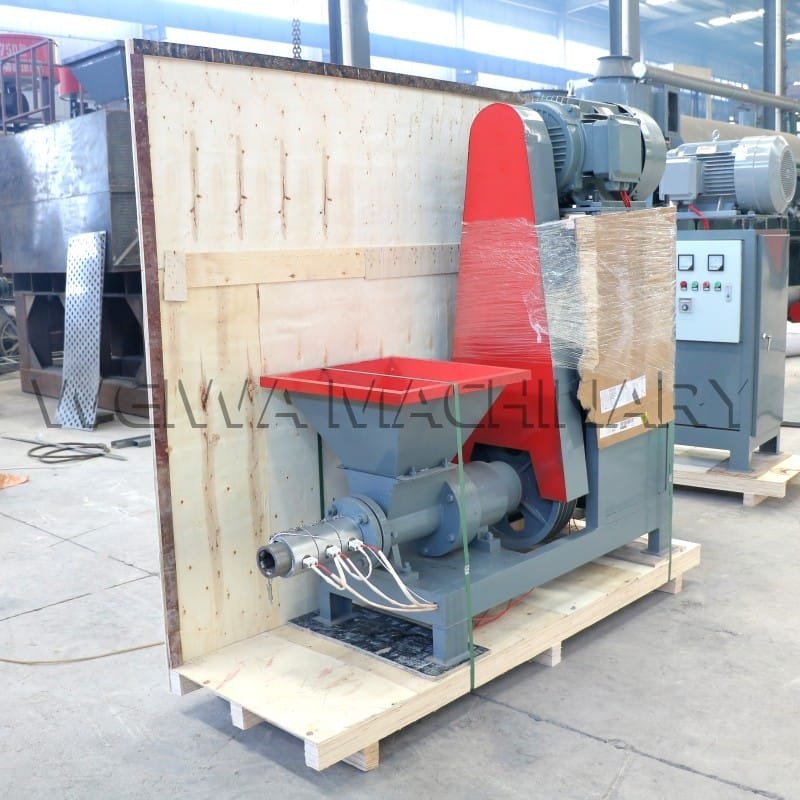
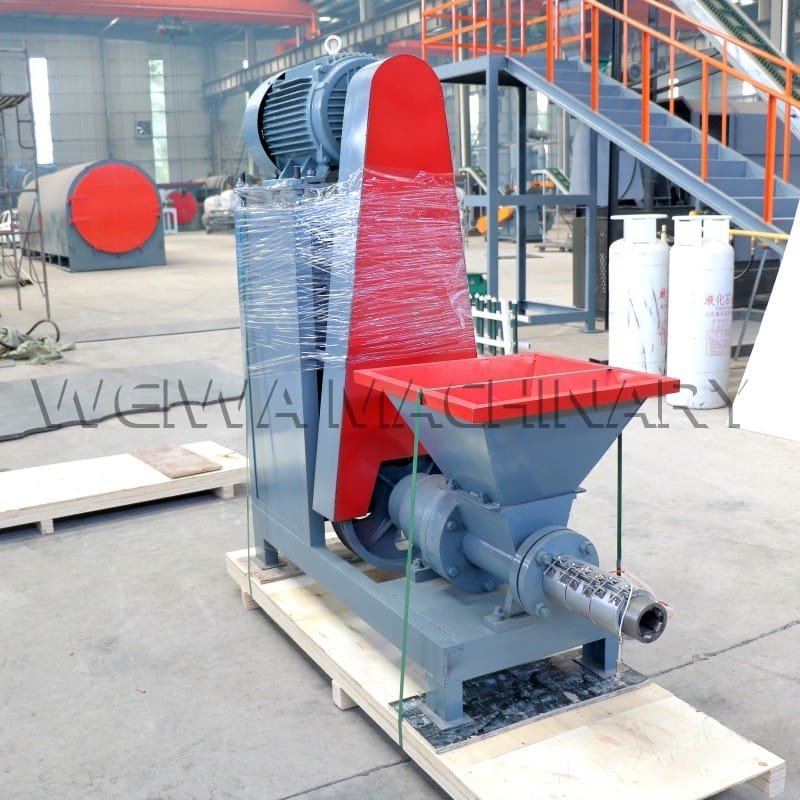
The unit in this container was a WM-80 screw extruder with a thirty-seven kilowatt motor and an output of three hundred to three hundred eighty kilograms per hour of green briquette. The screw shaft and inner sleeve use surfacing-welded wear-resistant alloy. The heating coil is segmented so the operator can fine-tune barrel temperature for different feedstock species. A central control cabinet manages ammeter reading, overload protection, and start-stop sequence for feeder, heater, and main motor. No binder, no chemical, and no added water are required during forming. Continuous runtime is rated at sixteen hours per day with proper lubrication.
How a Sawdust Extruder Machine Turns Dust into Charcoal Rods?
The science behind the sawdust briquetting machine is straightforward but elegant. Biomass cells contain lignin, a natural polymer that acts as an internal glue. Under normal temperature lignin is rigid. Under the combined action of screw pressure and barrel heat, lignin softens and coats neighbouring cellulose fibres. When the mass exits the die, it cools into a solid rod even though no external adhesive was added.
This is why a sawdust extruder outperforms simple piston presses in many cooking-fuel applications. The screw creates continuous length, the heated barrel pre-carbonizes the outer skin slightly, and the central hole improves air passage during later carbonization and final grilling. Typical finished rod diameter is fifty, sixty, seventy, or eighty millimetres with a fifteen to twenty millimetre central hole. Shapes can be switched by changing the die to square, segi lima, or hexagonal with edge.
Carbonization Chemistry Simplified for Plant Operators
Green briquettes are not charcoal yet. They still carry volatiles such as methanol, acetic acid precursors, and tar vapour. In the furnace, temperature climbs to four hundred to six hundred degrees Celsius under limited oxygen. Volatile gases escape through the chimney or are recovered in better furnace models. What remains is fixed carbon, abu, and trace moisture. The yield ratio is roughly three to four kilograms of green briquette per one kilogram of finished charcoal, depending on feedstock density and final temperature.
For Nigerian operators, the carbonization furnace choice matters. Batch hoisting furnaces are cheaper and simpler. Continuous furnaces save labour and smoke. The client in this shipment chose a self-ignition airflow furnace with a secondary gas recovery ring, which recirculates combustible vapour back to the burner and lowers diesel consumption during startup.
Operating a Sawdust Briquetting Machine in Hot and Dusty Conditions
West African sites are not gentle on steel. Harmattan dust, high ambient temperature, and irregular power supply all test equipment. Our pre-shipment checklist for Nigeria therefore includes a few non-negotiable items.
The control cabinet gets a voltage stabilizer recommendation when supply floats beyond plus or minus ten percent. The screw assembly ships with one spare screw tip and one spare sleeve. The dryer cyclone gets an extra dust bag. Bearings are greased with high-temperature lithium grease. Operators are trained to check moisture with a handheld meter before starting the sawdust extruder, because feeding wet material is the fastest way to jam the barrel and scorch the screw.
Daily Maintenance Habits That Extend Screw Life
Running a sawdust briquette machine is not difficult, but it rewards discipline. The barrel temperature should be logged every two hours. The hopper magnet should be cleaned of nails and bolts every shift. The screw thrust bearing temperature should never exceed seventy-five degrees Celsius. When the rod surface shows hairline cracks, either moisture is above twelve percent or barrel temperature is below two hundred sixty degrees. When the rod is glossy black but breaks easily, temperature is too high. Small adjustments on the indicator solve most quality complaints before they become mechanical failures.
Economic Picture for a Charcoal Line in Nigeria
Many Nigerian inquiries start with price, but the better question is payback. A medium line based on the WM-80 sawdust extruder and a one-ton-per-hour dryer can process roughly two and a half tonnes of dry input per eight-hour shift. After carbonization loss, that yields around seven hundred to eight hundred kilograms of finished charcoal. At local wholesale prices for quality briquette charcoal, the daily gross margin often covers labour, kekuatan, and rental within nine to fourteen months, assuming a steady sawdust supply and a distributor channel into meat grill spots or retail sacks.
The sawdust briquetting machine also creates secondary income. Siftings from the crusher can be pelleted separately. Carbonization condensate can be collected as wood vinegar for agricultural use. Even the furnace ash has local value as a soap input. None of this requires extra heavy machinery, only good housekeeping.
Logistics and Container Loading for Lagos or Port Harcourt
This particular line left in one forty-foot high-cube container. The crusher and dryer were wrapped in PE film, the sawdust extruder was bolted to a steel skid, the furnace was nested with its chimney, and spare parts rode in a dedicated plywood box. Export wooden packing used fumigated timber compliant with ISPM-15 because the destination was a Nigerian seaport. We sent the client container stuffing photos, a numbered parts list, and a wiring diagram annotated in English before Bill of Lading release.
Common Mistakes First-Time Nigerian Buyers Make
The first mistake is chasing the cheapest sawdust extruder online without checking screw material. Standard carbon steel screws wear out in under one hundred hours on rice husk blends. The second mistake is skipping the dryer to save budget, then blaming the sawdust briquetting machine for cracking rods. The third mistake is mixing wet fresh sawdust with dry old sawdust and assuming the average moisture is fine. It is not. The barrel reacts to local moisture at the die, not to spreadsheet averages.
The fourth mistake is underestimating carbonization. Some buyers think the sawdust extruder alone makes charcoal. It does not. The extruder makes a green briquette. The furnace makes charcoal. Both must be sized together, which is why Weiwa always quotes them as one line rather than separate gadgets.
Choosing Between Model 50 and Model 80
For a startup with sporadic sawdust supply, the WM-50 with eighteen and a half to twenty-two kilowatt motor and two hundred to two hundred twenty kilogram per hour output is enough. For a distributor supplying ten or more grill houses, the WM-80 is the practical floor. Going bigger than WM-80 in a first project usually creates downtime risk because the bottleneck moves to drying and carbonization, not extrusion. A balanced line beats a giant extruder with a small furnace.
Environmental Case for Sawdust Extruder Charcoal in Nigeria
Traditional earth mound charcoal kilns in parts of Nigeria can lose more than seventy percent of the wood energy to incomplete combustion and open smoke. A closed sawdust briquetting machine plus sealed carbonization furnace captures volatiles, standardizes rod size, and upgrades waste into a product that burns longer per kilogram. Field tests from similar Weiwa lines in West Africa show finished charcoal calorific value around seven thousand four hundred kilocalories per kilogram, fixed carbon above seventy percent, and ash under four percent. Burn time for a fifty millimetre rod in a controlled stove exceeds ninety minutes, about twenty-five percent longer than ordinary lump charcoal.
That matters for Nigerian cities trying to cut indoor smoke in small kitchens and for state governments promoting circular economy grants. A sawdust extrude machine in the Nigeria context is therefore not only a commercial tool. It is a compliance-friendly alternative to uncontrolled burning of agro waste.
How Weiwa Machinery Supports Nigerian Installations After Shipment?
Our job does not end at the port. Every Nigerian order includes English manuals, a wiring video, a spare-parts recommendation sheet, and remote WhatsApp troubleshooting during the first production week. When the client is ready, we can arrange a video call with the electrician on site and walk through ammeter reading, heater sequencing, and furnace ignition. For larger lines we can send a technician, but most WM-50 and WM-80 installations run successfully with remote guidance if the buyer follows the commissioning checklist.
Customizing the Line to Your Raw Material
We design different production plans according to different raw materials and different capacity of customers. If a buyer in Enugu mainly has palm kernel shell, we enlarge the crusher screen and slow the dryer. If a buyer in Kano mainly has groundnut shell and cotton stalk, we widen the moisture tolerance band and suggest a rotary dryer instead of a pipe dryer. The sawdust extruder itself stays central, but the surrounding machines change shape around it.
Field Notes from the Loading Day
On the morning the container was stuffed, the WM-80 sawdust extruder was run one last time in our workshop using a blend of poplar sawdust and rice husk. The rod came out as a sixty millimetre hexagonal stick with a clean fifteen millimetre hole. The cutter divided it into three hundred millimetre lengths. The client’s agent recorded the test video, checked the ammeter stable at thirty-seven kilowatt load, and signed the pre-shipment inspection. By afternoon the machine was skidded, filmed, and locked inside the container with desiccant bags because ocean humidity damages bare screw surfaces.
That single machine will soon sit in a Nigerian shed, fed by a young operator who may never have touched industrial equipment before. Within a month, if moisture and power cooperate, it will quietly convert what was once waste into sacks of charcoal that help a family cook dinner or a small bakery fire its oven.
Final Thoughts on Starting a Charcoal Project with a Sawdust Extruder
A sawdust extrude machine in the Nigeria market is not a magic box. It is a precise screw, a heated barrel, and a die. Around it sits a system of crushing, pengeringan, carbonizing, and packing. Buyers who respect the moisture rule, the particle-size rule, and the furnace rule usually succeed. Buyers who treat the sawdust briquette machine as a standalone miracle stall within weeks.
Weiwa Machinery has shipped biomass lines to more than one hundred thirty countries. The Nigerian order is one of many, but each one teaches the same lesson. The machine is half the project. The process discipline is the other half.
Tentang Mesin Weiwa
Weiwa Machinery is a Chinese manufacturer and project supplier of biomass briquette and charcoal production equipment. Our range covers sawdust extrude machines, ekstruder serbuk gergaji, mesin briket serbuk gergaji, mesin briket serbuk gergaji, wood crushers, pipe and rotary dryers, tungku karbonisasi, and full turnkey charcoal lines. We have served clients in Indonesia, India, Malaysia, Vietnam, Turki, Polandia, Afrika Selatan, Ghana, Kenya, Uganda, and Nigeria. Every order includes free production-line design, pre-shipment testing, export packing, English documentation, and remote after-sales support. Factory visits in Zhengzhou are welcome.
Hubungi Mesin Weiwa
Seluler / Whatsapp: +8613838093177
E-mail: info@cjlmachineGroup.com
Product reference: https://cjljx.com/product/sawdust-extrude-machine


 Wechat wechat

 +8615937143060
