


Why Zimbabwe Is a Strong Market for a Sawdust Charcoal Making Machine?
Zimbabwe’s urban cooking-fuel demand is still heavily dependent on traditional lump charcoal produced through earth-kiln burning. That method wastes wood, emits smoke, and delivers inconsistent calorific value. Pada saat yang sama, timber processors around Harare, Mutare, and Bulawayo generate thousands of tonnes of sawdust every month that is either dumped or burned openly. A sawdust charcoal making machine closes that loop: it upgrades waste biomass into uniform sticks, which are then carbonized into clean, high-heat charcoal.
For the client in this case, the business case was simple. Sawdust was available at a low gate price from three local sawmills. Retail charcoal prices in Harare remain stable year-round. The missing piece was reliable machinery. Previous second-hand presses had failed on moisture swings and screw wear. The client contacted Weiwa Machinery after reviewing our Sawdust Extrude Machine product page and requested a full trial before container loading.
Local Raw Materials We Tested
The trial batch used mixed hardwood sawdust from teak offcuts and pine planer dust, supplemented with a small ratio of ground maize cob to test agro-residue compatibility. Particle size after hammer milling was 3–5 mm. Initial moisture ranged from 38% ke 46%. All material was sourced within 60 km of the client’s yard, reflecting a realistic charcoal making machine in Zimbabwe feedstock scenario.
How the Mesin Extrude Serba Keragun Production Line Was Configured?
Weiwa Machinery did not ship a single standalone press. We designed a five-node sawdust extrude production line matched to the client’s 8-hour shift plan and 2-tonne daily dried-material target.
Node 1: Hammer Mill Crushing
Raw offcut pieces were fed into a 22 kW hammer mill with a 5 mm screen. This stabilized particle geometry so the extruder screw would not bridge or over-compress. Uniform size is the first condition for stable briquetting; uneven grit accelerates sleeve wear inside the sawdust extruder in Zimbabwe.
Node 2: Rotary Drum Drying
A 800 mm diameter rotary dryer with a 3 kW burner reduced moisture from 42% ke 10.5% at the outlet. We monitored moisture with a handheld probe every 20 menit. Di bawah 8% the lignin binding weakens; above 12% the barrel stalls. The trial confirmed 10–11% as the sweet spot for Zimbabwe winter ambient humidity.
Node 3: Weiwa Sawdust Extruder
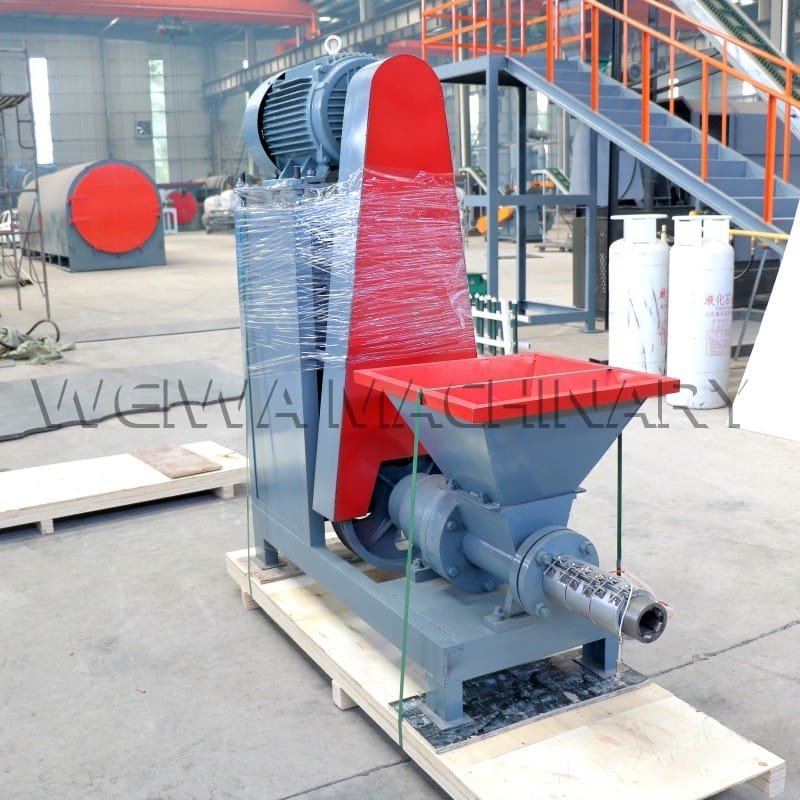
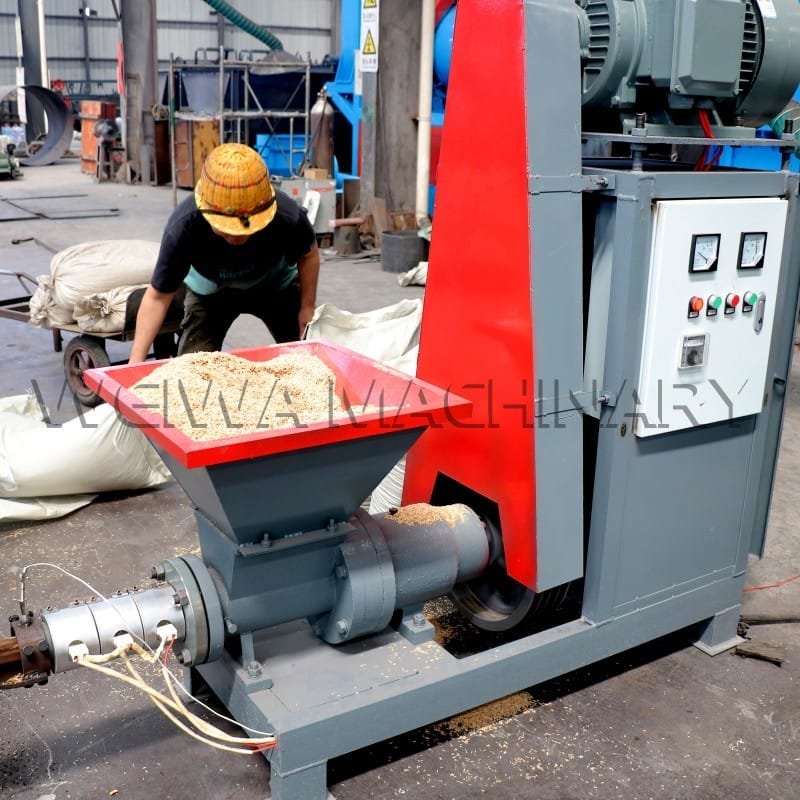
The core machine was our 22 kW screw extruder with a 50 mm hollow hexagonal die and a 15 mm central mandrel. Barrel heating rings held the compression zone at 285–310°C. The rotating screw pushed material through a tapering chamber, raising mechanical pressure past 30 MPa. Natural lignin softened and acted as the sole binder—no starch, no cassava paste, no chemical glue. This is the exact mechanism that makes a sawdust charcoal making machine viable for African workshops where additive supply is unreliable.
Node 4: Auto Cutter and Cooling Rack
An inline cutter segmented the continuous rod into 400 mm sticks. Sticks were laid on a ventilated steel rack for 40 minutes before transfer to the kiln. Premature loading causes cracking during pyrolysis.
Node 5: Batch Carbonization Kiln
For the trial we used a movable brick-lined batch kiln supplied by the client, then repeated the run on a Weiwa continuous carbonizer to compare yield. The batch kiln gave 3.1 kg charcoal from 10 kg green sticks. The continuous furnace returned 3.4 kg with lower flue loss. Both proved the charcoal briquette machine in Zimbabwe concept works with local masonry skills.
What Happened During the Three-Day Trial?
Day one focused on alignment and dry running. Day two processed 1.4 tonnes of dried mix. Day three pushed the line for six continuous hours.
Extrusion Stability
From the first warm-up, the sawdust extruder in Zimbabwe produced consistent hollow hexagonal rods. Diameter held at 50.2–50.6 mm across the shift. Surface was glossy dark brown, indicating correct barrel temperature. No screw jam occurred after the first 30-minute tuning window, when we lowered feeder speed from 38 Hz to 32 Hz to match moisture at 10.8%.
Output and Density
Sustained throughput reached 308 kg/h of green briquettes, above the 220–280 kg/h nameplate for the 22 kW class because Zimbabwe sawdust had high lignin content from teak blend. Stick density measured 1.18 g/cm³. Setelah karbonisasi, charcoal density was 0.86 g/cm³ with a compressive rating that survived a 1.2 m drop test without shattering—critical for informal retail sacks.
Nilai kalor
An independent Harare lab tested the finished charcoal. Fixed carbon was 71.4%. Gross calorific value reached 31.2 MJ/kg, roughly 23% higher than sampled open-kiln lump charcoal at 25.3 MJ/kg. For the client, this meant each 50 kg sack of machine charcoal replaced 62 kg of traditional charcoal in household braziers.
Client Reaction
The owner walked the line at hour five and asked to feel the extruded rod temperature at the die. After confirming no external binder was used, he requested a second 37 kW unit for a Bulawayo branch. The trial closed with a signed spare-parts list: two screw tips, one inner sleeve, three heating coils, and a PLC upgrade kit for remote ammeter logging.
The Science Behind a Sawdust Charcoal Making Machine
Many buyers in Africa assume charcoal briquetting requires imported binders. It does not. Woody biomass contains 18–28% lignin by dry weight. Under screw compression and 280–320°C barrel heat, lignin passes through glass transition and becomes viscoelastic. It coats cellulose fibres and re-solidifies as the rod exits the die and cools. That self-binding reaction is why a charcoal making machine in Zimbabwe can run on pure sawdust with zero additives, lowering operating cost and keeping the product food-safe for BBQ use.
The central hole in hollow dies is not decorative. It shortens the carbonization path so volatile gases escape evenly, reducing puffing and internal cracks. For the Zimbabwe client we kept the 15 mm hole because his batch kiln shelves were narrow; clients with continuous furnaces often choose 18–20 mm for faster pyrolysis.
Why a Complete Sawdust Extrude Production Line Outperforms a Standalone Press?
A single extruder without drying control will fail in Africa within weeks. Rainy-season sawdust in Zimbabwe can arrive at 55% kelembaban. If the operator skips drying, the barrel overheats trying to boil water inside the chamber, the screw seizes, and the heating coil burns out. The sawdust extrude production line we supplied puts drying, milling, and cutting upstream so the extruder only ever sees 10–12% material. This extends screw life past 800 hours before first overhaul, even with abrasive hardwood dust.
Maintenance Reality in African Workshops
Weiwa Machinery builds the screw tip with tungsten-carbide surfacing and the inner sleeve in high-manganese steel. The Zimbabwe client was trained to swap a sleeve in 35 minutes using standard spanners. We left one spare screw, one sleeve, and a digital temperature controller on site. The control panel uses an analog ammeter plus a PID temperature module, so a technician who has never seen a touchscreen PLC can still run the sawdust extruder in Zimbabwe safely.
Charcoal Market Context in Zimbabwe and Neighboring States
Zimbabwe consumes an estimated 250,000 tonnes of charcoal annually for cooking and heating. Mozambik, Zambia, and Botswana import portions of their urban supply. Machine-made briquettes are still a small slice, which is the opportunity. Supermarkets in Harare already stock imported coconut-shell charcoal at premium price. Locally extruded sawdust charcoal, if packed in 5 kg branded sacks, can undercut imports while delivering equal burn time. A charcoal briquette machine in Zimbabwe therefore serves both the wholesale brazier market and the rising middle-class BBQ segment.
Regulatory and Environmental Angle
Zimbabwe’s Environmental Management Agency has increased pressure on open-earth kilns. A contained carbonization furnace with syngas recirculation cuts visible smoke by an observable margin versus pit burning. Although our trial did not certify emissions, the client documented shorter burn times and less residual tar on the kiln walls, which supports a future compliance story for his expansion loan.
Key Machine Specifications Relevant to the Zimbabwe Trial
The supplied sawdust charcoal making machine configuration carried the following parameters, all of which can be adjusted per order:
Motor utama 22 kW, heating ring 4 kW across two zones, screw speed 38 Hz nominal, die 50 mm hollow hexagon, green-stick moisture acceptance 8–12%, raw particle limit 5 mm, rated green output 220–280 kg/h (actual 308 kg/h on teak-rich mix), charcoal yield 31–34% by weight, installed footprint 11 m × 4 m including dryer.
For clients targeting 1 tonne per hour green stick, we recommend the 37 kW model with a 70 mm die and a continuous carbonizer rather than batch kilns.
How Weiwa Machinery Supports African Installations?
Every export order includes a Chinese-English manual, a spare-parts kit, and a WhatsApp commissioning channel. For the Zimbabwe project, our engineer shared setup videos before the container arrived, then joined a live video call during the first extrusion. The client’s local electrician handled cable termination; we guided the ammeter calibration remotely. This hybrid model keeps the charcoal making machine in Zimbabwe running even when overseas travel is slow.
Custom Production Line Design
Weiwa Machinery does not sell a fixed SKU list. We ask three questions: what raw material, what moisture, what daily bag target. From that we size the dryer length, the extruder motor, and the carbonizer volume. A sawdust extrude production line for a Tanzanian cashew-shell client differs from a Zimbabwe sawdust client because shell lignin behaves differently at the die. Free line design is part of our quotation, not a paid extra.
Lessons from the Harare Trial That Apply Across Africa
The first lesson is that moisture discipline decides profitability. The client initially wanted to skip the rotary dryer and sun-dry on trays. We insisted on a powered dryer because Zimbabwe’s rainy season would otherwise stall production for months. The second lesson is screw metallurgy matters more than motor brand. The third lesson is that hollow hexagonal 50 mm sticks fit both traditional sack retail and modern carton retail, so the sawdust extruder in Zimbabwe should not be over-customized on day one.
Scaling Path for the Client
After the trial, the Harare client committed to a phase-two layout: add a second 22 kW extruder in parallel, replace the batch kiln with a Weiwa double-barrel continuous carbonizer, and introduce a 5 kg automatic weighing machine. Projected phase-two output is 2.4 tonnes of charcoal per 8-hour shift, enough to supply six bulk resellers and two supermarket chains.
Tentang Mesin Weiwa
Weiwa Machinery is a Chinese manufacturer of biomass briquetting and carbonization equipment with more than fifteen years of export experience. Our product range covers the Mesin Extrude Serba Keragun, wood crushers, rotary dryers, screw extruders, batch and continuous carbonization furnaces, and full plant electrical control cabinets. We have shipped to over 130 negara, including Zimbabwe, Kenya, Tanzania, Zambia, Indonesia, India, Turki, and Mexico. Each machine is bench-tested before painting, packed in fumigated wooden boxes for European-bound containers, and accompanied by English manuals plus remote video support.
We design different production plans according to different raw materials and different capacity requirements. Whether you run a sawmill in Harare, a cashew processor in Mombasa, or a furniture park in Lahore, our engineers can specify a sawdust extrude production line that matches your power supply, moisture profile, and bagging style. Factory visits are welcome.
Hubungi Mesin Weiwa
Situs web: https://cjljx.com
Seluler / Whatsapp: +86 13838093177
E-mail: info@cjlmachineGroup.com
If you are evaluating a charcoal briquette machine in Zimbabwe or comparing a sawdust charcoal making machine against traditional kilns, send us your raw material photo and moisture reading. We will return a free line design and a trial protocol you can repeat in your own yard before purchasing.


 Wechat wechat

 +8615937143060
