


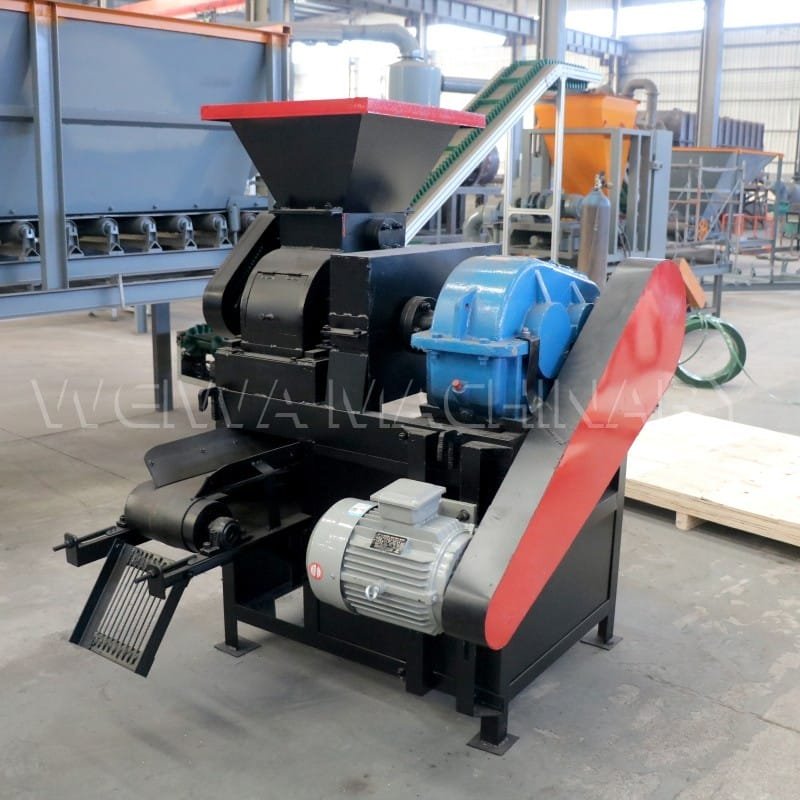
Weiwa Machinery baru saja menyelesaikan pengujian penerimaan pabrik, pemuatan kontainer, dan dokumentasi angkutan laut untuk lini produksi mesin briket arang bola lengkap yang ditujukan untuk klien di Uruguay. The order was not a single standalone unit. It was a coordinated charcoal ball press machine system with crusher, pengaduk, binder dosing, roller press, pengering, and packing support, engineered for making charcoal balls in Uruguay from local eucalyptus charcoal fines, imported hardwood powder, and agricultural residue carbon.
Why Uruguay Is a Real Market for Compressed Charcoal Balls?
Uruguay is a small country by land area but a stable one by income level, logistics access, and barbecue culture. Asado is not occasional in Uruguay. It is a weekly household rhythm in Montevideo, Salto, Maldonado, Canelones, and Rivera. Charcoal consumption is steady, and retail buyers are increasingly comparing lump charcoal with uniform shaped briquettes. A ball charcoal briquettes machine answers a specific commercial problem: powder waste that used to be landfilled or sold cheaply can now become dense, stackable, slow-burning charcoal balls with consistent size.
Market research on the Uruguay charcoal segment shows projected annual growth above 8 percent in the mid-2020s, with briquette formats gaining shelf space next to traditional lump wood charcoal. Uruguay also sits inside the Mercosur trade zone, which means a producer in Montevideo or Paysandú can reasonably target re-export or cross-border supply into Argentina and southern Brazil without rebuilding the product format.
For a Uruguayan buyer, making charcoal balls in Uruguay is not only about waste recovery. It is about product control. When you own the charcoal ball press machine, you control diameter, hardness, moisture after drying, ash content through binder choice, and carton weight. Importers who previously bought finished briquettes from Asia or Paraguay can localize part of the supply chain and protect margin when ocean freight or exchange rates move.
Feedstock Reality in Uruguay
Uruguay’s forestry base is dominated by planted eucalyptus and pine. Eucalyptus charcoal is common, but fresh wood chips carry high moisture, often 55 ke 60 persen, so any serious plant needs drying before carbonization or before briquetting. Many Uruguayan buyers also blend sawdust charcoal, rice husk carbon, and fine charcoal dust collected from lump charcoal screening yards. All of these are excellent inputs for a Charcoal Briquette Machine as long as particle size is reduced below 3 mm and moisture is stabilized between 9 Dan 15 percent before pressing.
Weiwa does not assume every client has perfect feedstock. In the Uruguay line we designed, the crushing and screening stage was oversized relative to the press so the client can run coarser incoming material without choking the roller pair. This is a typical customization choice for South American buyers who collect powder from multiple sources.
What a Mesin briket arang bola Production Line Includes?
A charcoal ball press machine is only one rotating component inside a full line. If you buy only the press and ignore mixing, binding, and drying, you will get cracked balls or unstable output. The Uruguay shipment from Weiwa contained the following connected stages.
1. Hammer Crusher and Vibrating Screen
Charcoal lumps, broken briquettes, and carbonized sawdust are fed into a hammer crusher with cyclone dust collection. Output size is adjusted to 0.5 ke 5 mm depending on screen mesh. A vibrating rotary screen removes oversize particles. This step matters because roller presses hate uneven granulometry. Fine uniform powder feeds evenly into the nip point and produces ball charcoal briquettes machine output with fewer edge fractures.
2. Double Shaft Mixer With Binder Dosing
Charcoal alone does not hold shape under light pressure. A binder is required. For food-adjacent BBQ charcoal, cassava starch, corn starch, or a small percentage of sodium lignosulfonate blended with starch works well. The double shaft mixer wets the powder homogeneously while a screw binder feeder doses dry starch at a controlled rate. Wheel mill mixers are also available when a client wants longer kneading time, but for making charcoal balls in Uruguay at 600 kg per hour, the double shaft design needed less labor.
3. Charcoal Ball Press Machine
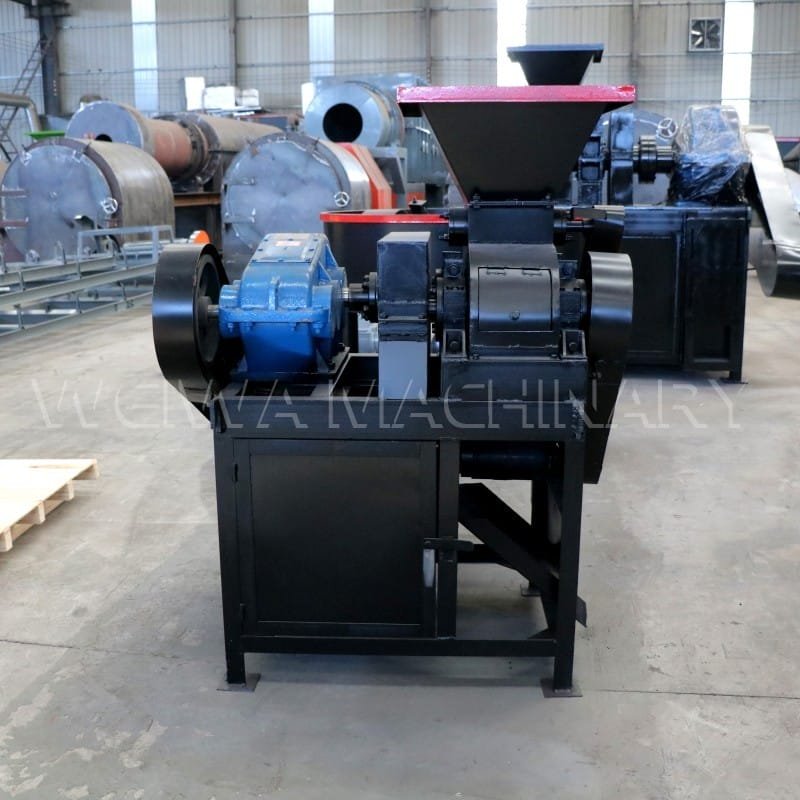
The core of the line is the charcoal ball press machine. Two alloy rollers rotate in opposite directions. Material drops into the feeding pocket, is pre-compressed by a screw feeder, then squeezed at the roller tangent line where pressure peaks. The pocket shape decides the final product. For this Uruguay client we used a 35 mm spherical pocket with a slight flat, which packs better in 10 kg and 20 kg cartons than pure round balls.
Roller material was 65Mn with surface hardening, and we offered 9Cr2Mo as an upgrade option for abrasive mixed biomass. The press motor was a 22 kW class unit with a heavy reducer. Roller change uses Weiwa’s connection-plate design, so the Uruguayan team can swap pocket shape in roughly one day without pulling bearings or shafts. That matters because many clients later want oval or pillow shapes for different retail brands.
4. Chain Plate Dryer
Fresh pressed balls leave the press at 12 ke 18 percent moisture depending on binder water. They must be dried to below 5 percent before packing. We supplied a chain plate dryer rather than a vertical dryer because chain plate units break fewer balls and handle 3 ke 5 tph in compact footprint. Hot air temperature and residence time were tuned for starch-bound eucalyptus charcoal. The Uruguay client can later raise dryer temperature if he switches to molasses binder.
5. Conveyors, Silos, and Packing Table
Belt conveyors link every machine. A small buffer silo sits before the press to stabilize feeding. At the end, a manual packing table with a pneumatic cutter and weight checker lets two operators fill cartons. For larger lines Weiwa can add an automatic carton sealer, but the Uruguay client chose semi-auto packing to keep initial investment lower.
How the Ball Charcoal Briquettes Machine Actually Forms a Ball?
The physics are simple but unforgiving. Charcoal powder is non-cohesive. You need three things: fine particle size, correct moisture, and high localized pressure. The screw feeder pushes powder into the roller pockets. As the rollers turn, pocket volume shrinks, so pressure rises. At the tangent line, pressure peaks and the powder densifies into a coherent ball. Past the tangent line pressure drops and the ball releases cleanly.
If moisture is too low, balls crumble. If moisture is too high, the press slips and balls stick to rollers. If binder is too low, balls break during transport. If binder is too high, ash rises and BBQ clients complain about white residue on grates. A properly tuned Charcoal Briquette Machine line balances all four variables, and that balance is exactly what Weiwa engineers during the pre-shipment trial run.
Making Charcoal Balls in Uruguay: A Practical Economic View
Assume a Uruguayan operator runs one 8-hour shift, presses 600 kg per hour of finished balls, and achieves 4.8 tons per day. At a conservative Montevideo wholesale price of 0.62 USD per kg for quality BBQ charcoal balls, daily gross revenue is about 2,976 USD. Power cost for the full line at roughly 45 kW average and 0.14 USD per kWh is near 50 USD per hour, atau 400 USD per shift. Labor for one crusher feeder, one press operator, and one packer adds perhaps 120 USD per shift. Binder and powder cost depend on whether charcoal fines are collected in-house or bought from Paraguay or Argentina.
The reason making charcoal balls in Uruguay works commercially is the spread between powder waste price and retail ball price. Powder that might sell at 90 USD per ton can become balls worth 620 USD per ton on a Montevideo shelf. Even after binder, energi, labor, and depreciation, the margin survives normal volatility because the ball charcoal briquettes machine converts low-value dust into a branded, stackable fuel.
Why a Client in Uruguay Chose Weiwa Machinery?
The client initially asked three Chinese suppliers for quotes. Two offered only a press. One offered a line but refused to provide a layout drawing sized to his existing warehouse in Salto. Weiwa sent a CAD layout within five working days, listed every conveyor length, marked maintenance aisles, and specified foundation bolts. That layout used the same 40-foot container footprint the client already had, with the chain plate dryer placed against the wall to save aisle space.
During the factory test, we ran a simulated Uruguay blend: 70 percent eucalyptus charcoal powder, 20 percent sawdust carbon, 10 percent fine coal dust, cassava starch at 4 persen, kelembaban 11 persen. The charcoal ball press machine held 4.6 tph at 35 mm ball size. Reject rate below 2 persen. Setelah dingin, balls showed no edge cracking and drop-test resistance from 1.2 meters exceeded 90 percent intact.
We then wrapped the machines in plastic film, secured them in a wooden case framework inside the container, separated spare rollers and bearings into a fixed crate, and loaded with moisture absorbers. The line left the Zhengzhou workshop and cleared for Montevideo via buffer port transshipment. Our engineer joined a WhatsApp video call during the client’s first cold start and reviewed belt tension, roller gap, and dryer temperature curves.
Ball Shape Versus Hexagonal Rod Versus Pillow
Uruguay retailers already know cylindrical extruded rods and hexagonal rods. The ball shape is less common but has advantages. Balls roll in the bag, which some clients dislike, but balls fill carton corners better than rods and press denser in the roller pocket. For making charcoal balls in Uruguay aimed at HoReCa bulk buyers, 30 ke 40 mm balls are ideal because they ignite slightly slower than rods but hold heat longer, which suits large parrilla grills.
Pillow and oval shapes are easier to stack in automatic carton lines. If the Uruguayan client later targets supermarket private label, he can swap roller pockets on the same charcoal ball press machine and keep the rest of the line unchanged. That flexibility is why we recommend roller press technology over fixed die extruders for ball products.
Common Mistakes When Buying a Charcoal Briquette Machine
The first mistake is chasing the lowest press price and ignoring the mixer. A 2,000 USD press behind a poor mixer will never make sellable balls. The second mistake is skipping drying capacity. Clients think sun drying is free, but in Uruguay winter humidity in Rio Negro or Tacuarembó can stall sun drying for days, and molded balls mold before they cure. The third mistake is wrong binder. Lime-based binders reduce cost but ruin taste on beef, and Uruguayan asado buyers notice immediately.
The fourth mistake is buying a Charcoal Briquette Machine rated at 1 tph when actual shift demand is 5 tph. Oversizing the press is cheaper than rebuilding the line in year two. Weiwa typically sizes the crusher and dryer one level above the press so the bottleneck stays at the roller, where it is easiest to control.
SEO and Commercial Intent Behind the Keywords
Buyers searching ball charcoal briquettes machine usually compare roller presses across Chinese exporters. Buyers searching making charcoal balls want process guidance, not just a price. Buyers searching charcoal ball press machine often already know the roller principle and want alloy specs. Buyers searching Charcoal Briquette Machine use the broad term and may accept extruder or punch press explanations, so the blog must clarify the difference. Buyers searching making charcoal balls in Uruguay have the strongest local intent and expect a supplier who understands Mercosur shipping, Spanish manuals, and eucalyptus feedstock. This article deliberately places those five phrases in introduction, headings, and case narrative rather than stuffing them in footers.
Technical Details of the Uruguay Shipment
Press model: WWPB-650 roller press, 35 mm ball pocket, 65Mn rollers, 22 kW motor, 320 rpm reducer, hydraulic gap adjustment. Penghancur: WWHC-800 hammer mill, 18.5 kW, 0.5 ke 5 mm output. Pengaduk: WWDS-1000 double shaft, 7.5 kW, with starch screw feeder. Pengering: WWCP-30 chain plate, 3-pass hot air, 220 cubic meters per minute fan, gas burner compatible with LPG or natural gas. Line footprint: 22 meters by 6 meters including packing. Production rate: 4 ke 5 tph finished balls. Moisture out of dryer: di bawah 5 persen. Commissioning support: remote video plus optional on-site technician for 7 hari -hari.
After-Sales Model for Overseas Clients
Weiwa Machinery has manufactured mineral, batu bara, and charcoal forming equipment for more than thirty years. Our workshop in Zhengzhou, Henan covers a large fabrication area with CNC roller milling, dynamic balancing for shafts, and a dedicated test bay where every press runs with real powder before paint. For the Uruguay client this meant the line was filmed during load test, the roller gap was set and locked, and the electrical panel was labeled in Spanish and English.
Spare parts such as rollers, scraper blades, coupling bushes, bearing blocks, and control relays are stocked for same-week dispatch. Manuals include wiring diagrams, lubrication intervals, roller change steps, and binder formula sheets. Clients can message a senior engineer on WhatsApp and receive a response window of 48 hours for mechanical questions. For larger projects we send a field technician for installation, usually 7 ke 14 days depending on foundation readiness.
Customization and Factory Layout Planning
No two charcoal yards are identical. Some Uruguayan clients receive bulk powder by truck; others collect fines in-house from lump screening. Weiwa prepares a customized proposal: feed analysis form, recommended binder, machine list with models, utility requirement table, foundation drawing, and 2D layout. If the client sends building dimensions and photo of the gate, we adjust conveyor angles so the container offload matches his forklift path. This is the difference between a machine that sits in a warehouse and a line that runs in month one.
Environmental and Regulatory Angle
Compressed charcoal balls reduce airborne dust in storage yards, use charcoal waste that would otherwise be discarded, and burn with lower smoke when binder choice is correct. Uruguayan municipalities are not yet strict on briquette plants, but clients who prepare now with dust collection, cyclone filters, and sealed binder tanks face fewer problems when environmental review arrives. A modern charcoal ball press machine line from Weiwa ships with cyclone units on the crusher and enclosed transfer points on the mixer.
Charcoal Ball Press Machine Versus Extruder in Uruguay Context
An extruder makes continuous rods and cuts them. A roller press makes discrete balls or pillows. For making charcoal balls in Uruguay, the roller press wins on shape flexibility, lower binder need, and easier dryer behavior because balls tumble in the chain plate. Extruders shine for hexagonal rods, but if the client’s retail channel asks for ball format, the extruder cannot switch without a full die redesign. The charcoal ball press machine simply changes rollers. That is why our Uruguay proposal led with roller technology despite the client initially asking about extruders.
Internal Workflow From Inquiry to Production
A typical Uruguay inquiry starts with three photos of raw material and one target ball diameter. Weiwa replies with a feed questionnaire. Once moisture and sieve data arrive, we send a line proposal. After deposit, we issue layout drawing, start steel cutting, and invite the client to a live video test. Before container loading we share the load plan, packing list, CE and ISO references, and Spanish operation manual draft. After arrival, the client prepares foundation using our bolt map, and we join commissioning remotely or on-site.
Mesin Weiwa Company Introduction
Weiwa Machinery is a Chinese manufacturer of mining, penumpasan, pengeringan, and briquetting equipment with more than thirty years of workshop experience. We design single charcoal ball press machine units and full ball charcoal briquettes machine plants for clients in Africa, Asia Tenggara, Timur Tengah, and Latin America. Our certifications include ISO 9001, Ce, and GOST for relevant markets. More than two million end users across 120 plus countries run Weiwa equipment in stone crushing, sand making, ore beneficiation, and biomass briquetting applications.
We employ a dedicated after-sales team available 24/7, offer part shipments and on-site field service technician support, and provide customized service including design drawings and site planning. Whether you need a 1 tph pilot line or a 10 tph commercial plant for making charcoal balls in Uruguay, we prepare the price list, installation plan, maintenance schedule, and operation training materials before shipment.
If you want to produce uniform charcoal balls from eucalyptus fines, sawdust carbon, or imported charcoal powder, contact Weiwa Machinery directly. We can arrange a live video trial on a 140, 160, or 180-type charcoal ball press machine, send a layout drawing sized to your warehouse, and quote a container-ready line with dryer, Pengumpan Binder, and packing table.
E-mail: sales@cjlmachinegroup.com
Whatsapp / Seluler: +86 18439853888
Alternative mobile: +86 18439853888
Weiwa Machinery treats every charcoal briquette machine for Uruguay not as a transaction but as a long-term production node. The line shipped to Uruguay this quarter is already running simulated blends in our test bay, and the same engineering package will travel with it to Salto or Montevideo: gambar, manual, spare rollers, binder sheet, and a direct line to our senior engineer.
Final Notes for Uruguayan Buyers
If you are evaluating a ball charcoal briquettes machine, do not start with price. Start with feedstock. Send us a 2 kg sample of your charcoal powder and we will test sieve, kelembaban, and press it on our charcoal ball press machine. You will receive a video of the balls dropping from one meter, a photo of the cross-section, and a binder suggestion. That 30-minute test saves months of guesswork after the container arrives.
Making charcoal balls in Uruguay is no longer an experimental idea. With stable asado demand, growing briquette shelf space, and accessible eucalyptus carbon, the country is ready for local shaped charcoal production. The only missing variable is the right Charcoal Briquette Machine line and a supplier who ships drawings instead of surprises. Weiwa Machinery is ready to fill that position.


 Wechat wechat

 +8615937143060
