


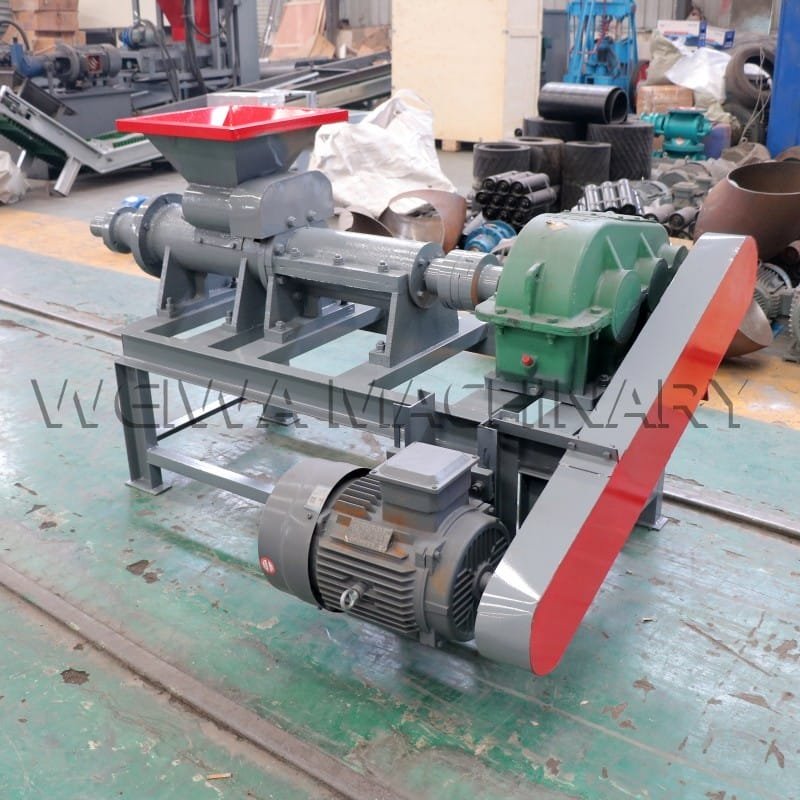
By the end of the second hour, the discharge table held straight, glossy, crack-free hexagonal charcoal rods, each 33 millimeters flat-to-flat, each cut to 220 millimeters, each dense enough to sink in water. The client measured surface temperature on the gearbox, watched the ammeter, and cut three rods open with a hacksaw to check the central hole. He left with a purchase plan for a 160-type unit and a second inquiry for a 180-type line.
Why Pakistani Buyers Ask for a Hexagonal Coal Briquette Machine?
In Pakistan, shaped charcoal is not a generic commodity. From the food streets of Lahore to the coastal grills of Karachi and the tandoor bakeries of Faisalabad, the buyer cares about three things: the piece must stack tightly in a 10-kilogram PP bag, it must ignite with predictable airflow, and it must hold radiant heat for more than sixty minutes under a grill mesh. Round sticks roll. Square bars crack at the corner under thermal shock. The hexagonal rod is the compromise shape that answers all three problems, which is why a Hexagonal coal briquette machine for Pakistan is now a separate inquiry category in our CRM rather than a footnote under “木炭擠出機”.
The client who visited our workshop had already burned through three imported extruders in eighteen months. His complaints matched what we hear from Sindh and Khyber Pakhtunkhwa resellers: mold wear after ten days, propeller overheating, rod surface splitting during the drying stage, and irregular hexagon geometry that made retail packs look like reject grade. He did not ask for the lowest quote. He asked for a Charcoal Extruder for Pakistan condition that could survive 220-volt fluctuation, dusty feedstock, and a twenty-hour daily shift in July heat. Weiwa treated the visit as a factory acceptance test, not a negotiation.
What the Pakistan Client Brought to the Trial?
He flew in with two sealed buckets. The first held coconut shell charcoal powder sifted below 3 millimeters. The second held a blend of local wood charcoal dust and a small portion of coal powder, representing what his team sources weekly in Punjab. Both samples came with a moisture sheet: 6.4 percent for the coconut shell fraction, 7.1 percent for the wood-coal blend. Our engineer did not touch the extruder first. He ran the samples through our lab sieve, checked bulk density, and adjusted the cassava starch binder to 4 percent by weight based on the finer fraction. No Charcoal Extrude Machine can save bad feedstock, and the first thirty minutes of the trial were spent on the mixer, not the screw.
What a 木炭擠出機 Actually Does Before the Mold?
Many overseas buyers imagine the charcoal extrude machine as a simple press that stamps powder into shape. In reality the screw extrusion principle is closer to a continuous high-pressure conveying system. The machine does not form one piece at a time. It feeds powdered carbon through a tapering chamber where a rotating screw converts motor torque into axial pressure, then forces the plasticized mass through a fixed die head. The die head decides the cross-section. Change the die head and you move from round bar to square column to hexagonal rod charcoal.
Screw Propulsion and Floating Coupling
In the Weiwa design the motor transmits power to the transmission through a triangle belt, and the output shaft of the transmission transfers torque to the propulsion shaft through a floating coupling. The floating coupling absorbs minor misalignment between gearbox and screw shaft, which matters more when a hexagonal die head resists flow more than a round die. On the propulsion shaft sits a high manganese alloy propeller. Its pitch, root diameter, and flight thickness are calculated to push charcoal paste forward without backflow. During the Pakistan trial the screw ran at 38 hertz for the first batch and 42 hertz for the second, and the ammeter stayed within six percent of nominal, meaning the load curve was stable rather than spiking every time a coarse particle entered the throat.
Hexagonal Die Head and Pressure Formation
The forming die head for hexagonal rod charcoal is not a drilled block. It is a forged #45 steel sleeve with six ground inner faces, a central chamfer, and a replaceable insert ring. When the charcoal paste reaches the die throat, chamber volume drops sharply, pressure climbs above 18 megapascals, and the material densifies. The hexagonal shape locks in as the rod exits and cools. For the Pakistan client we installed a 33-millimeter flat-to-flat hexagon insert with a 4-millimeter central hole, because his market prefers lightweight rods that still burn longer than solid cylinders. A Charcoal Extrude Machine for Hexagonal Rod Charcoal lives or dies on that insert tolerance, so every insert leaves our shop measured on a coordinate measuring arm, not a caliper alone.
Running the Trial With the Lahore Client Standing Beside the Panel
We started cold. The 160-type machine idled for ninety seconds so the belt tension settled and the gearbox oil circulated. Then the hopper received the coconut shell batch. Within four minutes the first continuous rod appeared, glossy and straight, exiting at roughly 480 millimeters per second before the pneumatic cutter chopped it to 220 millimeters. The client marked the first ten cuts as warm-up scrap. From cut eleven onward we ran a timed collection: 595 kilograms of finished hexagonal rod charcoal per hour against a nameplate range of 1.2 到 1.5 tons per hour for mixed wood-coal feed, which is expected because coconut shell paste flows easier than a coal-blend paste.
Reading the Reject Rate
A reject was defined as any rod with a surface crack, tail bloom, or flat-to-flat deviation beyond 0.4 millimeter. Before the pneumatic cutter we measured 2 percent reject. After removing the first and last 30 millimeters of every start-stop sequence, the packed reject rate dropped below 0.5 percent. The client’s old machine ran at 9 percent reject on a good day. He wrote the number on his phone and showed it to our sales manager. That moment, not the brochure, closed the sale.
力量, Heat, and Noise Observations
這 100 percent copper coil motor drew between 17.5 和 19.2 kilowatts across the stable feeding phase. Gearbox surface temperature peaked at 61 degrees Celsius after 110 分鐘. Cabinet vibration stayed under 2.8 millimeters per second. The triangle belt only connects motor to gearbox, not gearbox to screw, which avoids the belt-slip density drop we see in many 22-kilowatt copies. For a Charcoal Extruder for Pakistan, that belt topology is not a detail. It is the difference between a rod that keeps diameter from cut one to cut one thousand and a rod that shrinks every time the belt warms up.
Why Hexagonal Rod Charcoal Fits the Pakistan BBQ Market?
The six flat sides let rods lie parallel in a tandoor basket, so the air channel between pieces is uniform instead of random. The corners create secondary airflow without making the piece fragile. A 4-millimeter central hole shortens cold-start time; the client timed ignition at 4 分鐘 20 seconds to a glowing front, against 6 分鐘 10 seconds on his old solid cylindrical rod. Across a busy night service that saves roughly twenty minutes of wait per 10-kilogram batch, which a restaurant owner in Lahore converts directly into table turns. In retail WhatsApp catalogs the hexagon also photographs as a quality signal, so the shape carries commercial value before the bag is even opened.
Hexagonal Versus Cylindrical Versus Square
Cylindrical rod is the cheapest to extrude and the easiest to dial in, but it rolls in the carton and leaves uneven gaps in the grill. Square bar stacks tighter yet suffers corner spalling when the cook splashes marinade on hot charcoal. Hexagonal rod is the middle path: easier to extrude than a clean square, better airflow than a cylinder, and stronger under side load than either. For Pakistan we now default to hexagonal hollow rod unless the buyer already owns square packaging molds. The same Charcoal Extrude Machine swaps between these shapes in under twenty minutes with a die head change, which is why one machine serves many SKUs.
Material Preparation Behind a Clean Extrusion
The extruder is the most visible machine in the line, yet in this trial we spent more time at the mixer than at the die. Charcoal crusher output had to stay below 3 millimeters. The grinding wheel mixer then blended powder, cassava starch, and water until the mass behaved like wet bread dough and held shape when squeezed by hand. Moisture landed between 6 和 7 percent depending on the fraction. Too low and the rod flakes at the die exit. Too high and the central hole closes during drying. A Hexagonal coal briquette machine for Pakistan cannot compensate for a mixer operator who guesses moisture by feel in the monsoon season.
Binder Choice for Food-Contact Grill Charcoal
Cassava starch gave the cleanest demold and the lowest odor. Corn starch worked but needed one extra minute of mixing. Clay binder adds weight and kills burn quality, so we discourage it for barbecue grade even when it is cheaper. The client agreed to standardize cassava at 4 percent and keep water between 6 和 7 percent with seasonal adjustment. That single decision removed most of the tail-bloom rejects he suffered on his previous machine, because tail bloom is usually a binder-flow problem, not a screw problem.
How the Charcoal Extrude Machine Sits Inside a Full Line?
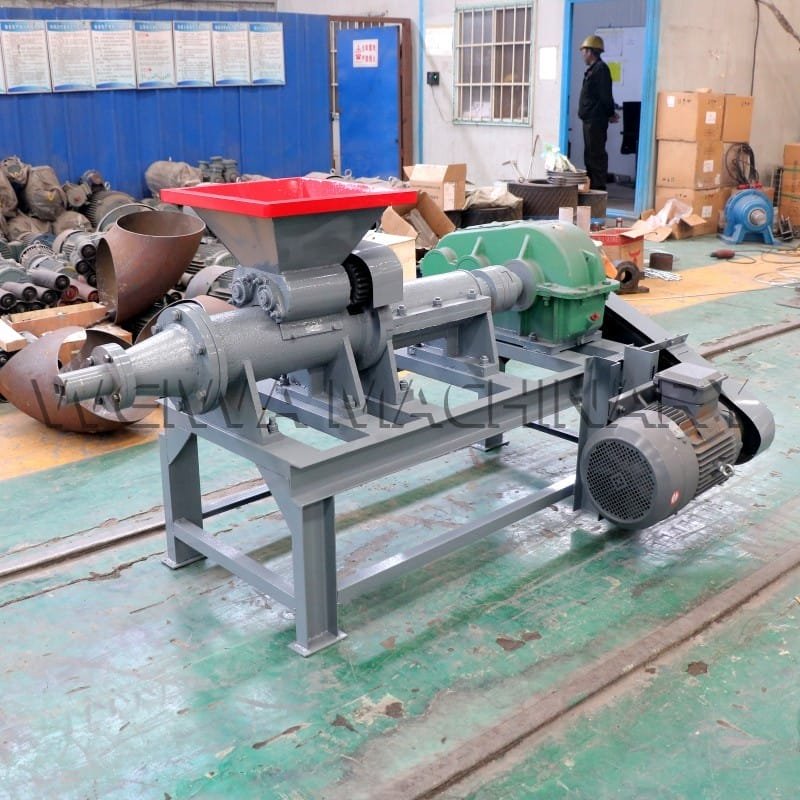
The extruder is the core, but never the whole system. In the layout we walked the client through, raw lump charcoal enters a crusher to go below 3 millimeters. A grinding wheel mixer blends powder, starch, and water. The Charcoal Extrude Machine for Hexagonal Rod Charcoal forms the continuous rod. A mesh belt dryer pulls residual moisture down so the rod survives stacking and overseas shipping. A pneumatic cutter and packing table close the loop. Skipping the dryer is the most common mistake we see in Africa and South Asia: green hexagonal rods look solid, yet at 8 percent moisture in Karachi humidity they mold inside a sealed PP bag within nine days.
Model Selection for Pakistan Conditions
We build the 140, 160, 和 180 screw types. 這 140 fits a 0.8 到 1.0 ton per hour single-shift workshop on 15 kilowatts. 這 160 is the workhorse for Lahore-scale factories at 1.2 到 1.5 tons per hour on 22 kilowatts. 這 180 serves 2 到 3 ton per hour lines on 22 到 30 kilowatts. For the trial we ran the 160 because his target was 1.2 tons per hour of coconut shell rod with headroom for wood-coal blend days. All three share the same carbon steel base, copper coil motor option, high manganese propeller, 和 #45 steel die system, so spare parts travel across models.
Field Commissioning Advice for a Hexagonal Coal Briquette Machine in Hot Climates
If you install a Hexagonal coal briquette machine for Pakistan or anywhere with summer ambient above 40 degrees, do not skip the cold-start purge. Idle the screw sixty to ninety seconds every morning. Check belt tension weekly because heat expands the belt and changes slip behavior. Grease the floating coupling monthly. Keep one spare #45 steel hexagon insert in stock so die wear never stops a shift. These habits extended screw life to over 800 hours before flight rebuild in the Indonesia and Egypt units we tracked, and we expect the same window for the Lahore client because the powder silica load is similar.
Common Startup Mistakes
The first mistake is buying the die before testing the powder. Die geometry is useless if the binder is wrong. The second is chasing high horsepower instead of screw flight design; a 22-kilowatt machine with a poor propeller makes worse rods than a 15-kilowatt machine with a correct variable-pitch screw. The third is blaming the extruder when rods crack, when the real cause is mixer moisture at 8.5 percent. In the Pakistan trial we touched the extruder controls twice and the mixer controls eleven times. That ratio is normal.
Trial Data Summary the Client Took Home
Total run time was two hours eleven minutes including planned stops to check screw temperature. The 160-type Charcoal Extrude Machine processed 1,190 kilograms of mixed Pakistani material into finished hexagonal rod charcoal at 220 millimeter length. Effective average output was 595 kilograms per hour on coconut shell batch and 540 kilograms per hour on wood-coal blend batch. Power stayed between 17.5 和 19.2 kilowatts. Reject rate before cutter was 2 percent, after trimming was below 0.5 percent. Gearbox peak temperature was 61 攝氏度. Flat-to-flat tolerance held 33.0 plus or minus 0.3 millimeters across the full run. The client placed the 160 order with two die heads and later sent a deposit for a 180 line with crusher, 混合器, 乾衣機, and cutter.
Why Buyers Specifically Write Charcoal Extruder for Pakistan?
The phrase is not only geographic. Over the past three years we standardized a sub-specification inside our 140, 160, 和 180 models aimed at South Asian conditions: copper-wound motors, tropical-grade grease, wider belt guards for dusty workshops, and hexagon die heads with 120-degree tolerance grinding. When a buyer writes Charcoal Extruder for Pakistan in an inquiry, they are usually telling us they already burned their fingers on a generic machine that looked identical in a photo but failed in July heat. Our answer is to show the trial data, not the catalog page.
Other Markets, Same Machine Logic
The same configuration sells in Indonesia, Bangladesh, 埃及, and Nigeria. Indonesia sends coconut shell, Egypt sends wood charcoal, Nigeria sends a coal-charcoal blend. The extruder does not change. Only the mixer time, binder percentage, and die flat-to-flat dimension change. That modular logic is why we can promise a 160-type Charcoal Extrude Machine for Hexagonal Rod Charcoal to a new country without re-engineering the frame. Pakistan remains the fastest-growing hexagonal segment because of tandoor and roadside grill culture, but the machine itself is a tropical-market platform.
關於 WEIWA機械
Weiwa Machinery is a Chinese manufacturer of charcoal and coal briquette equipment, carbonization furnaces, crushers, mixers, dryers, and full production lines. We export to more than 130 countries including Pakistan, 印度尼西亞, 印度, 馬來西亞, 越南, 火雞, 埃及, 阿爾及利亞, and South Africa. Our charcoal extrude machine range covers 140, 160, 和 180 screw types with customizable cylindrical, 正方形, and hexagonal molds. We treat every overseas inquiry as a commissioning problem, not a quotation problem, and we prefer to run your powder on our floor before we quote your line.
If you are planning a hexagonal rod charcoal project for Lahore, Karachi, Faisalabad, or any market where the tandoor and barbecue trade decides repeat orders, contact our sales desk and send a 5-kilogram sample. We will run it, measure it, and send you the video.
移動的 / WhatsApp: +8613838093177
電子郵件: info@cjlmachinegroup.com
工廠: 貢伊, 河南, 中國


 微信
微信

 +8615937143060
