


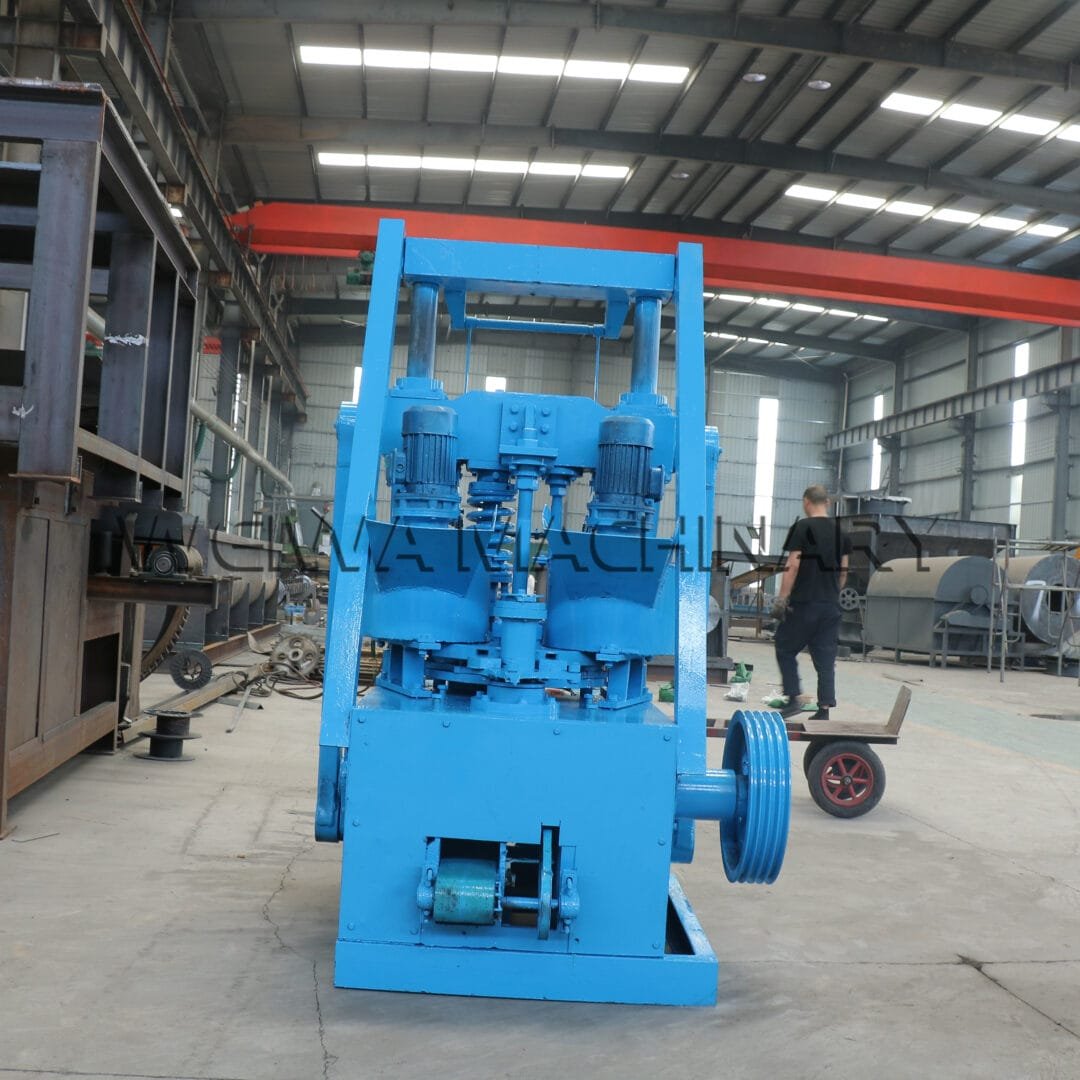
В Weiwa Machinery, every export unit is verified before shipment. Недавно, a long-term partner from Zambia specified our Honeycomb Briquette Charcoal Machine for local coal-dust and charcoal-fines processing. Before container loading, our engineering team conducted a full pre-delivery inspection, running trial production with sample raw-material blends to verify pressure calibration, mold alignment, and final briquette quality.
Why Zambian Entrepreneurs Invest in a Угольная машина соты?
Zambia has a well-established charcoal culture for cooking, baking, and small-scale heating, yet traditional hand-molded lumps suffer from inconsistent density, high ash, and excessive smoke. A modern Honeycomb Briquette Charcoal Machine converts low-cost coal dust, угольная мелочь, and certain biomass residues into uniform hexagonal or round cylinders with through-holes—the classic honeycomb pattern. These holes create controlled airflow, allowing near-complete combustion and extending burn time by 30–50 percent compared with loose powder or irregular lumps. For Zambian SMEs, a Coal Briquettes Making Machine reduces raw-material waste, creates a branded value-added fuel product, and opens access to institutional buyers such as schools, bakeries, and roadside food vendors who prefer predictable, low-smoke fuel.
The model selected by our Zambia client was a mechanical punching type Honeycomb Punching Machine with customizable mold—typically producing 90–120 pieces per minute depending on briquette diameter (Φ100 mm / Φ120 mm / Φ140 mm common) and configured with a 7.5 kW or 11 kW main motor. This Honeycomb Charcoal Coal Briquette Forming Machine is engineered for continuous 8–10 hour daily operation and is already in use across Kenya, Уганда, Танзания, Nigeria, and South Africa, proving its adaptability to African power supplies (220 V / 380 V / 415 V three-phase) and tropical workshop conditions.
Working Principle of the Honeycomb Charcoal Coal Briquette Forming Machine
Understanding the mechanics helps operators in Zambia optimize output. The Honeycomb Briquette Charcoal Machine follows a four-stage cycle:
Material Feeding and Pre-Mixing
Charcoal powder or coal dust is first sieved to below 3 mm and blended with a binder—commonly cassava starch, maize starch, or bentonite clay at 5–8 percent by weight—plus 8–12 percent water. Uniform moisture and particle size are critical. Inconsistent feed causes uneven density in the finished briquette. The pre-mix is loaded into the overhead hopper of the Coal Briquettes Making Machine, from where an auger or rotary feeder meters material into the molding chamber.
Stamping and High-Pressure Compression
A flywheel-driven crankshaft or eccentric cam converts motor rotation into reciprocating vertical motion of the punch head. On the down-stroke, the punch forces material into a precision-machined mold cavity—typically a hexagonal outer shape with a central pin array forming the honeycomb holes. Pressure reaches 15–25 MPa depending on raw material compressibility. The Honeycomb Punching Machine maintains this pressure long enough for binder activation and particle interlocking before the up-stroke begins.
Mold Design and Honeycomb Hole Formation
Mold inserts are changeable. A standard mold for the Zambia market produces a six-sided (гексагональный) briquette 100–140 mm across and 60–80 mm tall, with 12–19 evenly spaced holes of 8–14 mm diameter. The honeycomb geometry is not decorative—it lowers ignition temperature, permits oxygen ingress from multiple directions, and prevents smoldering extinguishment common in solid fuel blocks. Our Honeycomb Charcoal Coal Briquette Forming Machine allows mold customization for round or square profiles upon request.
Ejection and Conveyor Discharge
After compression, a bottom ejector pin pushes the formed briquette onto an outgoing belt conveyor. The Honeycomb Briquette Charcoal Machine repeats this cycle 45–60 times per minute on a single-cavity model, scaling with multi-cavity molds. Ejected briquettes are then sun-dried or passed through a mesh-belt dryer to reduce residual moisture below 5 percent before bagging.
Pre-Delivery Inspection Procedure for the Zambia Order
Before crating, our QC department performed a documented three-phase check on the specified Honeycomb Briquette Charcoal Machine:
Mechanical Alignment and Safety Check
All bolt torques on the main frame, transmission housing, and mold seat were verified. The punch-head perpendicularity relative to the mold cavity was measured with feeler gauges to ensure < 0.15 mm deviation—critical for mold longevity. Emergency-stop buttons, guard covers over moving parts, and the overload clutch on the flywheel were function-tested. Lubrication points were filled with recommended high-temperature grease.
Electrical and Control Panel Testing
The control panel of the Угольные брикеты изготовления машины was powered with simulated load to confirm correct motor start/stop sequencing, ammeter readings within rated range, and alarm response to phase-loss or over-current conditions. Since Zambian industrial zones may experience voltage fluctuation, we recommend clients fit a 3-phase voltage stabilizer if supply regularly drops below ±10 percent of nominal.
Trial Run With Sample Material Blends
Using a charcoal-fines + 6 percent cassava-starch blend (moisture ~10 percent), the machine was jogged for ten minutes, then run continuously for thirty minutes. We adjusted the punch-depth setting to achieve a target green-briquette density of 0.9–1.05 g/cm³. Throughout the run, the Honeycomb Punching Machine maintained stable stroke rate with no abnormal vibration. The Zambia client’s representative reviewed the live video feed and approved the sample batch.
Sample Briquette Quality Analysis From the Inspection Run
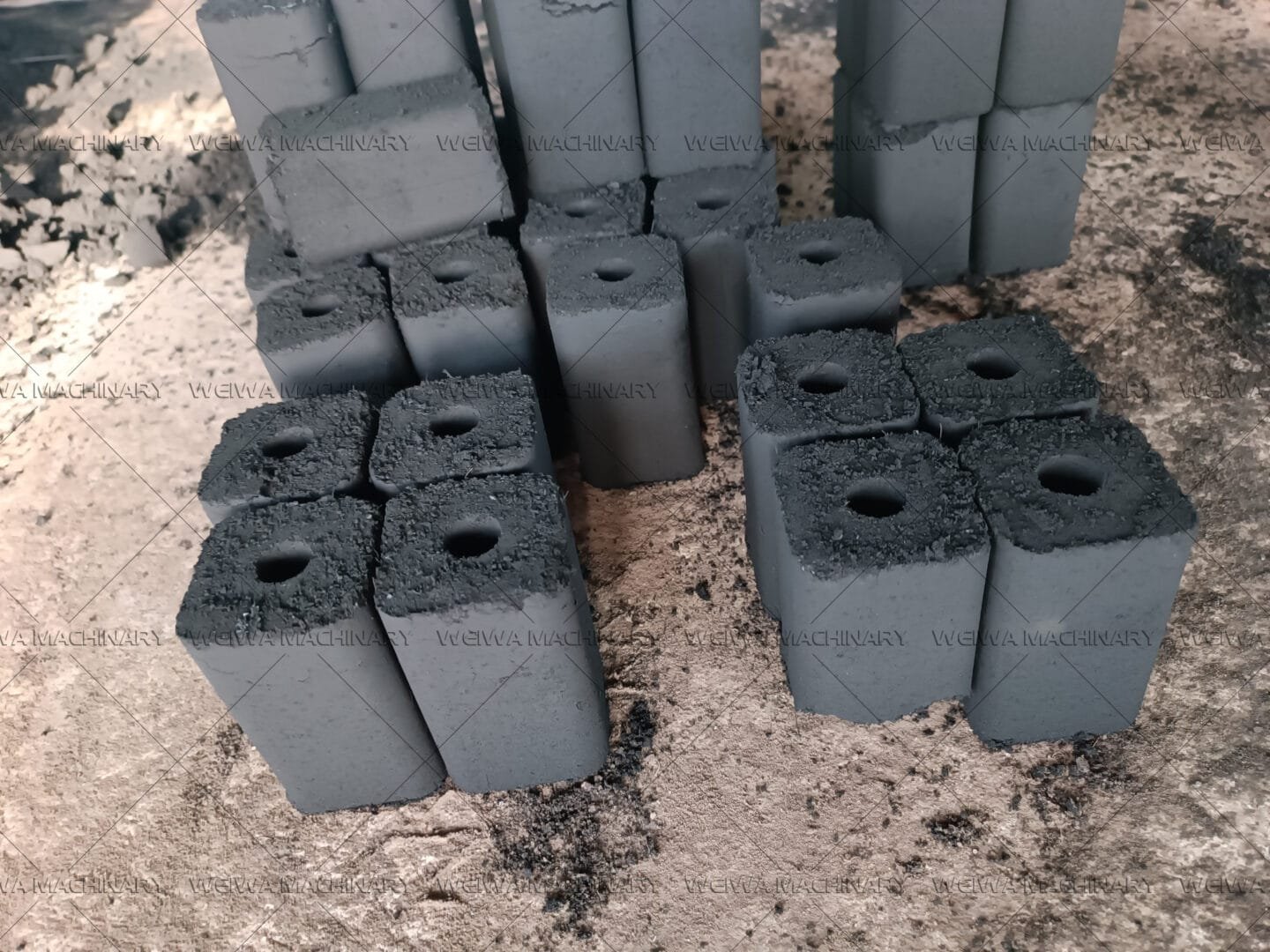
The samples produced during the pre-delivery test illustrate what Zambian buyers receive when ordering our Honeycomb Charcoal Coal Briquette Forming Machine
Physical Dimensions and Visual Uniformity
Measured samples showed a side-length tolerance of ±1 mm on a nominal 120 mm hexagon, height 70 mm ±2 mm, and hole-diameter variance under 0.5 мм. Surface finish was smooth with crisp edge definition—indicating proper mold fit and adequate compression hold-time. Color was dark matte charcoal-gray typical of well-carbonized feedstock.
Drop-Test and Handling Durability
Green briquettes (before full drying) were dropped三次 from 1 m onto a concrete surface; only minor corner chipping occurred on 2 из 20 pieces. After air-drying 48 часы, drop-test failure rate fell below 5 процент. This durability matters in Zambian distribution chains where briquettes are bagged, stacked on pickups, and transported over uneven roads.
Combustion Characteristics of Honeycomb Briquettes
Controlled burn tests in our lab stove showed ignition within 90–120 seconds when lit with dry kindling, steady flame front propagation through the honeycomb holes, and total burn duration of 55–75 minutes for a single 120 mm sample (depending on ambient draft). Smoke visibility was markedly lower than uncompressed lump charcoal of comparable mass. The Honeycomb Briquette Charcoal Machine therefore enables production of a premium fuel that commands higher retail price in Lusaka, Ndola, and Kitwe markets.
Raw Material Recommendations for Zambian Users of the Coal Briquettes Making Machine
В то время как Угольные брикеты изготовления машины is versatile, optimal results depend on feedstock prep:
Charcoal fines should come from a Horizontal Carbonization Furnace or similar, with fixed carbon >65 percent and ash <10 процент. Coal dust (anthracite or bituminous) should be sieved to <3 mm and may be blended up to 30–40 percent with charcoal fines to adjust hardness and cost. Binders—locally sourced maize or cassava starch boiled into paste—work well and keep the final fuel food-safe for cooking applications. Avoid over-wetting; >14 percent moisture in the mix leads to spongy, poorly formed briquettes and accelerated mold wear on the Honeycomb Punching Machine.
Maintenance Tips for Long-Term Operation of the Honeycomb Briquette Charcoal Machine
To protect your investment and maintain output quality from the Сотовая угольная машина для формирования углевых брекетков, Weiwa Machinery recommends:
Daily cleaning of hopper and mold after shutdown to prevent binder hardening. Weekly greasing of punch-guide bushings and checking V-belt tension. Monthly inspection of mold cavity wear—replace when hole-diameter enlargement exceeds 1 мм, as this affects briquette appearance and market acceptance. Keep a spare set of punch head and mold insert on site for quick changeover when switching briquette sizes. Train at least two operators per shift on safe feeding rhythm and emergency procedures.
Why Choose Weiwa Machinery as Your Honeycomb Briquette Equipment Partner?
Weiwa Machinery is a Henan-based manufacturer with more than a decade of experience exporting Honeycomb Briquette Charcoal Machine, Горизонтальная карбонизация печи, дробилки, mixers, and dryers to over 40 страны. For African clients—including repeat orders from Zambia—we provide pre-shipment video inspection, English/Swahili operation manuals, spare-parts kits, and remote technical support via WhatsApp. Machines are packed in standard export wooden cases with clearly labeled cables and fittings to simplify on-site assembly.
Whether you need a single Coal Briquettes Making Machine for a pilot workshop or a full briquette-production line with upstream carbonization, our team will tailor recommendations to your local raw materials, power conditions, and target daily capacity (typically 1–8 tons finished briquettes per 8-hour shift for our standard models).
О Weiwa Machinery
Weiwa Machinery specializes in manufacturing charcoal making machines, briquette presses, and carbonization equipment for global markets. Our product range includes the Honeycomb Briquette Charcoal Machine, Honeycomb Punching Machine, Угольные брикеты изготовления машины, Горизонтальная карбонизация печи, charcoal crushers, binders mixers, and mesh-belt dryers. Trusted by more than 2 миллионов клиентов по всему миру, we are committed to delivering durable, energy-efficient machinery with professional after-sales support.
Contact us for a free quotation:
Мобильный / WhatsApp: +86 138 3809 3177
Электронная почта: info@cjlmachinegroup.com


 WeChat

 +8615937143060
