


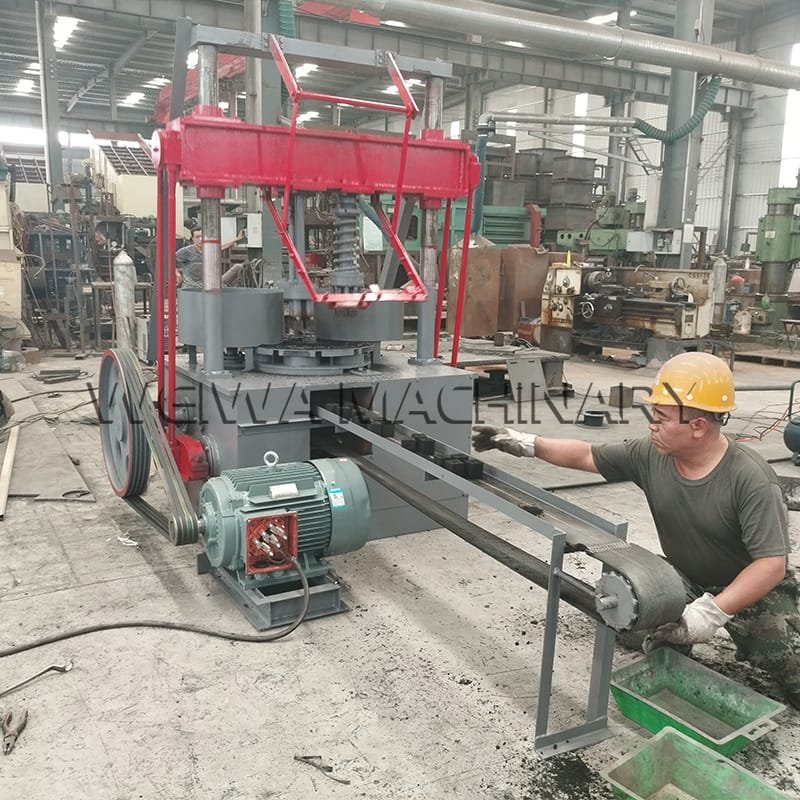
Why the Vietnam Client Needed a 蜂巢式煤成型機?
Vietnam’s fuel market is shifting from loose coal, firewood, and irregular charcoal chunks toward standardized briquettes. Distributors want consistent size. Households want cleaner burning. Small factories want products that can be packed, stacked, and shipped without breaking. The Vietnam client already understood this shift and wanted equipment that could deliver repeatable quality instead of occasional good samples.
Their raw material mix included charcoal powder, 煤粉, and locally available biomass residues. They cared about hole pattern, burning stability, briquette hardness, moisture tolerance, and whether the machine could run continuously without frequent die problems. For them, the honeycomb punching machine was not a novelty. It was a production tool.
What a Honeycomb Charcoal Coal Briquette Forming Machine Actually Does?
A honeycomb charcoal coal briquette forming machine compresses powdered raw materials into block-shaped fuel with multiple holes passing through the body. Those holes are not decorative. They create channels for air to enter the briquette during combustion. Better airflow means more stable ignition, steadier flame, less choking smoke, and more complete burning of the fixed carbon inside the briquette.
This machine is different from a roller press or screw extruder. In a punching system, material is fed into the hopper, conditioned to the right moisture and particle size, pressed into the mold cavity, and punched into shape. The punching action gives the briquette its characteristic honeycomb holes. That is why experienced buyers often search for honeycomb punching machine when they already know the hole structure is important for their market.
Raw Materials Suitable for Vietnam
The same coal briquettes making machine can handle several materials if preparation is correct. Charcoal powder from coconut shell, wood charcoal, 煤塵, 可樂粉, anthracite powder, and some agricultural residues can all be formed into briquettes. In Vietnam, coconut shell charcoal and rice husk charcoal are especially interesting because they turn agricultural byproducts into higher-value fuel.
The key is particle uniformity. Material that is too coarse feeds unevenly. Material that is too fine may trap air and create soft briquettes. Material with high moisture may stick to the punch or produce swollen, weak blocks. For the Vietnam trial, we guided the client toward screened powder, controlled moisture, and a binder recipe suitable for their blend.
How the Honeycomb Punching Machine Forms Briquettes?
The punch enters the mold, compresses the material under controlled pressure, and forms the holes at the same time the outer shape is created. The mold determines diameter, height, number of holes, and hole diameter. Because the client had already specified the machine type, our task was calibration rather than persuasion.
We checked moisture content, adjusted feed speed, verified punch alignment, and observed ejection behavior. When the punch and die are matched correctly, the briquette leaves the machine with sharp edges and clean holes. When they are not matched, the briquette may show tailing, cracking, double holes, or powder leakage. The trial was useful precisely because it exposed these details before mass production.
Preparing the Machine Around the Client Specification
Before running the machine, our team reviewed the client’s target briquette weight, local voltage situation, expected daily output, and finished-product use. Some buyers want household cooking briquettes. Others want industrial heating blocks. The Vietnam client wanted samples that could be shown to distributors, so appearance and consistency mattered as much as combustion data.
Material preparation started with screening. Oversized particles were removed. Moisture was brought into a workable range so the powder would bind under pressure without sticking to the punch. We then ran a short warm-up cycle to check vibration, noise, feeding stability, and belt discharge. Only after the machine behaved consistently did we begin collecting trial samples for inspection.
The client’s operators were invited to run part of the cycle themselves. This step matters for export projects because the buyer’s team must trust the machine after shipment, not only during the supplier’s demonstration. A honeycomb briquette charcoal machine should be easy enough for local operators to understand and robust enough for daily production.
Trial Day Observations From the Vietnam Workshop
The first thing the client’s team noticed was uniformity. Batch after batch, the briquettes left the machine with the same diameter, same height, and the same hole arrangement. For a distributor, uniformity is commercial value. It means labeling, 包裝, and pricing can be standardized.
Briquette Density and Surface Structure
Dense briquettes burn longer and resist crumbling. The trial samples showed tight surface texture with no loose powder on the edges. When tapped, they produced a solid sound rather than a dull, sandy response. High density does not mean over-compression. If pressure is too high, the briquette may crack during cooling. The objective is a balanced density that supports long burn time while keeping the structure stable.
Hole Pattern and Airflow
The honeycomb holes were evenly spaced and symmetrical. This matters because uneven holes cause uneven burning. A good honeycomb briquette charcoal machine in Vietnam should produce the same hole geometry across thousands of pieces, not only on the first ten samples. During the trial, we measured hole diameter, counted holes per piece, and checked whether the punch marks were centered.
The samples showed consistent hole walls, which means air can move through the briquette in a predictable way. Predictable airflow leads to predictable ignition, predictable flame, and fewer complaints from end users who simply want a stove that lights quickly and burns steadily.
Combustion Behavior of the Samples
We did not only inspect shape. We observed how the samples reacted after lighting. The briquettes ignited from the top and allowed air to travel through the holes, giving a steady combustion front. Ash formation was manageable. Smoke was much lower than loose coal or wet charcoal chunks. Burn time was suitable for household cooking and small commercial heating, depending on diameter and raw material blend.
For the Vietnam client, the most important result was not a single impressive briquette. It was the fact that later batches looked like the first batch. Repeatability is what turns a machine demo into a bankable production line.
Sample Showcase From the Honeycomb Briquette Trial
The trial produced several sample groups. One group used charcoal-dominant powder. Another used a blended recipe of charcoal powder and coal fines. A third group tested a slightly larger diameter for longer burn time. Each group was photographed, weighed, measured, and kept for the client’s distributor meetings.
The charcoal-dominant samples had a cleaner appearance and were more attractive for household retail. The blended samples reduced raw material cost while still holding shape. The larger-diameter samples burned longer but required more careful stove matching. This kind of sample matrix is exactly what a serious buyer needs before placing a full container order.
We also checked edge quality. A quality honeycomb charcoal coal briquette forming machine should give clean side walls, not ragged edges. Ragged edges usually mean worn dies, wrong moisture, poor feeding, or incorrect punch timing. None of those issues dominated the trial once the settings were stabilized.

Why Buyers Compare Coal Briquettes Making Machine Models?
Buyers often compare a coal briquettes making machine by price first, but the better comparison is total production cost. Mold change time, power consumption, spare part life, binder ratio, rejection rate, and local service distance all affect profitability. A cheaper machine with frequent die problems can cost more than a better-built unit over twelve months.
For the Vietnam market, the right model depends on briquette diameter, daily volume, raw material moisture, and operator skill. A honeycomb punching machine with adjustable punch stroke and interchangeable molds gives the buyer flexibility. A fixed model may be fine for one product, but limiting if the client later wants square holes, more holes, bigger diameter, or a harder industrial block.
Weiwa Machinery usually recommends clients start from their best-selling SKU, then choose a machine platform that can expand. That approach protects the first investment while leaving room for new distributor demands.
How Weiwa Machinery Supports Export Clients?
Export buyers need more than a machine photo. They need pre-shipment testing, raw material advice, voltage confirmation, spare part lists, operation training, and responsive after-sales communication. For the Vietnam client, we shared a material preparation sheet, a mold specification drawing, a preventive maintenance checklist, and a packing plan suitable for sea freight.
Our team can run a trial using the buyer’s own powder when samples are available. This reduces the risk of “it worked in the factory but not in our country” complaints. It also helps the buyer explain product quality to local distributors, because the samples were made from their own feedstock rather than an idealized test material.
Every honeycomb briquette charcoal machine project is handled as an engineering order, not only a sales order. Machine color, mold holes, motor power, voltage, conveyor length, and control panel language can be discussed before production starts.
關於 WEIWA機械
Weiwa Machinery is a manufacturer and exporter of briquette machines, charcoal processing equipment, and carbonization systems. We work with clients in Vietnam, 印度尼西亞, 奈及利亞, 肯亞, 坦尚尼亞, Colombia, Peru, 印度, and other growing fuel markets. Our focus is practical machinery that can run in real workshops, not only in supplier showrooms.
We support customers from raw material analysis to final briquette packaging. Whether you need a honeycomb briquette charcoal machine, a honeycomb charcoal coal briquette forming machine, a coal briquettes making machine, or a complete charcoal plant, our engineering team can help you choose the right configuration.
If you want to see your own raw material turned into honeycomb briquettes before ordering, Weiwa Machinery can arrange a customized trial and send sample photos, videos, and test data.
Contact Weiwa Machinery
暴民: +8613838093177
WhatsApp: +8613838093177
電子郵件: info@cjlmachinegroup.com


 微信
微信

 +8615937143060
