


了解 連續碳化爐 科技
A continuous carbonization furnace is fundamentally different from traditional batch-type kilns or retorts. While batch systems require operators to load raw biomass, seal the chamber, wait for the carbonization cycle to complete, cool down the unit, and then unload the charcoal, a continuous carbonization furnace operates on a flow-based principle. Biomass enters from one end, undergoes controlled pyrolysis in a heated, oxygen-limited environment, and finished charcoal discharges from the other end in a steady, ongoing stream.
This design eliminates the start-stop inefficiency that plagues batch operations. The thermal energy generated during the carbonization process is partially recovered and recycled back into the heating system, which dramatically reduces fuel consumption per ton of output. For operations in India where energy costs and biomass availability fluctuate regionally, this efficiency translates directly into a stronger bottom line.
The core of any continuous carbonization furnace lies in its multi-stage temperature control system. Raw materials such as coconut shells, 木屑, 稻殼, 竹子, or wood chips are first pre-dried, then gradually heated through primary and secondary carbonization zones. Each zone is maintained at a specific temperature range optimized for maximum charcoal yield and quality. The entire process is enclosed, which means smoke and volatile compounds are captured and either burned off in an afterburner system or condensed into wood vinegar and tar for secondary sale.
From an environmental standpoint, the continuous carbonization furnace addresses one of the oldest criticisms of charcoal production: uncontrolled emissions. Traditional earth mound kilns and even many brick kilns release large volumes of methane, carbon monoxide, 和顆粒物. A properly configured continuous carbonization furnace with gas recycling and dedusting systems reduces these emissions to a fraction of conventional methods, making it far easier for Indian operators to secure environmental clearances and maintain compliance with state pollution control board regulations.
Key Components of the Weiwa Continuous Carbonization Furnace
The Weiwa continuous carbonization furnace is engineered around a robust main carbonization host, which serves as the primary reaction chamber. This is paired with a combustion furnace that supplies the initial thermal energy, a gas purifier that cleanses the recycled flue gas before it re-enters the heating system, a dedusting tower that removes fine particulates from exhaust streams, and a PLC control cabinet that gives operators precise digital oversight of every temperature zone, conveyor speed, and gas valve position.
The structural materials used in the continuous carbonization furnace are selected for sustained high-temperature operation. The inner lining utilizes high-alumina refractory castables capable of withstanding repeated thermal cycling without cracking. The outer shell is constructed from heavy-duty carbon steel with thermal insulation layers that minimize heat loss to the surrounding environment. This dual-layer approach ensures both safety and energy efficiency during continuous multi-day production runs.
One of the most frequently asked questions we receive from Indian buyers concerns the feedstock flexibility of the continuous carbonization furnace. The machine is designed to handle a wide range of biomass types with minimal mechanical adjustment. Coconut shells, which are abundantly available across southern and coastal India, perform exceptionally well due to their high lignin content and natural density. Rice husks and sawdust require slightly different temperature profiles but are processed effectively through the same system. 竹子, which is rapidly renewable and widely cultivated in the northeast and parts of southern India, produces a high-quality charcoal with excellent calorific value when processed in a continuous carbonization furnace.
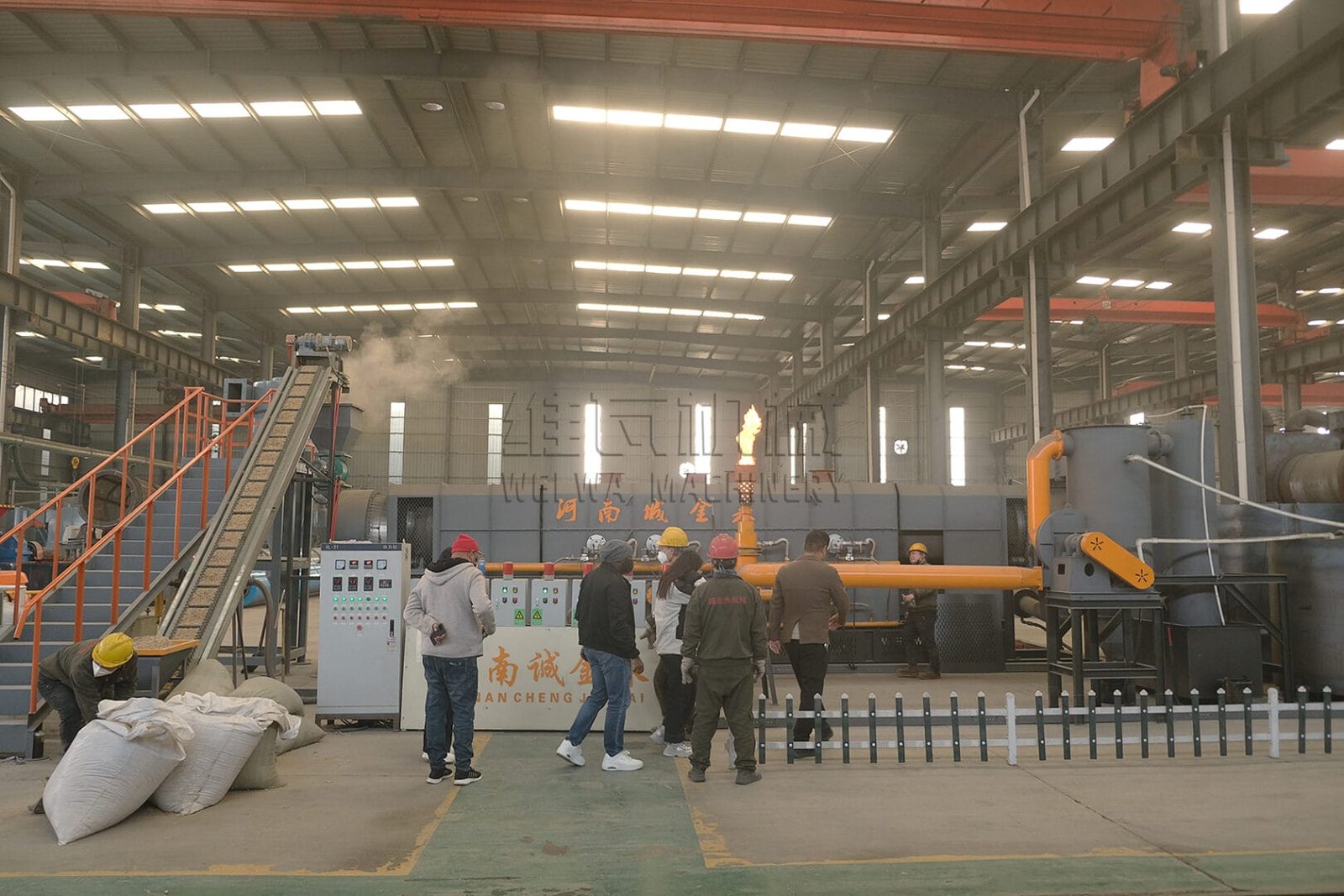
Live Test Run Results at the Weiwa Factory
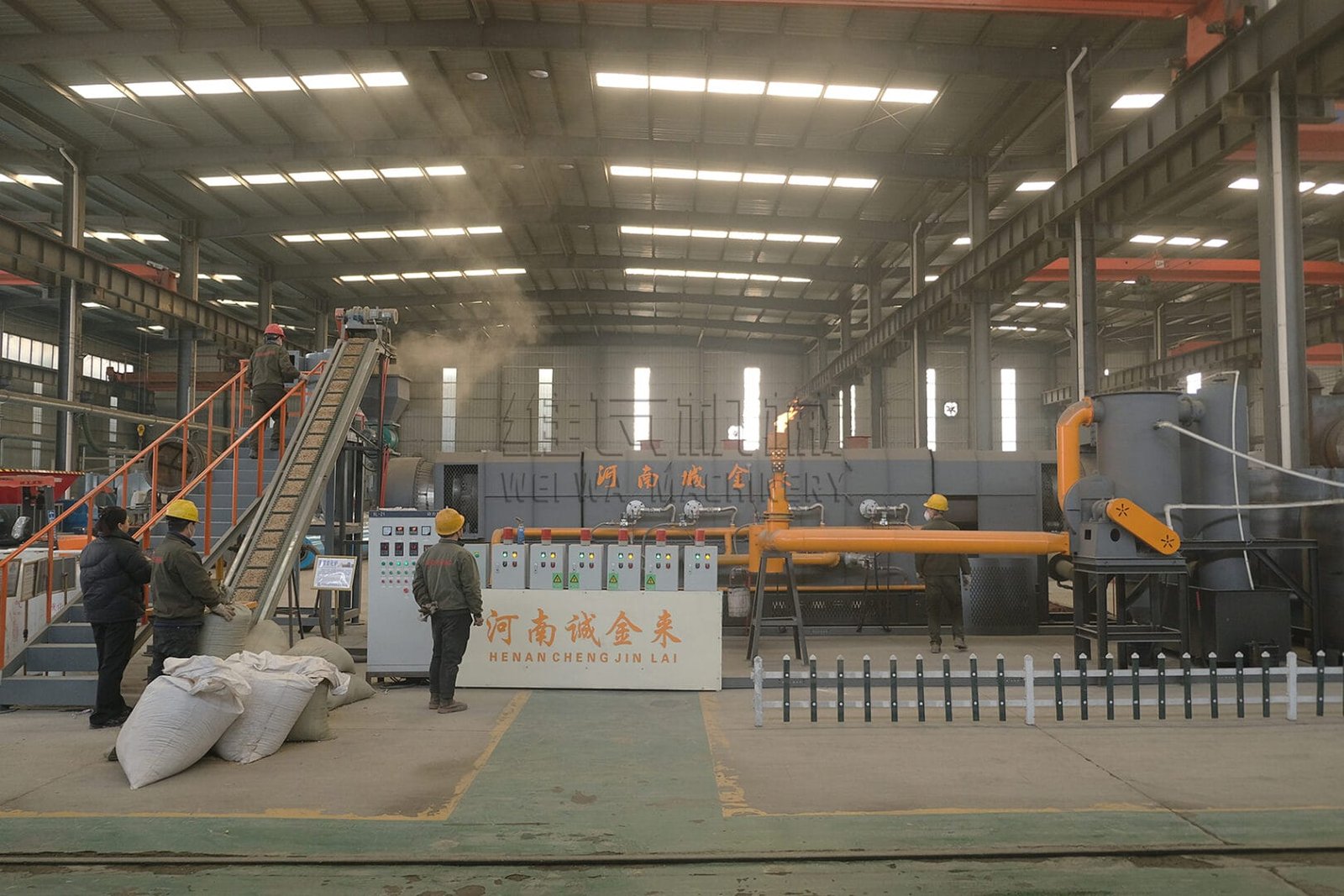
Prior to shipment, every continuous carbonization furnace manufactured at our facility undergoes a comprehensive live test run using actual biomass feedstock. This is not a simulation or a dry run. We load real materials, fire up the system, and document the entire carbonization cycle from cold start to steady-state operation. The purpose is twofold: first, to verify that all mechanical and electrical systems are functioning to specification; second, to provide our client with video evidence and performance data that confirms the machine is production-ready upon arrival.
For this particular continuous carbonization furnace destined for India, the test run was conducted using a blend of coconut shell and hardwood chips, reflecting the most common feedstock scenario our Indian client expects to encounter. The cold start sequence took approximately 40 minutes to reach the initial carbonization temperature of 300 攝氏度. Once the primary zone stabilized, the system transitioned into continuous mode, accepting a steady feed rate of 400 到 500 kilograms per hour depending on moisture content.
The temperature profile across the three carbonization zones was monitored continuously. Zone one, the preheating stage, was maintained at 300 到 350 攝氏度. Zone two, the primary carbonization stage, operated at 450 到 500 攝氏度. Zone three, the deep carbonization and homogenization stage, was held at 550 到 600 攝氏度. These temperatures were selected to maximize fixed carbon content while minimizing ash formation.
The resulting charcoal showed a fixed carbon content of 68 到 72 percent, moisture content below 5 percent, and volatile matter below 15 percent. These specifications meet the requirements for both domestic cooking fuel applications and industrial metallurgical use. The charcoal pieces maintained structural integrity with minimal powder formation, which is a critical quality indicator for export-grade charcoal products.
Fuel consumption during the test run was measured at approximately 15 到 18 percent of the feedstock weight when using biomass waste as the primary fuel source. This is significantly lower than the 30 到 40 percent fuel-to-feed ratio typical of traditional brick kiln operations. The gas recycling system captured combustible volatiles and redirected them into the combustion chamber, offsetting the need for external fuel once the system reached thermal equilibrium.
Emissions testing at the stack showed particulate levels well within acceptable industrial limits when the dedusting tower and afterburner were operating in tandem. The exhaust gas, after passing through the purification sequence, appeared nearly transparent, confirming the effectiveness of the continuous carbonization furnace’s environmental control systems.
The PLC control system performed reliably throughout the test, maintaining setpoint temperatures within plus or minus 5 攝氏度. Alarm functions were tested by intentionally simulating over-temperature and low-gas-pressure conditions, both of which triggered appropriate safety shutdowns and visual alerts on the control panel. These safety validations are a standard part of our pre-shipment quality assurance protocol for every continuous carbonization furnace we manufacture.
The Indian Market for Continuous Carbonization Furnace
India represents one of the most dynamic and fast-growing markets for biomass carbonization equipment in the world today. The country generates an estimated 500 million metric tons of agricultural residue annually, a significant portion of which is either burned in open fields or left to decompose, 造成空氣污染和溫室氣體排放. Government initiatives such as the National Bioenergy Programme and various state-level subsidies for biomass processing equipment are creating strong financial incentives for entrepreneurs to invest in technologies that convert waste biomass into valuable products.
The demand for charcoal in India spans multiple sectors. The domestic cooking fuel segment, while gradually transitioning toward LPG in urban areas, still relies heavily on charcoal and biomass briquettes in rural regions where LPG distribution infrastructure remains limited. The industrial sector uses charcoal as a reducing agent in metallurgy, as an activated carbon precursor for water treatment, and as a soil amendment in the form of biochar. Each of these applications requires a consistent supply of high-quality charcoal, which is precisely what a continuous carbonization furnace is designed to deliver.
同時, Indian buyers are becoming increasingly sophisticated in their equipment evaluation criteria. Price remains a major consideration, but it is no longer the sole deciding factor. Operators are asking deeper questions about fuel efficiency, automation levels, after-sales support, 備件供應情況, and compliance with environmental standards. This shift in buyer behavior aligns perfectly with the value proposition of a Weiwa continuous carbonization furnace, which prioritizes long-term operational efficiency and regulatory compliance over low upfront cost alone.
The competitive landscape in India includes both domestic equipment fabricators and imported machines from China, 歐洲, 和東南亞. Domestic fabricators often offer lower prices but may lack the engineering depth to provide advanced features like gas recycling, automated PLC controls, and comprehensive emission control systems. European equipment offers excellent quality but at price points that place it out of reach for most mid-scale Indian operators. Chinese manufacturers vary widely in quality, which is why reputation, factory verification, and documented test run results have become essential evaluation tools for Indian buyers. Weiwa Machinery has built its reputation by consistently delivering production-proven equipment backed by transparent factory testing and responsive technical support.
Continuous Carbonization Furnace Price Considerations for Indian Buyers
The continuous carbonization furnace price varies based on capacity, configuration, and the inclusion of auxiliary equipment such as screw conveyors, cooling dischargers, and gas purification towers. For Indian buyers, it is important to evaluate the total cost of ownership rather than focusing solely on the ex-factory price. A lower-priced machine that consumes more fuel per ton of charcoal, requires frequent refractory replacement, or fails to meet emission standards will ultimately cost far more over its operational lifetime than a higher-quality system with superior efficiency and durability.
Weiwa provides detailed cost-of-operation analyses to help Indian clients understand the payback period for their continuous carbonization furnace investment. These analyses factor in local biomass costs, expected charcoal selling prices, fuel consumption rates, labor requirements, and maintenance schedules. In most cases, a properly operated continuous carbonization furnace in the Indian market achieves payback within 12 到 18 months of consistent operation, after which the profit margin expands significantly as the capital cost is fully amortized.
Financing options are also an important consideration. Several Indian public sector banks and non-banking financial companies offer equipment financing for biomass processing machinery, particularly when the project aligns with government clean-energy or waste-management initiatives. Weiwa works with clients to provide the technical documentation, equipment specifications, and performance guarantees required by lenders to facilitate loan approvals.
Charcoal Making Machine in India Competitive Landscape
The term charcoal making machine in India encompasses a wide range of equipment types, from small-scale movable kilns to fully automated continuous production lines. The continuous carbonization furnace sits at the higher end of this spectrum in terms of throughput, automation, and environmental performance. For Indian entrepreneurs targeting commercial-scale charcoal production, the continuous carbonization furnace offers the best combination of volume capacity and operational consistency.
Market feedback from existing charcoal making machine operators in India indicates that reliability and ease of maintenance are the two most common pain points. Machines that require frequent downtime for repairs or that use components difficult to source locally create operational bottlenecks that directly impact profitability. Weiwa addresses this by using standardized, globally available components wherever possible and by maintaining a stock of critical spare parts that can be shipped to India within 3 到 5 business days. Our technical team also provides remote troubleshooting support via video call, enabling Indian operators to resolve many issues without waiting for an on-site service visit.
Installation and Commissioning Support in India
Once the continuous carbonization furnace arrives at the client’s site in India, the installation and commissioning process typically spans 7 到 14 days depending on site readiness and the complexity of the auxiliary systems. Weiwa provides comprehensive installation drawings, foundation plans, and utility connection diagrams well in advance of shipment so that civil works can proceed in parallel with equipment transit. This overlap significantly reduces the total project timeline.
Our technical engineers are available for on-site commissioning support, including travel to India when required. The commissioning process includes mechanical assembly verification, electrical system testing, refractory drying, cold commissioning of conveyors and feeders, and finally, hot commissioning with actual biomass feedstock. Operators from the client’s team receive hands-on training covering daily operation procedures, safety protocols, routine maintenance tasks, and basic troubleshooting techniques.
Language support is provided in English, and we work with local interpreters when regional language assistance is needed for on-site training. All operating manuals, spare parts catalogs, and maintenance schedules are supplied in printed and digital formats to ensure the client has permanent reference materials on hand.
Why Choose Weiwa Machinery for Your Continuous Carbonization Furnace?
Weiwa Machinery has been manufacturing biomass processing and carbonization equipment for over a decade. Our factory operates under a strict quality management system with in-process inspections at every major production stage. Each continuous carbonization furnace is assigned a unique serial number, and a complete manufacturing record is maintained, including material certificates for refractory linings, pressure test reports for gas pipelines, and electrical inspection records for control panels.
Our commitment to clients extends far beyond the point of sale. We provide ongoing technical consultation, process optimization advice, and market intelligence to help our clients succeed in their local markets. Many of our Indian clients have gone on to expand their operations with second and third production lines after their initial continuous carbonization furnace proved successful. These repeat orders are the strongest validation of both our equipment quality and our customer service approach.
The continuous carbonization furnace shipped to India this week will soon be in full commercial operation, producing high-quality charcoal for the local market. We look forward to sharing operational data and client feedback once the machine is running at full capacity. For prospective buyers in India evaluating a continuous carbonization furnace, we invite you to contact our team, request a factory video tour, and review the test run documentation for this and previous shipments.
The future of charcoal production in India is moving toward cleaner, 更有效率, and more automated technologies. The continuous carbonization furnace is at the center of this transformation, and Weiwa Machinery is proud to be a trusted partner for Indian businesses making the transition.
關於 WEIWA機械
Weiwa Machinery is a leading manufacturer of biomass carbonization and charcoal production equipment, serving clients across India, 東南亞, 非洲, South America, 和中東. Our product portfolio includes continuous carbonization furnaces, batch carbonization kilns, 木炭壓球機, sawdust dryers, and complete charcoal production line solutions. With a dedicated research and development team, in-house manufacturing facilities, and a global service network, Weiwa delivers reliable, 高效的, and environmentally compliant equipment tailored to the specific needs of each market.
We believe in building long-term partnerships based on transparency, technical excellence, and mutual growth. Every machine we produce is backed by rigorous quality assurance, comprehensive documentation, and responsive after-sales support. Whether you are establishing a new charcoal production facility or upgrading an existing operation, Weiwa Machinery has the expertise and equipment to help you succeed.
For inquiries, technical consultations, or to request a personalized quotation, please reach out to our international sales team. We respond to all inquiries within 24 hours and provide detailed proposals including technical specifications, commercial terms, and delivery timelines.
Contact Weiwa Machinery:
移動的: +8613838093177
WhatsApp: +8613838093177
電子郵件: info@cjlmachinegroup.com


 微信
微信

 +8615937143060
