


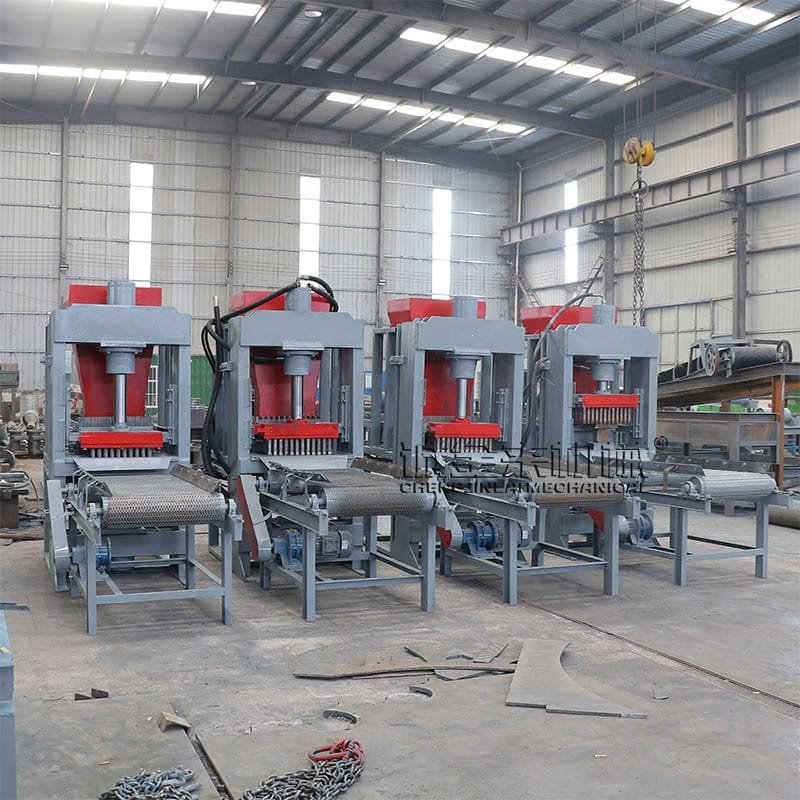
When a hookah charcoal distributor based in Moscow reached out to Weiwa Machinery in early 2026, the inquiry was not about whether to invest in a hookah charcoal making machine — the buyer had already decided to move from reselling imported charcoal to manufacturing his own product domestically, driven by the widening margin between the wholesale price of charcoal imported from Indonesia and the production cost he could achieve using locally warehoused coconut shell charcoal powder. The question was narrower and more technical: hydraulic or mechanical, and what difference would it actually make to the charcoal that Russian shisha lounges would burn and that their customers would judge with every session.
The buyer had done his homework. He had visited a competing manufacturer’s mechanical shisha press operation in the Moscow region, watched the eccentric-crank-driven punches cycle at 15 到 18 strokes per minute, and examined the finished charcoal cubes. They were acceptable — they held together, they burned, they did not crack apart in the hookah bowl. But they were not exceptional. The surface was slightly rough, the edges were not as crisp as the Indonesian imports his customers were accustomed to, and — most concerning to a businessman who understood that his product’s reputation would be built or broken on the subjective experience of shisha smokers — a small but noticeable percentage of cubes in every batch exhibited microscopic internal fractures that, during ignition, caused occasional sparking and uneven heat release patterns that his customers would notice and complain about.
The Weiwa hydraulic shisha BBQ press machine product line that the buyer ultimately selected represented a deliberate choice to compete on quality rather than on equipment purchase price. The hydraulic press, operating at 100 到 200 tons of compression force delivered through a closed-loop hydraulic cylinder driven by a PLC-controlled pump station, applies pressure that is not only higher than a mechanical press can achieve — it applies that pressure in a fundamentally different way. Where a mechanical press delivers a sudden impact as the crank reaches bottom dead center and then releases almost immediately, a hydraulic hookah charcoal briquette press machine applies sustained, controlled pressure over a dwell time that can be adjusted from fractions of a second to several seconds depending on the material characteristics and the desired briquette density. This dwell time — the period during which maximum pressure is held before the mold opens — is the variable that, more than any other single factor, determines whether a shisha charcoal cube emerges from the press as a barely-coherent aggregate of powder particles or as a dense, glassy-surfaced, acoustically solid briquette that delivers the burn quality Russian consumers expect.
The Moscow buyer placed his order for a complete hydraulic shisha BBQ press machine product line in March 2026. The configuration included a model with a rated output of 3,000 到 4,000 cubes per hour using a 72-cavity mold for 25-millimeter cubic charcoal — the standard size for Russian hookah bowls — served by an upstream charcoal crusher, binder mixer, and wheel mill, and feeding into a downstream heat pump dryer. The line was commissioned at Weiwa’s factory in Gongyi before shipment, with the buyer traveling to Henan to witness the trial run personally. What he saw — cubes emerging from the press with a surface finish smooth enough to reflect light, edges sharp enough to stack uniformly in packaging trays, and density high enough that a cube dropped from waist height onto concrete bounced rather than shattered — confirmed the decision.
Russia’s Growing Appetite for Premium Hookah Charcoal
Understanding why a hydraulic shisha BBQ press machine investment makes commercial sense in Russia requires understanding the structure of the Russian hookah market, which has evolved over the past decade from a niche Middle Eastern import into a mainstream hospitality category with its own supply chains, quality expectations, and consumer behaviors.
Russia’s tobacco and hookah market was valued at approximately USD 143 million in 2025 and is projected to grow substantially through the coming decade, driven by the expansion of shisha lounges across Moscow, St. Petersburg, Kazan, Novosibirsk, and virtually every major Russian city. The Russian shisha lounge — often a hybrid space combining elements of a cafe, a social club, and an evening entertainment venue — has become a fixture of urban social life, particularly among the 25-to-40 age demographic that values the communal, slow-burning ritual of hookah smoking as an alternative to the faster, more individual consumption pattern of cigarettes or vaping. A single well-trafficked Moscow shisha lounge can consume 200 到 500 charcoal cubes in an evening, and with an estimated 3,000 到 5,000 dedicated shisha establishments operating across Russia, the daily national consumption of hookah charcoal runs into the millions of cubes.
What distinguishes the Russian hookah charcoal market from those in the Middle East or Southeast Asia is the quality expectation. Russian consumers, conditioned by years of access to premium imported charcoal — primarily from Indonesia, where the coconut shell charcoal industry has spent decades refining its product — have developed a sophisticated palate for charcoal performance. They notice if the charcoal produces a smell during ignition, they notice if the heat output fluctuates during a session, they notice if the cube cracks or sparks, and they notice if the ash produced is excessive or if the charcoal burns through too quickly. In a market where a single shisha session at a Moscow lounge can cost 2,000 到 4,000 rubles, the charcoal is not a commodity input that can be sourced on price alone — it is a quality-determining component that directly affects the customer experience and the lounge’s reputation.
This quality sensitivity creates an opportunity for domestic manufacturers who can produce charcoal that matches or exceeds imported product quality. A hookah charcoal making machine that can deliver the density, surface finish, and burn consistency that Russian lounges demand enables a domestic producer to compete with Indonesian imports on quality while undercutting them on landed cost — a margin formula that has attracted a growing number of Russian entrepreneurs into the charcoal manufacturing business over the past two to three years.
What Makes a 液壓shisha燒烤新聞機 Fundamentally Different?
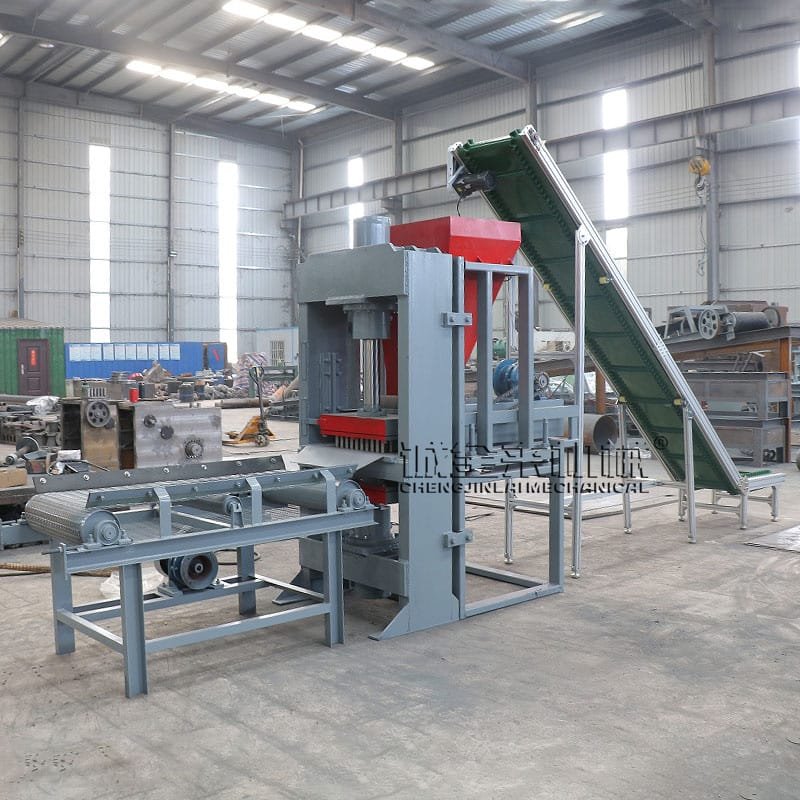
A hydraulic shisha BBQ press machine — also referred to as a hookah charcoal making machine, a hookah charcoal briquette press machine, or a shisha charcoal making production machine — is a forming press that compresses powdered charcoal mixed with a binder into densely compacted briquettes, most commonly in cubic, 圓形的, or finger shapes sized for hookah bowls. The hydraulic designation refers to the pressure generation system: rather than using a motor-driven crank and connecting rod to convert rotary motion into linear pressing force — the principle of a mechanical press — a hydraulic press uses an electrically driven pump to pressurize hydraulic fluid, which is then directed through valves into a cylinder where the fluid pressure acts on a piston to generate the pressing force.
Hydraulic Pressure Versus Mechanical Impact — A Different Physics of Compression
The physical difference between hydraulic and mechanical pressing is not merely quantitative — it is the hydraulic press generates more force — but qualitative, and it is this qualitative difference that directly affects charcoal quality in ways that matter to the end consumer. A mechanical hookah charcoal press delivers force as an impulse. The crank rotates, the connecting rod drives the punch downward, and the full pressing force is applied for a duration measured in milliseconds — the time it takes for the crank to pass through bottom dead center before beginning its upward return stroke. During this millisecond-scale force application, the charcoal powder particles are driven together so rapidly that they have limited time to rearrange into an optimally packed configuration. Air trapped between particles is compressed but not fully expelled, leaving microscopic voids in the briquette that become the initiation points for cracks, fissures, and density variations.
A hydraulic hookah charcoal briquette press machine operates on a fundamentally different time scale. The hydraulic cylinder extends at a controlled rate, applying pressure that builds gradually from zero to the full 100-to-200-ton pressing force over a period of approximately half a second to one second. 更重要的是, once full pressure is reached, the hydraulic system can hold that pressure — dwelling — for a programmable period ranging from one to five seconds depending on the material formulation and the desired briquette characteristics. During this dwell period, the charcoal particles, held under sustained maximum compression, continue to shift and settle into a progressively denser packing arrangement. The binder — typically a starch-based adhesive that was mixed into the charcoal powder prior to pressing — has time to flow between particles, filling interstitial spaces and creating a continuous binding matrix that extends throughout the entire briquette volume rather than forming isolated bonds at particle contact points as occurs in the instantaneous impact of a mechanical press.
The consequence of this sustained-pressure compression is visible in the finished briquette. Hydraulic-pressed hookah charcoal cubes exhibit a density that is typically 8% 到 15% higher than mechanically pressed cubes from the same feedstock and binder formulation. The surface of a hydraulic-pressed cube is smooth and almost glossy, reflecting light from the flat faces and revealing sharp, crisp edges that do not crumble when handled. The internal structure, revealed by breaking a cube in half, shows a uniform, fine-grained texture with no visible voids or layering — evidence that the charcoal powder has been compressed into a monolithic block rather than a mechanically bonded aggregate. For the Russian shisha lounge operator loading a hookah bowl, these quality attributes translate directly into performance: the cube ignites evenly across its entire surface rather than preferentially along crack lines, the heat release is steady and predictable throughout a 45-to-60-minute session, and the ash produced at the end of the burn is a fine, white powder that can be easily tapped off the bowl rather than a coarse, dark residue that indicates incomplete carbonization or binder burnout.
PLC Precision and the Elimination of Batch-to-Batch Variation
The hydraulic hookah charcoal briquette press machine’s second distinguishing feature, beyond the physics of compression, is its PLC-based control system that governs every variable in the pressing cycle. A Weiwa hydraulic shisha BBQ press machine product line includes a programmable logic controller with a touchscreen interface that allows the operator to set and save pressing parameters for different product recipes. The hydraulic pressure — displayed on a digital gauge in real time — can be adjusted from the control panel in increments as fine as 5 噸, enabling the operator to dial in the exact compression level that produces optimal density for a specific charcoal powder type, particle size distribution, and binder concentration.
The pressing speed — the number of mold cycles per minute — is independently adjustable, allowing the operator to balance throughput against density. For a premium Russian market product where maximum density and burn consistency are the primary quality drivers, the press can be operated at a slower cycle rate with a longer dwell time, producing fewer cubes per hour but cubes of exceptional density and surface finish. For a higher-volume product segment where price competitiveness is the primary market driver, the press can be operated at its maximum cycle rate with a shorter dwell time, producing more cubes per hour at a density that — while still higher than a mechanical press would achieve — is optimized for throughput rather than maximum compression.
The PLC also controls the mold temperature, maintained through embedded heating elements, which is a variable that matters because the starch-based binder used in hookah charcoal production achieves its maximum bonding strength only when the pressing occurs at an elevated temperature — typically between 60 和 90 degrees Celsius depending on the specific binder formulation. A mold that is too cold produces cubes with weak binder activation that crumble during drying; a mold that is too hot causes the binder to gelatinize prematurely on the mold surface, leading to sticking and surface defects. The PLC maintains mold temperature within a tolerance of plus or minus 3 攝氏度, eliminating the temperature drift that occurs in manually controlled presses and ensuring that every cube in a production batch — from the first after startup to the last before shutdown — is pressed under identical thermal conditions.
This batch-to-batch consistency is not a cosmetic feature. For a Russian charcoal brand building a reputation in a market where consumers notice quality variation — where a lounge owner who receives a batch of charcoal that burns differently from the previous batch will switch suppliers without hesitation — the PLC’s ability to reproduce the exact same pressing conditions across every production shift, every day, every week of operation, is a competitive moat. The machine does not rely on operator skill or experience to maintain quality — it relies on stored digital parameters that produce identical results regardless of who is operating the press on any given shift.
How 200 Tons of Hydraulic Pressure Produces Finer, Denser Hookah Charcoal?
The link between hydraulic pressing force and finished charcoal quality operates through several interconnected mechanisms that are worth understanding in detail, because they explain why a hookah charcoal making machine that costs more than a mechanical press delivers a return on that additional investment through product quality that commands a price premium in discerning markets like Russia.
Particle Rearrangement and Void Elimination Under Sustained Load
木炭粉, viewed at the microscopic scale, is not a continuous material but a collection of irregularly shaped particles ranging from sub-millimeter fragments to fines measuring tens of microns. When this powder is poured into a mold cavity, the particles settle into a random packing arrangement in which approximately 35% 到 45% of the mold volume is occupied by air — the void fraction, or porosity, of a loosely packed powder bed. The function of the press is to eliminate as much of this void space as possible by forcing the particles into closer proximity, ideally to the point where the air is fully expelled and the particles are in direct contact across their entire surface area, bonded together by the starch adhesive that fills any remaining interstitial gaps.
Under a mechanical press’s millisecond-scale impact, the particles are driven together rapidly, but the rearrangement is incomplete. Particles near the center of the mold cavity, furthest from the pressing face, experience less displacement than particles near the face because the force wave attenuates as it travels through the powder bed. The result is a density gradient through the thickness of the briquette: the face that was in contact with the pressing punch is significantly denser than the opposite face, and this density gradient creates internal stress that manifests as cracking during drying or as uneven burn rates during use.
A hydraulic hookah charcoal briquette press machine, by applying pressure that builds gradually and then holds at maximum force, allows the force to propagate uniformly through the entire powder column. Particles throughout the mold cavity have time to slide past each other, rotate into more tightly packed orientations, and settle into a configuration that approaches the theoretical maximum packing density for the given particle size distribution. The sustained dwell period allows the binder solution — which was distributed throughout the powder during mixing — to flow under pressure into the micro-scale gaps between particles, filling spaces that would remain as air voids under a shorter-duration press cycle. When the mold opens and the finished cube is ejected, the charcoal particles are locked into a configuration that is both denser and more structurally homogeneous than any impact-based press can produce, and this homogeneity is the physical basis for the burn consistency that Russian shisha lounges value.
Surface Finish as an Indicator of Internal Quality
The surface of a hydraulic-pressed hookah charcoal cube is not merely aesthetically pleasing — although the glossy, almost polished appearance of a hydraulically pressed cube does convey a premium product quality that supports a higher retail price point. The surface finish is a direct indicator of the internal compression quality. A smooth, glossy surface indicates that the charcoal particles at the mold wall were compressed with sufficient force to align their flat faces against the mold surface, creating a continuous, non-porous skin that resists abrasion during handling and packaging. A rough, matte surface — characteristic of mechanically pressed charcoal — indicates incomplete particle alignment at the mold wall, which correlates with lower internal density and a higher likelihood of surface crumbling during transport.
For the Russian buyer, surface finish matters for a specific commercial reason: the Moscow shisha lounge market is supplied through a distribution network in which charcoal cubes travel from the manufacturer’s facility to regional warehouses, then to city-level distributors, and finally to individual lounges — a supply chain that involves multiple handling events, each of which subjects the cubes to vibration, impact, and abrasion. Cubes with a smooth, dense surface survive this journey with minimal dust generation and minimal chipping of edges and corners, arriving at the lounge in the same condition they left the factory. Cubes with a rough, less dense surface generate dust at every handling point, and by the time they reach the end user, a noticeable fraction of the product has been reduced to fragments and powder that the lounge operator cannot use and the distributor must discount. The hydraulic press’s surface finish advantage is therefore not a cosmetic benefit — it is a logistics cost reduction that improves margin at every step of the distribution chain.
The Complete Shisha Charcoal Making Production Machine Line
A hydraulic shisha BBQ press machine, despite being the most technically sophisticated component, is only one station in a complete shisha charcoal making production machine line. The upstream and downstream equipment that feeds the press and handles its output is equally essential to producing charcoal that meets Russian market quality standards, and the line must be configured as an integrated system in which each component’s throughput, particle size specification, and moisture handling capacity are matched to the hydraulic press’s requirements.
The production sequence begins with raw material preparation at the carbonization furnace. Charcoal powder for hookah briquettes must be produced from a feedstock that carbonizes to high fixed carbon content with minimal ash — coconut shell is the gold standard, producing charcoal with fixed carbon above 80% and ash below 3%, which is why Indonesian coconut shell charcoal has dominated the global hookah charcoal trade. The carbonization furnace — a continuous or horizontal batch-type unit depending on the production volume target — heats the coconut shells in an oxygen-limited environment to temperatures between 450 和 550 攝氏度, driving off volatile compounds and leaving behind a high-carbon char. This char is then cooled and stored in covered bays, with moisture content monitored to ensure it stays below the threshold at which the subsequent crushing step becomes energy-intensive and prone to screen clogging.
The second station is size reduction. The carbonized coconut shell char — which retains the original shell’s shape and structure — is fed into a hammer mill or charcoal crusher that reduces it to a powder passing through a screen with apertures between 0.5 和 2 millimeters, depending on the surface finish specification the buyer is targeting. Finer powder — below 1 millimeter — produces smoother, denser cubes in the hydraulic press but requires more crushing energy and generates more airborne dust during handling. Coarser powder — up to 2 millimeters — processes faster and generates less dust but produces cubes with a slightly rougher surface texture. The Russian buyer’s line was configured for a 1-millimeter screen, a middle-ground specification that balances surface finish quality against throughput and operating cost.
The third station is binder mixing. Charcoal powder alone will not form a durable briquette under pressure — it lacks the natural plasticity that raw biomass lignin provides during extrusion-based briquetting. A starch-based binder, pre-gelatinized in hot water and mixed into the charcoal powder at approximately 3% 到 5% by weight using a paddle mixer, coats each charcoal particle with a thin adhesive film. Under the sustained high pressure of the hydraulic hookah charcoal making machine, these coated particles lock together into a rigid matrix. The water in the binder solution — typically 25% 到 30% of the total mix weight — also serves as a compaction aid, reducing inter-particle friction and allowing the charcoal particles to slide into more tightly packed configurations during the pressing cycle.
The fourth station — positioned between the mixer and the hydraulic press — is the wheel mill, a piece of equipment that is sometimes omitted from lower-cost production lines but that significantly improves briquette quality. The wheel mill consists of two heavy stone or steel wheels that rotate in a circular pan, 壓碎, kneading, and homogenizing the charcoal-binder mixture. This kneading action serves three functions: it further reduces any oversize charcoal particles that survived the hammer mill, it distributes the binder solution uniformly throughout the entire batch, and — most importantly — it mechanically works the mixture to the point where the starch binder begins to develop its adhesive properties before the material even reaches the press. Material that has been through a wheel mill presses more readily, achieves higher density at a given pressure, and produces cubes with fewer internal defects than material that goes directly from a paddle mixer to the press.
The fifth station is the hydraulic shisha BBQ press machine itself, operating at its configured pressure, dwell time, and cycle rate to produce cubes that emerge onto a discharge conveyor. The conveyor carries the freshly pressed cubes — still warm from the heated mold and containing the moisture from the binder solution — to the dryer.
The sixth and final station is drying. Freshly pressed hookah charcoal cubes contain 20% 到 25% 水分, and if they are packaged or stacked in this condition, the residual moisture will cause mold growth, binder degradation, and cube deformation. The heat pump dryer — selected for the Russian buyer’s line because its closed-loop design recovers latent heat from the exhaust air and achieves thermal efficiencies two to three times higher than a conventional electric resistance dryer — circulates heated, dehumidified air through trays of cubes at a controlled temperature of 50 到 60 攝氏度. The drying cycle runs for approximately 8 到 12 hours depending on the cube size and initial moisture content, reducing the final moisture to below 5%. At this moisture level, the cubes are dimensionally stable, microbiologically safe, and ready for packaging into branded retail boxes or bulk bags for distribution.
Why the Russian Hookah Market Demands Hydraulic-Grade Charcoal Density?
The Russian hookah charcoal consumer’s expectations are shaped by the product they have been buying for years — primarily Indonesian coconut shell charcoal, which is produced almost exclusively on hydraulic presses and has set the quality benchmark against which all other hookah charcoal is judged. For a Russian domestic manufacturer entering this market, the competitive question is not “can we make charcoal that is good enough” but “can we make charcoal that is indistinguishable from or better than what the lounges are already buying from Indonesia.” On a mechanical press, the answer to that question is usually no — the density deficit, surface finish gap, and burn consistency variation are noticeable to an experienced hookah user. On a hydraulic hookah charcoal briquette press machine, the answer can be yes — and the commercial implications of that “yes” are substantial.
A domestic Russian manufacturer using a hydraulic shisha charcoal making production machine can price his charcoal below the landed cost of Indonesian imports while delivering equivalent or superior quality. The landed cost advantage comes from several factors: the elimination of ocean freight from Southeast Asia to Russia, the elimination of import duties and customs brokerage fees, and the ability to purchase coconut shell charcoal powder in bulk — rather than finished cubes — from Indonesian carbonizers, shipping a denser, lower-volume raw material rather than a bulky finished product. The quality advantage comes from the hydraulic press’s ability to match or exceed the density, surface finish, and burn consistency of the imported product, precisely because the same hydraulic pressing technology that Indonesian manufacturers use is now operating in a Russian factory, compressing the same coconut shell feedstock to the same specifications.
There is also a branding opportunity that a mechanical press operation cannot access. A Russian-manufactured hookah charcoal brand that can legitimately claim “hydraulic-pressed for maximum density” — and back that claim with cubes that feel heavier in the hand, burn longer in the bowl, and produce the fine white ash that signals complete combustion of a high-purity charcoal — can position itself as a premium domestic alternative to imported charcoal. In a market where “imported” has historically been synonymous with “better quality,” a domestic brand that matches or exceeds the quality of imports while offering faster delivery, smaller minimum order quantities, and local-language customer service has a value proposition that resonates with Russian lounge operators who have experienced the frustrations of international supply chains — shipping delays, customs holds, and the difficulty of resolving quality complaints with a supplier located in a different hemisphere.
Why Russian Buyers Choose Weiwa Machinery’s Hookah Charcoal Briquette Press Machine?
Weiwa Machinery has supplied hookah charcoal making machines to customers across Eastern Europe, 中東, Central Asia, and beyond for over a decade, and the factors that consistently drive purchase decisions — particularly among buyers who have researched the market thoroughly and compared multiple suppliers — are weighted toward long-term production reliability rather than upfront purchase price.
The first factor is the hydraulic system’s engineering quality. A hydraulic shisha BBQ press machine operates its hydraulic cylinder, pump, and valve block for millions of cycles over its service life, and the engineering decisions made at the component level — pump displacement, cylinder seal material, valve response time, oil cooling capacity — determine whether the press maintains consistent pressure and cycle time across those millions of cycles or degrades progressively as seals wear and pump efficiency declines. Weiwa’s hydraulic power units use gear pumps from established manufacturers, cylinders with dual-stage rod seals and wiper rings rated for the abrasive environment of charcoal dust, and an oil cooling system — typically an air-to-oil radiator with thermostatically controlled fan — that maintains hydraulic fluid temperature within the 40-to-55-degree Celsius range even during extended production runs, preventing the viscosity breakdown that causes pressure loss and cycle time drift in under-cooled systems.
The second factor is mold quality and interchangeability. The mold — the tooling into which charcoal powder is loaded and compressed — is the component that most directly determines finished cube dimensions, surface finish, and release behavior. Weiwa molds are machined from alloy tool steel, heat-treated to a surface hardness of HRC 58 到 62, and polished to a finish that allows the pressed cube to release cleanly without sticking. The mold cavities are manufactured to a dimensional tolerance of plus or minus 0.05 millimeters, ensuring that every cube in a 72-cavity mold is identical in size and weight — a consistency that matters for automated packaging lines that reject undersized or oversized cubes. Mold changeover — from 25-millimeter cubes for the Russian market to 22-millimeter rounds for a different customer specification or to 33-millimeter finger shapes for another — can be completed by two operators in under three hours, a flexibility that allows a manufacturer to serve multiple market segments from a single hydraulic press.
The third factor is the pre-shipment factory trial. Every Weiwa hookah charcoal briquette press machine undergoes a full production trial at the Gongyi factory before disassembly and packing, using either charcoal powder provided by the buyer or a closely matched substitute. The trial runs the press at full production speed for a continuous period — typically two to three hours — with the buyer either present in person or observing via live video feed. Hydraulic pressure, cycle time, mold temperature, and finished cube density are recorded at 15-minute intervals and compiled into a trial report that serves as the baseline performance specification for the machine. If any parameter drifts outside the agreed tolerance during the trial, the press is adjusted and the trial is repeated. The machine ships only after it has demonstrated, in a documented production run, that it can produce cubes meeting the buyer’s specifications.
The fourth factor — and one that Russian buyers specifically cite as a differentiator — is the cold-climate engineering package. A hydraulic shisha BBQ press machine product line destined for a Russian production facility, where winter temperatures in an unheated or minimally heated factory building can fall below freezing, requires modifications that a machine destined for a tropical climate does not. The hydraulic oil is specified with a low-temperature viscosity grade that remains pumpable at startup temperatures as low as minus 10 degrees Celsius — a critical consideration because hydraulic oil that has thickened in a cold-soaked pump can cause cavitation damage if the pump is started without a warm-up cycle. The PLC control cabinet is equipped with an internal heater and thermostat that maintains the internal temperature above 5 degrees Celsius even when the factory ambient temperature drops below freezing, protecting the electronic components from condensation and the LCD touchscreen from the slow response and reduced contrast that occurs at low temperatures. These modifications, individually minor, collectively ensure that a press started on a minus-20-degree January morning in a factory outside Moscow will be running at full production speed within 30 minutes rather than requiring hours of warm-up or, worse, sustaining damage from a cold start.
Starting Your Hookah Charcoal Production Business with Weiwa Machinery
For a Russian entrepreneur evaluating an investment in a shisha charcoal making production machine, the path from initial inquiry to operational production follows a structured sequence that Weiwa Machinery’s application engineering team has refined through experience with buyers across multiple markets.
The process begins with a production requirements definition that establishes the basic parameters of the proposed operation. The buyer specifies the target product: cube size, 形狀, and weight; the desired hourly or daily output; the type of charcoal powder to be used and whether the buyer will purchase pre-carbonized powder or invest in upstream carbonization equipment; and the target market segment — premium lounges, mid-market retailers, or bulk wholesale — which determines the quality specification the production line must achieve. For the Moscow buyer, the specification was clear: 25-millimeter cubic charcoal, 3,000 到 4,000 pieces per hour, coconut shell charcoal powder purchased from Indonesian suppliers, and a quality target matching or exceeding the imported product that his customers were currently using.
With the requirements defined, Weiwa’s engineering team configures the hookah charcoal briquette press machine and the supporting equipment. The hydraulic press is specified with the appropriate mold cavity count and layout, pressing force, and cycle rate. The upstream equipment — crusher, 混合器, and wheel mill — is sized to supply the press at its rated throughput with a buffer capacity of approximately 20% to allow for upstream equipment downtime without starving the press. The downstream dryer is sized for the moisture load and throughput, and the packaging equipment — which can range from manual bagging stations for startup operations to automated counting, tray-filling, and shrink-wrapping lines for high-volume production — is specified according to the buyer’s market entry strategy.
Commissioning follows the same protocol that Weiwa applies to every export order. The machine is trialed at the factory, shipped to Russia — typically via sea freight to St. Petersburg or Vladivostok depending on the buyer’s location, or by rail for buyers in the Moscow region — and installed under the supervision of a Weiwa engineer who travels to the buyer’s site. The engineer oversees positioning, leveling, and utility connections; conducts production trials using the buyer’s actual charcoal powder and binder; calibrates all process parameters and saves them to the PLC recipe memory; and trains the buyer’s production team on all aspects of operation, 維護, and quality control. Training documentation is provided in both English and Russian, and the buyer’s team is trained to perform routine maintenance — hydraulic oil changes, filter replacements, mold cleaning, and seal inspections — according to a schedule that maximizes machine uptime and extends component service life.
After the engineer departs, Weiwa’s technical support team remains available by phone, WhatsApp video call, and email for ongoing production support. Spare parts — molds, seals, hydraulic pump components, PLC modules — are stocked at the Gongyi factory and can be shipped to Russia by air freight within 72 hours of an order. For Russian buyers who anticipate high production volumes, Weiwa recommends maintaining a small on-site spare parts inventory covering the components most likely to require replacement during the first two years of operation — a practice that reduces the production impact of component wear and eliminates the lead-time delay associated with international parts shipment.
關於 WEIWA機械
Henan Weiwa機械製造公司, 有限公司. has dedicated more than three decades to the design, manufacture, and global deployment of charcoal briquetting and biomass carbonization equipment. Operating from a 112,000-square-meter production facility in Gongyi City, 河南省, equipped with over 200 machine tools and staffed by a research and development team of more than 100 engineers, Weiwa Machinery supplies hydraulic shisha BBQ press machines, mechanical shisha presses, sawdust extrude machines, charcoal extruders, ball charcoal briquette presses, carbonization furnaces, crushers, dryers, mixers, and complete turnkey charcoal production lines to customers in more than 130 countries worldwide.
The company’s engagement with the Russian market reflects a consistent operating philosophy: a hookah charcoal making machine investment is a production partnership, not a commodity transaction. Every hydraulic shisha BBQ press machine product line sale includes the engineering support necessary to ensure that the equipment is correctly configured for the buyer’s feedstock, production volume, and market requirements. Pre-shipment factory trials verify that the machine meets its performance specifications before it leaves Gongyi. On-site commissioning and operator training ensure that the buyer’s team can operate the press independently and maintain quality standards from the first day of commercial production. Ongoing remote technical support, spare parts supply, and process optimization guidance sustain the production partnership over the equipment’s operational life.
Weiwa Machinery’s after-sales service team — a dedicated group of engineers and technicians with extensive field experience — provides responsive support to customers in Russia and across Eastern Europe. The company offers customized production line design services, including 3D site planning drawings that optimize equipment layout, material flow, and worker ergonomics within the buyer’s available factory space. Whether a customer is launching a single-press startup or a multi-press production facility, Weiwa’s engineering team works collaboratively to configure a solution that matches the business plan.
For inquiries about the hydraulic shisha BBQ press machine product line, hookah charcoal making machines, carbonization furnaces, or complete shisha charcoal making production machine configurations — including custom mold designs for specific cube shapes and sizes required by the Russian market — Weiwa Machinery’s technical sales team is available to discuss project requirements, analyze feedstock, and prepare a tailored production line quotation.
暴民 / WhatsApp: +8613838093177 電子郵件: info@cjlmachinegroup.com


 微信
微信

 +8615937143060
