


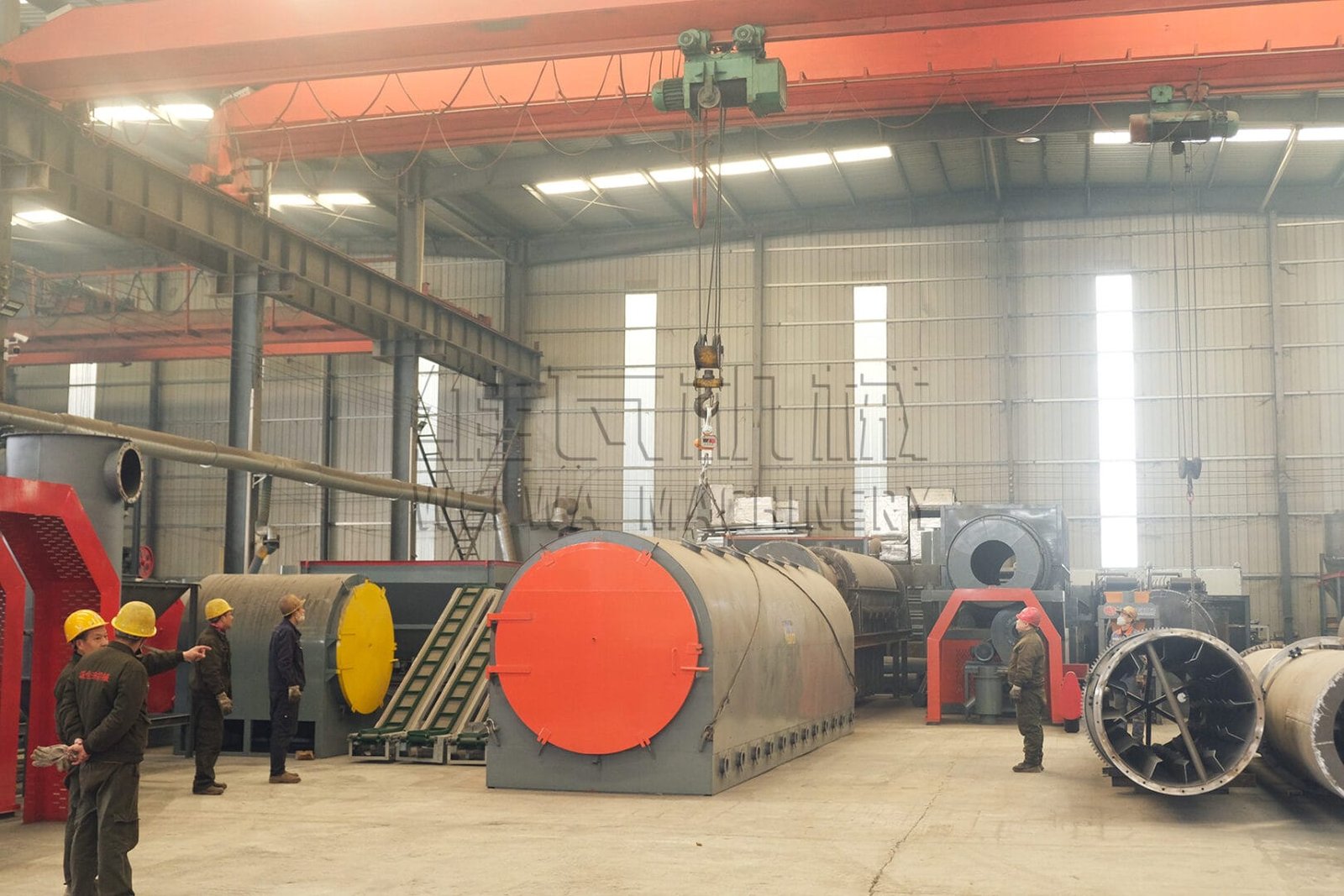
Morning at the Workshop – Loading a 水平碳化爐
Final loading began at 6:40 a.m. The barrel-style chamber, mounted on its rail frame, was wrapped in woven film, then lifted by a 5-ton chain hoist onto a flatbed already weighted with the purification tower, the combustion fan skid, and two spare rail carts. Our lead engineer checked four things before the truck driver signed the packing list: door seal compression, thermocouple response at 200 和 500 攝氏度, English labeling on the control panel, and the slope of the rail track inside the chamber so carts would not drift during a 3,200-kilometer haul to Qingdao port.
A horizontal carbonization furnace is heavier than it looks. The chamber shell is mild steel, but the inner liner is firebrick and ceramic fiber, and the gas recovery piping adds dead weight most buyers forget when budgeting for inland freight. For the Philippines order we chose the BLW-450 class, a 2,000-kilogram batch unit, because the client runs a mixed feedstock yard: coconut shell from neighboring copra mills, sawdust briquette offcuts from a furniture cluster in Laguna, and occasional hardwood offcut from pallet shops. They did not need continuous throughput yet, but they did need stable batch quality and low smoke, because their municipal permit references the Philippine Clean Air Act and a 2023 barangay complaint about pit-kiln haze.
We photographed the chamber from the rail side, the burner side, and the purification tower base. Those images now sit in the client folder alongside the factory test video. When the truck cleared the gate, the sales manager sent one line on WhatsApp: “Horizontal carbonization furnace for the Philippines is on the road.” It sounds casual. It is not. Every export unit carries six months of design feedback from three climates.
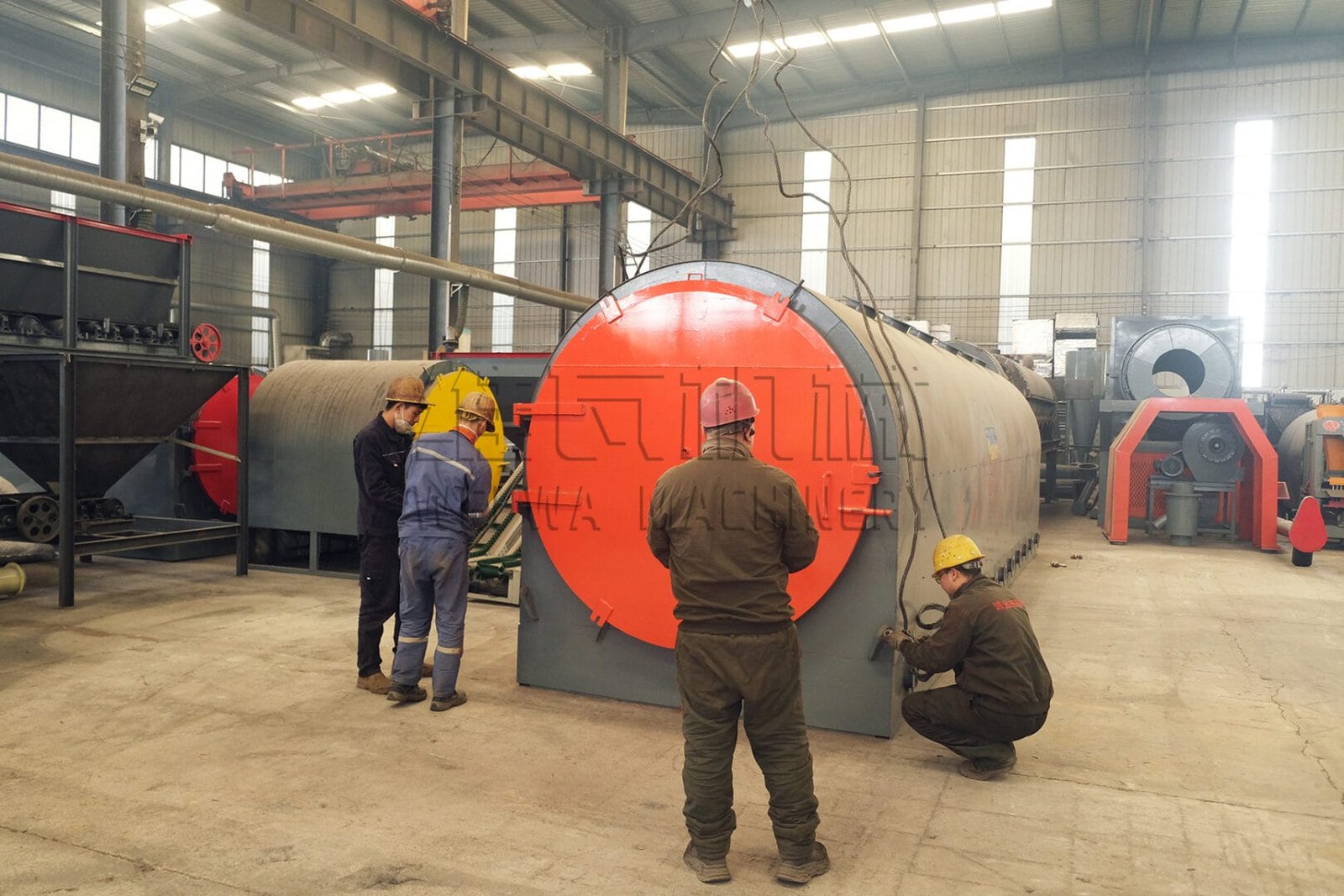
Why the Philippines Needs a Different Charcoal Making Machine?
Southeast Asian biomass is not European beech or North American pine. It is high in volatile content, often above 70 percent by dry mass, and it arrives wet. A charcoal making machine that performs well on kiln-dried hardwood in Poland can stall in Batangas if the designer ignored moisture swings between March and August. The Philippine buyer lives inside three constraints at once.
Coconut Shell, Sawdust Briquette and Humidity Factors
Coconut shell is dense, with calorific value near 20 megajoules per kilogram and moisture that can swing from 12 percent in a solar-dried pile to 34 percent straight from a monsoon-covered sack. Sawdust briquette is more uniform but still breathes humidity from the air. In a vertical kiln, tall stacks of shell develop cold spots near the base and over-fired crowns near the flame mouth. In a horizontal carbonization furnace, the cart spreads material in a single layer depth of 250 到 400 millimeters, so the indirect heat from the combustion jacket meets the load from below and the radiant wall meets it from the side. The gradient is gentler. The carbonization front moves left to right instead of bottom to top.
Humidity also attacks steel. Coastal Philippine sites in Cebu or Iloilo push salt aerosol into every bolt hole. We specify thicker shell gauge, zinc-rich primer under the topcoat, and stainless cladding on the purification tower base for any horizontal carbonization furnace in the Philippines order. It costs more upfront and saves the buyer a repaint cycle every eighteen months.
Traditional Charcoal Kiln vs Horizontal Chamber
The traditional charcoal kiln in rural Philippines is an earth mound or concrete ring with wood stacked inside, covered by banana leaf and soil, and burned with limited air for four to seven days. Yield from coconut shell in a good pit kiln reaches 22 到 26 percent. Labor is cheap but unpredictable. Smoke blankets the yard. Moisture control is impossible. A horizontal carbonization furnace trades some of that labor looseness for sealed doors, recoverable gas, and a yield curve the operator can repeat.
The client in Luzon had run two pit kilns and one brick kiln before contacting us. Their rejection rate on export-grade charcoal, measured by fixed carbon below 70 percent and ash above 5 percent, was 31 percent across a quarter. They did not hate the old method. They could not scale it without hiring ten more workers and fighting the barangay council. That is the real reason a charcoal making machine wins in 2026. Not because it is magical, but because it is auditable.
How a Horizontal Carbonization Furnace Works in Tropical Biomass?
The physics does not change across borders, but the operating envelope does. Our chamber heats by indirect combustion. A burner outside the retort raises the shell to target temperature. Inside, biomass undergoes dry distillation: free water leaves below 150 degrees, bound water and light volatiles leave up to 280, and the structural carbonization of lignin and cellulose accelerates between 420 和 600 攝氏度. We hold the batch near 580 到 600 degrees for the Philippine spec because coconut shell develops gloss and ring density in that window without sliding into over-firing.
Indirect Heating and Gas Recycling Near 600 ℃
Volatiles released from the shell do not vent to the sky. They travel through a condensate trap where wood vinegar and tar drop out, then through a scrubber where fine particulate settles. The remaining combustible fraction, mostly carbon monoxide, methane and hydrogen, returns to the burner as secondary fuel. In our trial the furnace reached self-sustaining mode at 54 minutes after ignition and needed only 19 percent of the original LPG reference flow to hold 590 degrees for the rest of the cycle. A horizontal carbonization furnace that cannot show this number is just a sealed barrel with a pipe.
Tar Condensate Recovery and Smoke Reduction
Tar is not waste if you catch it. The Philippine client sells wood vinegar to a nearby organic farm at a small but steady margin, so we angled the condensate drum higher and added a sight glass. Smoke at the stack during steady state measured below the dark opacity card rating of 1 on a Ringelmann chart, which matters for any horizontal carbonization furnace in the Philippines permit renewal. The buyer sees less haze. The neighbor sees less complaint. The accountant sees a second product line.
Factory Trial Run Before Shipping – What Weiwa Measured
We never ship a horizontal carbonization furnace for the Philippines without a witnessed trial on local feedstock proxy. Since we cannot fly Luzon coconut shell to Zhengzhou economically every time, we use Hainan coconut shell with 13 percent moisture and Guangxi sawdust briquette with 9 percent moisture, then adjust the cycle sheet for the higher tropical moisture the client will actually face.
Coconut Shell Batch Trial Data
Batch weight 2,010 kilograms at 13 percent moisture. Preheat to 160 degrees took 38 分鐘. Rise to 500 degrees took another 71 分鐘. Hold at 585 到 600 degrees lasted 150 分鐘. Cooling with sealed door natural loss took 260 minutes before cart extraction. Final charcoal weight 528 kilograms. Yield 26.3 percent by wet-in wet-out basis, 等效於 30.1 percent on absolute dry shell. Fixed carbon 74.2 percent. 灰 3.1 percent. Volatiles 22.7 percent. One cart, one operator, 6.8 hours door-to-door. By comparison the client’s old brick kiln gave them 23.4 percent yield and 68.9 percent fixed carbon on a good week.
Sawdust Briquette Batch Trial Data
Batch weight 1,880 kilograms at 9 percent moisture. Because briquette packs denser, preheat took 44 minutes and the 500-degree mark came at minute 121. Hold phase 165 分鐘. Yield 31.8 percent wet basis, fixed carbon 71.6 percent, 灰 4.4 percent. The briquette charcoal broke less during cooling, which the client liked because their export buyer in South Korea pays a penalty for fines above 15 percent. The horizontal carbonization furnace produced 11.2 percent fines versus 19.8 percent in their brick kiln sample we tested side by side.
We sent the trial sheet, the charcoal photos under natural light, and the condensed wood vinegar sample to the client on a Tuesday. On Thursday they transferred the balance payment. That is the entire sales cycle for a serious charcoal making machine buyer who already ran a charcoal kiln and knows what disappointment looks like.
Horizontal Carbonization Furnace in the Philippines – Field Expectations
Once the unit clears Manila customs and reaches the cooperative yard, the first week is about calibration, not production. Philippine coconut shell in July can arrive at 28 percent moisture even after a day under a tin roof. The operator must either pre-dry on a slatted rack for 36 hours or extend the preheat phase by 25 minutes per batch. We built that note into the English manual and into a laminated card hung on the control panel. A horizontal carbonization furnace in the Philippines that ignores wet-season shell will report low yield and blame the machine. The machine is fine. The moisture meter was ignored.
Power stability is the second field risk. Our control panel accepts 380 volt three-phase with plus or minus 10 percent tolerance, but many provincial sites in the Philippines ride on single-phase with a converter. For this client we added a voltage guard and a manual bypass so the damper motor still closes if the controller blinks out. Small change. Big difference during a typhoon brownout.
Expected monthly output on one BLW-450 chamber with two carts and a 7-hour cycle is 18 到 21 batches in a 24-hour day if they run double shift, which most cooperatives do not. Realistic single-shift output is 9 batches, roughly 17 到 18 tons of charcoal per month from coconut shell alone, plus sawdust briquette top-up on Fridays. That number replaces three pit kilns and five workers with two workers and one supervisor. The cooperative’s board did not care about the engineering. They cared that 18 tons a month at 74 percent fixed carbon clears their Seoul buyer’s specification.
Buying a Charcoal Kiln or a Charcoal Making Machine for Export
We get the question in every Philippines inquiry: should we just build three more concrete kilns? The answer depends on who buys your charcoal. If the output goes to a local grill stand, a charcoal kiln is fine and cheaper to start. If the output must meet export paperwork, fixed carbon threshold, moisture certificate, and a buyer who visits the yard once a quarter, then a charcoal making machine with sealed carbonization, gas recovery, and a repeatable cycle sheet is the only honest choice.
A horizontal carbonization furnace is not the cheapest option on the page. It is the option where the second-year cost curve bends down. Fuel drops because gas recirculates. Labor drops because carts replace shoveling. Rejection drops because temperature is logged. Permit renewals get easier because the stack is clear. Two years later the gap between a pit kiln operator and a chamber operator is not the machine. It is the bank statement.
For buyers comparing suppliers, ask for three things before paying a deposit: a witnessed trial on your own feedstock proxy, a yield sheet with fixed carbon and ash numbers, and a reference client in a tropical country who has run the unit for more than twelve months. Any horizontal carbonization furnace for the Philippines offer without those three is a drawing, not a machine.
關於 WEIWA機械
Weiwa Machinery is a Zhengzhou-based manufacturer of biomass carbonization and briquetting equipment with more than thirty years in heavy machinery and export experience across thirty-plus countries. We build horizontal carbonization furnace units from 300 kilogram batch size to 6,000 kilogram capacity, along with vertical carbonization kilns, continuous carbonization plants, charcoal briquette presses, crushers and dryers. Our designs focus on indirect heating, tar recovery, and gas recirculation so small- and medium-scale producers can match large-plant emission discipline without large-plant capital. Every horizontal carbonization furnace in the Philippines we ship leaves with factory trial data, English manuals, spare seal kit, and remote commissioning support. We have supplied more than two million customer installations worldwide when counting full production lines and standalone machines combined.
Contact Weiwa Machinery
暴民: +86 138 3809 3177
WhatsApp: +86 138 3809 3177
電子郵件: info@cjlmachinegroup.com
The truck from our gate reaches Qingdao in nine hours. The vessel reaches Manila in four days. The furnace reaches a coconut yard in Luzon a week later. Between those points is not just steel and freight insurance. It is the trial sheet, the moisture note, the tar drum angle, and the 590-degree hold line someone in our workshop decided not to skip. That is what a horizontal carbonization furnace for the Philippines means to us. Not a product photo. A promise that the charcoal will come out dark, dense, and repeatable.


 微信
微信

 +8615937143060
