


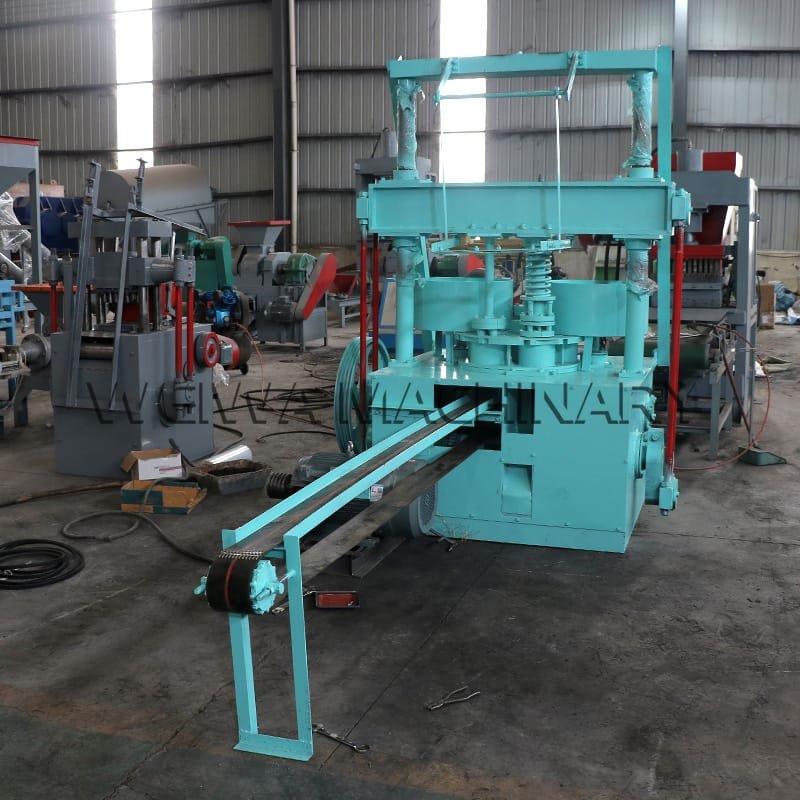
什麼是 蜂巢式煤成型機 and How Does the Honeycomb Punching Machine Work?
A Honeycomb Briquette Charcoal Machine, also widely known as a Honeycomb Punching Machine or Coal Briquettes Making Machine, is an industrial press designed to convert loose powdered raw materials such as coal dust, 木炭粉, 可樂粉, and certain biomass residues into solid, geometrically uniform briquettes featuring a characteristic honeycomb hole pattern. The honeycomb structure is not decorative—it increases the surface area exposed to air during combustion, promotes even airflow through the fuel bed, allows faster and easier ignition, and results in more complete, low-smoke burning compared to irregular lump coal or loosely packed powder.
The core working principle of our Honeycomb Charcoal Coal Briquette Forming Machine involves several sequential stages. 第一的, pre-crushed and sieved raw material (particle size typically below 3 毫米) is blended with a small percentage of natural binder—commonly starch, 黏土, or molasses depending on local availability—and adjusted to an optimal moisture content of approximately 8% 到 14%. The homogeneous mixture is fed into a hopper that delivers it to a rotating mold table equipped with multiple cylindrical mold cavities. A mechanically or hydraulically driven punch head descends into each cavity with precisely calibrated pressure, compressing the material into a dense cake which is then ejected upward by a lower ejector pin. The finished piece bears the signature round or hexagonal outer shape with several through-holes—the “honeycomb”—formed by fixed inner pins within the mold. This punching-type Coal Briquettes Making Machine differs from simple extrusion models in that it generates higher single-point compaction pressure, yielding briquettes with superior mechanical strength, reduced breakage during handling, and a smoother surface finish.
Key Components of the Honeycomb Charcoal Coal Briquette Forming Machine
The Weiwa Honeycomb Punching Machine is engineered with a heavy-duty welded steel frame, a hardened alloy steel punch head and mold set, an automatic lubrication system, an electric motor coupled with reduction gearbox, and a variable-frequency drive allowing speed adjustment to match different material characteristics. Mold inserts are interchangeable so that customers can produce various diameters (commonly 100 毫米, 120 毫米, 140 毫米, 160 毫米, 180 毫米), heights (通常 60 毫米至 100 毫米), numbers of holes (usually 12, 16, 19 或者 21), and even alternative shapes such as square or custom logo-stamped faces upon request. The entire process is continuous and cyclic, with typical production capacities ranging from 800 to over 3,000 pieces per hour depending on machine model and briquette size.
Raw Material Versatility of the Coal Briquettes Making Machine for South African Conditions
One of the main reasons South African entrepreneurs inquire about our Honeycomb Briquette Charcoal Machine is its ability to add value to locally abundant waste materials. The Coal Briquettes Making Machine accepts anthracite coal dust, bituminous coal fines, washed coal tailings, charcoal powder from carbonized wood or coconut shell, coke breeze, and even certain agricultural residues such as ground nut shell or rice husk ash when blended appropriately. In the trial arranged for our South Africa client, we prepared two feedstock recipes: one using 70% local South African bituminous coal dust + 30% hardwood charcoal powder, and another using 85% 煤粉 + 15% charcoal with 8–10% cassava starch binder. Both formulations performed well, demonstrating that the Honeycomb Charcoal Coal Briquette Forming Machine adapts easily to regional raw material variations without requiring major equipment modification.
Proper material preparation remains critical. Oversized particles must be re-crushed, and moisture must be controlled because too-wet mixtures cause poor mold release and bloated briquettes, while overly dry mixes reduce green strength and lead to crumbling before drying. Our technicians always advise clients on binder selection, mixing ratios, and moisture testing protocols during commissioning of every Honeycomb Punching Machine.
Live Trial of Honeycomb Briquette Charcoal Machine for the South Africa Client
The on-site trial began with a safety briefing and machine overview. Our engineers installed the customer-specified mold—a 140 mm diameter hexagonal honeycomb shape with 19 holes of 14 mm diameter and a 90 mm height—onto the Honeycomb Charcoal Coal Briquette Forming Machine. After warming up the system and checking lubrication points, we fed the pre-mixed South African coal–charcoal blend into the hopper. Within minutes, the conveyor began delivering neatly formed honeycomb briquettes at a stable rate of approximately 1,200 pieces per hour.
The client’s technical team observed several performance aspects: fill consistency in each mold pocket, cleanness of ejection, absence of jamming, noise level of the drive unit, and visual uniformity of the output. We paused periodically to collect sample batches for closer inspection. The trial ran continuously for three hours to simulate a realistic production shift. Throughout the run, the Coal Briquettes Making Machine maintained steady pressure, showed no overheating, and required only routine scrap removal from the die table.
Sample Quality Analysis From the Honeycomb Punching Machine Trial
The sampled briquettes were measured for diameter, height, hole alignment, surface smoothness, edge sharpness, and approximate bulk density. Results showed:
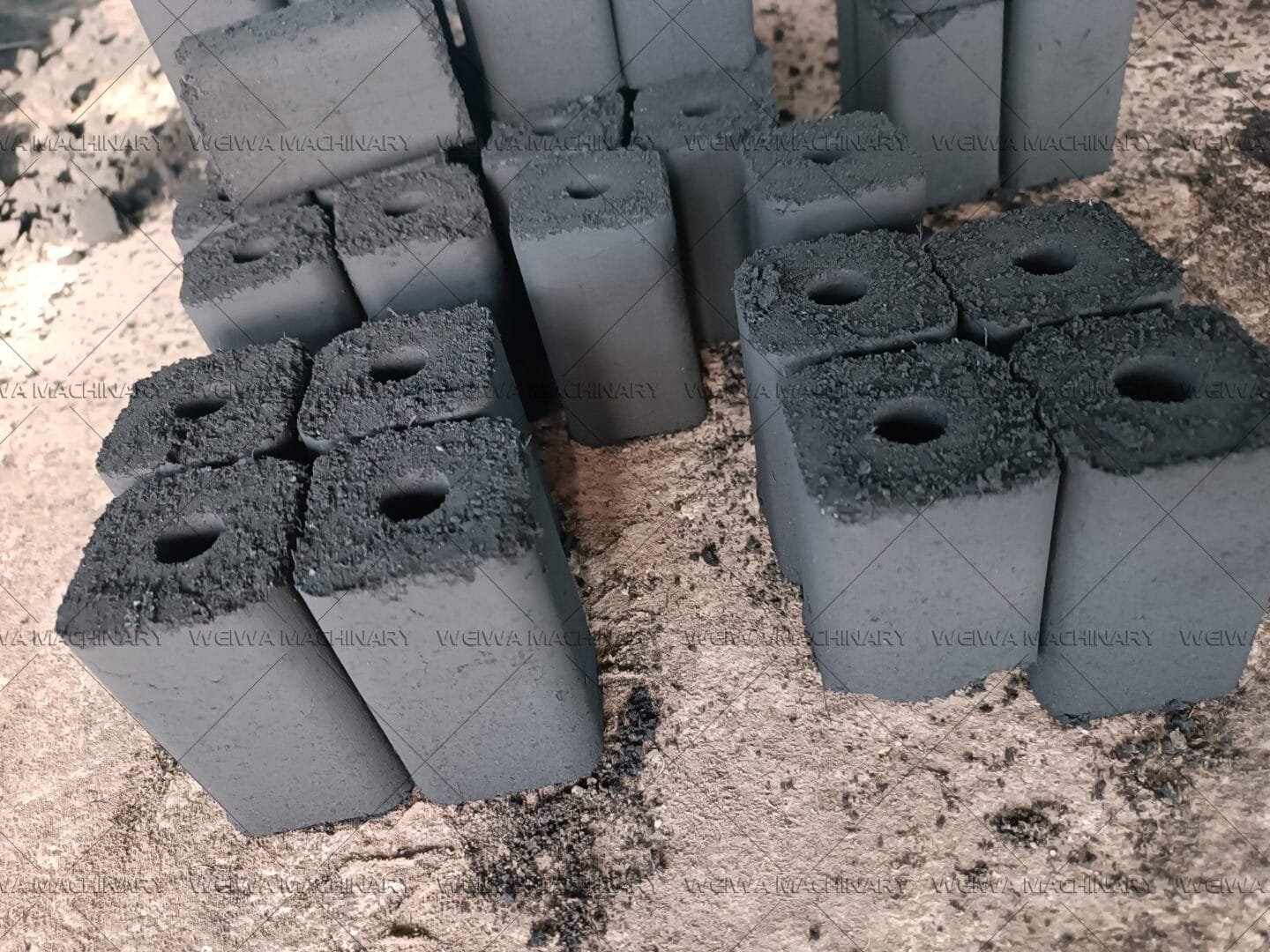
Diameter held within ±1 mm of nominal 140 毫米. Height variance was less than ±2 mm. Hole centers were concentric and fully penetrated. Bulk density exceeded 1.05 克/立方厘米, indicating tight particle packing under the punching pressure of the Honeycomb Briquette Charcoal Machine. A random subset of ten briquettes was subjected to a simplified drop test from 1 meter onto a concrete floor—none fractured, confirming adequate green strength for stacking and transport. When ignited in a test stove, the honeycomb briquettes lit within 3–5 minutes, burned with a steady blue-orange flame, produced minimal visible smoke after initial volatiles burned off, and sustained combustion for more than two hours in a controlled draft condition. Ash residue was fine and gray-white, consistent with good carbonization of the charcoal component.
The South African client expressed satisfaction with both the machine stability and the aesthetic and functional quality of the samples produced by the Honeycomb Charcoal Coal Briquette Forming Machine. Photos and physical samples were packed for the client to take back for further evaluation with their local distributors and end users.
Market Potential of Honeycomb Briquette Charcoal Machine in South Africa
South Africa remains one of the largest consumers of coal in Africa, with widespread use of coal and charcoal for residential heating and cooking, institutional kitchens, small restaurants, and certain industrial thermal processes. 同時, many urban and peri-urban areas face rising electricity tariffs, intermittent power supply challenges, and increasing environmental awareness regarding open biomass burning. These factors combine to create a strong business case for adopting the Coal Briquettes Making Machine to manufacture clean-burning honeycomb briquettes from otherwise wasted coal fines and charcoal dust.
The Honeycomb Punching Machine enables small-to-medium enterprises to collect low-cost coal dust from mines or wholesalers, blend it with charcoal powder or biomass residue, form value-added honeycomb briquettes, and sell them in local markets as a premium, uniform fuel product. Compared with irregular lump coal, honeycomb briquettes offer measurable advantages: approximately 20–30% improvement in combustion efficiency due to better air distribution through the holes, reduced smoke and particulate emissions, standardized sizing for easier packaging and retail display, and longer burn time per kilogram—an important selling point for cost-conscious households.
In provinces such as Gauteng, KwaZulu-Natal, Western Cape, and Mpumalanga, there is also growing interest from agro-processing businesses and community cooperatives in utilizing agricultural waste briquetted on a Honeycomb Briquette Charcoal Machine as part of corporate social responsibility and waste-to-energy initiatives. Government programs encouraging cleaner household fuels and recycling of mining by-products further support the relevance of the Honeycomb Charcoal Coal Briquette Forming Machine in the South African context.
Competitive Differentiation for Honeycomb Coal Briquette Making Machine Suppliers
When selecting a Coal Briquettes Making Machine, buyers in South Africa typically compare build quality, 備件供應情況, ease of mold change, local voltage compatibility (commonly 380 V / 50 Hz three-phase), and supplier responsiveness. Weiwa Machinery differentiates its Honeycomb Punching Machine line through reinforced frame construction, heat-treated punch heads with extended service life, transparent acrylic safety guards, digital hour-meter and cycle counter, and comprehensive English-language operation manuals. We also provide remote video guidance for installation, onsite training options where feasible, and maintain a stock of wearing parts for quick dispatch to African ports including Durban, Cape Town, and Mombasa for transshipment.
Why Choose Weiwa Machinery Honeycomb Briquette Charcoal Machine?
Weiwa Machinery has specialized in briquetting and carbonization equipment since 2000, exporting to more than 130 countries across Asia, 歐洲, the Americas, 中東, and Africa. Our Honeycomb Charcoal Coal Briquette Forming Machine models are CE-certified where applicable, built in our 100,000 m² manufacturing complex in Zhengzhou, 河南省, 中國, and tested prior to shipment. Each Honeycomb Punching Machine undergoes a no-load run-in and a load trial using representative material before container loading. We offer turnkey solutions that may include a complete line—crusher, wheel mill mixer, binder dosing system, the Coal Briquettes Making Machine itself, and a mesh-belt or sun-drying rack drying system—tailored to the client’s daily capacity requirement, raw material type, and budget.
Our South Africa client’s successful trial reinforces why more African entrepreneurs are turning to Weiwa for reliable, cost-effective briquetting technology. Whether you plan to start a new honeycomb briquette production business or upgrade an existing Honeycomb Briquette Charcoal Machine, our sales engineers are ready to discuss your project and arrange a personalized demonstration.
Contact WEIWA機械 for Honeycomb Punching Machine Quotation and Support
If you are interested in the Honeycomb Briquette Charcoal Machine, 蜂巢式木炭型煤成型機, or any related Coal Briquettes Making Machine and Honeycomb Punching Machine models, please feel free to reach out:
WEIWA機械 (Chengjinlai Machinery Group)
移動的 / WhatsApp: +86 138 3809 3177
電子郵件: info@cjlmachinegroup.com
地址: Zhengzhou City, 河南省, 中國
We welcome inquiries from South Africa and worldwide, and look forward to supporting your briquette production business with proven equipment and professional service.


 微信
微信

 +8615937143060
