


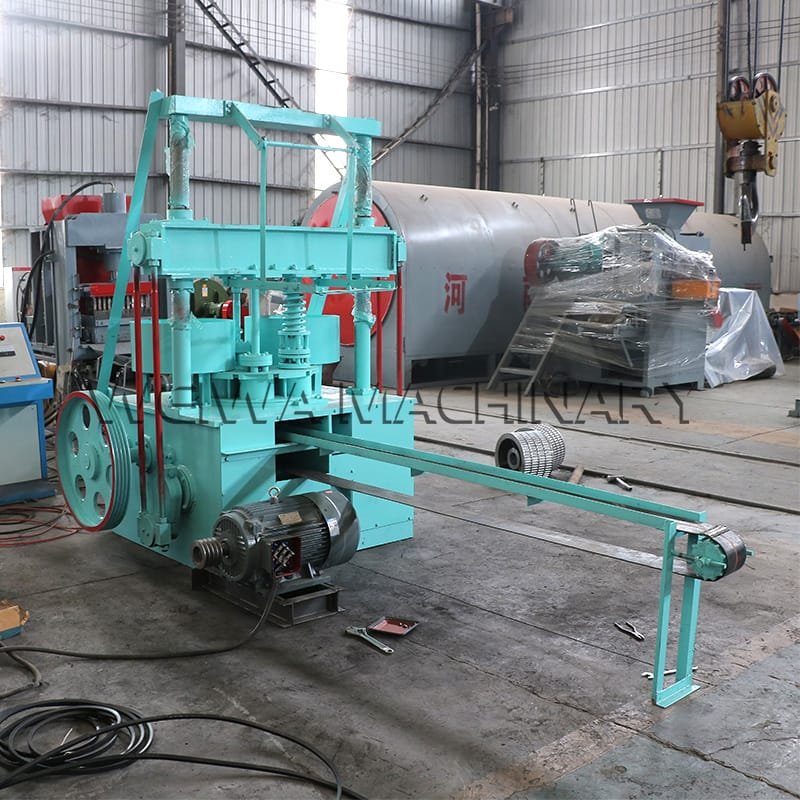
Why Ghana Customers Choose the 蜂巢式煤成型機?
In many regions of Ghana, charcoal dust and coal fines are often treated as waste, yet they hold significant energy potential. A properly configured 蜂窩沖孔機 allows factory owners to compress this powder into uniform, ventilated briquettes that ignite faster and burn longer than loose powder or irregularly shaped blocks. The honeycomb holes are not decorative—they function as air channels that promote complete combustion and reduce smoke emission, which is especially important for both domestic cooking and small commercial kitchens in Ghanaian cities and towns.
Unpacking and Foundation Preparation Before Installation
Upon arrival at the customer’s workshop in Ghana, our technicians supervised the unloading and positioning of the 蜂巢式煤成型機. The machine was placed on a level reinforced concrete foundation to minimize vibration during the punching cycle. Anchor bolts were tightened according to our engineering drawing, and a three-phase power supply of 380V/50Hz—standard for industrial equipment in Ghana—was verified before any trial run. We also checked the lubrication points on the gearbox and punching assembly to ensure smooth initial operation of the 型煤成型機.
Connecting the Feeding System and Mixer
這 蜂巢式木炭型煤成型機 is typically fed by a belt conveyor from a pre-mixing unit where charcoal powder, a small percentage of binder such as starch, and water are blended to an optimal moisture level. During the Ghana installation, we adjusted the mixer residence time so that the material had even plasticity before entering the hopper of the 蜂窩沖孔機. Uniform feeding is critical—overly dry mix causes crumbling, while excess moisture leads to sticking in the mold barrel.
Commissioning Procedure on Site in Ghana
After mechanical installation, our engineer performed a no-load test to confirm correct rotation direction of the main motor and proper indexing of the rotary table. Once the 蜂巢式煤成型機 ran smoothly without load, we introduced a small batch of prepared charcoal mix for a loaded trial. The punch head stroke was fine-tuned to achieve a pressing pressure that yielded dense briquettes without cracking. Throughout the commissioning, the Ghana operator was trained on start-up sequence, emergency stop procedure, daily greasing, and mold changeover.
Observing the First Production Run
Within two hours of commissioning, 這 型煤成型機 was producing consistent cylindrical honeycomb briquettes measuring 140 mm in diameter with 19 ventilation holes. The customer’s team noted that the finished samples had sharp edges, smooth surfaces, and audible “click” when tapped—an informal but useful indicator of adequate compaction. We collected several samples for drop testing and ignition observation on site.
Honeycomb Briquette Sample Display and Quality Analysis
The samples taken from the Ghana site allow us to illustrate what a well-formed product from a 蜂巢式木炭型煤成型機 should look like. Key quality indicators include:

Geometric Consistency
Diameter and height variation among ten random samples was within acceptable tolerance. The holes were centered and free of burrs, confirming that the mold and punch alignment on the 蜂窩沖孔機 were correctly set during installation.
Drop Resistance and Density
When dropped from approximately one meter onto a concrete floor, the majority of briquettes did not fracture—a sign of high bulk density and good inter-particle bonding. This is essential for stacking, 包裝, and transport in the Ghanaian retail fuel market.
Ignition and Burn Behavior
In a simple stove test, the honeycomb briquettes reached glowing condition within a few minutes. The central holes allowed airflow that sustained an even flame front. Compared with unformed powder or solid blocks, the honeycomb design produced noticeably less visible smoke during the early stage of burning. These characteristics make the output of a 蜂巢式煤成型機 well suited to local cooking habits in Ghana.
Raw Material Flexibility of the Honeycomb Punching Machine
Although the Ghana project focused on charcoal dust blended with anthracite coal, the same 型煤成型機 can process coke powder, biomass carbonized residue, and certain industrial fines. Changing the mold set enables production of different diameters—from 100 mm up to 220 mm—and alternative shapes such as square or polygonal honeycomb blocks. This flexibility lets entrepreneurs in Ghana adapt their product lineup as market demand evolves.
Maintenance Tips Learned from the Ghana Commissioning
To keep a 蜂巢式煤成型機 running reliably, we advised the customer to:
Clean the mold barrel daily to prevent powder buildup, check gearbox oil level every month, tighten foundation bolts periodically due to vibration from the punching stroke, and store spare punch heads and mold sleeves on site to minimize downtime during changeovers. Following these simple practices extends service life and maintains briquette quality.
Expanding Production with a Complete Briquette Line
While the standalone 蜂窩沖孔機 meets the needs of many small workshops, higher-capacity operations in Ghana often add a crusher, wheel mixer, and mesh screen ahead of the 蜂巢式木炭型煤成型機. Such a line improves material uniformity and frees operators from manual feeding, increasing hourly output while keeping product consistency.
關於 WEIWA機械
Henan Weiwa機械製造公司, 有限公司. (WEIWA機械) is located in Gongyi City, 河南省, 中國, 超過 30 years of experience in the design and manufacture of briquette machines, carbonization furnaces, and complete charcoal production lines. Our equipment is exported to over 100 國家和地區, serving customers in Africa, 東南亞, South America, 和中東. We provide factory testing, customized mold design, 工廠佈局圖紙, operation training, and worldwide after-sales support. Whether you need a single 蜂巢式煤成型機 or a full turnkey briquette plant, Weiwa Machinery is committed to creating real value for your business.
Contact us today for a quotation and free production solution:
移動的 / WhatsApp: +86 138 3809 3177
電子郵件: info@cjlmachinegroup.com


 微信
微信

 +8615937143060
