


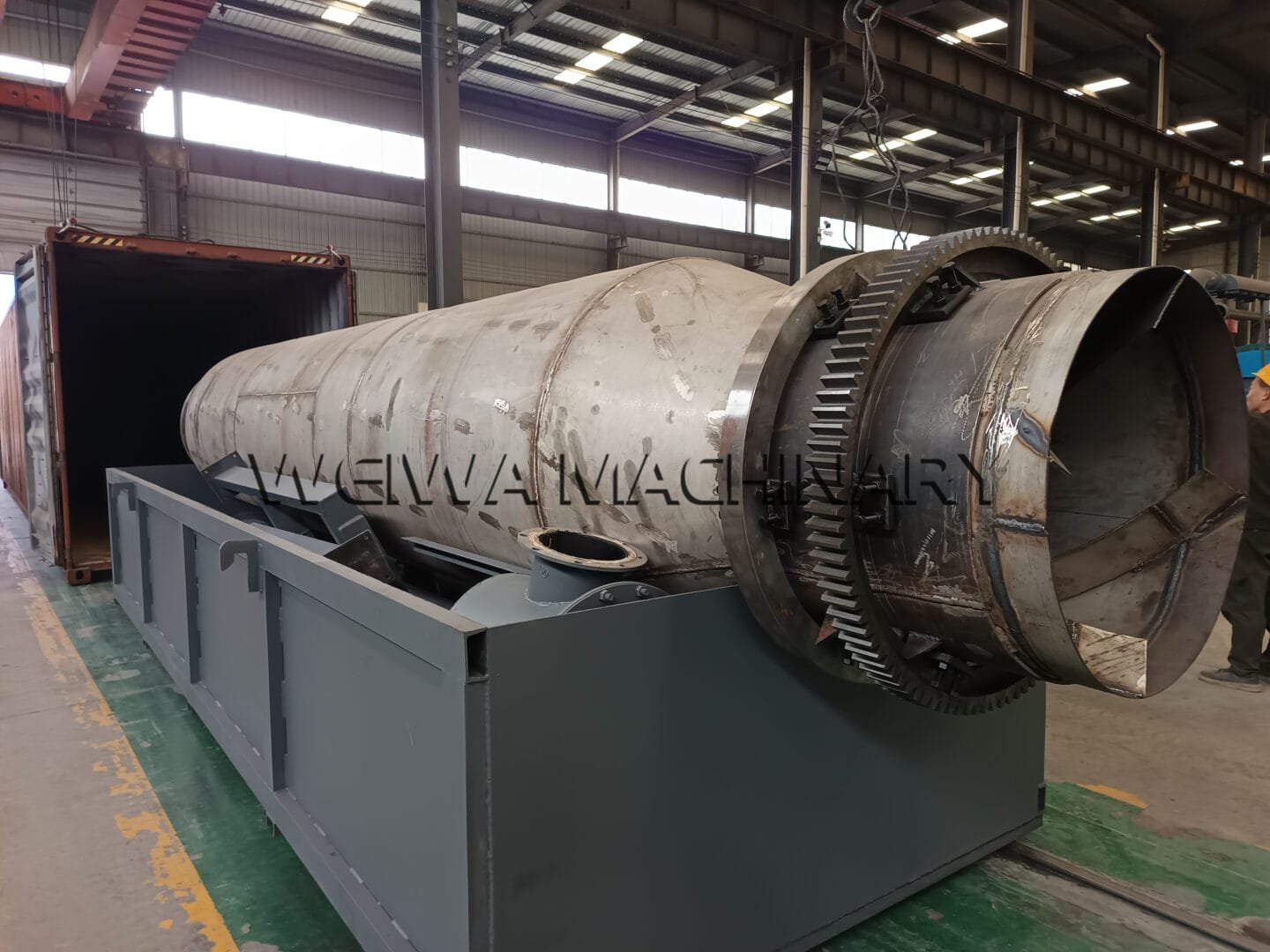
The sun rose gently over the port of Shanghai, casting a golden glow on rows of shipping containers lined up like silent sentinels. For the team at Weiwa Machinery, this was no ordinary dawn. 今天, we were witnessing a moment that blended decades of engineering heritage with the promise of sustainable transformation—our continuous carbonization furnace, destined for Malaysia, was about to begin its journey across the sea. As a company founded in 1990, with over thirty years of experience as an industry leader and a mature technical team capable of guiding overseas installation, we have always seen equipment delivery not just as a transaction, but as the first step in a partnership to solve real-world challenges. And in Malaysia, those challenges revolve around biochar—a material whose potential is vast, yet hindered by gaps in efficient production.
The Scene at the Port Our Continuous Carbonization Furnace Prepares for Malaysia
在 7:30 a.m., our logistics team gathered beside Container No. 23, where the continuous carbonization furnace lay cocooned in protective wrapping. Every bolt, every panel, had been inspected thrice before loading—a ritual we follow religiously, knowing that precision in preparation ensures reliability in operation. 熔爐, designed for uninterrupted biomass conversion, gleamed under the morning light, its stainless-steel body bearing the quiet confidence of machinery built to endure. Nearby, 先生. Lim, our project coordinator for Southeast Asia, checked the customs documentation one last time. 「這不僅僅是一台機器,” he said, running a hand along the furnace’s frame. “It’s a tool to turn palm waste into opportunity for Malaysian farmers and manufacturers.”
The port buzzed with activity, but our focus was singular. Cranes hummed as workers guided the container onto the cargo ship, its destination Port Klang, 馬來西亞. 威瓦機械, shipping a continuous carbonization furnace for sale is never routine; it’s a bridge between our expertise and a market hungry for innovation. 最近幾年, inquiries about continuous carbonization furnace in Malaysia have surged, driven by a growing recognition of biochar’s role in soil health, carbon sequestration, and renewable energy. 今天, we were turning curiosity into action.

Malaysia’s Biochar Challenge A Gap Between Potential and Production
To understand why this shipment matters, one must first grasp Malaysia’s complex relationship with biochar. Blessed with abundant biomass resources—palm kernel shells, 稻殼, coconut fibers—the country produces millions of tons of agricultural waste annually. 然而, much of this waste is either burned openly, releasing greenhouse gases, or left to rot, wasting its latent energy. 生物炭, a carbon-rich byproduct of pyrolysis, offers a solution: it enriches soil, 保留水分, and locks away carbon for centuries. Studies suggest biochar application could boost Malaysian crop yields by 10–20% while reducing fertilizer dependency.
But here lies the problem: production capacity lags far behind need. Most small-scale producers rely on batch carbonization methods—slow, 勞力密集, and inefficient. These systems struggle with inconsistent heat distribution, leading to variable biochar quality, and they can’t handle large volumes, limiting scalability. For industries eyeing biochar as a commercial product, from agriculture to construction, this bottleneck stifles growth. It’s why queries about continuous carbonization furnace price often come paired with questions about efficiency and output. Malaysian businesses need technology that can process tons of biomass daily, with minimal downtime, to meet both local demand and export opportunities.
Why Batch Methods Fall Short for Malaysia’s Biomass Scale?
Batch carbonization, while simple, is ill-suited to Malaysia’s biomass volume. Farmers and factories generate waste continuously, yet batch systems require stopping and starting for loading and unloading—wasting energy and time. 而且, uneven heating in batch reactors often results in biochar with inconsistent porosity, reducing its effectiveness in soil amendment. For a country aiming to integrate biochar into national sustainability goals, such inefficiencies are more than inconveniences; they’re barriers to progress. This mismatch has fueled interest in continuous carbonization furnace in Malaysia, where the “continuous” model aligns with the relentless flow of agricultural waste.
How Our Continuous Carbonization Furnace Addresses Malaysia’s Needs?
Our continuous carbonization furnace, now bound for Malaysia, is engineered precisely to overcome these hurdles. 與批次系統不同, it operates non-stop, feeding biomass through a heated chamber where pyrolysis occurs under controlled conditions. This ensures uniform heat exposure, producing biochar with consistent quality—high in fixed carbon, low in ash, and optimized for soil and industrial use. For Malaysian clients, this means higher productivity: a single unit can process 500–2000 kg of biomass per hour, depending on feedstock, slashing processing time and labor costs.
Energy efficiency is another key advantage. The furnace recycles hot gases generated during pyrolysis to preheat incoming biomass, cutting fuel consumption by up to 30% compared to traditional methods. This is critical in Malaysia, where energy costs can impact operational margins. 此外, the system’s modular design allows customization—whether processing palm shells, 稻殼, or mixed biomass—making it adaptable to diverse regional needs, from Sabah’s palm plantations to Penang’s rice mills. When clients ask about continuous carbonization furnace price, we emphasize long-term savings: lower energy bills, reduced waste disposal costs, and premium biochar prices due to quality consistency.
Customization for Malaysian Feedstocks and Climates
Malaysia’s tropical climate and varied biomass types demand flexibility. Our furnace features adjustable temperature zones (400–700°C) to accommodate different feedstocks—palm shells require higher heat for complete carbonization, while softer materials like coconut fibers need gentler treatment. We also integrated corrosion-resistant alloys to withstand high humidity, a common challenge in coastal regions like Johor. For clients concerned about space, the compact footprint fits neatly into existing facilities, minimizing retrofitting costs. These details matter: they ensure the continuous carbonization furnace for Malaysia isn’t just a generic import, but a tailored solution.
The Bright Future of Continuous Carbonization Furnace in Malaysia
The arrival of our furnace in Malaysia signals more than a single sale—it heralds a shift in the biochar landscape. With the government’s push toward a circular economy and net-zero emissions, demand for efficient pyrolysis technology will only grow. The continuous carbonization furnace price, once a barrier, is becoming justified by rising biochar premiums and subsidies for green manufacturing. Local startups and multinationals alike are exploring biochar for applications ranging from organic farming to carbon credit trading, creating a robust market.
WEIWA機械, with our three-decade legacy, is poised to lead this growth. Our mature technical team doesn’t just sell equipment; we provide end-to-end support. Upon arrival in Malaysia, our engineers will travel to the client’s site to oversee installation, train operators, and fine-tune settings for local feedstocks. This hands-on approach builds trust—and ensures the furnace delivers peak performance from day one. For Malaysian businesses, partnering with us means access to technology that evolves with their needs, backed by a team that understands their unique context.
Why Weiwa Machinery Is the Partner of Choice for Malaysia?
Founded in 1990, Weiwa Machinery has spent over 30 years refining carbonization technology, emerging as an industry leader trusted across Asia, 非洲, and Latin America. Our strength lies not just in manufacturing robust equipment, but in solving problems. We listen to clients, adapt designs to local conditions, and stand by them long after the shipment leaves our factory. For continuous carbonization furnace for Malaysia, this means understanding that success isn’t just about the machine—it’s about empowering local communities to turn waste into wealth.
As the cargo ship carrying our furnace slipped anchor, 先生. Lim turned to our team. “This is just the start,” he said. We nodded in agreement. In Malaysia, a nation striving for sustainability, the continuous carbonization furnace is more than a piece of equipment—it’s a catalyst. And with Weiwa Machinery by their side, Malaysian businesses are ready to harness its power.
關於 WEIWA機械
Established in 1990, Weiwa Machinery brings over three decades of expertise as an industry leader in carbonization technology. With a mature technical team, we specialize in designing and manufacturing advanced carbonization equipment, including continuous carbonization furnaces tailored for global markets. Our commitment extends beyond sales: we provide on-site installation guidance and training for overseas clients, ensuring seamless integration and optimal performance. Trusted worldwide, we are dedicated to driving sustainable solutions through innovative machinery.
- 暴民:+8613838093177
- WhatsApp:+8613838093177
- 電子郵件:info@cjlmachinegroup.com


 微信
微信

 +8615937143060
