


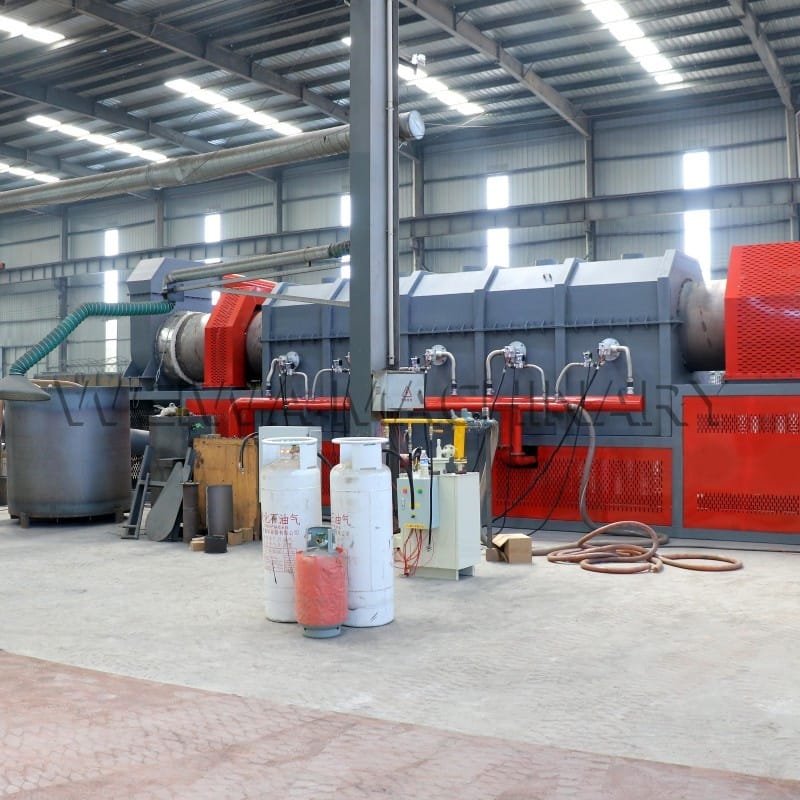
Why India Needs a Cleaner Печа непрерывной карбонизации?
Indian buyers are increasingly careful about environmental performance. State-level pollution rules, buyer audits, export requirements, and corporate sustainability commitments all push charcoal and biochar projects toward cleaner technology. A basic furnace may still produce charcoal, but it often struggles with smoke, tar-laden gas, unstable temperature control, and short refractory life.
For rice husk, the challenge is even more specific. Rice husk has low bulk density, high silica content, and variable moisture. If the furnace is not designed for continuous feeding, controlled pyrolysis, and stable heat recovery, the plant will face uneven char quality and higher maintenance cost. That is why Weiwa designed the new continuous carbonization furnace for India around one key component: the secondary combustion chamber.
What Makes the Secondary Combustion Chamber Different?
The secondary combustion chamber is not a decorative add-on. It is the component that changes how the furnace treats pyrolysis gas, recovered heat, and exhaust emissions. During carbonization, biomass releases combustible volatiles such as carbon monoxide, метан, and hydrogen. In older designs, part of this energy is lost or only partly reused. In our new design, the hot gas stream enters the secondary combustion chamber, where residual combustibles are burned at higher temperature before the gas continues through the heat recovery and treatment path.
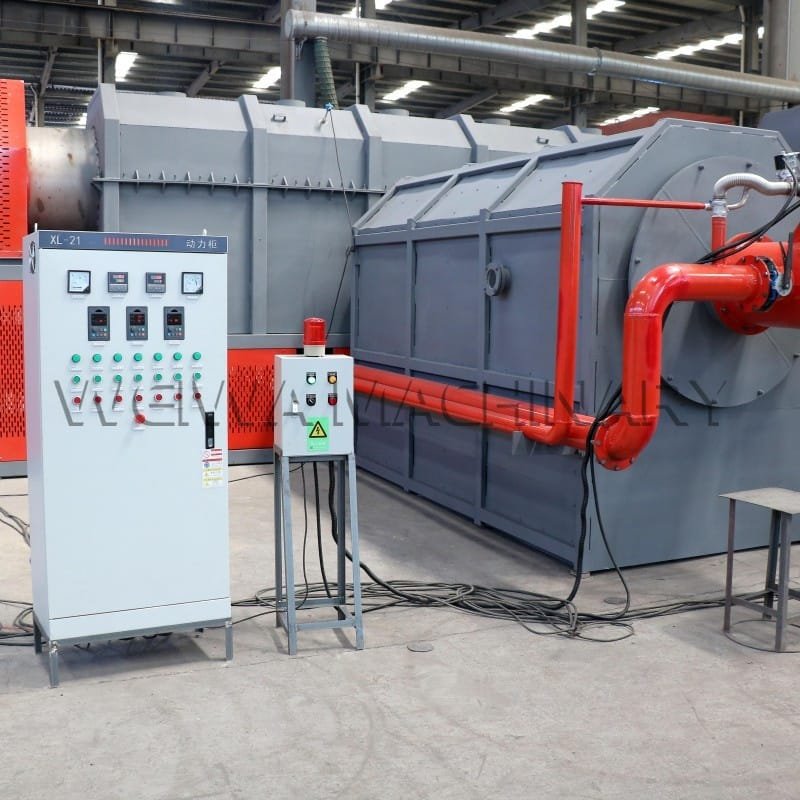
Heat Recovery for Lower Energy Cost
One of the biggest operating costs in any charcoal or biochar plant is external fuel. The secondary combustion chamber allows the furnace to recover thermal energy from its own process gas. The reheated gas is then redirected back into the carbonization system to support drying and pyrolysis zones.
In the rice husk trial, the furnace reached stable thermal conditions faster and depended less on auxiliary burners. For an Indian investor, that means lower LPG or diesel consumption, more predictable operating cost, and better project economics during long running hours.
Flue Gas Cleaning for Higher Emission Standards
Indian industrial projects are increasingly benchmarked against international environmental expectations. Many export-oriented buyers, ESG-funded projects, and premium biochar programs look at EU-aligned emission discipline even when local rules are still developing.
The secondary combustion chamber improves oxidation of tar vapors and combustible pollutants. After high-temperature residence, the gas passes through the downstream cleaning system with lower organic load. The result is cleaner stack gas, less visible smoke, and a much stronger position when the project must satisfy environmental inspection or international buyer requirements.
Longer Furnace Life by Reducing Direct Flame Impact
Another advantage is often underestimated. When unburned pyrolysis gas strikes the main carbonization drum with direct, aggressive flame patterns, the refractory lining, drum surface, and sealing components age faster. The secondary combustion chamber stabilizes combustion outside the main pyrolysis zone. The main barrel receives more controlled radiant and convective heat instead of harsh direct flame冲击.
For the Indian client, this matters because downtime is expensive. A furnace that protects its own core components can run longer between major repairs. Lower maintenance frequency means higher annual output and a better return on capital.
Rice Husk Trial Run for the Indian Client
The trial began with feedstock preparation. Rice husk was checked for moisture, bulk density, and impurity level. Because Indian rice husk quality varies by region, mill type, and storage condition, Weiwa engineers did not assume a single setting would work. The feeding speed, вращение барабана, drying zone temperature, and carbonization zone temperature were adjusted step by step.
Unlike a batch kiln, the continuous carbonization furnace kept feeding and discharging without stopping the process. The operator console showed gradual stabilization of outlet gas temperature, drum current, and char discharge consistency. After the warm-up phase, the secondary combustion chamber reached its operating window and began returning recovered heat to the process.
The Indian client specifically watched three things: smoke level at the stack, char appearance, and whether the machine could hold stable temperature during fluctuating feed moisture. The rice husk trial answered all three. Smoke became noticeably lighter after the secondary combustion chamber reached working temperature. Char color stayed uniform. Temperature curves remained controllable even when moisture spiked slightly from humid storage conditions.
Trial Results That Matter for Charcoal Making Machine for India
The rice husk biochar from the trial had stable carbon content, low unburned volatility, and good physical uniformity. While exact figures depend on feedstock moisture and target product, the key outcome was process stability. The machine did not require frequent manual intervention. The secondary combustion chamber reduced the load on the final treatment stage. Energy recovery lowered auxiliary fuel demand.
For a Charcoal Making Machine for India, stability is the real selling point. Indian projects often fail not because the machine cannot make charcoal once, but because output quality changes every shift. Our trial showed that a Biochar Making Machine built around heat recovery and cleaner combustion can deliver repeatable results across long operating cycles.
The client also observed that the furnace was easier to explain to local consultants. When the project team can show a dedicated secondary combustion chamber, high-temperature gas oxidation, heat recovery loop, and treated flue gas path, the equipment looks like an industrial system rather than a modified kiln.
Carbon Credits and Compliance Advantages in India
India’s biochar and charcoal sector is moving toward carbon accounting. Verified biochar projects can store carbon in soil, replace fossil fuels, and reduce open burning of agricultural residue. But verification depends on more than claiming environmental benefits. The process must be documented, emissions must be controlled, and the product must be consistent.
A continuous carbonization furnace with secondary combustion chamber helps project owners build that documentation. Cleaner combustion reduces unburned hydrocarbon and tar emissions. Recovered heat reduces fossil fuel use. Stable char quality supports laboratory reporting and third-party validation.
For Indian entrepreneurs, this creates a strategic advantage. A charcoal plant can become more than a fuel supplier. It can position itself as a biochar carbon removal project, an agricultural residue management solution, and a potential participant in carbon credit or carbon incentive programs.
Weiwa does not promise automatic approval from any carbon registry. What we do provide is equipment that makes compliance easier: better combustion data, cleaner exhaust, stable product quality, and a process design that auditors can understand.
Market Outlook for Continuous Carbonization Furnace for India
The Indian market for rice husk biochar, уголь из скорлупы кокоса, sawdust char, and agricultural residue carbonization is expanding quickly. Rising awareness of soil health, rising pressure against crop-residue burning, and growing demand for green fuel alternatives are pushing investors toward industrial systems.
A continuous carbonization furnace for India must satisfy several conditions at the same time. It must handle local feedstock. It must run for long shifts. It must control emissions. It must save energy. And it must be serviced by a supplier who understands export documentation, site layout, and after-sales support.
We believe the next wave of Indian buyers will not ask only “how many kilograms per hour.” They will ask “how clean is the gas,” “how much fuel do I save,” “how long will the drum last,” and “can this project qualify for sustainability funding.” Our new design answers exactly those questions.
Rice husk is only the beginning. The same platform can be adapted for coconut shell, опилки, bamboo waste, groundnut shell, Сахарный тростник Багассе, and mixed biomass. For Indian states with strong rice milling clusters, the rice husk version alone can unlock a large circular-economy opportunity.
Why Buyers Choose Weiwa Machinery
Weiwa Machinery has more than thirty years of experience in machinery manufacturing and biomass processing equipment. We are not a trading company that simply relabels unknown machines. We design, manufacture, test, and support the equipment ourselves.
Our advantage for overseas buyers is practical. We provide customized machine configuration based on feedstock type, влага, target output, and local emission expectations. We prepare layout drawings for the client’s site. We support installation guidance, commissioning support, and after-sales service through an experienced technical team.
For India especially, we understand that the project is not just about one furnace. It is about feeding system, сушка, dust control, gas recovery, cooling, разрядка, packaging, and future expansion. Weiwa plans the line as a complete system rather than a single machine sale.
When a client chooses a Biochar Making Machine from Weiwa, they are not only buying steel and burners. They are buying process knowledge, export experience, and a partner who can explain the project to local engineers, consultants, and financiers.
Контакт Weiwa Machinery
If you are planning a rice husk biochar project, coconut shell charcoal plant, or agricultural waste carbonization line in India, Weiwa Machinery can help you select the right continuous carbonization furnace and design a compliant, energy-efficient plant.
We welcome distributors, project investors, EPC companies, and biochar startups to contact us for technical discussion, quotation, and site layout planning.
- Моб: +8613838093177
- WhatsApp: +8613838093177
- Электронная почта: info@cjlmachinegroup.com
Weiwa Machinery — more than thirty years of experience, professional after-sales team, customized service, and engineered layouts for your charcoal and biochar project.


 WeChat

 +8615937143060
