


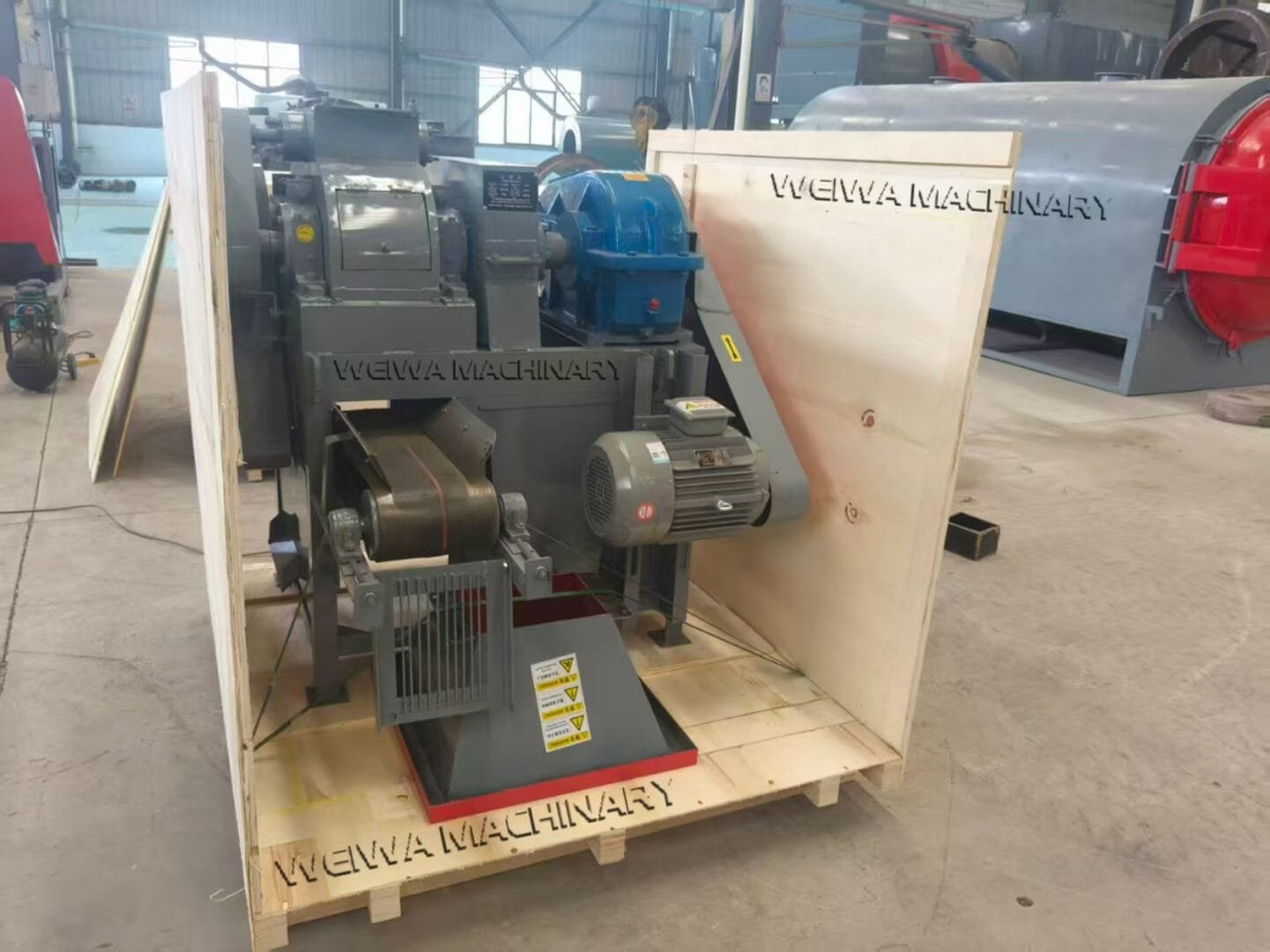
A charcoal ball press machine leaving our Weiwa workshop for India is more than an export order. It is the result of raw material analysis, capacity planning, roller calibration, no-load testing, load testing, export packing, and a long conversation about how charcoal balls will actually be sold in the Indian market.
India does not lack raw material. Coconut shell charcoal comes from the south, wood charcoal dust is common near timber and plywood clusters, sawdust is available near furniture hubs, rice husk and sugarcane bagasse are abundant in agricultural states, and coal dust or furnace carbon powder exists near industrial belts. The real bottleneck is not material. The bottleneck is consistency. Buyers want uniform size, stable hardness, low breakage, good burning time, and a machine that does not fail after two weeks. That is why the charcoal press machine sent to India this month was tested before painting, tested after painting, and tested again during the pre-shipment run.
Shipment Scene At Weiwa Factory
The loading yard was busy from early morning. The Indian client had ordered a complete line, not only a single machine for making charcoal. The container included a double roller charcoal ball press machine, a hammer crusher, a rotary dryer, a feeding conveyor, a mixer, and a semi-automatic bagging unit. Spare rollers, bearing sets, hydraulic seals, клиновые ремни, and tool kits were packed in a plywood box with the project number printed on the side.
Before loading, our quality engineer checked roller alignment, reducer oil level, coupling clearance, hydraulic pressure gauge, electrical terminals, and the gap between the two pressing rollers. The charcoal ball press machine was rotated manually to confirm the rollers did not scrape. Then the electric panel was powered on for a no-load test. The motor ran smoothly, the gearbox stayed quiet, and the discharge chute ejected test balls evenly.
After the running test, the machine was cleaned, wrapped with anti-rust film, and fixed on a steel skid. The crusher and dryer were loaded first because they occupy more volume. The ball briquette machine was loaded second, standing upright with wooden blocks on both sides. Conveyor sections were folded and strapped. Photographs were taken from six angles. One showed the nameplate of the ball charcoal briquettes machine. Another showed the India destination label. A third captured our warehouse manager signing the packing list while the freight forwarder checked the seal number.
None of this was for show. Making charcoal balls in India means the client expects the machine to arrive in working condition, not as a repair project. Ocean freight, port handling, inland transport, and site installation already create enough risk. The factory must remove the risks it can control.
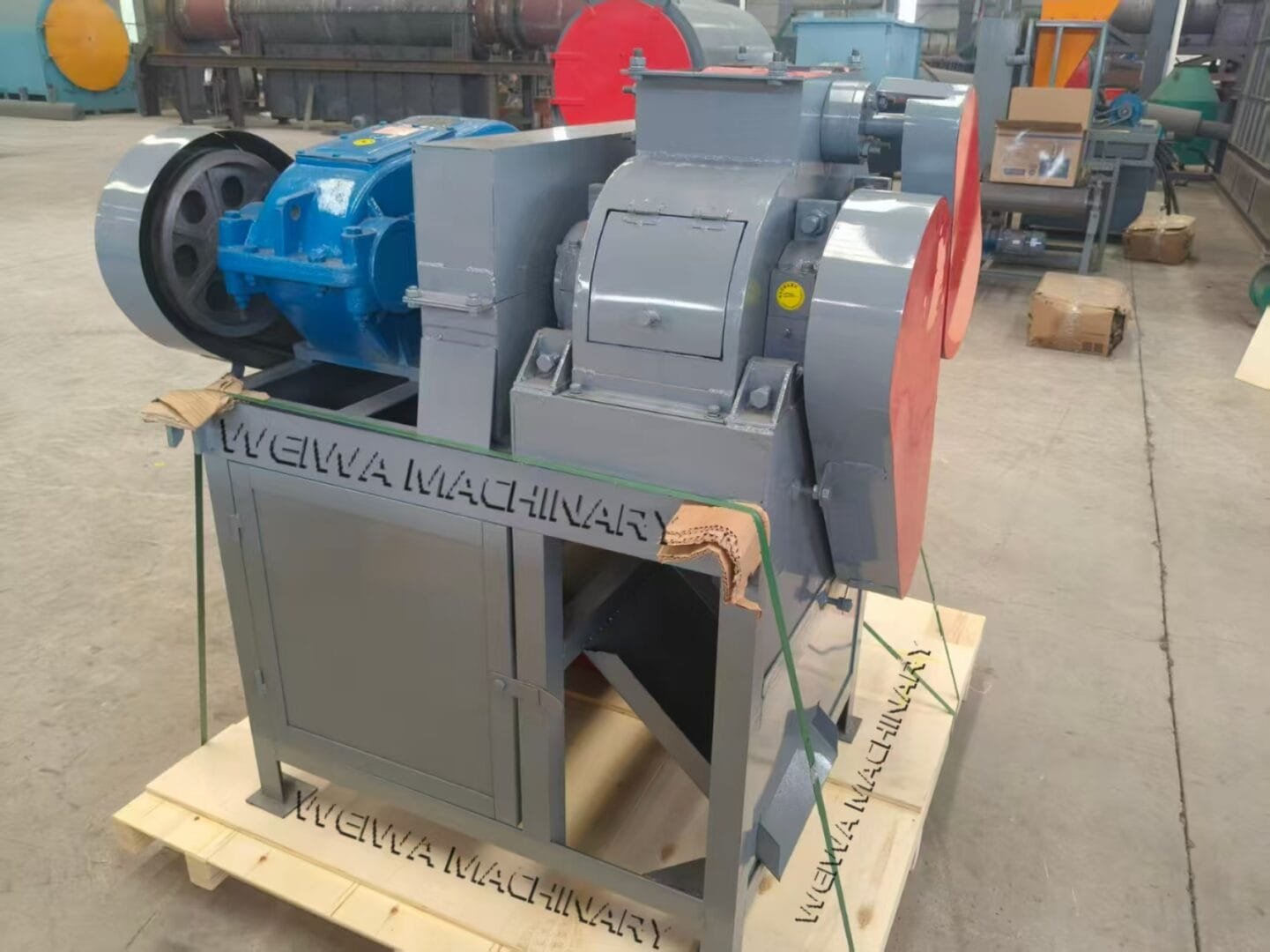
What The India Buyer Actually Ordered?
Many inquiries begin with a short sentence such as send me price of charcoal ball press machine. That is understandable, but it is not enough. The India buyer in this case started with a simple inquiry and then moved into feedstock analysis, hourly capacity planning, voltage confirmation, moisture level, binder option, finished ball size, packaging style, and factory layout.
His raw material was a blend of coconut shell charcoal powder and wood charcoal dust. Initial moisture after storage was around 18 процент. Target finished ball was 35 mm pillow shape with Weiwa logo emboss because his sales team wanted retail pouches for barbecue users in tier-one and tier-two cities. Target capacity was one ton per hour at start, with space reserved for a second shift and a future 2 tph upgrade.
We did not push the biggest model. We proposed a practical line. А 1 tph ball charcoal briquettes machine line needs roughly 1.3 tons of mixed material per hour, о 25 kW connected power, и 150 square meters of covered shed plus 200 square meters open yard for drying and storage. If the buyer later reaches 200 tons per month, we move him to 2 tph. If he buys 3 tph on day one without distributor contracts, half the line sits idle and the payback period becomes painful.
How The Пресс для древесного угля Works?
A charcoal ball press machine is a roller-type briquette press. Fine charcoal powder is fed from the hopper into the roller zone. Two counter-rotating rollers carry pockets. When the material enters the pressing zone, mechanical force compresses the powder into a dense ball. The ball drops from the discharge side, still semi-finished, and moves to drying or curing.
Roller Press Principle
The pocket geometry decides the final shape. Round balls, pillow balls, oval balls, форма яйца, cube shape, and custom logo shapes are all possible. The roller skin decides wear life. For Indian coconut shell charcoal, which is abrasive, roller life is typically 800 к 1200 working hours before pocket refresh. That is why Weiwa sends one spare roller pair in the container and quotes rebuild service separately. The buyer should budget for wear parts from month four onward, not act surprised when pockets shrink.
Material Preparation Before Pressing
The machine is not magic. If the powder is too coarse, balls lack cohesion. If the powder is too fine, gas escape during carbonization can cause cracks. If moisture is too high, balls stick to the roller. If moisture is too low, dust increases and binding becomes weak.
For this India project, the workflow was crushing, смешивание, conditioning, нажатие, and drying. Crusher reduced lumps below the required size. Mixer blended charcoal powder with a small percentage of binder and water. Conditioning brought moisture to the correct band. The charcoal press machine formed the balls. The dryer reduced surface and core moisture until the balls could survive stacking, транспорт, and bagging.
Binder choice matters. Starch binder is common for BBQ charcoal because it is food-safe and gives good green strength. Molasses or cassava starch can reduce cost in some Indian states. Clay is cheaper but increases ash. For industrial heat applications, the client may accept higher ash if the price is lower. For shisha or premium barbecue, ash must be low and smell must be clean. The same machine for making charcoal cannot automatically guess the recipe. The process team must set it.
Trial Run Results Before Loading
We ran the line with the client’s representative material three days before container cut-off. The goal was not to make the prettiest ball in the showroom. The goal was to prove the line could run continuously, hold pressure, keep ball weight stable, and survive roller cleaning without stopping for long periods.
First trial used 16 percent moisture and no pre-mixing. Balls formed but stuck slightly to the pocket. Second trial used 12 percent moisture, 4 percent starch binder, и 1 percent water adjustment. Ball weight became stable. Compression was firm. Drop test from 1 meter showed low breakage. Finished balls had smooth surface, clear pillow shape, and uniform size.
Third run simulated production. We fed mixed material for 40 minutes without stopping. Roller temperature stayed normal. Gearbox noise stayed within range. Discharge chute did not clog. Bagging unit filled 10 kg and 5 kg pouches without jamming. The India buyer watched the live video and approved loading.
The trial proved four things. The charcoal ball press machine could handle a coconut-wood blend. The binder recipe was simple enough for local operators. The capacity matched the promised 1 tph under real conditions. The line was not over-engineered for the buyer’s current order book.
Why Making Charcoal Balls For India Is Growing?
India produces huge volumes of agricultural residue every year. Rice husk in the north, sugarcane bagasse in Maharashtra and Uttar Pradesh, coconut shells along the Kerala and Tamil Nadu coast, and sawdust from furniture clusters in Gujarat and Punjab. Much of this material is either burned in the open or sold at low price. A charcoal briquette machine turns that waste into a denser, чище, and more valuable fuel.
Making charcoal balls in India is attractive for three reasons. Первый, the raw material is local and often cheap. Второй, charcoal balls burn longer than loose powder and create less dust during handling. Третий, small factories can start with one charcoal ball press machine and later add a crusher, сушилка, and conveyor when orders grow.
Urban demand also plays a role. Restaurants, tandoor shops, hotels, and resort kitchens want uniform BBQ charcoal that lights fast and does not break in the bag. Rural users want affordable heating fuel. Industrial users want boiler and furnace feed that is easier to store than loose powder. Export traders want uniform shisha charcoal for the Gulf and Southeast Asian markets. One machine platform can serve all these channels if the ball size and quality are chosen correctly.
Raw Materials Available In India
Coconut shell charcoal is popular in Kerala, Tamil Nadu, Karnataka, and Andhra Pradesh. Wood charcoal dust is common near timber, фанера, and agro-processing zones. Sawdust and crop residues are available across Punjab, Haryana, Уттар-Прадеш, Madhya Pradesh, and Bihar. Coal dust and carbon-bearing industrial powder exist near steel, foundry, and thermal power regions.
The mistake many new entrants make is mixing everything together. A good India project starts with one dominant feedstock. If the main material is coconut shell charcoal, the dryer size, binder percentage, and roller hardness are selected for that. If the main material is sawdust-based biomass, the carbonization step and moisture path change. The charcoal press machine is only one part of the system.
End Users In India
Retail BBQ users care about lighting time, smell, spark, and ash. Tandoor restaurants care about steady heat and long burning time. Hotels and caterers care about bag cleanliness and consistent weight. Industrial buyers care about calorific value, влага, пепел, and price per ton. Exporters care about appearance, certification, private labeling, and container loadability.
Weiwa never asks only what machine do you want. We ask who will burn the ball. The answer decides pocket shape, binder recipe, drying method, packaging format, and after-sales training.
Ball Shape And Size Selection For Indian Market
Shape is not decoration. Shape affects filling density, drying speed, breakage, and buyer perception. For retail pouches in Delhi, Mumbai, Bengaluru, or Pune supermarkets, 35 к 40 mm pillow shape with Weiwa logo emboss sells well. For export to Gulf shisha market via Mumbai or Mundra port, 25 mm round with center dimple is often requested. For industrial cupola or annealing furnace use in Ludhiana or Rajkot, 70 mm oval with 8 percent binder survives stacking and long-distance handling.
The Indian client in this shipment chose 35 mm pillow because his distribution plan targeted modern retail and HoReCa supply. His competitor in another state may choose 25 mm round for Dubai buyers. Another may choose 50 mm oval for boiler fuel. Tell us your buyer, not just your raw material, and we select pocket geometry accordingly.
Color also matters. Premium shisha charcoal is usually silver-grey after carbonization. BBQ charcoal is often black with clean fracture. Industrial balls may be darker and rougher. The charcoal ball press machine can make all of them, but the carbonization furnace, cooling system, and sorting process must be planned together.
Common Mistakes In Charcoal Ball Projects
The first mistake is buying the biggest machine too early. А 3 tph line looks impressive in a quotation, but if the buyer has no distributor network, the balls pile up and cash flow suffers. Start with proven demand, then scale.
The second mistake is ignoring moisture. Many Indian buyers think pressing can fix wet powder. It cannot. If moisture is high, balls stick, rollers clog, drying time doubles, and breakage rises. A proper crusher, микшер, and dryer are not optional accessories. They are part of the machine for making charcoal commercially.
The third mistake is poor binder calculation. Too little binder means crumbling balls. Too much binder means smoke, odor, higher cost, and soft combustion. Weiwa provides recipe ranges, but the operator must learn local material behavior. Coconut shell from one district is not identical to coconut shell from another district.
The fourth mistake is weak maintenance. A charcoal ball press machine is a wear machine. Rollers, подшипники, scraper blades, couplings, and conveyor belts all age. Indian buyers who assign one responsible operator, keep spare parts on site, and follow a monthly checklist usually run the same line for years. Buyers who wait until the roller fails often lose two weeks of production.
The fifth mistake is treating export and domestic quality as the same. Domestic tandoor charcoal can tolerate wider variation. Export shisha charcoal cannot. If the India buyer eventually exports, he must plan screening, metal detection, uniform carbonization, controlled cooling, and premium bagging from day one.
After Sales Support For Indian Clients
Buying heavy machinery from China is no longer the problem. The problem is what happens after the container arrives. Weiwa Machinery supports Indian clients with foundation drawings, pipe routing, electrical single-line diagrams, video commissioning, обучение операторов, spare part lists, and roller rebuild guidance.
Our after sales team speaks English, responds on WhatsApp within one business day, and can read your local voltage, влажность, and dust conditions into the design. We welcome Indian clients to visit our factory, inspect the ball charcoal briquettes machine running with charcoal powder, and witness the dryer outlet moisture test.
After shipment we guide installation by video and, when needed, send an engineer to Chennai, Ahmedabad, Mumbai, Delhi, Kolkata, Hyderabad, or Coimbatore for seven to ten days. Our machines are already running in Indonesia, Индия, Малайзия, Лаос, Мьянма, Таиланд, Вьетнам, Филиппины, Пакистан, Шри-Ланка, Ливан, Грузия, Турция, Польша, Чешская Республика, Монголия, Южная Корея, Румыния, Египет, Судан, Tunisia, Алжир, Эфиопия, Танзания, Мексика, and South Africa. That global track record is why Indian buyers come back for a second line.
Spare parts are the quiet hero of briquette projects. We recommend Indian clients keep one roller pair, one scraper blade set, one bearing kit, one hydraulic seal kit, one V-belt set, and one electrical contactor kit on site. Downtime caused by a 20 dollar part is worse than the part itself.
О Weiwa Machinery
Weiwa Machinery has more than thirty years of working experience in briquetting and pressing equipment. We are not a trading company that rebrands someone else’s press. Our own workshop handles plate cutting, roller machining, press assembly, electrical wiring, and trial run. We supply design drawings, планы фундамента, pipe routing, and 3D layout before production.
We provide customization service. If your site is 18 meters long and 7 meters wide, we redraw the line to fit, not the other way around. If your voltage is 415V 50Hz three phase, we build for it. If your raw material is coconut shell, опилки, угольная пыль, гипс, металлический порошок, or mixed biomass, we adjust the process.
Over two million end users worldwide have used briquettes made on Weiwa presses. That number is not only about machines. It is about recipes, layouts, operator habits, maintenance discipline, and long-term support. A charcoal ball press machine is an asset only when it keeps producing sellable balls month after month.
If you are evaluating making charcoal balls in India, send us three things. Your monthly target tonnage. Your main raw material name and photo. Your city. We reply with a recommended charcoal ball press machine model, full line quotation in USD, container count, installation timeline, and a draft factory layout drawing. The first layout discussion is free.
Reach Weiwa Machinery directly:
Мобильный / WhatsApp: +8613838093177
Электронная почта: info@cjlmachinegroup.com
Whether you need a single ball charcoal briquettes machine or a complete charcoal briquette machine production line with dryer and civil works plan, Weiwa is ready to help you press your first commercial charcoal ball in India.


 WeChat

 +8615937143060
