


Why Saudi Arabia Is Paying Attention to Biomass Charcoal?
Saudi Arabia is often discussed in relation to oil and gas, but the local fuel market is broader than that. Restaurants, hotels, farms, poultry houses, Промышленные котлы, shisha cafes, and outdoor grilling businesses all need reliable heat. Imported charcoal has dominated for years, yet import dependence creates price volatility, inconsistent calorific value, and long logistics delays.
A biomass briquette machine changes the equation. Instead of shipping finished charcoal across oceans, the producer keeps the value chain closer to home. Sawdust from furniture workshops, wood chips from pallets, coconut shell from food importers, and agricultural residue from farms can all become feedstock. The Saudi buyer understood this early. His team visited several suppliers, reviewed videos, asked about screw life, and finally selected Weiwa Machinery because the proposal focused on the full process rather than a single machine.
The Saudi Energy Context Is Changing
Vision 2030 has pushed Saudi Arabia toward diversification. Waste recovery, local manufacturing, and cleaner industrial fuel are no longer abstract policy words. They are procurement requirements. A factory owner in Riyadh or Dammam now asks practical questions. Can I dry sawdust in this climate? Will the screw extruder survive summer heat? Can my workers operate the line without an engineer on site every week? Those questions shaped the entire Weiwa design.
The answer is not to sell the biggest machine. The answer is to design a line where moisture control, размер частиц, extrusion pressure, cooling, and carbonization all work together. That is where a sawdust briquetting machine becomes more than a piece of equipment. It becomes a production system.
What Was Actually Loaded Into the Container?
Before the containers were closed, the Weiwa team completed factory testing, video recording, rust protection, and export packaging. The shipment included crushers, a dryer, screw feeders, a sawdust extruder, a biomass briquette machine, spare screws and dies, electrical panels, tools, and the documentation required for Saudi customs clearance.
Every rotating part was checked under load. The screw shaft, bearing housing, heating ring, and discharge die were inspected separately. The client received a test video showing rod formation, surface smoothness, плотность, and uniform length. Only after the trial passed did the team move to container loading.

Crusher and Screening Stage
Raw biomass is rarely ready to extrude. Wood chips may be too large. Pallet waste may contain nails. Furniture sawdust may include varnish dust. The first stage breaks oversized material into a manageable size and removes contaminants where possible. For this Saudi project, the target was a fine, uniform feed below a controlled particle range so the sawdust briquetting machine could compress material without choking the screw.
If the particle size is wrong, the extruder works harder. The screw wears faster. The die overheats. The briquette develops cracks. Good charcoal starts long before carbonization. It starts with preparation.
Drying and Moisture Control
Moisture is the silent killer of biomass briquette production. Too wet, and the rod smears at the die. Too dry, and the material loses the natural lignin bonding needed for strength. For Saudi Arabia, drying deserves special attention because ambient humidity behaves differently than in coastal Guangdong or rainy Southeast Asia.
Weiwa configured the dryer around the client’s moisture test. The target before extrusion was roughly 8 к 12 процент, depending on feedstock. The line used a rotary or pipe dryer arrangement sized for throughput, not just for show. Operators were trained to check inlet moisture, outlet moisture, and return material. A biomass extruder can be perfect, but if the feed is wet, the final charcoal will be weak.
Sawdust Extruder as the Core of the Line
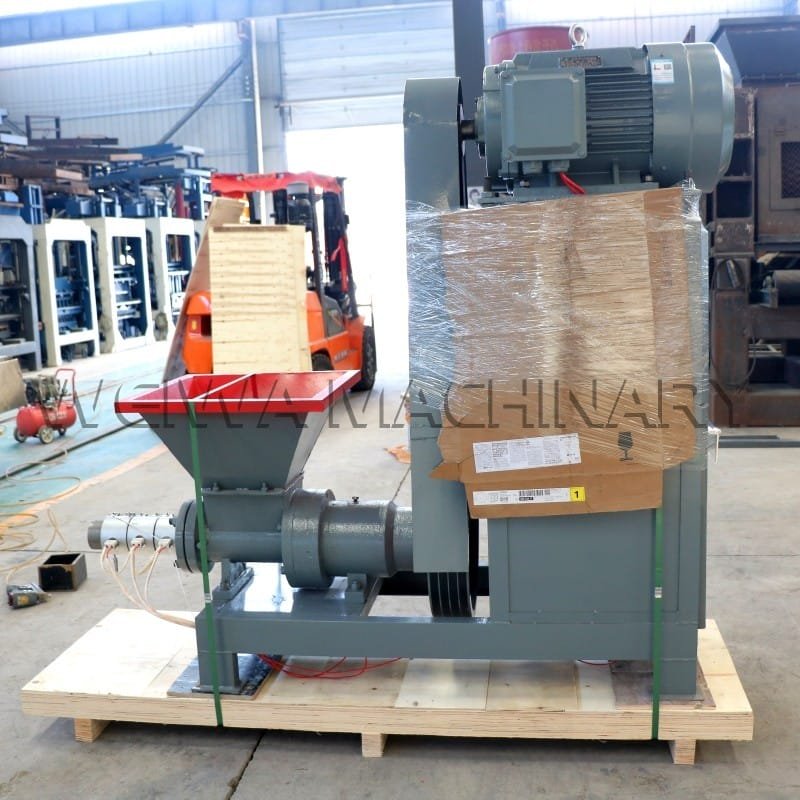
The sawdust extruder is the heart of the system. It uses a high-torque screw to push prepared sawdust through a heated die. Friction and compression raise temperature. Lignin softens. The material fuses into a dense rod without chemical binders. The rod leaves the machine hot, then cools and hardens.
For the Saudi client, Weiwa selected screw geometry and die diameter based on desired stick size. Shisha charcoal often needs slim, uniform rods. Grilling charcoal may prefer thicker hexagonal or round sticks. Industrial fuel may prioritize density over appearance. The same biomass briquette machine platform can serve different markets if the screw pitch, compression ratio, and die shape are correct.
How a Машина для производства брикетов из биомассы Turns Sawdust Into Charcoal?
Many buyers think charcoal is made by burning wood. Mechanism charcoal is different. Первый, the machine forms a dense biomass rod. Второй, the rod is carbonized in a kiln, furnace, or retort. Carbonization drives off volatiles and leaves fixed carbon, producing the black, high-heat product familiar to grill and shisha users.
The quality of the final charcoal depends on the rod quality. If the rod is loose, carbonization creates excess ash. If the rod has uneven density, some sections burn fast and others barely ignite. A well-built sawdust briquetting machine creates uniformity, and uniformity is what commercial buyers pay for.
Extrusion Stage
During extrusion, the sawdust extruder compresses material continuously. The heating ring keeps the die zone warm. The screw conveys material forward while building pressure. The die shapes the rod. The cutter lengths it. At this stage, the product is still brown biomass, not black charcoal, but its internal structure already determines carbonization performance.
Weiwa uses hardened screw materials and replaceable dies because Saudi buyers care about uptime. A broken screw is not just a repair cost. It is lost orders during peak grilling season. Spare parts strategy matters as much as machine price.
Cooling and Curing
Fresh rods are soft and hot. They must cool slowly and evenly. Rapid cooling can cause surface checking. Stacking wet rods can cause mold. The Weiwa layout included space for tray cooling or conveyor cooling depending on the client’s shed size.
In Saudi Arabia, summer heat can be misleading. High air temperature does not mean fast, safe cooling if humidity and airflow are wrong. The line design accounted for ventilation, stacking height, and operator movement. A biomass briquette machine may produce perfect rods, but poor curing still ruins the batch.
Carbonization Stage
Carbonization is where biomass rods become charcoal. The rods are loaded into a furnace and heated with limited oxygen. Water, смола, and volatile gases escape. What remains is fixed carbon with higher energy density and cleaner combustion than raw wood.
For this Saudi order, Weiwa discussed several carbonization options: vertical furnace, horizontal furnace, batch kiln, and continuous retort. The choice depended on labor cost, land area, emission rules, and daily capacity. A small workshop may prefer batch carbonization. A serious Saudi fuel supplier may need a continuous system with gas recovery and better temperature control.
Why Sawdust Briquetting Machine Quality Matters in the Gulf ?
The Gulf market is unforgiving. Buyers compare imported charcoal side by side. If your stick breaks in the bag, burns too fast, smells like glue, or leaves white ash, distributors switch suppliers quickly. That is why cheap machines often become expensive mistakes.
A sawdust briquetting machine must deliver repeatable rod density. The Saudi client cared about three things: burn time, ash content, and breakage rate. Those metrics are not created in the carbonization furnace alone. They are engineered earlier in crushing, сушка, extrusion, and curing.
Screw and Die Life in Harsh Conditions
Sand, dust, and heat are part of life in Saudi Arabia. Electrical panels need protection. Bearings need sealing. Motors need correct voltage and cooling. The screw and die need the right steel grade because sawdust is abrasive once it contains sand or fine mineral dust.
Weiwa supplies spare screws, spare dies, and maintenance schedules for this reason. A biomass extruder running 20 hours per day in Riyadh is not the same as a hobby machine running two hours per week in a European workshop. The Gulf buyer needs industrial-grade thinking.
Voltage, Language, and Operator Comfort
Saudi projects usually require 380V or 415V three-phase power, 50Hz or 60Hz depending on region and generator set. Control panels can be supplied with English labels, Arabic labels, or both. Buttons can be enlarged. Alarms can be simplified. The goal is not to impress engineers. The goal is to let a local operator run the sawdust extruder without fear.
Weiwa also provides wiring diagrams, spare-part photos, and video training. For overseas buyers, after-sales communication is part of the machine. A biomass briquette machine that nobody can troubleshoot will sit idle no matter how low the price was.
Charcoal Market Opportunity in Saudi Arabia
Saudi Arabia consumes large volumes of charcoal for shisha, grilling, catering, and hospitality. Tourism projects, entertainment zones, and food-service expansion increase demand for consistent fuel. Local production reduces freight cost, shortens lead time, and allows the producer to adjust stick size for local preference.
A Saudi charcoal producer can serve Riyadh, Jeddah, Makkah, Madinah, Dammam, Khobar, and export nearby to the UAE, Kuwait, Bahrain, Катар, and Oman. The Gulf Cooperation Council market rewards suppliers who can deliver the same product every month. That consistency comes from process control, not luck.
Shisha Charcoal Demand
Shisha charcoal requires low odor, low spark, длительное время горения, and uniform shape. Cubes and fingers are common. Some buyers want silver skin, some want black natural charcoal. A sawdust briquetting machine can produce the base rod, but the carbonization profile decides the final smoking experience.
Weiwa advises clients not to chase the cheapest binder or the fastest carbonization. Over-carbonized rods crumble. Under-carbonized rods smoke. The Saudi market notices these flaws immediately in cafe testing.
BBQ and Restaurant Charcoal
Grilling charcoal is less sensitive to shape but very sensitive to heat and ash. Restaurants hate charcoal that flares up, leaves heavy ash, or fails halfway through service. A biomass briquette machine that produces dense, dry, well-carbonized sticks helps restaurants control cooking temperature and labor.
For bulk buyers, pallet stability and moisture-proof packaging also matter. Charcoal that absorbs humidity in Dammam storage will underperform on a Riyadh grill. The production line is only one part of the commercial system.
Common Mistakes When Starting a Charcoal Line
New investors often believe the machine is everything. They compare prices, pick the lowest quote, and assume charcoal will sell itself. In reality, most failed projects share the same problems: wrong moisture, wrong particle size, unstable power, no spare parts, poor carbonization control, and unclear target market.
Mistake One: Ignoring Raw Material Testing
Sawdust from pine is not the same as sawdust from beech, acacia, or mango wood. Moisture, fiber length, resin content, and ash content all change machine behavior. Weiwa asks every Saudi client for a sample before final machine confirmation. A biomass extruder tuned for one feedstock may struggle with another.
Mistake Two: Buying Only the Extruder
The sawdust extruder is important, but crushing and drying decide rod quality. A client who buys only the extruder and feeds it wet, coarse powder will blame the machine for his own preparation mistake. Weiwa sells the process, not just the steel.
Mistake Three: Underestimating Carbonization
Some buyers think any furnace will do. Then they burn rods instead of carbonizing them. Proper carbonization controls temperature ramp, residence time, oxygen exposure, and cooling. A biomass briquette machine can make beautiful rods, but a bad furnace turns them into ash.
How Weiwa Machinery Supports Saudi Clients?
Weiwa Machinery is not a trading company that resells random machines with a new logo. The team manufactures briquette and carbonization equipment, prepares factory layouts, runs material tests, trains operators, and supports spare parts. For the Saudi shipment, the workflow included consultation, sample analysis, machine selection, factory trial, video inspection, export packing, ocean booking, and post-arrival guidance.
After the container arrives, the client receives installation drawings, электрические схемы, spare-part lists, operation videos, and remote support. If needed, Weiwa can discuss on-site commissioning once visa, accommodation, and local safety rules are arranged.
Layout Design for Saudi Warehouses
Many Saudi buyers operate from industrial plots with corrugated roofing, open yards, and limited skilled labor. Weiwa draws the line according to available length, width, power supply, raw-material inflow, and finished-charcoal storage. A U-shape layout may save space. A straight layout may improve material flow. The right choice depends on the site, not on a catalog photo.
The sawdust briquetting machine should sit where maintenance access is easy. The dryer needs safe combustion clearance. The carbonization area needs fire separation. These details protect the client’s investment and insurance position.
Training and Remote Commissioning
Operators learn how to check moisture, adjust feeder speed, monitor die temperature, change cutters, inspect screws, and record daily output. Supervisors learn how to track burn time, ash content, breakage, and moisture of finished charcoal. A biomass briquette machine runs better when the team understands cause and effect.
Weiwa’s remote support covers screw wear judgment, выбор матрицы, dryer temperature adjustment, carbonization schedule, and emergency stop procedures. The Saudi client does not have to guess.
Environmental and Economic Logic of Biomass Briquettes
Biomass briquettes use material that would otherwise be burned openly, dumped, or left to rot. Sawdust from workshops, prunings from farms, shells from food processing, and offcuts from pallets all carry stored energy. Converting them into charcoal creates local jobs in collection, grinding, сушка, extrusion, карбонизация, упаковка, and delivery.
For Saudi Arabia, the logic is strategic. Less waste, more local fuel, better resource use, and new small-industry opportunities outside oil. A sawdust extruder may look like a modest machine, but multiplied across regions, it supports circular economy goals.
Waste to Value
Wood waste has low value loose. Compressed into uniform rods, it becomes storable, stackable, and transportable. Carbonized properly, it becomes premium fuel. The biomass briquette machine is the bridge between waste and product.
Local Supply Security
When charcoal is imported, the buyer depends on exchange rates, freight rates, port congestion, and foreign factories. Local production reduces those risks. Even partial local supply gives Saudi distributors pricing power and faster replenishment.
Choosing the Right Capacity for Saudi Arabia
Capacity should match market access, not ambition. A first-time investor may not need three extruders and two furnaces. He may need one reliable sawdust briquetting machine, one dryer, and a batch carbonization system. Once distribution channels prove themselves, the line can expand.
Weiwa often recommends phased investment. Start with validated product quality. Sell to ten distributors. Collect feedback on stick size, burn time, and packaging. Then add a second biomass extruder or continuous carbonizer. This approach protects cash flow and avoids dead inventory.
Small Workshop Model
One extruder, manual feeding, batch carbonization, local delivery. Output is modest, but learning curve is fast. Suitable for an entrepreneur supplying nearby restaurants and cafes.
Commercial Supplier Model
Two or more sawdust extruders, automated feeding, controlled drying, multiple furnaces, bagging system, and regional distribution. Suitable for a Saudi company targeting Riyadh, Jeddah, и экспортные рынки.
Industrial Fuel Model
Higher throughput, continuous carbonization, dust control, лаборатория качества, and contract supply to boilers or industrial users. The biomass briquette machine is part of a larger energy strategy.
Quality Checklist Before You Buy
Buyers should inspect more than price. Ask for material test results. Ask for screw material specification. Ask for die hardness. Ask for dryer capacity at your moisture level. Ask for carbonization temperature curve. Ask for spare-part prices. Ask for reference projects in the Middle East or Africa with similar feedstock.
A serious supplier explains limitations. A weak supplier promises miracle output for every material. Weiwa prefers honest engineering. If Saudi acacia sawdust behaves differently from Egyptian rice husk, the proposal should say so.
Questions to Send Every Supplier
What is the real output at 10 percent moisture, not the brochure output at 6 процент? What screw steel do you use? How many hours before first screw change? Do you supply dies for shisha size and BBQ size? Can your furnace handle batch loads without oxygen spikes? What happens if the heater ring fails in August?
If the supplier cannot answer, the biomass briquette machine may still run, but the business behind it is fragile.
From Zhengzhou Factory to Saudi Site
The shipment leaving Weiwa’s yard carried more than machines. It carried a production philosophy: test the material, design the process, train the people, protect the spare parts, and improve continuously. The Saudi client did not buy a box of steel. He bought a pathway into the charcoal business.
When the container reaches Dammam or Jeddah, the real work begins. Foundations, power connection, dryer positioning, extruder alignment, furnace safety, first rod test, first carbonization batch, first customer sample. Weiwa stays involved through that period because a biomass extruder is only successful when the client’s bags of charcoal actually sell.
First Batch Strategy
The first extruded rods should not all go into the furnace immediately. Some are kept for density and length checks. Some are tested for surface cracks. Some are photographed and shared with Weiwa engineers. Only after rod quality is stable does carbonization scale up.
This discipline separates professional producers from weekend experiments. The sawdust briquetting machine gives structure to the material. The operator gives intelligence to the process.
Scaling With Market Feedback
Saudi distributors may ask for longer sticks, denser cubes, lower ash, faster ignition, or cleaner silver skin. The producer adjusts die size, температура карбонизации, cooling time, and packaging. A flexible biomass briquette machine platform allows this without rebuilding the entire factory.
Future of Biomass Extruder Projects in the Gulf
The Gulf’s fuel habits will not change overnight, but they are changing. Hospitality growth, waste-management regulation, local-manufacturing incentives, and cleaner-fuel preferences all point in the same direction. Local charcoal production will become more common, and suppliers with consistent quality will win.
A biomass extruder is no longer a curiosity. It is industrial equipment for entrepreneurs who want to replace imports, serve shisha cafes, supply grilling restaurants, and build export channels across the GCC. The technology is mature. The opportunity is regional. The missing piece is often execution discipline.
Weiwa’s View on Long-Term Partnership
Weiwa Machinery does not measure success by container count. We measure success by whether the Saudi client is still producing good charcoal six months later, still reordering screws and dies, still expanding capacity, and still trusting our engineering team.
That is why the shipment this week matters. It is not the end of a sales process. It is the beginning of a production relationship built around a sawdust extruder, a biomass briquette machine, and a shared goal: turn Saudi biomass waste into reliable charcoal fuel.
О Weiwa Machinery
Weiwa Machinery is a Chinese manufacturer of biomass briquette machines, экструдеры для опилок, линии по производству древесного угля, печи карбонизации, and related biomass processing equipment. With decades of workshop experience, Weiwa serves clients in Saudi Arabia, Объединенные арабские эмираты, Египет, Iraq, Nigeria, Индонезия, Вьетнам, and many other markets.
Our team focuses on practical engineering rather than generic promises. We analyze raw-material samples, design factory layouts, test machines before shipment, supply spare parts, and provide remote commissioning support. Whether the client needs a single sawdust briquetting machine or a full charcoal plant, Weiwa builds the solution around local feedstock, climate, power supply, labor skill, and target market.
From the first material test to the first bag of charcoal sold in Saudi Arabia, Weiwa Machinery acts as a production partner, not just an equipment seller. Наша цель проста: help customers turn biomass waste into stable, profitable, and locally produced charcoal fuel.
If you are planning a charcoal production project in Saudi Arabia or anywhere in the Gulf, contact Weiwa Machinery for raw-material analysis, line design, machine selection, and long-term after-sales support.


 WeChat

 +8615937143060
