


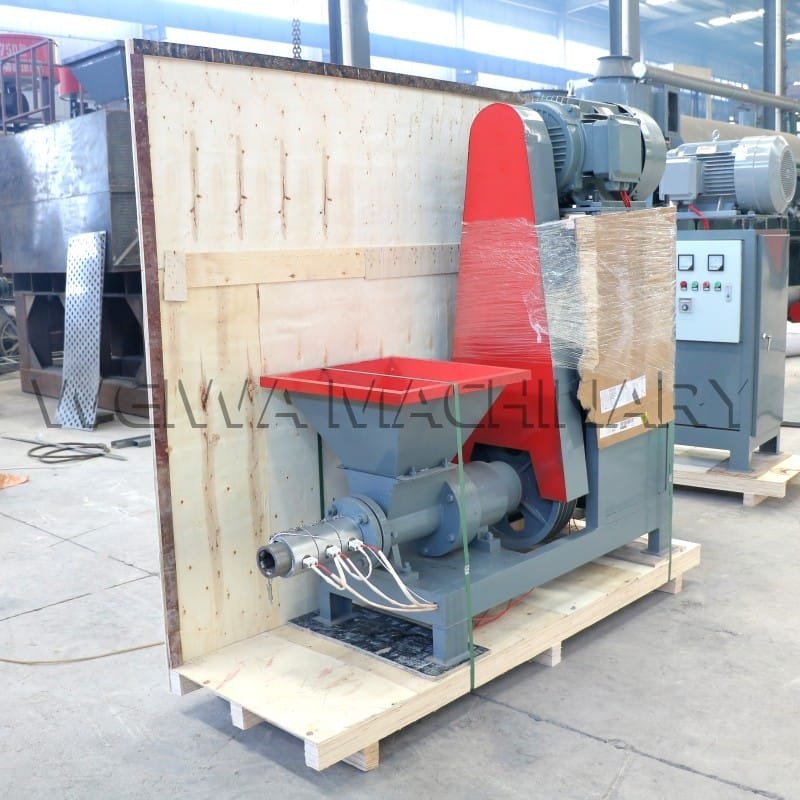
Factory Loading Scene: What Went Into the Container
The shipment started with a pre-inspection. Our engineer checked motor rotation, coupling alignment, and gearbox oil level on the sawdust extruder, then ran the screw empty for nine minutes. After that the line was disassembled into transport modules. The crusher was bolted to a steel skid. The wheel grinding mixer was wrapped with anti-rust paper because sea air during the transit leg to Umm Qasr can reach the plywood crate edges. The sawdust briquetting machine itself—the screw extruder with a 22 kW copper-coil motor—was film-wrapped, strapped to a iron frame, and placed upright so the propeller shaft would not bend under stacked weight.
One detail Iraqi buyers often miss: die storage. We packed three die heads separately in a foam-lined wooden box—40 mm cylindrical, 45 mm hexagonal, و 50 mm square. The client initially asked only for cylindrical BBQ sticks, but our sales engineer suggested keeping the other two because wedding-hall charcoal vendors in Iraq pay more for hexagonal slow-burn rods. A sawdust extruder is flexible only if the operator keeps spare dies on site.
Before the container door closed, we photographed the layout drawing, the CE-style nameplate, and the bill of loading. The same documentation travels with every charcoal extrude machine we export, because customs officers in the Middle East increasingly ask for a machine function sheet, not just a commercial invoice.

Why Iraqi Buyers Evaluate a Sawdust Extruder Before Carbonization
In Iraq the raw material question is different from Indonesia or Vietnam. Many inquiries start with “I have sawdust, can I make charcoal?” The short answer is yes, but not in one step. Sawdust is biomass. To get a black charcoal stick you must first carbonize the sawdust into char powder, then extrude it. A sawdust extruder never sees white wood powder; it sees fine black powder under 3 مم.
That is why we explain early: a sawdust briquette machine is the second half of the story. The first half is a carbonization furnace. Iraqi clients who already buy semi-carbonized powder from Kurdish furniture towns can skip the furnace and start with the briquette line. Clients who collect fresh sawdust from door factories in Karrada or Basra need a furnace in phase two. Staging the investment protects cash flow and avoids importing a 40-foot furnace before the extruder proves itself.
This distinction also changes the keyword buyers use. Some search “sawdust extrude machine in Iraq” because they assume the extruder eats raw sawdust. Others search “sawdust briquetting machine” because their consultant already told them about the two-stage process. Both land on the same equipment family, and the blog has to serve both intents without confusing them.
Sawdust to Charcoal Stick: The Science of Briquetting
A sawdust briquette machine works on screw pressure, not on glue strength. The motor drives a triangular belt, the belt turns the gearbox, the gearbox turns a propulsion shaft through a floating coupling, and the high manganese alloy propeller pushes material forward. As the black powder moves toward the die head, pressure climbs. At the die throat the mass is squeezed into a continuous rod and exits hot. The operator cuts it with a simple pusher into 300–500 mm lengths.
Crushing and Moisture Control
Charcoal powder must pass a 3 mm screen before it touches the hopper. Larger particles chip the propeller tip within a week. In Iraq’s ambient humidity, which drops under 20 percent in summer, powder loses surface moisture fast. That sounds good, but too dry powder slides instead of compacting. We advise the Iraq client to keep mixed material at 8–12 percent moisture. They will sprinkle water during mixing, not after crushing. A sawdust extruder jams when an operator wets the powder at the hopper mouth.
Binding Agents and Mixing Ratio
We do not sell binders, but we tune the mixer. For sawdust char, cassava starch at 4–6 percent gives a hard rod. Some Iraqi clients prefer date syrup molasses blended with lime at 2 بالمائة; it smells sweet while drying and burns steady. The wheel grinding mixer kneads powder, water, and binder the way a baker folds dough. Ribbon mixers leave dead zones; wheel mixers do not, which matters when the binder is sticky and the room temperature passes 40°C.
Screw Extrusion Pressure and Die Shapes
The propeller pitch decides pressure. A sawdust extruder running at 60 rpm with a 22 kW motor builds enough pressure for cylindrical BBQ sticks and square shisha blocks alike. Hexagonal dies need a slightly tighter throat because the corners need filling. ملكنا #45 steel dies are heat treated twice; cheap dies crack at the hexagon corner after 40 tonnes. Shape choice is commercial, not technical—Iraqi grills know the round stick, but hookah cafes in Erbil pay more for square briquettes that stack inside a ceramic bowl.
Drying Rods Under Iraq’s Heat Curve
Fresh rods leave the die at 60–80°C surface temperature but still hold 15–18 percent internal moisture. In Iraq you can sun-dry in July, but April and December need a tunnel or batch room. We supplied mesh trays and a 40 m³ fan cycle. The trick is pre-shade: rods rest under a covered yard for 6 hours before entering the heated room, so the surface does not case-harden while the core stays wet. A sawdust briquetting machine is only as good as the drying discipline behind it. Many Iraq inquiries fail not on extrusion but on rods exploding in the bag two weeks later because the core never dried.
Sawdust Extruder vs Sawdust Briquetting Machine: Same Goal, Different Terms
Buyers use four phrases that mean almost the same hardware: الطارد نشارة الخشب, آلة البثق نشارة الخشب, آلة فحم حجري نشارة الخشب, آلة قولبة نشارة الخشب. In our catalog the screw-type unit is a charcoal extrude machine. The piston-type unit with a hydraulic ram is a briquette press. Iraq clients mostly want the screw type because it runs continuous, needs one operator, and shapes rods without a second cutting press. When a buyer says “sawdust briquetting machine” they usually still accept a screw extruder if we explain the difference in the quotation.
The risk is semantic: a procurement officer in Baghdad may request a “briquetting machine” and expect a 5 kg block for boiler fuel. Our sawdust extruder makes 30–50 mm sticks, not 5 kg blocks. We now add a one-line clarification in every Iraq quote: “Screw sawdust extruder for 40–50 mm charcoal rods, not hydraulic block press.” That line has prevented three cancelled orders this year.
Configuration We Loaded for the Iraq Order
The line we sent was mid-range, not our largest. The crusher is 7.5 kW with a 3 mm screen. The wheel grinding mixer is 1.5 m pan, 4 كيلوواط. The sawdust extruder is 22 kW main motor, 60 rpm screw, floating coupling, high manganese propeller, three dies. Drying is batch-style with 60 trays. Spares include one propeller, two coupling bushes, and a die wrench. Total footprint is 38 m² with a 1.2 m aisle. Power requirement is stable three-phase 380 V, which matches most Iraqi industrial yards outside old residential zones.
We did not include automatic packing. At expected 12–15 tonne monthly output, manual weighing and heat sealing is cheaper. When the client crosses 40 tonnes per month, a conveyor cutter and auto bagger can be added without removing the extruder. This modular logic is the same one we used in the charcoal extruder shipped to Martinique and the coal rod machine in Ecuador project.
Operating a آلة طحن نشارة الخشب Line in Iraqi Conditions
Iraq changes three things compared with Southeast Asia. أولاً, daytime heat shortens belt life; we upgraded the triangular belt to a heat-resistant grade. ثانية, dust is finer because Iraqi pine and poplar offcuts mill to flour, not granules, so the crusher screen must stay at 3 مم, never 5 مم. ثالث, voltage dips during peak evening hours in some governorates, so we set the motor starter with a 15 percent under-voltage tolerance and advised a 30 kVA stabilizer.
Operators need half a day of training. The screw must never start under load; the hopper stays empty during first spin. Die change takes 18 minutes with two spanners. Propeller clearance to the barrel is 1.5 مم; beyond 3 mm the rod develops a soft center. None of this is in the Arabic manual alone, so we send a Chinese-English video and a WhatsApp call window for the first run.
One more field note: Iraqi clients try to reuse BBQ ash as binder filler. Ash works at 3 percent max. Above that the rod crumbles because ash has no cohesive film. A sawdust briquette machine cannot fix a bad recipe; it only exposes it faster.
عن آلات ويوا
Weiwa Machinery has over thirty years of experience building charcoal and biomass briquette lines for more than 130 بلدان, from Indonesia and India to Poland, ديك رومى, and Iraq. We manufacture the charcoal extrude machine, الطارد نشارة الخشب, آلة قضيب الفحم, فرن الكربنة, محطم, and mixer under one roof in China, and we export under our own quality control rather than trading third-party units. Our after-sales team handles layout drawing, قطع غيار, and video commissioning. The sawdust extrude machine in Iraq described above is one of eleven Middle East lines we prepared in the last two quarters.
If you are evaluating a sawdust extruder, a sawdust briquette machine, or a full sawdust briquetting machine line for the Iraqi or wider GCC market, contact us for a site-specific quotation.
الغوغاء: +8613838093177
Whatsapp: +8613838093177
بريد إلكتروني: info@cjlmachinegroup.com


 WeChat

 +8615937143060
