


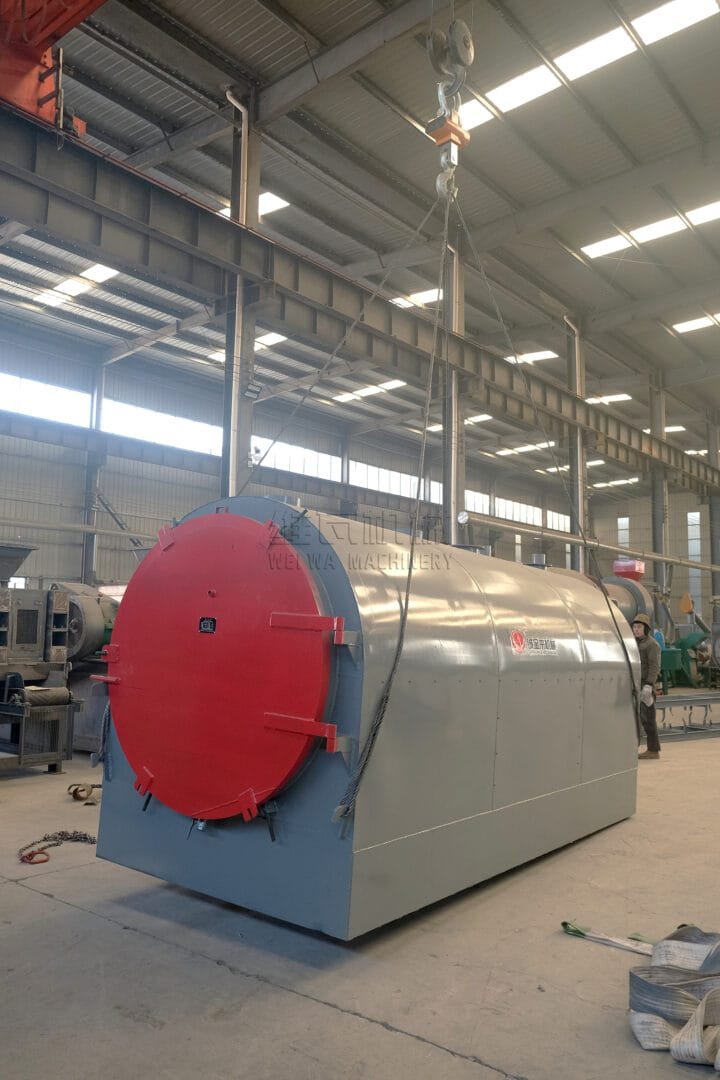
The Shipment and On-Site Trial at the Cameroon Facility
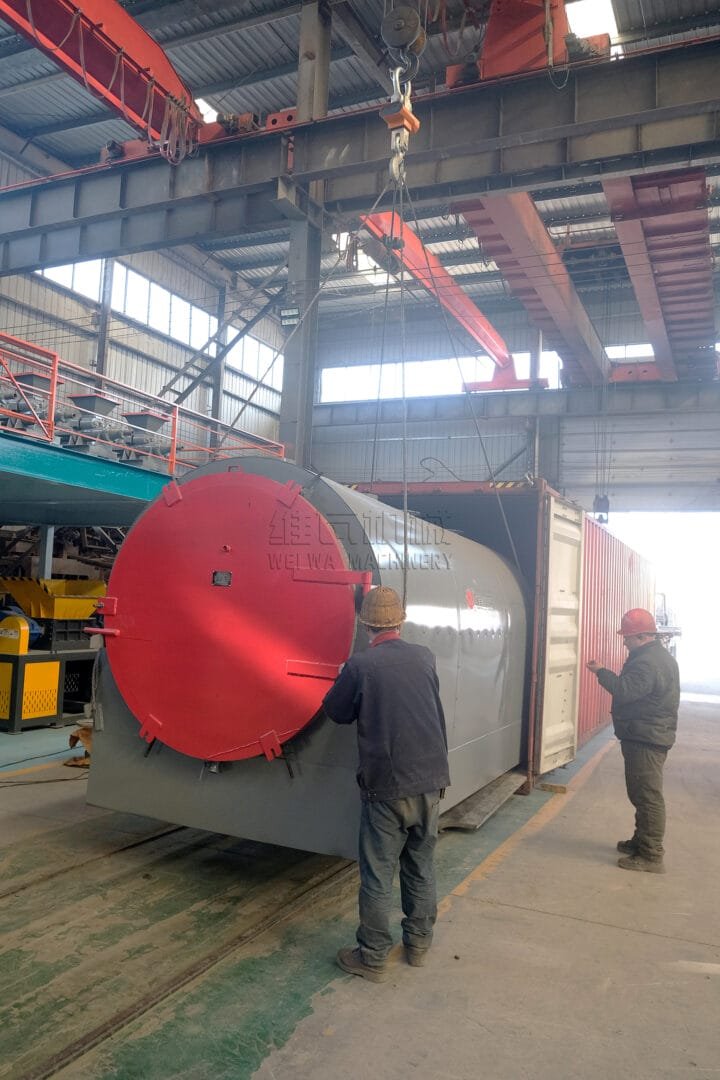
In the third week of June 2026, a Weiwa Machinery 2.0-meter-by-4.5-meter horizontal carbonization furnace — the centerpiece of a making charcoal machine configuration ordered by a growing charcoal production enterprise in Douala — completed its journey from the factory floor in Gongyi, มณฑลเหอหนาน, to an industrial compound on the outskirts of Cameroon’s economic capital. The shipment had traveled by sea to the Port of Douala, cleared customs within three days thanks to Weiwa’s pre-prepared documentation package, and been trucked to the buyer’s site on a flatbed trailer escorted by a Weiwa technical engineer who had flown in two days ahead to prepare the foundation and utility connections.
What made this delivery different from a standard equipment shipment was the trial protocol that Weiwa and the buyer had agreed upon during the negotiation phase. Rather than simply installing the making charcoal machine and departing after a brief commissioning run, the Weiwa engineer would remain on site for twelve days, conducting a structured trial program using the buyer’s actual feedstock — locally sourced wood logs and branches from Cameroon’s abundant timber processing sector — and documenting every parameter from loading density to charcoal yield to burn quality. The buyer, a Cameroonian entrepreneur who had spent three years operating a small-scale sawdust briquette press and selling raw briquettes to household consumers in Douala’s Makepe and Bonaberi districts, wanted to vertically integrate by carbonizing his own briquettes rather than purchasing carbonized charcoal from third-party suppliers whose quality and delivery reliability had become a growing constraint on his business.
The installation itself proceeded without incident. The horizontal carbonization furnace, with its rail-mounted trolley system, barrel-style carbonization chamber, and integrated flue gas recovery circuit, was positioned on a leveled concrete pad and anchored at four points. The refractory lining was inspected for any transit-related cracking — none was found, as Weiwa’s wooden crate packaging with internal bracing had held the furnace immobile throughout the 11,000-kilometer journey. Electrical connections for the temperature monitoring thermocouples and the induced draft fan were completed on the second day, and a cold-run test confirmed that all valves, seals, and the trolley rail alignment were functioning within specification. By the fourth day on site, the furnace was ready for its first hot run with Cameroonian wood.
Why Charcoal Briquette Production Is Surging Across Cameroon?
To understand why a making charcoal machine investment makes sense for briquette manufacturers in Cameroon, one must look at the country’s energy landscape through the lens of both crisis and opportunity. Cameroon, a Central African nation of approximately 29 million people, sits at the intersection of two powerful trends reshaping the continent’s cooking fuel economy. The first is a persistent and worsening deforestation crisis driven in large part by traditional charcoal production. The second is a nascent but rapidly accelerating shift toward manufactured biomass fuels — charcoal briquettes, carbonized agricultural residues, and processed wood charcoal — that offer a pathway to decouple cooking fuel supply from forest depletion.
Cameroon loses an estimated 220,000 hectares of forest annually, with charcoal production for urban markets identified by the Ministry of Forestry and Wildlife as one of the top three drivers alongside agricultural expansion and illegal logging. In the country’s two largest cities, Douala and Yaounde, household charcoal consumption runs into hundreds of tonnes per day, supplied almost entirely by informal producers who cut standing timber, carbonize it in low-efficiency earth-mound kilns that convert only 12% ถึง 18% of the wood’s mass into usable charcoal, and transport the finished product to urban markets over hundreds of kilometers of deteriorating roads. The supply chain is environmentally unsustainable, economically inefficient, and — as Cameroon’s road infrastructure faces increasing strain during the rainy seasons — increasingly unreliable.
A making charcoal machine deployed by briquette manufacturers in Cameroon addresses this supply chain failure at its root. Instead of cutting standing trees, a horizontal carbonization furnace can make charcoal from wood waste — offcuts, กิ่งก้าน, and rejected logs from Cameroon’s large-scale timber industry, which exports sawn timber to markets across Europe and Asia and generates enormous volumes of processing residue in the process. The Douala buyer’s site sits within 40 kilometers of three major sawmills, each of which produces between 8 และ 15 tonnes of wood offcuts daily, much of which is currently burned in open piles or left to rot. Converting this waste stream into commercial charcoal through a proper making charcoal machine does not add to Cameroon’s deforestation burden — it reduces the pressure on standing forests by substituting waste-derived fuel for forest-sourced charcoal in the urban cooking fuel market.
The economic pull is reinforced by Cameroon’s policy direction. The government’s Vision 2035 development framework explicitly identifies biomass energy valorization as a strategic priority, and the Ministry of Energy and Water Resources has begun pilot programs that provide subsidized access to industrial land and simplified environmental permitting for enterprises engaged in waste-to-energy conversion. For briquette manufacturers in Cameroon who can demonstrate that their feedstock comes from processing residues rather than standing timber, the regulatory environment is becoming increasingly supportive — a factor that materially improves the risk profile of a making charcoal machine investment with a multi-year operational horizon.
ก.คืออะไร เตาเผาคาร์บอนแนวนอน and How Does It Make Charcoal from Wood?
A horizontal carbonization furnace is a batch-type thermal processing unit designed to make charcoal from wood and other biomass materials through controlled pyrolysis — the thermochemical decomposition of organic material in an oxygen-limited environment. Unlike traditional earth-mound kilns that bury wood under soil and rely on partial combustion of the feedstock itself to generate heat, a horizontal carbonization furnace uses an external combustion chamber that heats the carbonization vessel indirectly, allowing precise control over temperature ramp rates, peak carbonization temperature, and residence time. This precision translates directly into higher charcoal yields, more consistent product quality, and a dramatically cleaner production process with minimal smoke emission.
The Indirect Heating Principle
The fundamental engineering insight behind a horizontal carbonization furnace is the separation of the heating function from the carbonization function. In the Weiwa design deployed at the Douala site, the furnace body is a horizontal cylindrical steel shell, refractory-lined for thermal insulation and durability, mounted on a structural steel frame approximately 2.4 meters above ground level. Beneath this shell sits a separate combustion chamber — essentially a firebox into which the operator feeds a start-up fuel such as kindling wood or, once the process is running, the combustible gases recovered from the carbonization process itself. Hot combustion gases from this firebox circulate through a jacket surrounding the carbonization chamber, heating the chamber walls which in turn radiate heat inward to the wood charge. At no point do the combustion gases mix with the material being carbonized — the two gas streams are physically separated, which is why the process is described as indirect heating.
This indirect configuration solves the fundamental problem that makes traditional charcoal production inefficient. In an earth-mound kiln, a portion of the wood charge must be burned to generate the heat that carbonizes the remainder, and because combustion and carbonization occur in the same space, the operator has limited control over how much of the feedstock is consumed versus converted. The result is a charcoal yield — the mass of charcoal produced divided by the mass of dry wood input — that rarely exceeds 20% and often falls below 15% in poorly managed kilns. A horizontal carbonization furnace, by contrast, achieves charcoal yields in the range of 28% ถึง 35% on a dry weight basis, nearly doubling the output per tonne of wood input. For briquette manufacturers in Cameroon paying for feedstock by weight, whether in cash or in transport cost, this yield improvement represents a direct and substantial margin enhancement.
Flue Gas Recovery and Self-Sustaining Combustion
The horizontal carbonization furnace’s second defining feature is its smoke recovery and gas recirculation system. As wood heats inside the carbonization chamber, it releases volatile organic compounds — primarily a mixture of combustible gases including methane, carbon monoxide, ไฮโดรเจน, and heavier hydrocarbons — along with water vapor and a small quantity of wood tar in vapor form. In traditional kilns, these volatiles are vented to the atmosphere, contributing to the dense, acrid smoke plumes that make charcoal production one of the most visible sources of air pollution in rural Cameroon.
In the Weiwa making charcoal machine, these gases travel through a duct from the carbonization chamber to a purification train — a series of baffles and condensers that separate tar and water vapor from the combustible gas fraction — and then are piped directly into the combustion chamber beneath the furnace. Once the carbonization process reaches approximately 270 ถึง 300 degrees Celsius and volatile release becomes self-sustaining, the recovered gas supplies enough thermal energy to maintain the carbonization temperature without the need for additional external fuel. The furnace essentially runs on its own by-products for the majority of the carbonization cycle, a feature that reduces operating cost and — critically for Cameroonian operators where purchased fuel represents an ongoing operational expense — eliminates the need to buy firewood or other fuel to sustain the carbonization process after the initial startup phase.
The purification step matters for two reasons beyond energy recovery. First, removing tar from the gas stream before it enters the combustion chamber prevents tar condensation on the burner nozzles, which would otherwise clog within days and require disassembly for cleaning. Second, a cleaner-burning fuel gas produces a cleaner exhaust stream, which is relevant to briquette manufacturers in Cameroon whose operations face increasing scrutiny from environmental regulators and — for those targeting export markets or carbon credit certification — from international auditors who inspect production facilities for compliance with emissions standards.
Raw Materials Cameroon Producers Can Carbonize
One of the horizontal carbonization furnace’s strongest selling points for briquette manufacturers in Cameroon is its feedstock flexibility. The furnace can make charcoal from wood in forms that range from solid logs and branches to compacted briquettes and processed biomass residues, accommodating the diversity of raw material streams that characterize Cameroon’s forestry and agricultural sectors.
Solid wood — the most straightforward feedstock — can be loaded directly into the carbonization chamber either manually or, as configured with the Douala buyer’s furnace, using the rail-mounted trolley system that allows an entire batch of material to be loaded onto a steel cart outside the furnace and then rolled into the carbonization chamber on rails. This trolley loading system is a practical advantage for Cameroonian operators because it reduces the physical labor of loading a hot furnace and shortens the turnaround time between carbonization cycles, enabling higher daily throughput. Wood logs up to approximately 1.2 meters in length and 25 centimeters in diameter can be accommodated in the 2.0-by-4.5-meter chamber, making the furnace compatible with the offcut sizes typically produced by Cameroonian sawmills processing logs from species such as ayous, sapelli, iroko, and azobe.
Beyond solid wood, the making charcoal machine can carbonize a range of other biomass materials. Coconut shells — available in the coastal regions around Douala and Kribi — produce charcoal with exceptionally high fixed carbon content and low ash, commanding premium prices in both domestic and export markets. Palm kernel shells, a by-product of Cameroon’s extensive palm oil industry concentrated in the Southwest and Littoral regions, carbonize reliably in the horizontal furnace and yield charcoal suitable for industrial boiler fuel and activated carbon production. Bamboo, which grows widely across Cameroon’s western highlands and regenerates rapidly after harvesting, can be carbonized successfully when cut to lengths that fit within the chamber dimensions. For the Douala buyer who also operates a sawdust briquette press, the ability to carbonize his own extruded sawdust briquettes in the same furnace that processes solid wood offcuts provides a level of production flexibility that single-feedstock carbonization equipment cannot match. On days when sawmill offcut supply is plentiful, the furnace runs on wood logs; on days when briquette inventory has accumulated, the furnace switches to carbonizing briquettes — the same machine, the same process, a different loading configuration.
The Cameroon Trial — Testing the Making Charcoal Machine with Local Wood
The trial program that Weiwa Machinery conducted at the Douala buyer’s facility was designed to answer the questions that matter most to briquette manufacturers in Cameroon evaluating a making charcoal machine investment: what charcoal yield can be achieved with the specific wood species available at this location, how long does a complete carbonization cycle take from loading to cool discharge, and — most importantly — does the finished charcoal meet the performance expectations of Cameroonian consumers who have spent their lives cooking with traditional lump charcoal and will quickly reject a product that burns too fast, produces too much smoke, or fails to ignite reliably in the metal braziers used in virtually every Cameroonian household.
Feedstock Preparation
The trial ran three carbonization cycles over the course of eight days, each using a different feedstock configuration to map the furnace’s performance envelope. The first cycle used mixed hardwood logs sourced from a nearby sawmill — predominantly ayous with smaller quantities of sapelli and tali offcuts. Ayous, a light, fast-growing timber species widely logged across Cameroon’s forest zone, has a relatively low density and correspondingly low lignin content, making it a useful test of whether the horizontal carbonization furnace could achieve acceptable charcoal density from a low-density feedstock that Cameroon producers frequently encounter in the form of sawmill reject logs. The logs were cut to approximately 80 centimeters in length and split where diameters exceeded 20 centimeters to ensure uniform heat penetration during carbonization.
The second trial cycle used a 50-50 blend of solid wood offcuts and extruded sawdust briquettes produced by the buyer’s existing Weiwa sawdust extruder. This blended load configuration — solid wood in the lower portion of the trolley, briquettes stacked in the upper portion — was intended to simulate a production scenario in which the operator had access to both feedstock streams and wanted to maximize furnace loading density while testing whether briquettes carbonized in the upper, slightly cooler zone of the chamber would achieve the same quality as those in the lower, hotter zone.
The third cycle used exclusively extruded sawdust briquettes, stacked in an engineered pattern with deliberate gaps between briquette rows to allow the circulation of hot gases through the entire charge. This configuration tested the furnace’s performance with the buyer’s primary value-added product — a scenario in which the charcoal briquette production business would purchase carbonized charcoal from external suppliers when sawmill waste was unavailable, but would carbonize its own briquettes in-house whenever feedstock supply permitted.
Trial Production Run and Charcoal Yield Analysis
Each carbonization cycle followed the same standardized procedure: loading the material onto the trolley using a combination of manual stacking and — for the briquette-only cycle — a loading jig that ensured consistent spacing, sealing the furnace door with the high-temperature gasket and toggle clamps that maintain an airtight seal even as the steel shell expands thermally during heat-up, igniting the start-up fire in the combustion chamber using dry kindling, and then monitoring the internal temperature via three thermocouples positioned at the top, middle, and bottom of the carbonization chamber.
Temperature data from the first cycle — the mixed hardwood trial — showed the internal chamber temperature rising from ambient to 100 degrees Celsius in approximately 45 minutes as the charge underwent the drying phase, during which residual moisture in the wood evaporated and was vented. The temperature then climbed steadily through the 200-to-300-degree Celsius range over the subsequent two hours, at which point the volatile release became observable both in the temperature curve — which began to accelerate as exothermic decomposition reactions contributed heat — and in the combustible gas flow to the combustion chamber, which became sufficient to sustain the furnace temperature without external fuel input. The peak carbonization temperature, deliberately limited to 520 degrees Celsius to produce charcoal with the burn characteristics preferred in the Cameroonian household market rather than the higher-temperature industrial charcoal that burns hotter but for shorter duration, was reached at approximately the five-hour mark and held for one hour before the combustion chamber fuel supply was cut and the furnace was allowed to begin its natural cooling cycle.
The charcoal yield from the first cycle — measured as the mass of discharged charcoal expressed as a percentage of the air-dried input mass — was 31.2%, meaning that 3,120 kilograms of charcoal were recovered from 10,000 kilograms of input wood. This figure is consistent with the 28% ถึง 35% yield range that Weiwa’s making charcoal machine typically achieves with hardwood feedstocks and represents approximately double the yield that the same wood species would deliver in a traditional earth-mound kiln operating in Cameroon’s informal charcoal sector. For the buyer, this yield figure translated directly into feedstock cost economics: at the prevailing Douala market price for sawmill offcuts of approximately 15,000 Central African CFA francs per tonne, the feedstock cost per tonne of charcoal produced was approximately 48,000 CFA francs — less than half the wholesale price of a tonne of traditional lump charcoal in the Douala market, which ranged between 110,000 และ 140,000 CFA francs depending on quality and season.
The second cycle, using the blended wood-and-briquette load, produced a yield of 29.8%, slightly lower than the all-wood cycle because the briquettes, being denser than solid wood, retained more heat during the cooling phase and experienced a small amount of post-carbonization oxidation when the furnace door was opened. The third cycle, using exclusively briquettes, delivered the highest yield at 33.5%, reflecting the uniform geometry and density of extruded briquettes which allowed more even heat distribution through the charge and minimized the cold spots that can leave partially carbonized material in the corners of the chamber.
Charcoal Quality Testing and Burn Performance
Yield is a production metric; burn quality is a market metric. The trial’s quality assessment protocol began with a visual and mechanical inspection of the discharged charcoal. Across all three cycles, the charcoal emerged from the furnace with a uniform black coloration, a metallic sheen on fracture surfaces — an indicator of complete carbonization — and minimal cracking or fragmentation. The charcoal was firm to the touch, producing a clean ringing sound when struck, and the cross-sections showed no evidence of the brown or partially carbonized cores that indicate incomplete heat penetration during the carbonization cycle.
Fixed carbon content, measured using a laboratory muffle furnace at the Douala buyer’s facility with support from a local materials testing service, averaged 76.4% for the ayous-dominant charcoal from the first cycle, 78.1% for the blended cycle, และ 79.8% for the briquette-only cycle. These figures place Weiwa’s making charcoal machine output in the high-quality tier for cooking charcoal — fixed carbon above 75% is generally considered the threshold at which charcoal burns hot enough, long enough, and cleanly enough to satisfy the expectations of household cooks who are the ultimate arbiters of charcoal quality in the Cameroonian market.
The practical burn test was conducted using a standard Cameroonian fourneau — the cylindrical metal charcoal stove found in kitchens across Douala, Yaounde, and virtually every other urban and peri-urban settlement in the country. A 500-gram sample of charcoal from each trial cycle was ignited using a small amount of paper and kindling, and the time to reach cooking temperature, the duration of usable heat output, and the quantity of visible smoke were recorded. The ayous charcoal from the first cycle ignited within seven minutes, reached cooking temperature in approximately fourteen minutes, and sustained usable heat output for just over two hours — a burn duration that Cameroonian household cooks consistently rate as sufficient for preparing a full family meal including the staple dishes of ndole, eru, or grilled fish and plantains that form the backbone of the country’s culinary repertoire. The briquette charcoal from the third cycle burned for slightly longer — approximately two hours and twenty minutes — and produced noticeably less visible smoke during the ignition phase, a characteristic that the buyer’s market research had identified as highly valued by urban consumers cooking in enclosed or semi-enclosed kitchen spaces.
Perhaps the most commercially significant result from the burn test was the uniformity of the charcoal pieces. Traditional lump charcoal, produced in earth-mound kilns without temperature control, exhibits wide variation in piece size, ความหนาแน่น, and degree of carbonization — a bag of traditional charcoal typically contains a mixture of well-carbonized lumps, partially carbonized brown ends, and small fragments and dust at the bottom of the bag. The charcoal from Weiwa’s horizontal carbonization furnace, by contrast, was uniformly carbonized throughout each piece, with minimal size variation and almost no dust generation during handling. For the Douala buyer, this uniformity translates into a market positioning advantage: a branded bag of consistently high-quality charcoal can command a price premium and build consumer loyalty in a way that an anonymous bag of variable-quality traditional charcoal cannot.
How Briquette Manufacturers in Cameroon Build a Complete Production Line?
A horizontal carbonization furnace, while operationally independent, is most productive when integrated into a complete charcoal making production line that handles feedstock preparation upstream and product finishing downstream. For briquette manufacturers in Cameroon who want to make charcoal from wood waste at commercial scale, the production line typically spans three process zones.
The feedstock preparation zone handles the receipt, storage, and size reduction of incoming raw material. For the Douala buyer, this zone consists of a covered storage bay where sawmill offcuts are stockpiled and allowed to air-dry to below 25% moisture content before processing, a wood chipper that reduces oversize logs to furnace-compatible dimensions, and a conveyor that moves prepared material to a loading station adjacent to the carbonization furnace. The air-drying step is particularly important in Cameroon’s humid coastal climate, where freshly cut wood can contain more than 50% moisture by weight — carbonizing wood at that moisture level would consume excessive energy in the drying phase and reduce both throughput and charcoal quality.
The carbonization zone contains the horizontal carbonization furnace itself, positioned with sufficient clearance on all sides for safe operation and maintenance access. The flue gas recovery duct runs from the top of the carbonization chamber to the purification train and then to the combustion chamber, forming a closed gas loop that operates under slight negative pressure maintained by the induced draft fan. A temperature monitoring panel displays real-time readings from all three internal thermocouples, and a simple control protocol — developed by Weiwa and documented in the operating manual — guides the operator through the sequence of combustion chamber adjustments that maintain the temperature profile within the target window throughout the carbonization cycle.
The product finishing zone handles charcoal discharge, ระบายความร้อน, และบรรจุภัณฑ์. After a carbonization cycle completes and the furnace has cooled to below 60 degrees Celsius — a process that takes approximately eight to ten hours in Cameroon’s ambient temperatures — the trolley is rolled out on its rails and the charcoal is manually unloaded onto a sorting table. Oversize pieces are broken to bagging size using a simple hand-operated crusher, and the charcoal is packaged into 25-kilogram polypropylene bags for wholesale distribution or 5-kilogram branded bags for retail sale through Douala’s network of neighborhood grocery shops and charcoal vendors.
Briquette manufacturers in Cameroon who operate both a briquette press and a making charcoal machine can close the production loop entirely. Sawmill sawdust is extruded into raw briquettes, the briquettes are carbonized in the horizontal furnace, and the carbonized briquettes are packaged and sold — a fully integrated charcoal briquette production operation in which the only external inputs are waste sawdust acquired at minimal cost and a modest quantity of labor and electricity.
Why Cameroon Buyers Choose Weiwa’s Charcoal Making Machine for Sale?
Weiwa Machinery has supplied charcoal making machines to West and Central African markets for over a decade, and the factors that drive Cameroonian buyers toward Weiwa’s equipment rather than lower-priced alternatives from other manufacturers are consistent across multiple transactions. Price matters, but in the charcoal making machine market, the lifetime cost of ownership — encompassing not just the purchase price but also maintenance cost, downtime frequency, spare parts availability, and technical support responsiveness — matters more.
The first factor is build quality under tropical operating conditions. A making charcoal machine installed in Douala faces an environment that accelerates degradation: ambient humidity that hovers above 80% for much of the year, the saline atmosphere from the city’s coastal location, and the abrasive effects of the fine laterite dust that blows in from unpaved roads during the dry season. Weiwa’s horizontal carbonization furnaces are fabricated from boiler-grade steel plate, the refractory lining is formulated for thermal cycling resistance in humid environments where thermal shock from rain hitting a hot furnace shell is a real risk, and all external steel surfaces receive a multi-layer epoxy coating with a zinc-rich primer tested for corrosion resistance in accelerated weathering chambers simulating years of tropical exposure. These are not decorative features — for a Cameroonian operator whose furnace sits outdoors under a simple canopy roof, corrosion resistance is the difference between a furnace that requires a repaint at the five-year mark and one that develops structural rust perforations within two years.
The second factor is the gas recovery system’s reliability. Many lower-cost horizontal carbonization furnace designs include a basic smoke duct that routes volatiles to the combustion chamber, but without the purification stage — the tar condensers and baffles — that prevent tar fouling of the burner nozzles and duct walls. Operators who have used both designs report that an unpurified gas recovery system requires burner cleaning every three to five cycles and duct cleaning every twenty to thirty cycles, with each cleaning episode consuming several hours of production time. Weiwa’s purified gas system, by separating tar from combustible gas before it reaches the combustion chamber, extends the cleaning interval to approximately fifty cycles on the burner side and well over one hundred cycles on the duct side. Over the multi-year operating life of a making charcoal machine, the cumulative production hours lost to maintenance downtime represent a cost that far exceeds any purchase price savings from a cheaper furnace.
The third factor is the commissioning support and operator training that accompany every Weiwa charcoal making machine for sale. For the Douala buyer, the twelve-day trial program was not a premium service sold as an extra — it was the standard commissioning protocol that Weiwa provides to every customer. The engineer who conducted the trial trained the buyer’s four-person production team on furnace startup and shutdown procedures, temperature monitoring and combustion chamber adjustment, the recognition of normal versus abnormal carbonization cycle indicators, and routine maintenance tasks including refractory inspection, gasket replacement, and gas duct cleaning. All training materials were provided in both English and French — Cameroon’s two official languages — ensuring that the buyer’s team could reference documented procedures without language barriers that might otherwise lead to operational errors.
The fourth factor, and one that holds particular weight for briquette manufacturers in Cameroon who are building production businesses from the ground up, is Weiwa’s willingness to provide production line design beyond the furnace itself. The Douala buyer did not simply purchase a horizontal carbonization furnace — he purchased a charcoal making machine configuration that included advice on site layout, feedstock storage and handling, charcoal cooling and packaging workflows, and even charcoal quality control sampling procedures. This engineering support, delivered as part of the equipment sale rather than billed separately, reduces the risk that a buyer will purchase the right furnace but install it in the wrong location, with inadequate feedstock flow, or without the auxiliary equipment needed to achieve the throughput that the furnace is capable of delivering.
The Business Case for Charcoal Briquette Production in Cameroon
For briquette manufacturers in Cameroon evaluating whether to add carbonization capacity to an existing briquetting operation or to enter charcoal briquette production as a new venture, the business case for a making charcoal machine investment rests on the margin spread between raw briquettes and carbonized charcoal.
Raw sawdust briquettes — sometimes called white briquettes in West and Central African markets — are a saleable product in their own right. They can be burned directly in stoves, and in some Cameroonian cities, a market for white briquettes has developed among price-sensitive consumers who are willing to tolerate the slightly longer ignition time and the visible smoke that raw briquettes produce compared to carbonized charcoal. อย่างไรก็ตาม, the price that white briquettes command in the Douala market — approximately 65,000 ถึง 80,000 CFA francs per tonne — is substantially lower than the 110,000 ถึง 140,000 CFA francs per tonne that carbonized charcoal fetches. The price differential reflects the consumer’s revealed preference: carbonized charcoal burns hotter, ignites faster, produces less smoke, and delivers a cooking experience that more closely matches the traditional lump charcoal that Cameroonian households have used for generations.
Carbonizing a tonne of white briquettes in a horizontal carbonization furnace converts approximately 300 ถึง 350 kilograms of that tonne into high-quality charcoal. The remaining mass — mostly water and volatile organic compounds — is driven off during the carbonization process. At first glance, อัน 65% ถึง 70% mass loss might seem to undermine the economic case for carbonization, but the math works in the opposite direction because the price per tonne roughly doubles while the mass loss is less than two-thirds. A tonne of white briquettes sold raw at 75,000 CFA francs generates 75,000 CFA francs of revenue. That same tonne, carbonized to 330 kilograms of charcoal and sold at 125,000 CFA francs per tonne, generates approximately 41,250 CFA francs of revenue — less, not more. This calculation is why many small-scale briquette producers in Cameroon sell their briquettes raw rather than carbonizing them.
But this calculation assumes that the feedstock is purchased white briquettes, which is not how an integrated charcoal briquette production operation works. The Douala buyer produces his own raw briquettes from sawdust that costs him approximately 5,000 CFA francs per tonne in transport — effectively zero material cost, since the sawmills are paying him a small tipping fee to remove the sawdust from their sites. His raw briquette production cost, including labor, ไฟฟ้า, and equipment depreciation, is approximately 28,000 CFA francs per tonne. Carbonizing these briquettes in his own making charcoal machine adds a further processing cost — predominantly labor for loading and unloading, plus a small allocation for furnace maintenance — of approximately 15,000 CFA francs per tonne of input briquettes. The all-in cost of producing a tonne of raw briquettes and then carbonizing them is therefore approximately 43,000 CFA francs. The carbonization process converts one tonne of raw briquettes into 330 kilograms of charcoal — equivalent to 0.33 tonnes of finished product. The all-in production cost per tonne of finished charcoal is therefore 43,000 divided by 0.33, or approximately 130,000 CFA francs. At a wholesale selling price of 125,000 CFA francs per tonne, the operation breaks even.
The missing variable, however, is the sale of the raw briquettes that are not carbonized. If the buyer carbonizes one batch of briquettes and sells the next batch raw at 75,000 CFA francs per tonne, the raw briquette revenue subsidizes the carbonized charcoal margin. And if the buyer sources solid wood offcuts — which cost even less than sawdust on a per-tonne basis because sawmills are actively seeking disposal routes for offcuts — and carbonizes those directly without the intermediate briquetting step, the cost structure shifts further: direct wood-to-charcoal carbonization bypasses the briquetting cost entirely, and the charcoal yield on a dry wood input basis is in the 28% ถึง 35% range, meaning that a tonne of wood offcuts costing perhaps 15,000 CFA francs delivered yields 300 ถึง 350 kilograms of charcoal at a total production cost — including labor, furnace operation, and packaging — of approximately 80,000 ถึง 95,000 CFA francs per tonne of finished charcoal, leaving a gross margin of 25% ถึง 40% at Douala wholesale prices.
The business case, then, is not about replacing white briquette sales with charcoal sales. It is about operating a flexible production system in which the making charcoal machine can process whichever feedstock is most economically favorable at any given time — solid wood offcuts when sawmill supply is abundant, extruded briquettes when briquette inventory has accumulated, or a blend of both to maximize furnace loading density. This feedstock flexibility, combined with the ability to sell both raw briquettes and carbonized charcoal into different market segments at different price points, creates a more resilient business than either a pure briquetting operation or a pure charcoal carbonization operation could achieve on its own.
Starting Your Charcoal Business in Cameroon with Weiwa Machinery
For Cameroonian entrepreneurs considering an investment in charcoal briquette production, the path from initial inquiry to operational production with a Weiwa making charcoal machine follows a structured process that minimizes the risk of misconfiguration — the most common cause of underperforming charcoal production investments, in which a buyer purchases equipment that is technically functional but poorly matched to their specific feedstock, production volume targets, and market requirements.
The first step is a feedstock and market assessment. Weiwa’s application engineering team works with the prospective buyer to quantify the available raw material supply: what types of wood waste or biomass are available, in what volumes, at what delivered cost, and with what seasonal variability. In Cameroon, this assessment typically identifies sawmill offcuts, ขี้เลื่อย, หอยเคอร์เนลปาล์ม, and coconut shells as the most accessible feedstocks, with volumes and costs varying by region — sawmill residues are most abundant in the timber-producing East and South regions, while palm kernel shells concentrate around the palm oil mills of the Southwest and Littoral regions. Simultaneously, the market assessment maps the buyer’s target customer segments: household consumers purchasing charcoal in 5-kilogram and 25-kilogram bags, commercial restaurants and street food vendors purchasing in larger volumes, and — for buyers with sufficient production scale — export buyers in neighboring countries or the Middle East who purchase container-load quantities.
With the feedstock and market baselines established, the production line is configured to match. A buyer whose primary feedstock is solid wood offcuts and whose primary market is household consumers in Yaounde might configure a 2.0-by-4.5-meter horizontal carbonization furnace with a wood chipper and bagging station, producing approximately 8 ถึง 10 tonnes of charcoal per day of furnace input. A buyer whose primary feedstock is palm kernel shells and whose primary market is industrial boiler fuel might configure a larger 2.0-by-6.0-meter furnace with mechanized loading and a bulk-bag filling system. A buyer who, like the Douala entrepreneur, operates both a briquette press and a making charcoal machine, would configure an integrated line with a crusher, เครื่องเป่า, sawdust extruder, and carbonization furnace, producing both raw briquettes and carbonized charcoal from a single feedstock stream.
Installation and commissioning follow the standard Weiwa protocol: the furnace arrives at the buyer’s site in Cameroon, a Weiwa engineer travels to the site for installation supervision and commissioning, trial production runs are conducted using the buyer’s actual feedstock, process parameters are calibrated and documented, and the buyer’s production team is trained on all aspects of operation, การซ่อมบำรุง, and quality control. This on-site support, standard with every charcoal making machine for sale, continues remotely after the engineer departs, with Weiwa’s technical support team available by phone, WhatsApp video call, and email to address operational questions, diagnose production issues, and guide the buyer through maintenance procedures that extend beyond routine upkeep.
เกี่ยวกับ เครื่องจักร Weiwa
Henan Weiwa Machinery Manufacturing Co., จำกัด. has spent more than three decades designing, การผลิต, and supporting the machinery that converts raw biomass into formed charcoal for household, commercial, and industrial markets worldwide. Based in Gongyi City, มณฑลเหอหนาน, the company’s 112,000-square-meter production facility houses over 200 machine tools and a dedicated engineering team of more than 100 research and development professionals. The product portfolio spans horizontal carbonization furnaces, เตาเผาคาร์บอนอย่างต่อเนื่อง, lifting carbonization furnaces, sawdust extrude machines, charcoal extruders, ball charcoal briquette presses, hydraulic shisha press machines, wood crushers, rotary dryers, and complete turnkey charcoal production lines — all designed for reliable operation under continuous industrial production conditions.
Weiwa Machinery’s equipment is in active commercial use across more than 130 ประเทศ, serving customers from single-furnace startups to multi-line charcoal manufacturing enterprises with annual output measured in thousands of tonnes. Five overseas branch offices provide regional sales and technical support, and a strategically managed spare parts inventory ensures that the highest-wear components — furnace gaskets, thermocouples, refractory repair materials, and trolley wheel bearings — can be shipped promptly to customers in Cameroon and across the Central African region when they are needed.
The company’s approach to the Cameroonian market reflects a broader operating philosophy: a making charcoal machine is not a commodity item to be sold and shipped, but a production asset whose value is realized through correct configuration, proper installation, trained operation, and sustained technical partnership. From the initial feedstock analysis through commissioning and well into multi-year operational support, Weiwa Machinery works alongside its customers to ensure that every charcoal making machine delivers the throughput, ผลผลิต, and product quality that the buyer’s business plan requires.
ม็อบ / WhatsApp: +8613838093177 อีเมล: info@cjlmachineGroup.com Website: https://cjljx.com Product Page: https://cjljx.com/product/horizontal-carbonization-furnace


 Wechat

 +8615937143060
