


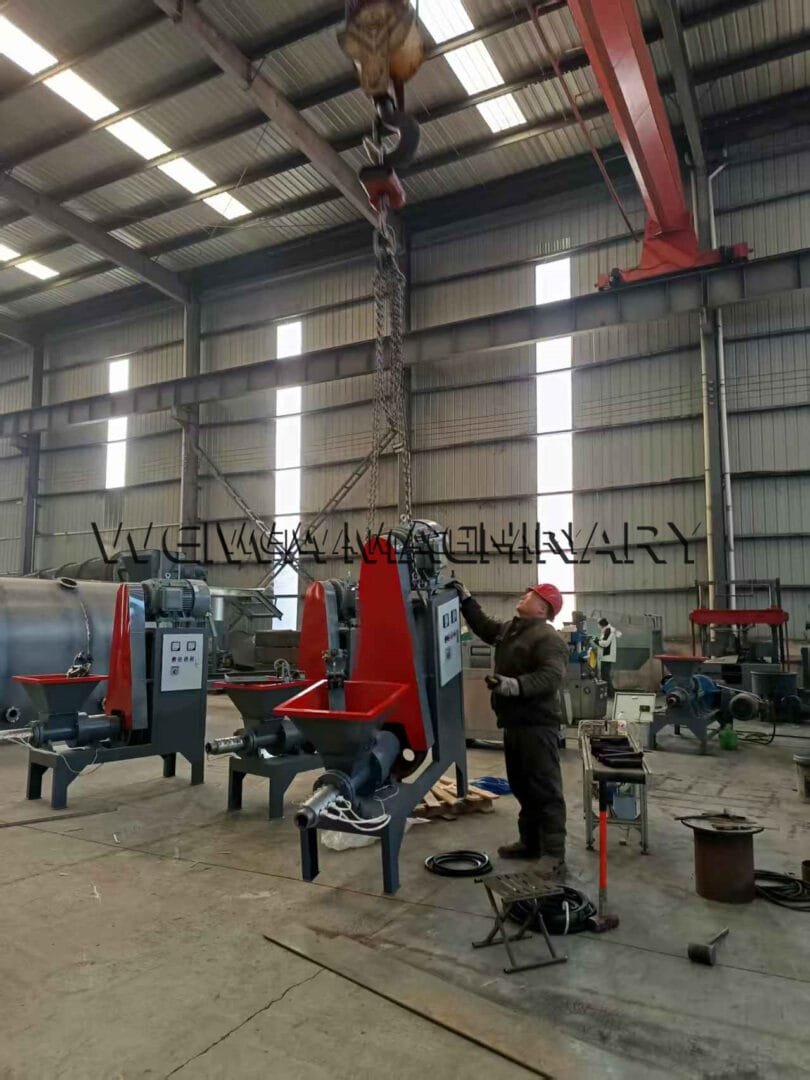
The Shipment Scene at Weiwa Machinery Factory
On a bright morning in mid-July 2026, the sprawling production yard of Weiwa Machinery in Gongyi City, มณฑลเหอหนาน, was alive with the hum of overhead cranes and the measured commands of logistics coordinators. A complete sawdust extrude machine production line — carefully disassembled, wrapped in protective polyethylene film, and secured inside fumigated wooden crates — was being loaded into three 40-foot high-cube containers bound for the Port of Lagos, Nigeria. The destination was a rapidly growing charcoal production enterprise in Ogun State, where a Nigerian entrepreneur had spent the better part of a year planning his entry into the country’s booming manufactured-charcoal market with a sawdust briquette machine operation that would convert locally abundant sawmill waste into premium cooking fuel.
The shipment represented more than just machinery in transit. It was the culmination of months of collaborative engineering: Weiwa’s technical team had worked closely with the Nigerian buyer to design a production line tailored to the specific characteristics of the sawdust available at his site — predominantly Gmelina arborea and teak residues from nearby timber processing mills, with moisture content averaging 35% in the rainy season and dropping to 18% during the dry harmattan months. A standard off-the-shelf sawdust briquetting machine configuration would not have handled that moisture range reliably, so the line incorporated a reinforced rotary drum dryer with variable-speed control and an oversized cyclone separator designed to cope with the fine, sticky dust that tropical hardwoods produce when processed at industrial scale.
As container doors were sealed and customs documentation was verified, a Weiwa commissioning engineer was already preparing his travel documents for the follow-up trip to Ogun State, where he would spend ten days overseeing installation, calibrating the sawdust extruder to local feedstock, and training the buyer’s production team of six operators. This end-to-end approach — from factory floor to customer site, with technical support extending well beyond the point of sale — has defined Weiwa Machinery’s engagement with the Nigerian market and with over 130 countries worldwide where the company’s sawdust briquette machines and carbonization equipment are in active commercial operation.
Why Nigeria Is Embracing Sawdust Briquette Machines?
To understand why a sawdust extrude machine in Nigeria represents a compelling business proposition, one must first understand the structural dynamics of the country’s cooking fuel economy. Nigeria, with a population exceeding 220 million and an urbanization rate that has seen cities like Lagos, Kano, and Ibadan expand at double-digit rates over the past two decades, consumes an estimated 30 ถึง 35 million tonnes of wood fuel annually. The vast majority of this consumption takes the form of lump charcoal and firewood burned in traditional stoves, a pattern that has persisted despite decades of government-led kerosene and LPG promotion campaigns aimed at reducing dependence on solid biomass fuels.
The environmental cost of this dependence is visible across Nigeria’s savanna and forest zones. Deforestation rates in the country rank among the highest globally, driven in significant part by charcoal production for urban markets. In states like Kwara, Oyo, and parts of the Niger Delta, the charcoal trade has transformed once-forested landscapes into degraded scrubland. The Nigerian Conservation Foundation estimates that the country loses approximately 350,000 ถึง 400,000 hectares of forest cover annually, with charcoal production representing a major contributing factor. A sawdust briquette machine offers a tangible intervention in this cycle — not by asking Nigerians to abandon charcoal cooking, which remains deeply embedded in culinary culture and household economics, but by shifting the feedstock base from standing timber to sawmill waste that is currently burned in open piles or left to decompose.
The economic logic is equally compelling. Nigeria’s timber industry generates an enormous volume of sawdust as a processing by-product. In sawmill clusters like the ones in Ondo State’s Ore timber market or the Ijebu-Ode processing zone in Ogun State, mountains of sawdust accumulate daily, often disposed of at a cost to mill operators or simply piled and burned. For an entrepreneur operating a sawdust briquetting machine, this material represents a raw material stream that can often be acquired at minimal or zero cost, sometimes even with a tipping fee from the sawmill operator who would otherwise pay for disposal. Converting this waste sawdust into formed charcoal briquettes through a sawdust extruder transforms a liability into a product that retails alongside conventional lump charcoal in every urban market in the country.
The regulatory environment is also shifting in favor of manufactured charcoal. Nigeria’s National Biofuel Policy and the broader Energy Transition Plan recognize biomass briquetting as a priority pathway for clean cooking fuel development. Several state governments, including those in Ogun, Lagos, and Cross River, have begun offering incentives to briquette manufacturers, including access to industrial land at concessional rates and streamlined environmental permitting for enterprises that use waste-derived feedstocks. A sawdust extrude machine in Nigeria thus operates within a policy framework that is increasingly supportive rather than obstructive — a consideration that matters greatly to entrepreneurs evaluating a capital investment with a multi-year payback horizon.
What Is a Sawdust Extrude Machine and How Does It Work?
A sawdust extrude machine — often referred to interchangeably as a sawdust extruder, sawdust briquette machine, or sawdust briquetting machine — is the core forming equipment in a charcoal production line that converts loose, powdered biomass into dense, uniformly shaped fuel sticks. The machine operates on the principle of screw extrusion: a large-diameter screw rotates inside a heated barrel, compressing sawdust particles under high pressure while simultaneously subjecting them to elevated temperatures that plasticize the natural lignin contained in wood fiber. This lignin, which functions as the plant’s own structural binding polymer, softens under heat and pressure and then re-solidifies as the extruded material cools, creating a rigid briquette that holds its shape without requiring any synthetic binder or chemical additive.
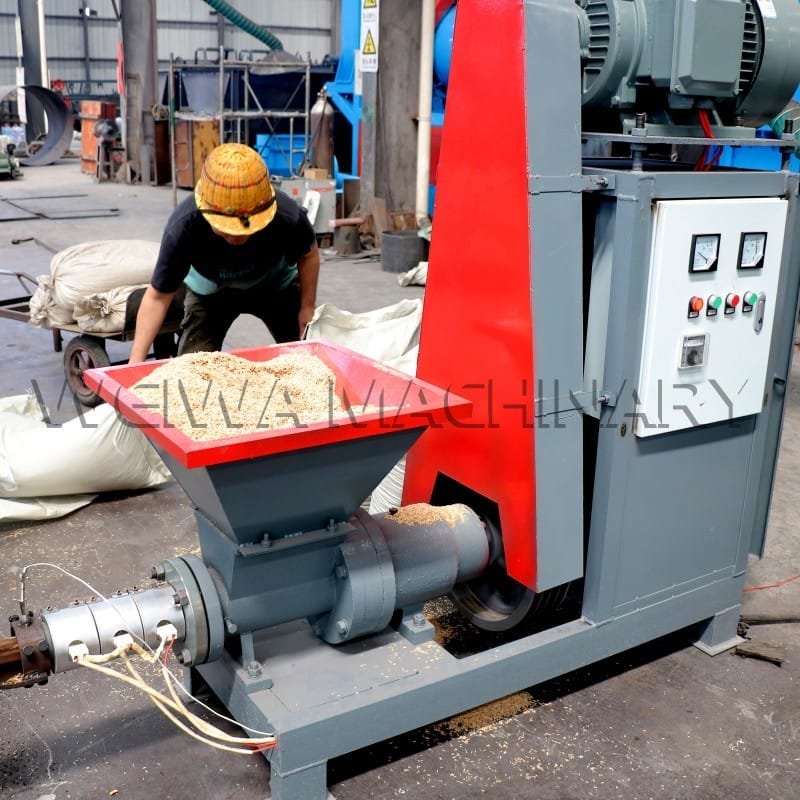
The Screw Extrusion Principle
The operating mechanism of a sawdust briquette machine centers on the interaction between three variables: compression ratio, อุณหภูมิ, and residence time. Raw sawdust, pre-dried to a moisture content of approximately 8% ถึง 12%, enters the machine through a feed hopper at the top of the barrel. A rotating screw — typically a variable-pitch design in which the flight depth decreases progressively from the feed zone to the discharge end — conveys the material forward while simultaneously reducing the available volume, thereby generating compression forces in the range of 30 ถึง 50 megapascals. At the discharge end of the barrel, a heating collar or resistance band maintains the die zone at a temperature between 280 และ 320 องศาเซลเซียส, the range at which wood lignin transitions from a glassy solid to a viscous fluid capable of coating and binding individual sawdust particles.
The extruded material emerges from the die as a continuous, dense rod — typically hexagonal, เป็นสี่เท่า, or pentagonal in cross-section, with a central hole running through the entire length. This hollow-core geometry is not an aesthetic choice but a functional design feature: the central channel facilitates uniform carbonization during the subsequent furnace stage by allowing heat to penetrate the briquette from both the exterior surface and the interior void, reducing the time required for complete carbonization and minimizing the risk of under-carbonized cores that would compromise the finished charcoal’s burn quality.
A well-engineered sawdust extruder, such as the Weiwa Machinery models rated at 18.5 ถึง 37 kilowatts depending on throughput capacity, can process between 220 และ 380 kilograms of dried sawdust per hour into formed briquettes. The machine’s output rate depends on feedstock particle size uniformity, moisture content consistency, and the specific die geometry selected. Weiwa’s sawdust extrude machines incorporate an integrated temperature control system with digital readout and automatic shut-off, ensuring that the die zone remains within the optimal thermal window throughout the production shift and eliminating the quality variability that occurs when operators attempt to manage temperature through manual adjustments.
Raw Materials Compatible with Sawdust Extruders
While sawdust — particularly from medium-density hardwoods — is the most common feedstock for a sawdust briquette machine, the equipment’s versatility extends across a broad spectrum of agricultural and forestry residues. แกลบ, groundnut shells, coffee husks, ชานอ้อยอ้อย, หอยมะพร้าว, ฝุ่นละอองไม้ไผ่, หอยเคอร์เนลปาล์ม, corn cobs, ก้านฝ้าย, and tea waste can all be processed through a sawdust briquetting machine, either individually or in blended formulations. The key requirement is consistent particle size — below 5 millimeters in the largest dimension — and appropriate moisture content. Materials that deviate substantially from sawdust in their lignin content, such as rice husks which are high in silica and low in natural binding agents, may require adjustments to die temperature or screw compression ratio, adjustments that Weiwa Machinery’s engineering team configures during the pre-shipment testing phase using samples of the customer’s actual feedstock.
For the Nigerian buyer in Ogun State, the primary feedstock would be Gmelina sawdust supplemented with teak residues — both abundant in the local sawmill industry. Gmelina, a fast-growing plantation hardwood widely cultivated across West Africa for timber and pulp, produces a sawdust that flows well through the extruder barrel and contains sufficient lignin to form strong briquettes at the standard 300-degree Celsius die temperature. Teak sawdust, being denser and more resinous, produces briquettes with slightly higher calorific value and longer burn duration, making a Gmelina-teak blend an attractive formulation for a product positioned as premium cooking charcoal.
A Complete Sawdust Briquetting Machine Production Line Explained
A sawdust extrude machine, despite being the heart of the operation, cannot function in isolation. A commercially viable charcoal production line built around a sawdust briquetting machine comprises four sequential process stages, each requiring its own specialized equipment and each influencing the quality and consistency of the final product.
Step One — Raw Material Crushing
The first stage in any sawdust briquette machine production line is size reduction. Sawmill sawdust, while already fine relative to wood chips or whole branches, often contains oversize particles, splinters, and occasional foreign material that would obstruct the extruder screw or produce briquettes with inconsistent density. A hammer mill or wood crusher reduces incoming material to a uniform particle size passing through a 3- to 5-millimeter screen. For Nigerian operations sourcing sawdust from multiple mills with varying cutting practices, this crushing stage also serves to homogenize the feedstock, eliminating the density variations that would otherwise cause the sawdust extruder to produce briquettes of uneven weight and burn characteristics.
Weiwa Machinery supplies wood crushers in a range of capacities matched to the throughput of the downstream sawdust briquetting machine. For the Ogun State delivery, a 15-kilowatt hammer mill with a cyclone discharge and dust collection bag was included, sized to supply sufficient crushed material to keep the sawdust extruder operating continuously across an eight-hour shift without material starvation.
Step Two — Drying to Optimal Moisture
Moisture control is arguably the single most critical variable affecting sawdust briquette machine performance. Feedstock entering the extruder at moisture levels above 12% causes steam generation inside the compression zone, which creates voids and cracks in the extruded briquette and, in severe cases, can cause explosive decompression at the die face that sprays partially formed material across the production floor. Conversely, excessively dry sawdust — below 6% moisture — lacks the thermal conductivity needed for efficient heat transfer through the particle mass inside the barrel, resulting in incomplete lignin plasticization and briquettes that crumble during handling.
The Weiwa dryer deployed in the Nigerian line is a rotary drum design, approximately 8 meters in length with a 1.2-meter diameter, heated by a biomass furnace that burns the same sawdust it is drying — a closed-loop energy arrangement that eliminates the need for purchased fuel. A variable-frequency drive on the drum rotation motor allows the operator to adjust residence time to match the incoming moisture content, which in Ogun State’s tropical climate can swing from under 20% during the dry season to over 40% during the rainy months. The dryer discharges into a cyclone separator that drops dried sawdust into a buffer silo feeding the sawdust extrude machine, with exhaust air passing through a bag filter before release.
Step Three — High-Pressure Extrusion Forming
With feedstock crushed to uniform particle size and dried to optimal moisture, the material enters the sawdust briquette machine for the core forming operation. The screw rotates inside a heated barrel, compressing and plasticizing the sawdust before forcing it through a shaped die that determines the final briquette cross-section. The Nigerian line was configured with a hexagonal die producing briquettes of 50 millimeters in diameter with a 16-millimeter central hole, a format that has proven popular in West African charcoal markets because the hexagonal shape allows tight packing in bags while the central hole ensures reliable ignition and steady combustion in the simple metal stoves used across the region.
The Weiwa sawdust extruder in this shipment — a Model 50 rated at 18.5 ถึง 22 kilowatts — is equipped with an automatic temperature controller, a reinforced screw manufactured from wear-resistant alloy steel with a service life of approximately 1,200 ถึง 1,500 tonnes of throughput before resurfacing or replacement is required, and a water-cooled discharge chute that rapidly cools the extruded briquettes to handling temperature, preventing deformation of the still-warm material as it stacks.
Step Four — Carbonization into Finished Charcoal
The extruded sawdust briquettes, at this stage, are not yet charcoal. They are dense biomass logs — sometimes called white charcoal or raw briquettes — that must undergo carbonization in a furnace to convert the wood fiber into the high-carbon, low-volatile material that consumers recognize as cooking charcoal. The Nigerian production line includes a horizontal carbonization furnace, a batch-type unit in which stacked briquettes are heated in an oxygen-limited environment to temperatures between 450 และ 550 degrees Celsius over a cycle of approximately 6 ถึง 8 hours.
During carbonization, volatile organic compounds are driven off as combustible gases that can be recirculated to fuel the furnace itself, reducing external energy input. The process increases the fixed carbon content of the material from roughly 18% in raw sawdust to over 75% in finished charcoal, while simultaneously reducing volatile matter that would otherwise produce smoke during cooking. The result is a charcoal briquette that ignites reliably, burns with minimal visible smoke, and delivers a calorific value approximately 20% higher than conventional lump charcoal produced from the same wood species — a performance advantage that directly addresses one of the most common consumer complaints about traditional charcoal in Nigerian markets.
The Nigerian Charcoal Market: Demand Drivers and Business Potential
The commercial opportunity for a sawdust extrude machine in Nigeria extends well beyond the simple substitution of waste-derived briquettes for forest-sourced lump charcoal. Nigeria’s charcoal market is undergoing a structural transformation driven by urbanization, rising consumer expectations for fuel quality, and the increasing unreliability of traditional charcoal supply chains as deforestation pushes production further from urban consumption centers.
In Lagos, Africa’s largest city with an estimated population exceeding 20 ล้าน, the daily charcoal throughput at major wholesale markets — including the Mile 12 and Oyingbo markets — runs into hundreds of tonnes. Retail prices for a standard 25-kilogram bag of lump charcoal fluctuate seasonally, spiking during the rainy season when rural roads become impassable and charcoal producers in the hinterland cannot transport their output to urban buyers. During these price spikes, which can see bag prices increase by 40% or more, manufactured briquettes from a sawdust briquetting machine operation located closer to market — as the Ogun State buyer’s facility would be, sitting approximately 80 kilometers from Lagos — command a premium and sell without price resistance.
The hotel, ร้านอาหาร, and catering sector — known in Nigerian commercial parlance as the HORECA segment — represents a particularly attractive customer base for sawdust briquette machine operators. Commercial kitchens in Lagos, Abuja, and Port Harcourt consume charcoal on a scale that dwarfs household use: a single medium-sized restaurant grilling suya or roasting fish can burn through 50 ถึง 80 kilograms of charcoal in an evening. For these commercial buyers, the purchase decision is driven not by sentiment but by cost per cooking hour and supply reliability, two metrics on which consistently manufactured briquettes outperform irregular lump charcoal, where bag-to-bag variation in density, ความชื้น, and burn duration forces kitchen managers to adjust cooking times and charcoal replenishment schedules unpredictably.
The export angle should not be overlooked either. Nigerian-manufactured charcoal already flows to markets in Niger, Chad, and Benin, and — subject to certification requirements around sustainable sourcing — to the Middle East and European Union. A sawdust briquetting machine operation using sawmill waste as feedstock has a straightforward sustainability narrative that simplifies compliance with emerging EU deforestation-free supply chain regulations, which will increasingly restrict market access for charcoal produced from unsustainably harvested timber. For a Nigerian entrepreneur thinking beyond the domestic market, a sawdust extruder represents not just a manufacturing asset but a platform for export-oriented value addition.
Why Nigerian Entrepreneurs Choose Weiwa Machinery’s Sawdust Extruder?
Nigeria is not a new market for Weiwa Machinery. The company has supplied sawdust extrude machines, เตาถ่าน, and complete charcoal production lines to customers across West Africa for over a decade, building a track record that newer entrants to the equipment supply business cannot match. Several factors consistently emerge in Nigerian buyers’ decision-making when they select a Weiwa sawdust briquette machine over competing options.
The first factor is machine reliability in tropical operating conditions. A sawdust briquette machine installed in Ogun State faces challenges that a machine in temperate Henan Province never encounters: ambient humidity that accelerates corrosion on unprotected steel surfaces, fine abrasive dust that can infiltrate bearing housings, and electrical supply that — despite improvements in Nigeria’s grid infrastructure — still requires voltage stabilization equipment to protect motor windings from the fluctuations that are a fact of life in a country where generator backup remains standard practice for industrial operations. Weiwa’s sawdust extruders are built with these conditions in mind: the electrical control cabinet is rated IP54 for dust and moisture ingress protection, the main drive motor is wound for voltage tolerance of plus or minus 10% without performance degradation, and exposed steel surfaces receive a multi-coat epoxy paint system tested for corrosion resistance in salt-spray chambers simulating years of tropical exposure.
The second factor is the availability of after-sales technical support and spare parts. For a Nigerian charcoal producer whose sawdust briquetting machine represents the sole source of production capacity, a machine that sits idle while parts are shipped from China imposes a daily revenue loss that can quickly erode the business case for the investment. Weiwa maintains a strategic spare parts inventory covering the highest-wear components — extruder screws, heating collars, die inserts, and bearing sets — and ships replacement parts by air freight on a same-day or next-day basis when a customer reports a critical need. The company’s commissioning engineers, during their on-site visits, also train the customer’s maintenance team to perform routine preventative maintenance and to identify early-warning signs of component wear before they progress to the point of failure.
The third factor, and one that Nigerian buyers specifically cite as differentiating Weiwa from lower-priced competitors, is the company’s willingness to design a production line around the customer’s specific feedstock and production goals rather than shipping a standard configuration and leaving the buyer to make it work. The Ogun State production line, with its oversized dryer capacity for rainy-season moisture management, its cyclone dust collection system modified for the sticky characteristics of tropical hardwood dust, and its carbonization furnace with a gas recirculation circuit optimized for Gmelina volatiles, is a product of this collaborative engineering approach. A standard sawdust briquette machine would have produced briquettes; a Weiwa designed line produces briquettes at the throughput, คุณภาพ, and cost that the buyer’s business plan requires.
Starting Your Charcoal Business in Nigeria with Weiwa Machinery
For an entrepreneur evaluating the entry into charcoal manufacturing with a sawdust extrude machine in Nigeria, the investment journey typically begins not with equipment selection but with feedstock mapping. Before a single machine specification is discussed, Weiwa’s application engineers work with the prospective buyer to quantify the available sawdust supply within economic transport distance of the proposed production site: what wood species, in what volumes, at what moisture content, and at what cost — or in many cases, at what avoided disposal cost. This feedstock audit establishes the technical and economic foundation on which all downstream equipment decisions are built.
With the feedstock baseline established, the production line is configured to match both the available raw material and the target market. A buyer planning to supply household consumers in a specific Nigerian city might configure a sawdust briquetting machine with a 50-millimeter hexagonal die producing approximately 800 ถึง 1,000 briquettes per hour bound for retail bags. A buyer targeting the commercial restaurant segment might specify a 70-millimeter die producing larger, longer-burning briquettes at a lower piece count but higher weight throughput. The sawdust extruder itself is dimensionally the same machine; it is the die geometry, the dryer throughput, and the carbonization furnace cycle time that scale with the specific product-market fit.
Weiwa Machinery provides, as part of every sawdust briquette machine order, a comprehensive package of startup support services. The commissioning engineer travels to the customer site, oversees equipment installation and alignment, runs trial production using the customer’s own feedstock, calibrates all process parameters, and certifies that the line is producing output meeting the agreed quality specifications. Operator training covers machine startup and shutdown procedures, process adjustment for feedstock variations, routine maintenance tasks with illustrated checklists, and troubleshooting of common issues such as die blockage, screw wear detection, and temperature control anomalies. The training documentation is provided in English — Nigeria’s official language and the language of industrial operations — ensuring that production teams can reference procedures without translation gaps.
Ongoing support after commissioning includes remote video diagnosis of production issues, annual preventative maintenance visits for customers operating at high throughput, and access to Weiwa’s growing library of technical bulletins documenting process optimizations developed through experience with sawdust extrude machine installations across Africa, Asia, and South America. This continuity of support transforms a one-time equipment purchase into a sustained production partnership — a relationship model that has proven particularly valued in Nigeria, where the availability of reliable technical support can make the difference between a charcoal production business that thrives and one that struggles through extended downtime.
เกี่ยวกับ เครื่องจักร Weiwa
Henan Weiwa Machinery Manufacturing Co., จำกัด. has dedicated more than three decades to the design, manufacture, and global supply of biomass briquetting and carbonization equipment. Headquartered in Gongyi City, มณฑลเหอหนาน, the company operates from a 112,000-square-meter production facility equipped with over 200 machine tools and staffed by a research and development team exceeding 100 engineers. Weiwa Machinery’s product portfolio spans sawdust extrude machines, charcoal extruders, ball charcoal briquette presses, horizontal and continuous carbonization furnaces, hammer crushers, rotary dryers, เครื่องผสม, and complete turnkey charcoal production lines — each designed and built to operate reliably under the demanding conditions of continuous industrial production.
The company’s equipment is in active commercial operation in more than 130 ประเทศ, serving customers ranging from single-machine startups processing a few tonnes of sawdust per day to integrated charcoal manufacturing enterprises operating multiple parallel production lines with annual output measured in thousands of tonnes. Weiwa’s five overseas branch offices provide regional points of contact for sales inquiries, technical support, and spare parts supply, ensuring that customers in Nigeria and across West Africa can access assistance within their own time zone and business hours.
Weiwa Machinery’s engagement with the Nigerian market reflects a broader company philosophy: the sawdust briquette machine itself is only part of the value that the company delivers. Feedstock analysis, production line design, operator training, process optimization, and ongoing technical support are integral to every equipment sale, and the company measures its success not by the number of sawdust extruders shipped but by the number of charcoal production enterprises it has helped to build and sustain.
For inquiries about sawdust extrude machines, sawdust briquetting machines, เตาถ่าน, or complete charcoal production line solutions — including customized configurations for Nigerian and West African operating conditions — Weiwa Machinery’s technical sales team is available to discuss your project requirements, analyze your feedstock, and prepare a production line configuration and quotation tailored to your business goals.
ม็อบ / WhatsApp: +8613838093177 อีเมล: info@cjlmachineGroup.com


 Wechat

 +8615937143060
