


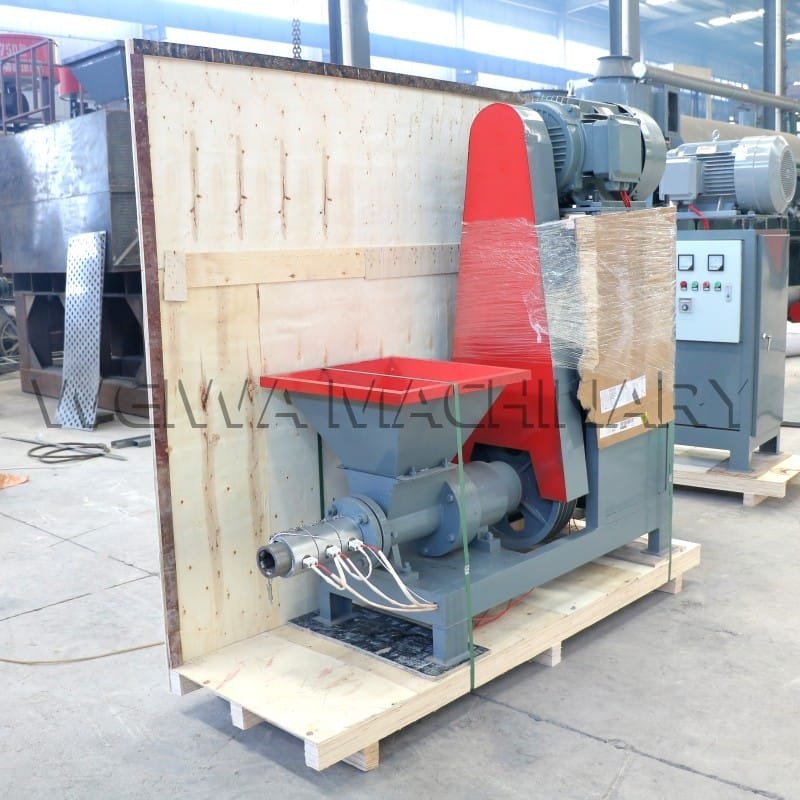
Semana passada, Weiwa Machinery completed factory testing and container loading for a full charcoal machine production line bound for Abidjan, Côte d’Ivoire. The order centers on a biomass briquette machine in Côte d’Ivoire market context where sawdust, cassava stalks, Palm lembre -se, and cocoa pod waste are abundant but underutilized. This delivery is not only a logistics milestone for our export team, but also a practical demonstration of how a sawdust extruder can convert agricultural residue into high density charcoal sticks suited for urban cooking fuel, bakery ovens, and small industrial boilers.
Côte d’Ivoire relies on biomass for roughly 70 percent of national energy consumption, and traditional charcoal making still depends on earth mounds or shallow pits that waste wood and emit heavy smoke. A modern biomass briquette machine changes that equation by compressing dried sawdust into uniform rods, which are later carbonized in a sealed furnace. The result is cleaner combustion, higher calorific value, and a product that travels better than loose lump charcoal.
Why Côte d’Ivoire Is a Strong Fit for Sawdust Briquetting?
The Ivorian timber, furniture, and plywood sectors generate steady volumes of sawdust around Abidjan, San Pedro, and Yamoussoukro. Ao mesmo tempo, cocoa cooperatives discard thousands of tonnes of pod shells every harvest season. A sawdust briquetting machine placed near a woodworking cluster can absorb offcuts from three or four workshops and return processed fuel within 48 horas.
Unlike European buyers who often use biomass briquettes for pellet stoves, Ivorian entrepreneurs typically resell carbonized rods to restaurant districts or blend them with coconut shell charcoal for shisha exports. That dual use makes the biomass extruder a flexible investment rather than a single purpose tool.
Local Raw Materials That Work Well
In this shipment we configured the line for mixed feedstock: sawdust from mahogany and iroko offcuts, dried rice husk from northern districts, and crushed palm kernel shell. All of them pass through the same crusher and dryer, provided moisture stays below 12 percent and particle size stays under 5 mm. The client in Abidjan already runs a small planer mill, so sawdust supply is stable even in the dry season.
What Was Loaded in the Container?
The production line we dispatched is a 500 kg per hour configuration. It contains a hammer crusher, screw conveyor, secador de fluxo de ar, three sawdust extruder heads sharing one control cabinet, a horizontal carbonization furnace, and a smoke condensation tower. Spare screws, heater coils, and mold sleeves were packed in a separate fumigated wooden crate.
Each biomass briquette machine in the line uses a 18.5 kW motor with a 280 para 300 degree Celsius heating ring. Under pressure, natural lignin in the sawdust softens and acts as an internal binder, so no chemical adhesive is required. The extruded stick leaves the die as a hollow hexagonal rod, 50 mm outer diameter with a 15 mm central hole, which improves heat penetration during carbonization.
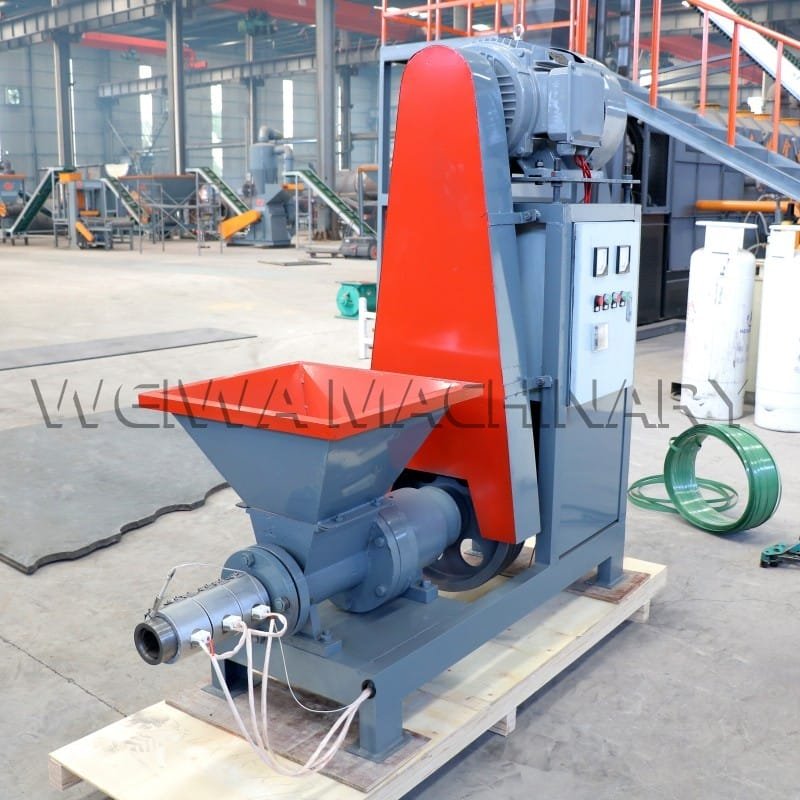
Pre Shipment Testing at Weiwa Workshop
Antes de carregar, our technicians ran the line for six hours using simulated Ivorian sawdust blended with 20 percent palm husk. Output sticks held shape after cooling, and carbonization trials returned a 3.2 para 1 reduction ratio, meaning 3.2 tonnes of dried briquettes yield one tonne of finished charcoal. That ratio matters for the client’s payback calculation because transport cost from interior villages to Abidjan port is the largest variable in their margin model.
How the Charcoal Production Line Works Step by Step?
A biomass charcoal line is not a single machine but a sequence. Understanding each stage helps owners in Côte d’Ivoire train operators and avoid downtime.
Crushing and Screening
Raw wood waste enters a hammer crusher with a 6 mm sieve. Branches thicker than 80 mm are pre cut with a circular saw. The goal is uniformity: if particles vary too much, the sawdust briquetting machine screw wears unevenly and the heating ring struggles to stabilize temperature.
Drying to Safe Moisture
Sawdust from a planer mill often carries 35 para 45 porcentagem de umidade. The airflow dryer in this line drops it to 8 para 10 percent using a 0.7 ton per hour hot air blower heated by a small biomass burner. Drying is the most energy sensitive stage, so we tuned the burner to use rejected briquette offcuts as fuel, closing the loop on waste.
Extrusion with the Sawdust Extruder
Dried material feeds into the hopper. Inside the biomass extruder, a hardened screw pushes it toward a tapered die while the heating ring keeps the cylinder at forming temperature. Pressure reaches 35 para 40 MPa. The stick emerges glowing at the tip, then cools on a stainless tray conveyor. No binder, no water addition, no cooling water required.
Carbonization in Sealed Furnace
Green briquettes are stacked in the horizontal carbonization furnace. The chamber is sealed and heated indirectly. Volatile gases are drawn into a condenser where wood vinegar and tar separate, while combustible gas recirculates to the furnace burner. Depois 14 para 18 horas, the chamber cools and the operator pulls out matte black charcoal sticks with a metallic ring when tapped. This stage is where a biomass briquette machine in Côte d’Ivoire setup proves its environmental advantage over pit kilns: smoke is captured, not released.
Quality of Charcoal Produced in Ivorian Conditions
The client’s target is household barbecue and commercial grill houses. Test charcoal from the workshop line showed calorific value around 7,400 kcal per kg, fixed carbon above 72 por cento, and ash under 4 por cento. Burning time for a 50 mm stick exceeds 90 minutes in a controlled stove, roughly 25 percent longer than local lump charcoal from cordwood.
Because the rod has a central hole, air drafts through the core during cooking, giving steadier flame control to street food vendors. That small geometry detail is why the sawdust extruder design outperforms simple piston presses for urban fuel markets.
Storage and Handling Benefits
Briquette charcoal packs tighter than irregular lumps. UM 20 foot container can carry about 18 tonnes of finished rods versus 11 tonnes of traditional charcoal. For an Abidjan wholesaler supplying Bololo and Treichville restaurants, that density cuts freight per kilogram by a third.
Operating Cost Picture for Côte d’Ivoire Buyers
Electricity in Côte d’Ivoire runs around 70 para 90 CFA per kWh for small industry. The full 500 kg line draws approximately 65 kW peak, but average load sits near 42 kW because dryers cycle. Labor needs two operators in daytime and one for furnace watch at night. Maintenance is dominated by screw replacement every 350 para 450 running hours, which costs far less than the lost output from a worn piston seal in older machines.
A biomass briquette machine line also qualifies the owner for municipal waste diversion dialogue with local councils, since sawdust stockpiles near wood markets currently rot or burn illegally.
Why Weiwa Machinery Configures Per Destination?
We do not sell the same line to Canada and Côte d’Ivoire. Humidity, voltage stability, and raw material mix change the dryer size, screw pitch, and furnace insulation. For this West African client we upgraded the electrical cabinet with surge protection, added French labels on gauges, and substituted tropical grade paint on the frame. The biomass extruder screw was given a wider flight root to handle palm husk grit without scoring the barrel.
Our engineers will join the commissioning remotely via video, then travel if needed after the first 200 bags of charcoal are sold. This after sales rhythm has helped Weiwa place lines in Ghana, Senegal, and now Côte d’Ivoire without a local branch office.
Sobre Weiwa Machinery
Weiwa Machinery is a Chinese manufacturer of biomass energy equipment with more than ten years of export experience. Our core range covers sawdust extruder models from 160 kg per hour to 1 tonelada por hora, complete charcoal production lines, secadores rotativos, and carbonization furnaces. We have delivered machines to over 130 países incluindo a Indonésia, Índia, Peru, México, Egito, and now Côte d’Ivoire. Every order includes free production line design, container loading photos, spare parts recommendations, and lifetime technical consultation.
If you are evaluating a biomass briquette machine in Côte d’Ivoire or comparing a sawdust briquetting machine against imported charcoal, our team can model your raw material cost and local selling price before you sign anything.
Contact Máquinas de Weiwa
Móvel / Whatsapp: +86 138 3809 3177
E-mail: info@cjlmachinegroup.com
Site: https://cjljx.com
We welcome Ivorian traders, wood market associations, and agro processing cooperatives to request a customized flow sheet. Factory visits in Zhengzhou can be arranged with airport pickup.


 WeChat

 +8615937143060
